Accounting Technology is the use of digital tools and software to automate accounting tasks, improve financial accuracy, simplify bookkeeping, and help businesses make better financial decisions. This guide explains accounting technology, its major types, benefits, real-world applications, and how businesses use it to improve accuracy, save time, and make better financial decisions. You will also see practical examples from leading companies and understand why modern accounting systems have become essential for organizations of every size.
Businesses today process thousands of financial transactions every month. Managing them manually is time-consuming and increases the risk of errors. This is why accounting technology has become an essential part of modern financial management.
Small startups, mid-sized businesses, and multinational enterprises are adopting advanced accounting solutions powered by artificial intelligence (AI), cloud computing, automation, and blockchain. These technologies simplify everyday accounting tasks, such as recording transactions, generating invoices, preparing tax reports, managing payroll, and tracking expenses.
According to Grand View Research (2025), the global accounting software market was valued at USD 19.4 billion in 2024 and is projected to grow to USD 31.3 billion by 2030, at a CAGR of 8.4% from 2025 to 2030. This growth is driven by the increasing demand for automation, greater accuracy, improved efficiency in financial operations, and the rising adoption of cloud-based and AI-powered accounting solutions.
Whether you run a small business, manage a finance team, or want to understand modern accounting systems, learning about Accounting Technology can help you improve financial management, reduce manual work, and make smarter business decisions.
This guide explains how accounting technology works, its key features, benefits, challenges, and the latest innovations shaping the future of finance.
Table of Contents
What is accounting technology and why is it important?
Accounting Technology is the use of software, artificial intelligence (AI), cloud computing, automation, and other digital tools to manage financial records, automate accounting tasks, and improve business decision-making.
It helps businesses record transactions, track expenses, manage payroll, generate financial reports, maintain compliance, and detect fraud with greater speed and accuracy. By replacing manual processes with automated workflows, accounting technology reduces errors, saves time, and provides real-time financial insights that support better business decisions.
Whether you’re a freelancer, small business, or large enterprise, accounting technology simplifies financial management and helps organizations scale more efficiently.
According to Gartner, 58% of finance functions were using AI in 2024, up from 37% in 2023. Common use cases include intelligent process automation, anomaly detection, and financial analytics.
The history and evolution of accounting technology explained
Accounting has evolved significantly over the years. Here’s how the journey has progressed:
| Era | Accounting Method | Characteristics |
| Traditional Era | Paper bookkeeping | Manual records, ledgers, calculators |
| Spreadsheet Era | Excel-based accounting | Faster calculations but still manual |
| Desktop Software Era | Installed accounting software | Better reporting and automation |
| Cloud Accounting Era | Online accounting platforms | Real-time collaboration and remote access |
| AI-Driven Era | Intelligent accounting systems | Automation, predictive analytics, fraud detection |
| Future Era | Autonomous accounting | AI-powered bookkeeping, blockchain verification, continuous auditing |
This evolution shows how accounting has moved from manual bookkeeping to intelligent, cloud-based financial management.
How does accounting technology work?
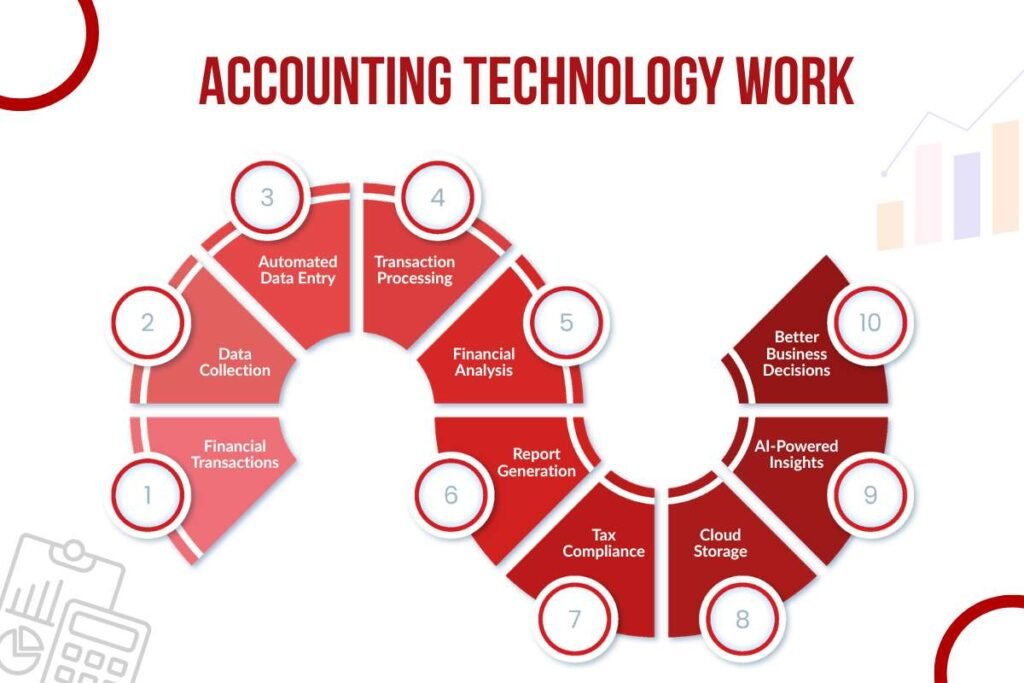
Understanding how this technology works helps businesses make the most of modern financial systems. While different accounting platforms offer unique capabilities, most follow a similar workflow to collect, process, analyze, and report financial data efficiently.
Step 1: data collection
Every accounting system starts by gathering financial information from multiple business sources, such as sales transactions, purchase orders, bank statements, credit card payments, digital wallets, payroll records, tax documents, inventory systems, e-commerce platforms, and point-of-sale (POS) systems. Modern accounting software automatically imports this data through secure integrations, reducing manual effort and improving data accuracy.
Step 2: Automated data entry
After collecting financial information, the accounting system automatically records and organizes it. Using technologies such as Optical Character Recognition (OCR), the software captures invoice details, imports bank transactions, categorizes expenses, matches payments with invoices, and maintains organized financial records. This automation minimizes repetitive tasks and significantly reduces the chances of human error.
Step 3: Transaction processing
Once the data is entered, the software processes each transaction according to standard accounting principles. It automatically updates ledgers, records journal entries, calculates account balances, adjusts financial records, reconciles bank transactions, and tracks accounts receivable and accounts payable. This ensures that financial information remains accurate, consistent, and up to date.
Step 4: Financial analysis
After processing transactions, the system analyzes financial data to provide valuable business insights. It evaluates revenue trends, operating expenses, profit margins, cash flow, budget performance, customer payments, outstanding invoices, and financial risks. Many modern accounting platforms also use artificial intelligence to detect unusual spending patterns and forecast future financial performance.
Step 5: Financial reporting
Accounting technology automatically generates detailed financial reports that help businesses monitor their financial health. These reports typically include Profit and Loss Statements, Balance Sheets, Cash Flow Statements, Trial Balances, General Ledgers, Tax Reports, Expense Reports, Budget Reports, Payroll Reports, and Accounts Receivable Reports. Real-time reporting enables business owners and finance teams to make informed and timely decisions.
Step 6: Tax Preparation and compliance
Modern accounting systems simplify tax management by automatically calculating taxes, organizing financial records, tracking deductible expenses, generating tax-ready reports, maintaining audit trails, and supporting compliance with financial regulations. This reduces manual work, minimizes filing errors, and helps businesses meet tax deadlines more efficiently.
Step 7: Secure cloud storage and backup
Most modern accounting platforms securely store financial data in the cloud. They provide automatic backups, data encryption, disaster recovery, remote accessibility, multi-device synchronization, and secure document storage. These features ensure that financial information remains protected while allowing authorized users to access it anytime and from anywhere.
Step 8: AI-powered insights and decision-making
The final step involves using artificial intelligence and machine learning to transform financial data into actionable insights. Advanced accounting technology can forecast cash flow, predict future expenses, detect fraudulent activities, recommend cost-saving opportunities, identify delayed payments, monitor business performance, generate financial forecasts, and support strategic planning. These intelligent capabilities help businesses move beyond basic bookkeeping toward proactive financial management and informed decision-making.
This streamlined workflow shows how this technology transforms raw financial data into actionable insights that support business growth.
Key features of accounting technology every business should know
Instead of spending hours on manual accounting tasks, businesses can automate daily processes, reduce errors, and access financial information whenever they need it. Here are some of the most important features of modern accounting.
1. Automated bookkeeping
Automated bookkeeping is the biggest advantage of accounting. It automatically records financial transactions, updates accounting records, and organizes financial data with very little manual work.
For example, the software can record sales, categorize expenses, update ledgers, and match transactions with bank statements. This not only saves time but also reduces the chances of human error, helping businesses maintain accurate financial records.
2. Cloud accounting
Cloud accounting allows businesses to access their financial data through the internet from anywhere in the world. Whether you’re working from the office, home, or while traveling, you can securely manage your accounts using a computer, tablet, or smartphone.
Another major benefit of cloud accounting is that it automatically backs up your data, making it safer than storing records on a single computer. It also allows multiple team members to work on the same financial information at the same time, making collaboration easier.
Industry Insight: Gartner reports that cloud subscription revenue accounted for 60.1% of the worldwide enterprise software market in 2024, highlighting the growing shift toward cloud-based business applications, including accounting software.
3. AI-powered financial insights
Many modern accounting platforms use Artificial Intelligence (AI) to help businesses understand their financial performance. Instead of just recording transactions, AI analyses financial data and provides useful insights.
It can identify unusual transactions, predict future cash flow, highlight spending patterns, generate financial forecasts, and suggest ways to improve budgeting. Rather than replacing accountants, AI supports them by providing valuable information that helps them make better business decisions.
4. Expense management
Tracking business expense management becomes much easier with accounting technology. Businesses can digitally store receipts, categorize expenses, monitor employee spending, and create expense reports automatically.
Many accounting systems also include approval workflows and reimbursement tracking, helping organizations control spending while keeping financial records organized and up to date.
5. Payroll processing
Payroll is another area where technology saves significant time and effort. Modern accounting software can automatically calculate employee salaries, deduct taxes, manage benefits, generate payslips, and prepare payroll reports.
By automating these tasks, businesses can reduce administrative work, minimize payroll errors, and ensure employees are paid accurately and on time.
Types of accounting technology every business should know

Businesses have different accounting needs, so various types of accounting technology are available. Each type is designed to help businesses manage their finances more efficiently. Below are the most common types.
1. Cloud accounting software
Cloud accounting software stores financial data online instead of on a computer. Users can access their accounts anytime through a web browser or mobile app.
- How it works: The software automatically stores and updates financial data on secure cloud servers. It also syncs information in real time, making it easy for teams to work together.
- Best for: Small businesses, startups, freelancers, and remote teams.
- Benefits: Easy access from anywhere, automatic backups, real-time reporting, and simple collaboration.
2. Desktop accounting software
Desktop accounting software is installed on a computer and stores financial data locally instead of online.
- How it works: Users manage bookkeeping, payroll, invoicing, and financial reports directly from their computer without needing an internet connection.
- Best for: Businesses that prefer offline access or local data storage.
- Benefits: Works without the internet, offers full control over data, and is simple to use.
3. Enterprise accounting systems
Enterprise accounting systems are designed for large organizations that handle complex financial operations across multiple departments or locations.
- How it works: The system manages all financial data in one place, making reporting, budgeting, compliance, and audits easier.
- Best for: Large businesses and multinational companies.
- Benefits: Centralized financial management, better reporting, and improved compliance.
4. ERP accounting systems
ERP (Enterprise Resource Planning) accounting systems combine accounting with other business functions like inventory, sales, purchasing, and human resources.
- How it works: All departments share one system, so financial information updates automatically whenever business transactions take place.
- Best for: Medium and large businesses.
- Benefits: Better teamwork, accurate data, faster reporting, and improved business efficiency.
5. AI accounting software
AI accounting software uses artificial intelligence to automate routine accounting tasks and provide useful financial insights.
- How it works: It can process invoices, categorize expenses, detect unusual transactions, and generate reports with minimal manual effort.
- Best for: Businesses looking to save time and improve accuracy.
- Benefits: Reduces manual work, improves decision-making, and increases productivity.
6. Blockchain-based accounting systems
Blockchain-based accounting systems record financial transactions on a secure digital ledger that is difficult to change or tamper with.
- How it works: Every transaction is verified and added to the blockchain, creating a transparent and secure financial record.
- Best for: Businesses that need high security and transparent financial records.
- Benefits: Improves security, reduces fraud, and creates reliable audit trails.
7. Mobile accounting applications
Mobile accounting apps help users manage their business finances directly from a smartphone or tablet.
- How it works: Users can create invoices, track expenses, scan receipts, and check financial reports on the go.
- Best for: Freelancers, consultants, and small business owners.
- Benefits: Easy access to financial data anytime and anywhere.
8. Industry-specific accounting software
Industry-specific accounting software is designed to meet the unique financial needs of different industries like healthcare, construction, retail, hospitality, and nonprofit organizations.
- How it works: It includes specialized features based on the business type, such as project costing for construction or patient billing for healthcare.
- Best for: Businesses that require industry-focused accounting solutions.
- Benefits: Simplifies financial management, improves efficiency, and supports industry-specific compliance.
Technologies used in modern accounting: AI, cloud, blockchain & automation
Modern accounting technology is powered by advanced digital tools that make financial management faster, more accurate, and more efficient. These technologies help businesses automate daily accounting tasks, improve security, reduce manual work, and make better financial decisions.
Let’s look at the key technologies used in modern accounting.
Artificial Intelligence (AI) in Accounting: Artificial Intelligence (AI) is one of the most important technologies in modern accounting. It helps businesses automate routine tasks and analyze financial data more efficiently.
According to PwC, AI has the potential to contribute up to $15.7 trillion to the global economy by 2030, with finance and accounting among the industries expected to benefit significantly through automation, productivity improvements, and better decision-making.
How does AI work in accounting?
AI studies financial data, recognizes patterns, and performs repetitive tasks without constant human effort. It can also provide useful insights that help businesses make smarter financial decisions.
What can AI do?
AI can:
- Categorize business expenses
- Process invoices automatically
- Match bank transactions
- Detect unusual or duplicate transactions
- Forecast future cash flow
- Generate financial reports
- Assist with budgeting
- Benefits of AI in Accounting
Using AI helps businesses:
- Save time on bookkeeping
- Improve financial accuracy
- Reduce manual errors
- Detect fraud more quickly
- Make better financial decisions
- Increase overall productivity
AI handles repetitive work while finance professionals focus on analysis and business strategy.
Machine Learning in Accounting: Machine Learning (ML) is a type of Artificial Intelligence that allows accounting software to learn from past financial data. As it processes more information, it becomes better at identifying patterns and making accurate predictions.
How does machine learning work?
Machine learning analyzes historical transactions and continuously improves its performance. It learns from previous data to make future accounting tasks faster and more accurate.
Common Uses
Machine learning is commonly used for:
- Expense categorization
- Invoice matching
- Fraud detection
- Revenue forecasting
- Predicting customer payments
- Credit risk analysis
- Benefits of Machine Learning
Machine learning helps businesses by:
- Improving accounting accuracy
- Reducing manual work
- Providing better financial forecasts
- Speeding up data processing
- Supporting smarter business decisions
Blockchain in Accounting: Blockchain is a secure digital system that records financial transactions in a way that makes them difficult to change or delete. Every transaction is verified before it is added to the system, making accounting records more transparent and trustworthy.
How does blockchain work?
Instead of storing financial records in one central database, blockchain keeps copies of the records across multiple computers. Once information is recorded, it cannot be changed without approval from the network.
Where is blockchain used?
Blockchain can be used for:
- Digital payments
- Cryptocurrency accounting
- Smart contracts
- Supply chain finance
- International transactions
- Financial auditing
- Benefits of Blockchain
Industry Trend: Deloitte reports that blockchain technology is becoming increasingly important for financial reporting, auditing, and transaction verification because of its transparency and security features.
Blockchain offers several advantages, including:
- Better transparency
- Stronger data security
- Reduced fraud
- Reliable audit trails
- Faster transaction verification
Although blockchain in accounting is still developing in the accounting industry, it is expected to play a bigger role in financial reporting and auditing in the future.
Cloud Computing in Accounting: Cloud computing allows businesses to access accounting software and financial records over the internet instead of storing them on a single computer.
How does cloud computing work?
Financial data is stored on secure cloud servers. Users can access their accounting information anytime using a computer, laptop, or smartphone.
Benefits of cloud accounting
Cloud computing offers several benefits, such as:
- Access to financial data from anywhere
- Automatic software updates
- Secure data backups
- Easy collaboration with team members
- Lower IT and maintenance costs
Cloud accounting has become one of the most popular solutions for businesses because it supports remote work and provides real-time financial information.
Robotic Process Automation (RPA): Robotic Process Automation (RPA) uses software robots to perform repetitive accounting tasks automatically. These digital bots follow predefined rules and complete routine work without human intervention.
How does RPA work?
The software automatically performs repetitive processes that usually take up a lot of time. This allows accountants to focus on more important financial activities.
Common uses of RPA
RPA is used for:
- Processing invoices
- Payroll calculations
- Bank reconciliation
- Report generation
- Tax calculations
- Financial data migration
- Benefits of RPA
RPA helps businesses by:
- Saving time
- Reducing manual errors
- Increasing productivity
- Lowering operating costs
- Improving consistency
Optical Character Recognition (OCR): Optical Character Recognition (OCR) is a technology that converts printed or handwritten documents into digital text.
How does OCR work?
OCR scans documents like invoices and receipts, reads the information, and automatically transfers it into accounting software. This eliminates the need for manual data entry.
Documents OCR can read
OCR works with:
- Receipts
- Bills
- Invoices
- Tax documents
- Purchase orders
- Bank statements
- Benefits of OCR
OCR helps businesses by:
- Speeding up bookkeeping
- Reducing paperwork
- Improving accuracy
- Saving time on data entry
- Organizing financial documents more efficiently
Big Data Analytics in Accounting: Businesses generate a large amount of financial data every day. Big Data Analytics helps accountants organize and analyze this information to identify useful trends and insights.
How does big data analytics work?
It collects financial information from different sources and analyzes it to help businesses understand their financial performance and make informed decisions.
Common Uses
Big Data Analytics helps with:
- Revenue analysis
- Expense tracking
- Customer spending patterns
- Market forecasting
- Financial risk analysis
- Investment planning
- Benefits
Big Data Analytics enables businesses to:
- Make better financial decisions
- Improve planning
- Identify business trends
- Increase profitability
Business Intelligence (BI): Business Intelligence (BI) helps businesses turn financial data into easy-to-understand dashboards, charts, and reports.
How does BI work?
Instead of looking through long spreadsheets, business owners and accountants can view visual reports that show important financial information at a glance.
Common Uses
BI is commonly used for:
- Profit analysis
- Budget monitoring
- Revenue tracking
- Financial forecasting
- Executive reporting
- Benefits
Business Intelligence helps organizations:
- Understand financial performance quickly
- Improve decision-making
- Monitor business growth
- Identify financial opportunities
Cybersecurity in Accounting: Financial data is one of the most valuable assets of any business. Cybersecurity helps protect this information from hackers, data breaches, and unauthorized access.
IBM’s Cost of a Data Breach Report 2024 found that the global average cost of a data breach reached USD 4.88 million, highlighting why businesses must prioritize cybersecurity when managing financial information.
How does cybersecurity work?
Modern accounting systems use advanced security measures to protect financial records and ensure that only authorized users can access sensitive information.
Common Security Features
Most accounting software includes:
- Data encryption
- Multi-factor authentication (MFA)
- User access controls
- Secure cloud storage
- Automatic backups
- Audit logs
- Benefits
Strong cybersecurity helps businesses:
- Protect confidential financial data
- Reduce fraud risks
- Prevent cyberattacks
- Improve customer trust
- Maintain regulatory compliance
API Integration: Application Programming Interfaces (APIs) allow different software applications to communicate and share information automatically.
How do APIs ork?
APIs connect accounting software with other business tools so that information flows automatically between systems without manual data entry.
Common Integrations
Accounting software often connects with:
- Banking systems
- Payroll software
- CRM software
- E-commerce platforms
- Inventory management systems
- Payment gateways
- Tax software
- Benefits
API integration helps businesses:
- Save time
- Reduce duplicate work
- Improve data accuracy
- Increase efficiency
- Simplify business operations
Internet of Things (IoT) in Accounting: The Internet of Things (IoT) connects physical devices to the internet, allowing them to collect and share information automatically. Although IoT is still developing in accounting, it helps businesses collect real-time operational data that can improve financial management.
How does IoT work?
Connected devices automatically send information to business systems. Accountants can use this data to monitor assets, track inventory, and calculate business costs more accurately.
Common Uses
IoT is used for:
- Smart inventory tracking
- Equipment monitoring
- Asset management
- Fleet tracking
- Utility usage monitoring
- Benefits
IoT helps businesses:
- Improve inventory management
- Track business assets in real time
- Control operating costs
- Support accurate budgeting
- Make better financial decisions
Benefits and challenges of accounting technology
| Benefits | Challenges |
| Saves time with automation. | Setup and software can cost money. |
| Reduces errors and improves accuracy. | Financial data may face cyber risks. |
| Shows real-time financial data. | Employees may need training. |
| Lowers paperwork and manual work. | Software may be hard to integrate. |
| Helps make better business decisions. | Cloud systems need internet access. |
| Makes tax work easier. | Moving old data can be difficult. |
| Improves cash flow tracking. | Rules and compliance may change. |
| Keeps data secure with backups and encryption. | Businesses depend on the software provider. |
Top accounting technology tools that help businesses save time and improve accuracy
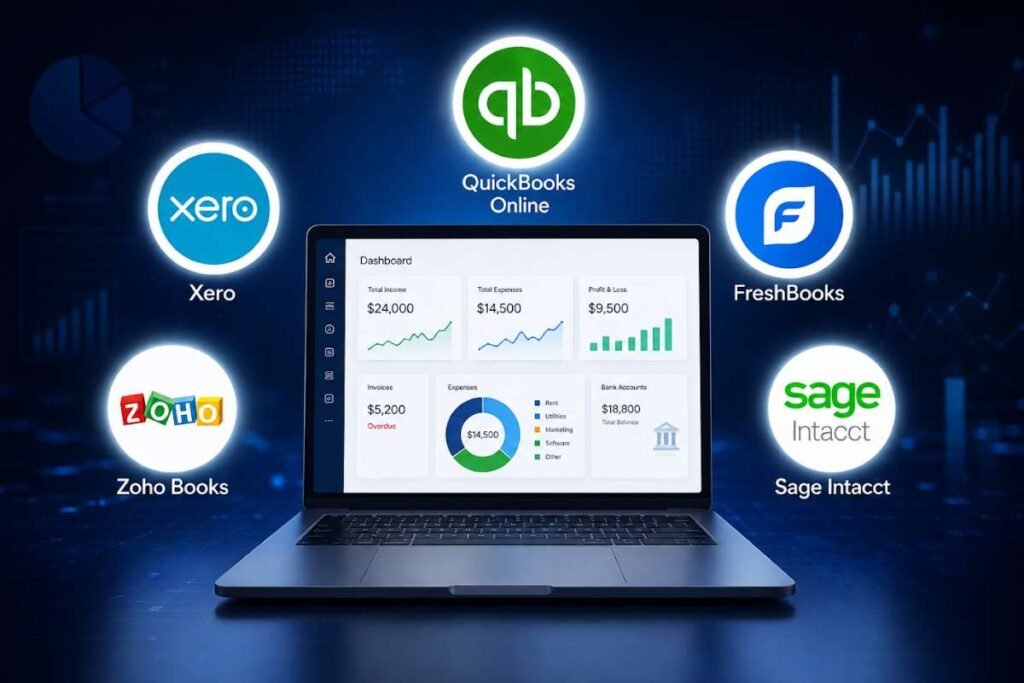
There are many accounting software solutions available today, and each one is designed to meet different business needs. Some are ideal for freelancers and small businesses, while others are built for large enterprises that manage complex financial operations. Choosing the right tool depends on your business size, budget, and the features you need.
- QuickBooks Online: QuickBooks Online is one of the most popular accounting software solutions for small and medium-sized businesses. It helps users manage bookkeeping, create invoices, track expenses, monitor cash flow, and generate financial reports. Its cloud-based platform allows business owners and accountants to access financial data from anywhere.
- Xero: Designed for startups and small businesses, Xero offers features such as online invoicing, bank reconciliation, expense tracking, and financial reporting. Its easy-to-use interface makes it a popular choice for businesses that are moving from manual accounting to digital systems.
- FreshBooks: FreshBooks is a good option for freelancers, consultants, and service-based businesses. It simplifies invoicing, time tracking, expense management, and payment collection. It is especially useful for professionals who want an easy way to manage their business finances without complicated accounting processes.
- Zoho Books: Zoho Books is a cloud-based accounting solution for growing businesses. It helps automate routine accounting tasks, manage invoices, track expenses, handle inventory, and prepare tax records. Businesses that already use other Zoho applications can easily integrate them with Zoho Books for better workflow management.
- Sage Intacct: Sage Intacct is designed for medium-sized businesses that need advanced financial management. It offers detailed financial reporting, budgeting, multi-entity accounting, and automation features. It is commonly used by organizations with more complex accounting requirements.
- Oracle NetSuite: Oracle NetSuite is a powerful cloud-based ERP and accounting platform built for large enterprises. It combines accounting, financial management, inventory, customer management, and business analytics into a single system. It also uses AI-powered insights to help businesses improve financial planning and decision-making.
- Microsoft Dynamics 365 Finance: Microsoft Dynamics 365 Finance is an enterprise accounting solution that helps organizations manage their finances, budgets, and financial reporting. It provides AI-powered forecasting, automation, and real-time business insights, making it suitable for companies with large-scale financial operations.
- SAP S/4HANA Finance: SAP S/4HANA Finance is an advanced financial management system used by multinational companies and global enterprises. It supports real-time financial reporting, predictive analytics, financial planning, and compliance management. It is ideal for organizations handling high volumes of financial transactions across multiple locations.
- Wave Accounting: Wave Accounting is a free cloud-based accounting software designed for freelancers, entrepreneurs, and small businesses. It includes essential features such as invoicing, income and expense tracking, receipt management, and basic financial reporting. It is a suitable choice for businesses with limited budgets.
- TallyPrime: TallyPrime is one of the most widely used accounting software solutions, especially among small and medium-sized businesses. It supports bookkeeping, inventory management, payroll, taxation, GST compliance, and financial reporting. Businesses can choose between desktop and cloud-based access based on their operational needs.
How accounting technology benefits different businesses and industries
Not every business has the same accounting needs. A freelancer sending a few invoices each month requires different tools than a large company handling thousands of daily transactions. The right accounting technology depends on your business size, industry, budget, and future growth plans. Choosing software that matches your requirements helps improve efficiency, reduce errors, and simplify financial management.
1. Small businesses
Small businesses need affordable and easy-to-use accounting software that simplifies daily financial tasks. This helps business owners manage bookkeeping, create invoices, track expenses, prepare taxes, and reconcile bank accounts without spending hours on manual work.
With automated accounting tools, accounting technology for small businesses can save time, reduce accounting costs, and gain a clear view of their financial performance, allowing owners to focus more on growing their business.
2. Startups
Startups often work with limited budgets and need flexible accounting solutions that can grow with the business. Technology helps startups track funding, manage budgets, monitor cash flow, forecast revenue, and prepare financial reports for investors.
Cloud-based accounting software is a popular choice because it is scalable, affordable, and accessible from anywhere.
3. Medium-sized businesses
As businesses expand, their accounting needs become more complex. Medium-sized companies often require features such as payroll management, inventory tracking, project accounting, budgeting, and financial reporting across multiple departments.
Integrated accounting technology helps these businesses improve productivity, automate routine tasks, and maintain accurate financial records as they continue to grow.
4. Large enterprises
Large organizations handle complex financial operations across multiple branches or countries. They require advanced accounting systems that support multi-company accounting, multiple currencies, financial consolidation, compliance, and risk management.
Many enterprises use ERP (Enterprise Resource Planning) systems because they integrate accounting with other business functions such as inventory, procurement, human resources, and supply chain management, providing a complete view of the organization’s finances.
5. Freelancers and consultants
Freelancers and consultants usually need simple accounting software to create invoices, record expenses, track client payments, prepare taxes, and monitor income. Mobile accounting apps are especially useful because they allow users to manage their finances anytime and from anywhere.
How do different industries use accounting technology?
Every industry has unique financial processes, and modern technology provides specialized features to meet those needs. Industry-specific accounting software helps businesses improve efficiency, maintain compliance, and manage finances more effectively.
| Industry | How Accounting Technology Helps |
| Healthcare | Manages patient billing, insurance claims, payroll, medical inventory, and regulatory compliance. |
| Retail | Tracks sales, manages inventory, records supplier payments, processes customer refunds, and generates sales reports. |
| Manufacturing | Monitors production costs, raw materials, inventory, equipment depreciation, and supply chain expenses. |
| Construction | Handles project budgets, job costing, contractor payments, equipment expenses, and progress billing. |
| Real Estate | Manages rental income, property expenses, lease accounting, maintenance costs, and investment reporting. |
| Hospitality | Supports hotel and restaurant operations by managing reservations, guest billing, payroll, food costs, and revenue reporting. |
| Education | Tracks student fees, payroll, grants, budgeting, and financial reporting for schools and universities. |
| E-commerce | Integrates with online stores, payment gateways, inventory systems, shipping platforms, and tax software to automate financial processes. |
| Nonprofit Organizations | Manages donations, grants, fund accounting, donor records, and compliance reporting. |
| Financial Services | Helps banks and financial institutions with regulatory compliance, investment accounting, audit management, financial reporting, and risk analysis. |
Real-world examples of accounting technology
Many well-known companies use accounting to manage their finances, improve accuracy, and save time. Here are a few simple examples:
Example 1: D-Mart (Retail)
D-Mart uses accounting technology integrated with its billing and inventory systems. Every customer purchase is recorded automatically, stock levels are updated in real time, and daily sales reports are generated instantly. This helps the company reduce manual work, avoid inventory errors, and manage its finances more efficiently.
Example 2: Amazon (E-commerce)
Amazon relies on advanced accounting to process millions of online orders every day. Its accounting systems automatically record customer payments, refunds, taxes, shipping costs, and inventory updates. This automation helps Amazon manage large volumes of transactions accurately and generate real-time financial reports.
Example 3: Tata steel (Manufacturing)
Tata Steel uses enterprise accounting and ERP systems to manage production costs, supplier payments, inventory, and financial reporting across its operations. Real-time financial data helps the company monitor expenses, improve budgeting, and make informed business decisions.
Example 4: HDFC bank (Banking)
HDFC Bank uses modern technology to manage customer transactions, loans, deposits, payroll, compliance, and financial reporting. Automation allows the bank to process millions of transactions securely while maintaining accurate financial records and meeting regulatory requirements.
Example 5: Apollo hospitals (Healthcare)
Apollo Hospitals uses accounting to manage patient billing, insurance claims, payroll, medical inventory, and financial reporting. Automated systems reduce paperwork, improve billing accuracy, and help the hospital provide faster and more efficient services.
The future of accounting technology
The future of accounting extends far beyond digital bookkeeping. Finance teams are shifting from manual data processing to strategic financial planning supported by intelligent systems.
Several developments are expected to shape the next generation of accounting:
- Greater AI-driven automation
- Improved predictive analytics
- Wider blockchain adoption
- Real-time compliance monitoring
- Autonomous financial reporting
- Advanced fraud detection
- More personalized financial insights
- Increased cloud adoption
- Enhanced cybersecurity
- Smarter business intelligence dashboards
While accounting will automate many repetitive accounting tasks, the expertise of accountants will remain essential. Professionals will increasingly focus on interpreting financial data, advising business leaders, managing risks, and supporting long-term strategy.
Businesses that adopt accounting today will be better prepared for future financial challenges and changing industry requirements.
Conclusion
Accounting technology has transformed modern financial management by making accounting faster, more accurate, and more efficient. From AI and cloud accounting to automation and blockchain, these technologies help businesses streamline operations, improve compliance, and make smarter financial decisions.
Businesses that invest in a modern accounting system today will be better positioned to improve efficiency, stay compliant, and adapt to future financial challenges.
FAQs
1. How do you choose the right accounting technology for your business?
Choose a solution based on your business size, budget, industry needs, scalability, integrations, and security features. The right platform should simplify financial management while supporting future growth.
2. Can accounting technology integrate with other business software?
Yes. Most accounting integrates with ERP, CRM, payroll, inventory management, banking, and payment systems to streamline business operations and improve data accuracy.
3. Is accounting technology suitable for startups?
Yes. Startups can use this technology to automate bookkeeping, manage cash flow, track expenses, and stay tax compliant without hiring a large finance team.
4. What skills are needed to use accounting technology?
Basic accounting knowledge, financial analysis, and familiarity with cloud accounting software are helpful. Understanding AI and automation tools can further improve productivity.
5. What trends are shaping the future of accounting technology?
AI-powered automation, predictive analytics, blockchain, cloud accounting, and real-time financial reporting are driving the next generation of smarter accounting solutions.