
Digital transformation in finance is the process of replacing outdated financial systems with cloud technology, AI, automation, and ERP solutions. It helps businesses improve efficiency, reduce manual work, strengthen security, and make faster, data-driven financial decisions.
Finance has evolved far beyond spreadsheets and manual bookkeeping. Today, finance teams are expected to deliver real-time insights, support strategic decisions, strengthen compliance, and improve operational efficiency. Traditional systems often struggle to meet these expectations, making digital transformation in finance a business priority rather than an optional upgrade.
Digital transformation is not simply about adopting new software. It involves rethinking financial processes, replacing outdated systems, integrating intelligent technologies, and preparing employees to work in a digital-first environment. Organizations that successfully modernize their finance function gain faster reporting, better data accuracy, stronger security, and greater agility.
Whether you’re planning to replace legacy accounting software or build a cloud-based finance ecosystem, understanding the right migration strategy and change management approach is essential for long-term success.
Why digital transformation in finance is no longer optional for modern businesses?
Digital transformation in finance is the process of replacing outdated, manual financial systems with modern digital technologies such as cloud accounting, Artificial Intelligence (AI), automation, Enterprise Resource Planning (ERP), and real-time analytics. It helps businesses automate routine tasks, improve financial visibility, reduce operational costs, strengthen compliance, and make faster, data-driven decisions.
Unlike traditional finance systems that rely on spreadsheets and disconnected software, digital finance creates a connected ecosystem where financial data flows seamlessly across accounting, payroll, procurement, banking, and reporting systems. This gives finance teams instant access to accurate information, enabling quicker decisions and better business planning.
Today’s finance leaders are expected to do much more than manage transactions. They need to deliver real-time financial insights, improve forecasting accuracy, minimize risks, and support business growth. However, legacy systems often slow down reporting, increase manual errors, and make it difficult to adapt to changing regulations or market conditions.
Digital transformation addresses these challenges by automating repetitive processes, improving collaboration, and providing real-time financial intelligence. As a result, finance professionals spend less time on manual work and more time supporting strategic decision-making.
Modern finance organizations commonly use technologies such as:
- Cloud accounting platforms
- Artificial Intelligence (AI)
- Robotic Process Automation (RPA)
- Enterprise Resource Planning (ERP)
- Business Intelligence (BI) dashboards
- Digital payment solutions
- Advanced financial analytics
According to Deloitte, organizations that modernize their finance functions improve operational efficiency while allowing finance teams to focus on strategic planning instead of routine transaction processing. Gartner also reports that finance leaders continue increasing investments in AI, automation, and cloud technologies to build more agile and resilient finance operations.
Is your finance team falling behind? 5 clear signs it’s time for digital transformation
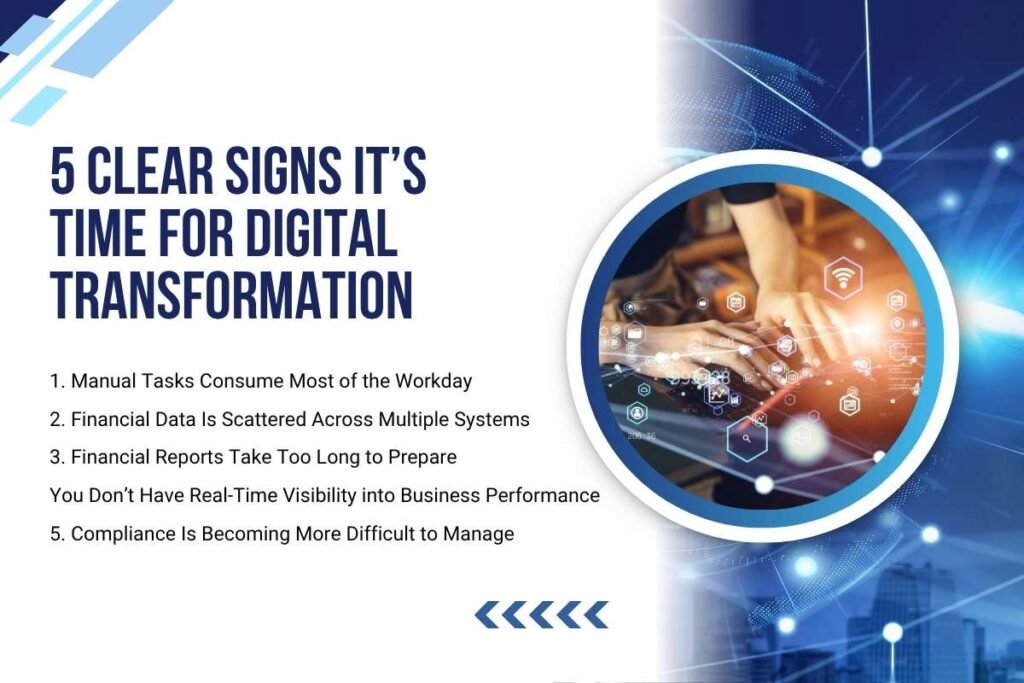
If your finance team spends more time fixing errors than analyzing business performance, your current systems may be holding you back. Here are five common signs that indicate it’s time to modernize your finance operations.
1. Manual tasks consume most of the workday
If employees spend hours entering invoices, reconciling accounts, updating spreadsheets, or generating reports manually, productivity suffers. Accounting Automation can handle these repetitive tasks faster, reduce errors, and free your team to focus on strategic financial planning.
2. Financial data is scattered across multiple systems
When accounting, payroll, procurement, CRM, and inventory systems don’t communicate with each other, finance teams waste time gathering data from different sources. An integrated finance platform creates a single source of truth, improving accuracy and speeding up decision-making.
3. Financial reports take too long to prepare
If your month-end close or financial reporting process takes days or weeks, outdated systems are likely slowing you down. Modern finance solutions automate reconciliation and provide real-time financial reporting dashboards, allowing leaders to access accurate financial information whenever they need it.
4. You don’t have real-time visibility into business performance
Finance leaders need instant access to key metrics like cash flow, revenue, expenses, profitability, budgets, and forecasts. If you’re relying on outdated reports or spreadsheets, you’re making decisions based on old data instead of current business performance.
5. Compliance is becoming more difficult to manage
Keeping up with changing tax laws, financial regulations, and audit requirements is challenging when processes are manual. Digital finance systems automatically track transactions, maintain audit trails, generate compliance reports, and reduce the risk of costly human errors.
Why legacy finance systems are the biggest barrier to digital transformation in finance
One of the most significant obstacles in digital transformation is legacy infrastructure.
Legacy systems include:
- Old accounting software
- On-premise ERP platforms
- Spreadsheet-based reporting
- Manual approval workflows
- Disconnected financial applications
Although these systems may appear cost-effective, they often create hidden operational expenses.
Challenges created by legacy finance systems
| Challenge | Business Impact |
| Manual data entry | Increased errors and slower processing |
| Poor system integration | Duplicate work across departments |
| Outdated reporting | Delayed decision-making |
| High maintenance costs | Reduced IT efficiency |
| Limited scalability | Difficult business expansion |
| Weak security architecture | Higher cybersecurity risks |
According to IBM, outdated enterprise systems significantly increase maintenance costs while reducing organizational agility, making modernization essential for long-term competitiveness.
How to migrate legacy finance systems without disrupting your business
Migrating from a legacy finance system doesn’t have to be risky. A phased migration approach helps organizations modernize financial operations while minimizing downtime, protecting data, and maintaining business continuity. Instead of replacing everything at once, businesses should assess their current systems, define clear goals, modernize high-impact processes first, and choose technology that supports future growth.
Step 1: Assess your current finance infrastructure
Start by reviewing your existing finance environment to identify what’s working and what needs improvement. Evaluate:
- Current accounting software
- Data quality and accuracy
- Integration with other business systems
- Financial workflows
- Compliance requirements
- Reporting capabilities
This assessment creates a clear roadmap for modernization and helps avoid costly implementation mistakes.
Step 2: Define clear business goals
Technology should solve business problems, not create new ones. Set measurable objectives before investing in new solutions, such as:
- Reduce month-end closing time
- Automate invoice processing
- Improve forecasting accuracy
- Lower operational costs
- Strengthen financial controls and compliance
Having clear goals also makes it easier to measure the success of your digital transformation project.
Step 3: Modernize high-impact processes first
Rather than transforming every finance function at once, focus on processes that deliver quick and measurable results. Common starting points include:
- Accounts payable automation
- Expense management
- Financial reporting
- Budget planning
- Bank reconciliation
These improvements often generate faster ROI while helping finance teams adapt confidently to new technologies.
Step 4: Choose technology that supports future growth
Select solutions that meet your current needs while allowing your business to scale. A modern finance technology stack may include:
- Cloud accounting software
- ERP platforms
- AI-powered analytics
- Business intelligence tools
- Robotic Process Automation (RPA)
- Secure cloud storage
- API integrations
When comparing solutions, consider scalability, security, compliance, integration capabilities, ease of use, and long-term vendor support.
Why do finance transformations fail even after investing in the best technology?

Most finance transformation projects don’t fail because of technology; they fail because people struggle to adapt to new ways of working. Clear communication, practical training, employee involvement, and ongoing support help finance teams embrace change and ensure digital transformation delivers lasting business value.
Technology is only one part of successful digital transformation in finance. Employees need to understand why the change is happening, how it benefits their daily work, and what support they’ll receive throughout the transition. When organizations prioritize change management alongside technology implementation, they improve user adoption, reduce resistance, and achieve better long-term results.
Why employees resist finance transformation
Resistance is natural during any major technology upgrade. Finance professionals may worry that automation will replace their jobs, disrupt familiar workflows, or require skills they don’t yet have.
The most common reasons include:
- Fear of job displacement
- Low confidence in using new technology
- Insufficient training
- Poor communication from leadership
- Concerns about increased workload during implementation
Addressing these concerns early builds trust, encourages adoption, and helps employees see digital transformation as an opportunity rather than a threat.
5 proven change management strategies that help finance teams embrace digital transformation
- Communicate the Purpose Clearly: Explain why the transformation matters and how it benefits both the business and employees. When people understand the “why,” they’re more likely to support the change.
- Involve Finance Teams From the Beginning: Include accountants, finance managers, auditors, and analysts during planning and software selection. Their input improves processes and creates a stronger sense of ownership.
- Deliver Role-Based Training: Provide hands-on training tailored to each team’s responsibilities, ensuring employees gain the confidence to use new systems effectively.
- Build a Network of Digital Champions: Identify experienced users who can answer questions, share best practices, and support colleagues during the transition.
- Measure Adoption and Keep Improving: Track user adoption, training progress, employee feedback, and reductions in manual work. Continuous monitoring helps identify improvement opportunities and ensures the transformation continues to deliver value.
How can you protect financial data during digital transformation?

Protecting financial data should be a priority from the very beginning of your digital transformation journey, not something you address after implementation. As finance systems become more connected through cloud platforms, automation, and AI, they handle highly sensitive information such as customer payment details, payroll records, tax data, vendor contracts, and banking transactions. Without the right security measures, this information becomes vulnerable to cyber threats and unauthorized access.
To strengthen security, organizations should use multi-factor authentication (MFA), encrypt data both in transit and at rest, implement role-based access controls, continuously monitor user activity, perform regular security audits, and maintain secure accounting data backups. Following a layered cybersecurity approach, as recommended by NIST and CISA, helps protect financial systems while supporting compliance and business continuity.
Conclusion
Digital transformation in finance is no longer just an IT initiative; it’s a strategic business investment that helps organizations stay competitive in a rapidly evolving digital economy. Modern finance teams need real-time insights, automated workflows, secure financial systems, and the flexibility to adapt to changing business demands. Replacing legacy systems with intelligent technologies not only improves operational efficiency but also enables finance professionals to focus on strategic planning instead of repetitive manual tasks.
The key to successful transformation lies in balancing accounting technology with people. A phased migration approach, strong leadership, employee training, and continuous improvement help organizations maximize the value of their digital investments while minimizing disruption. Whether you’re modernizing a large enterprise or a growing business, investing in digital finance today builds a stronger, more agile, and future-ready organization for tomorrow.
FAQs
1. What is digital transformation in finance?
Digital transformation in finance is the use of technologies like AI, cloud accounting, and automation to modernize financial processes and improve business decisions.
2. Why is digital transformation important for finance?
It reduces manual work, improves reporting accuracy, strengthens compliance, and provides real-time financial insights.
3. What are legacy finance systems?
Legacy finance systems are outdated accounting software and manual processes that slow reporting, increase errors, and limit business growth.
4. How can businesses modernize their finance systems?
Businesses should assess existing systems, migrate in phases, adopt modern finance technologies, and train employees throughout the process.
5. How do you secure financial data during digital transformation?
Protect financial data by using encryption, multi-factor authentication, role-based access controls, regular security audits, and secure backups.