
Blockchain in accounting is the use of secure distributed ledger technology to record, verify, and store financial transactions with greater accuracy, transparency, and security.
This article explains how blockchain is transforming book-keeping, auditing, fraud prevention, and compliance, along with its benefits, challenges, and real-world business applications.
Financial data is only as trustworthy as the system that manages it. A single hidden change or missing record can delay audits, create compliance issues, and reduce confidence in financial reports.
Blockchain in accounting solves this by creating a secure and permanent record of every transaction. It improves transparency, reduces fraud, speeds up audits, and simplifies compliance.
Companies are already using this technology. EY OpsChain helps businesses manage financial records through a shared ledger, while IBM Food Trust provides verified transaction data that supports accurate accounting and reporting.
The demand for blockchain is growing rapidly. According to Fortune Business Insights, the global blockchain market is projected to grow from USD 31.18 billion in 2025 to over USD 577.36 billion by 2034.
As businesses move toward digital finance, blockchain in accounting is becoming an essential tool for accurate reporting, stronger security, and better financial management.
What is blockchain in accounting and how does it work?

Blockchain in accounting is the use of distributed ledger technology to securely record, verify, and store financial transactions. Unlike traditional accounting systems that keep financial data in one central database, blockchain creates identical copies of records across multiple authorized computers (called nodes). Every approved transaction is encrypted, time-stamped, and permanently linked to previous records, making financial data highly transparent and extremely difficult to alter.
The technology works through a simple step-by-step process:
Step 1: A financial transaction is recorded
The process begins when a business records a transaction, such as a customer payment, supplier invoice, payroll entry, or product purchase. Instead of storing the information in a single database, the transaction is prepared for inclusion in the shared blockchain ledger.
Step 2: The network verifies the transaction
Before the transaction is accepted, the blockchain network validates it using predefined rules. It checks details such as digital signatures, transaction amounts, user permissions, and supporting records. Only verified transactions move forward, while suspicious or incorrect entries are rejected.
Step 3: A new block is created
After verification, the approved transaction is grouped with other validated transactions into a new digital block. This block contains:
- Transaction details
- Permanent timestamp
- Unique cryptographic hash
- Reference to the previous block
Each new block connects to the previous one, creating an unbroken chain of financial records that is highly resistant to tampering.
Step 4: The record becomes permanent
Once approved, the block is permanently added to the blockchain ledger. Every authorized participant sees the same updated financial information in real time. Since all users work from one trusted source of data, businesses spend less time reconciling records and more time making informed decisions.
Key features of blockchain in accounting
Every verified transaction provides:
- Permanent timestamps
- Complete transaction history
- Strong cryptographic security
- Shared visibility for authorized users
- Automatic verification through network consensus
Instead of managing multiple disconnected systems, blockchain in accounting creates one trusted financial record that everyone can access. This improves accuracy, reduces reconciliation work, increases transparency, speeds up audits, strengthens compliance, and helps prevent fraud. Here’s how distributed ledgers are transforming modern accounting.
How are distributed ledgers changing audit and compliance in blockchain accounting?
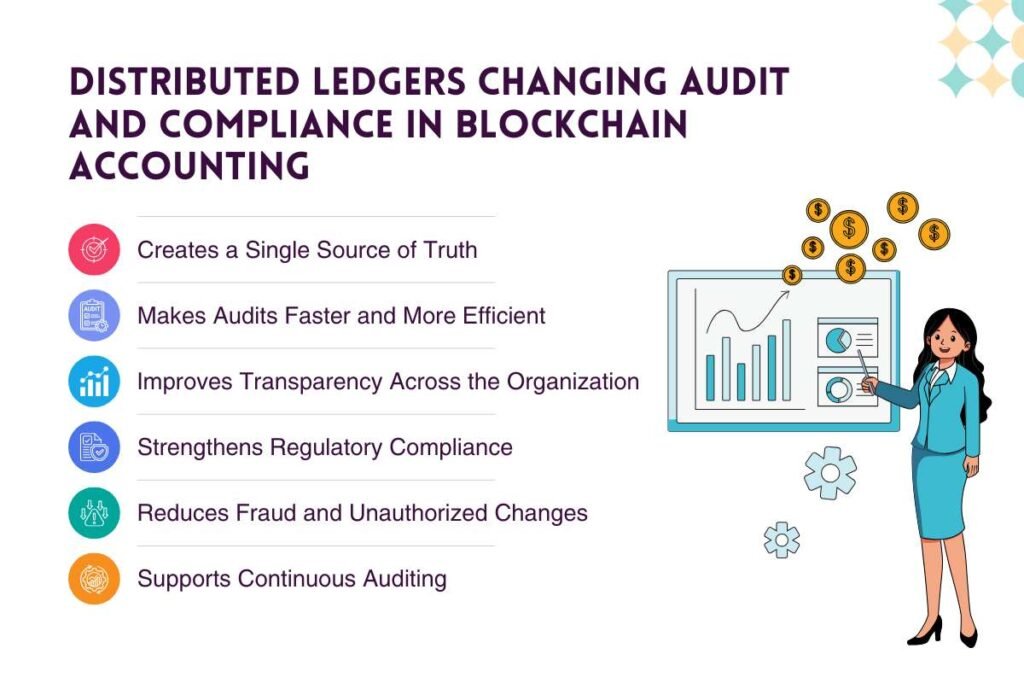
Distributed ledgers are the foundation of blockchain in accounting. Unlike where financial records are stored in a single database, a distributed ledger stores the same verified data across multiple authorized participants. Every transaction is recorded, validated, time-stamped, and linked to previous records, creating a complete and permanent history that cannot be secretly changed.
This approach is changing the way businesses handle audits, regulatory compliance, and financial reporting by making accounting data more secure, transparent, and reliable.
1. Creates a single source of truth
One of the biggest challenges in traditional accounting is that financial data is often stored across different software, departments, or business locations. For example, the finance team, procurement department, and sales team may all maintain separate records. This can lead to duplicate entries, missing transactions, and reconciliation issues.
With blockchain in accounting, all approved transactions are recorded on a shared distributed ledger. Every authorized user accesses the same verified information, ensuring that everyone works with identical financial records.
Benefits:
- Eliminates duplicate or conflicting records.
- Improves consistency across departments.
- Reduces the need for manual reconciliation.
2. Makes audits faster and more efficient
Traditional audits require auditors to collect invoices, bank statements, receipts, contracts, and other supporting documents from multiple sources. Verifying each transaction manually can take weeks or even months, especially for large organizations.
A distributed ledger changes this process. Since every transaction is verified before being added to the blockchain, auditors can review trusted financial records directly from the ledger. Instead of spending time confirming whether a transaction is genuine, they can focus on evaluating financial risks and compliance.
Benefits:
- Reduces audit preparation time.
- Lowers audit costs.
- Speeds up financial verification.
3. Improves transparency across the organization
Transparency is essential for accurate accounting and regulatory compliance. In traditional systems, tracking who changed a financial record and when it was changed can be difficult.
A distributed ledger records every transaction with important details such as the transaction amount, date, time, digital signature, and complete transaction history. Every authorized participant can view the same information based on their access rights.
This creates a clear audit trail that makes financial reporting more transparent and easier to verify.
Benefits:
- Provides complete transaction visibility.
- Improves accountability among departments.
- Makes financial reporting more trustworthy.
4. Strengthens regulatory compliance
Businesses must comply with accounting standards, tax laws, and financial regulations. During inspections or audits, companies often need to provide regulators with accurate records within a short period.
Because blockchain stores verified and tamper-resistant records, businesses can quickly generate complete audit trails whenever required. Regulators can verify financial transactions without reviewing multiple spreadsheets or disconnected databases.
This simplifies compliance with accounting standards and reduces the risk of penalties caused by missing or inaccurate records.
Benefits:
- Simplifies regulatory reporting.
- Supports compliance with accounting standards.
- Reduces documentation errors.
5. Reduces fraud and unauthorized changes
Fraud remains one of the biggest challenges in financial management. In traditional accounting systems, unauthorized users may alter records, delete transactions, or manipulate financial data without immediate detection.
In blockchain accounting, every transaction is linked to the previous one using cryptographic technology. Once a transaction is verified and added to the blockchain, changing that record would require changing every connected block across the network, which is practically impossible in a properly managed blockchain.
As a result, businesses gain stronger protection against financial fraud and unauthorized modifications.
Benefits:
- Prevents hidden changes to financial records.
- Protects data integrity.
- Increases trust in accounting information.
6. Supports continuous auditing
Traditional audits are usually performed once a quarter or once a year. If an error or fraudulent transaction occurs shortly after an audit, it may remain unnoticed for several months.
Distributed ledgers support continuous auditing by recording financial transactions in real time. Auditors can monitor transactions whenever needed instead of waiting until the end of the financial year. This allows businesses to identify unusual activities early and take corrective action before small issues become major problems.
Continuous auditing also helps organizations maintain better financial control throughout the year.
Benefits:
- Detects issues earlier.
- Improves risk management.
- Supports real-time financial monitoring.
Industries already using blockchain technology

Blockchain technology is helping many industries improve security, transparency, and record management. Here are some sectors already using it.
- Banking and Financial Services: Banks use blockchain to make payments faster, improve transaction security, reduce fraud, and simplify cross-border transfers.
For example, JPMorgan’s Kinexys (formerly Onyx) uses blockchain to support secure institutional payments and digital financial services.
- Healthcare: Healthcare organizations use blockchain to secure billing records and verify payments between hospitals, insurers, and patients. This improves data security and reduces billing disputes.
- Supply Chain Management: Companies use blockchain to track products from manufacturers to customers. Every shipment is recorded, improving inventory management and financial reporting.
For example, Walmart uses blockchain to improve product traceability across its supply chain.
- Government and Public Sector: Governments are testing blockchain for public spending, tax collection, land records, and procurement. It improves transparency, reduces fraud, and strengthens trust in public financial management.
Conclusion
Every financial transaction tells a story, but that story is only valuable when people trust it. Traditional accounting systems have served businesses well for decades, yet they often depend on manual verification, reconciliation, and separate databases.
Blockchain in accounting offers a new approach by creating secure, transparent, and permanent financial records that improve accuracy, strengthen compliance, and reduce fraud risks. While challenges such as implementation costs and regulatory changes still exist, the long-term benefits are becoming increasingly clear.
Businesses do not need to transform overnight. Understanding the different Types of Accounting Technology (T1) can help organizations decide where blockchain fits within their broader digital finance strategy.
Starting with a single process, learning from the results, and expanding gradually can make the transition smoother. As technology continues to evolve, blockchain is likely to become an essential part of modern accounting. Businesses of every size, including those adopting Accounting Technology for Small Businesses, can use blockchain to improve transparency, efficiency, and confidence in financial decision-making.
Frequently asked questions (FAQs)
1. What is Blockchain in Accounting?
Blockchain in accounting uses a secure shared ledger to record financial transactions. It creates permanent, transparent, and tamper-resistant financial records.
2. How does blockchain improve auditing?
Blockchain provides a complete and verified transaction history, making audits faster and more accurate. It reduces manual checks and improves transparency.
3. Can small businesses benefit from blockchain?
Yes. Small businesses can use blockchain to improve payment tracking, invoice management, and financial accuracy while reducing manual work.