
Should you do an MBA after graduation or start working first?
There is no single answer. Your choice depends on your career goal, current skills, finances, and the type of job you want.
An MBA can help you build skills in finance, marketing, strategy, leadership, and management. Work experience helps you understand how these ideas work in real business situations.
That is why the MBA vs work experience is really about timing and career goals, not simply choosing one over the other.
Top business schools also show that work experience is common among MBA students. Harvard Business School’s Class of 2027 has an average of 4.9 years of work experience. Wharton reports an average of about five years, while also accepting candidates with little or no experience.
What is the difference between an MBA vs work experience?
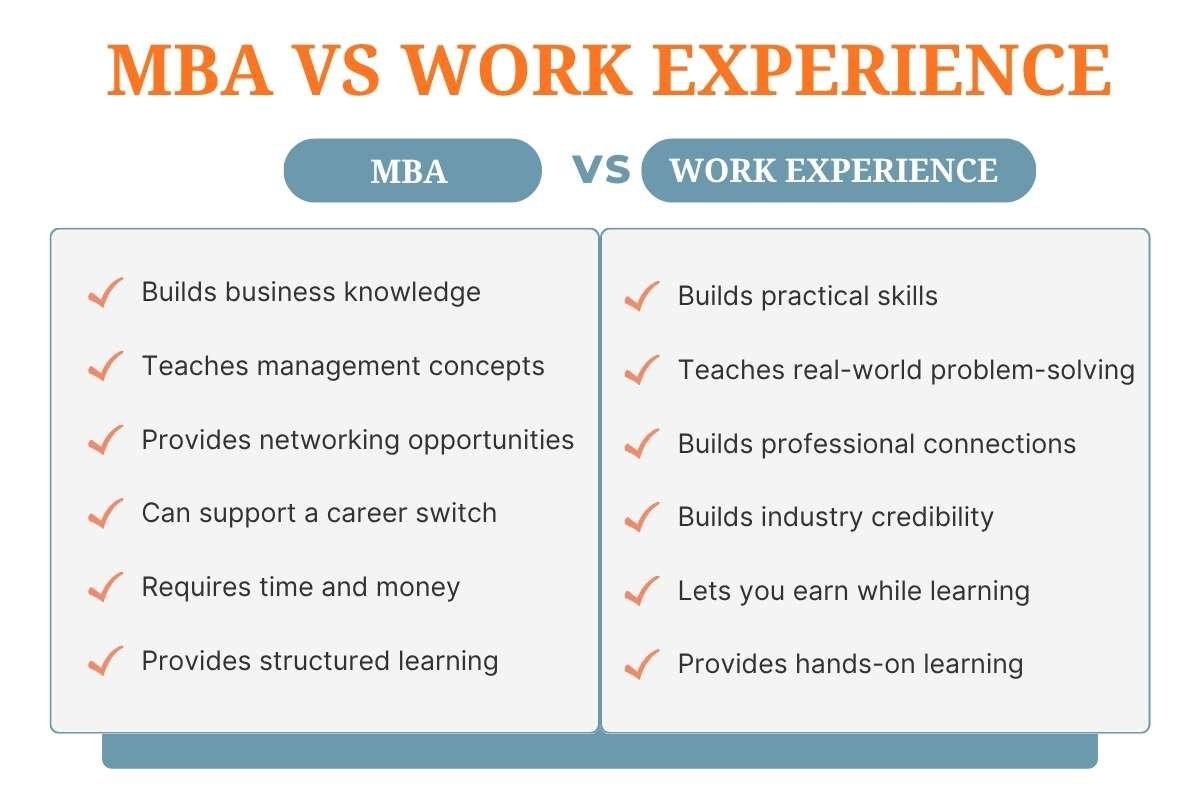
The simple difference is: An MBA teaches you how to understand business. Work experience teaches you how to handle business problems.
This difference is also central to Types of business education, where classroom learning and practical learning serve different career needs.
| MBA | Work Experience |
|---|---|
| Builds business knowledge | Builds practical skills |
| Teaches management concepts | Teaches real-world problem-solving |
| Provides networking opportunities | Builds professional connections |
| Can support a career switch | Builds industry credibility |
| Requires time and money | Lets you earn while learning |
| Provides structured learning | Provides hands-on learning |
For example, an MBA may teach you how to create a marketing strategy. Work experience lets you actually create campaigns, manage budgets, study customers, and measure results.
The strongest career path can combine both.
Why work experience can make your MBA more valuable
1. You understand business better
Real work helps you connect classroom ideas with actual business problems.
A finance professional may understand financial models better because they have already worked with budgets or reports. A marketing professional may understand customer behavior because they have worked directly with customers.
This practical knowledge can make MBA case studies and classroom discussions more meaningful, similar to the practical learning approach used in the Harvard Business School case method.
2. You know what career you want
Working before an MBA can help you understand what you actually enjoy.
You may discover that you want to move into:
- Consulting
- Finance
- Marketing
- Product management
- Operations
- Technology
- Entrepreneurship
This makes it easier to choose the right MBA program and career path. It can also help you decide between Online business courses and a traditional full-time MBA based on your career needs and learning goals.
3. You build a stronger MBA profile
Business schools often look at more than your academic marks.
Wharton says it looks at the depth and breadth of experience, contribution, responsibility, and career progression, rather than simply counting years.
Stanford also says it is more interested in the impact you have made at work than the name or size of your organization.
So, three years of strong work with clear achievements can be more useful than simply collecting years of experience.
When should you choose an MBA?

An MBA may be a good choice if you already know what you want from it.
Consider an MBA when you:
- Want to change your career.
- Want to move into management.
- Need stronger business knowledge.
- Want to change industries.
- Have reached a career plateau.
- Want access to a strong business network.
- Have a clear post-MBA career goal.
The key question is: What will the MBA help you do that you cannot easily do without it? If you have a clear answer, the degree may be worth considering.
Understanding the ROI in business education is also important before making this decision. Compare the tuition cost, lost income, career opportunities, and expected long-term benefits.
When should you choose work experience?
Work experience may be better if you are:
- A recent graduate.
- Unsure about your career direction.
- Still building basic professional skills.
- Getting good learning opportunities in your current job.
- Not ready for the financial cost of an MBA.
- Looking to strengthen your MBA application later.
Working first can also help you understand your strengths and weaknesses before investing in a business degree.
Avoiding Business education mistakes is equally important. Choosing an MBA without a clear career goal or comparing programs only by their brand name can lead to poor decisions.
MBA vs work experience: which is better?

There is no universal winner.
Choose work experience first if:
- You are unsure about your career: Work can help you understand what you actually want.
- You are a fresh graduate: You can build practical skills before spending money on an MBA.
- You have a good learning opportunity: Stay and grow if your job gives you responsibility and career growth.
- You want a stronger MBA application: Work can give you real achievements, leadership examples, and career stories.
Choose an MBA earlier if:
- You have a clear career goal: You know exactly how the MBA fits into your next step.
- You want to switch careers: An MBA can provide business knowledge, recruiting access, and networking.
- Your current career has limited growth: A good MBA may help you access new roles or industries.
The best option may be both
The real answer to MBA vs work experience does not always have to be “MBA or work.”
For many professionals, the better path is: Graduation → Work experience → Career clarity → MBA → Career growth
Work gives you practical knowledge.
An MBA adds structured business knowledge.
Together, they can create a stronger professional profile.
The profiles of Harvard, Wharton, and other leading schools show that several years of professional experience are common among MBA students, although these schools do not all require it.
A simple way to make the decision
Ask yourself these three questions:
- What do I want to achieve?
Do you want a promotion, career change, higher responsibility, or a move into management? - What am I missing?
Do you need business knowledge or more practical experience? - What will change after an MBA?
If you cannot clearly explain what the MBA will add to your career, gaining more experience may be the better choice.
Conclusion
The MBA vs work experience does not have one correct answer.
An MBA can give you business education, knowledge, leadership skills, networking, and career opportunities. Work experience gives you practical skills, industry knowledge, and professional confidence.
For many graduates, working first and doing an MBA later can be a smart choice. But if you have a clear career goal and the right MBA can help you reach it faster, starting earlier may also make sense.
The best choice is simple: Do not choose an MBA just because it looks good on your resume. Choose it because it solves a real career need.
FAQs
1. Is an MBA better than work experience?
Neither is better; an MBA builds business knowledge, while work experience develops practical skills.
2. How many years should I work before an MBA?
There is no fixed rule, but 3-5 years of relevant experience is common among MBA students.
3. Can I do an MBA without work experience?
Yes, some MBA programs accept students without prior work experience.
4. Should I work before doing an MBA?
For many graduates, working first can build practical skills and provide clearer career goals.