
AI in accounting automates financial tasks, improves accuracy, detects fraud, and supports faster decision-making. This guide explains how AI works, its key benefits, real-world applications, future trends, and its role alongside other modern accounting technologies.
What if your accounting software could think before you did? Sounds like a dream, doesn’t it? A few years ago, it was. Today, it is becoming normal because of AI in accounting.
Finance teams spend hours checking invoices, correcting errors, preparing reports, and searching for missing transactions. These repetitive tasks slow down decision-making and increase the chances of mistakes. Artificial intelligence changes that. It works quietly in the background, handling routine financial work while giving accountants more time to solve business problems and support growth.
A great example is Intuit QuickBooks, which uses AI to automatically categorize expenses, suggest invoice reminders, and generate financial insights for small businesses. Instead of spending hours organizing transactions manually, business owners receive intelligent recommendations within seconds. According to Intuit, these AI-powered features help users save valuable time while improving financial accuracy.
The future of accounting is no longer about working harder. It is about working smarter with intelligent technology that supports people instead of replacing them.
What is AI in accounting and why are businesses using it?
AI in accounting uses artificial intelligence (AI), machine learning (ML), and data analytics to automate financial tasks, analyze accounting data, identify patterns, and provide real-time insights. Unlike traditional accounting software that follows fixed rules, AI learns from financial data and continuously improves its accuracy over time.
Businesses are adopting AI because manual accounting is slow, costly, and prone to errors. AI helps automate repetitive tasks, speeds up financial processes, improves accuracy, detects fraud, supports compliance, and provides better financial insights for faster decision-making.
How AI turns everyday accounting into smarter financial decisions?
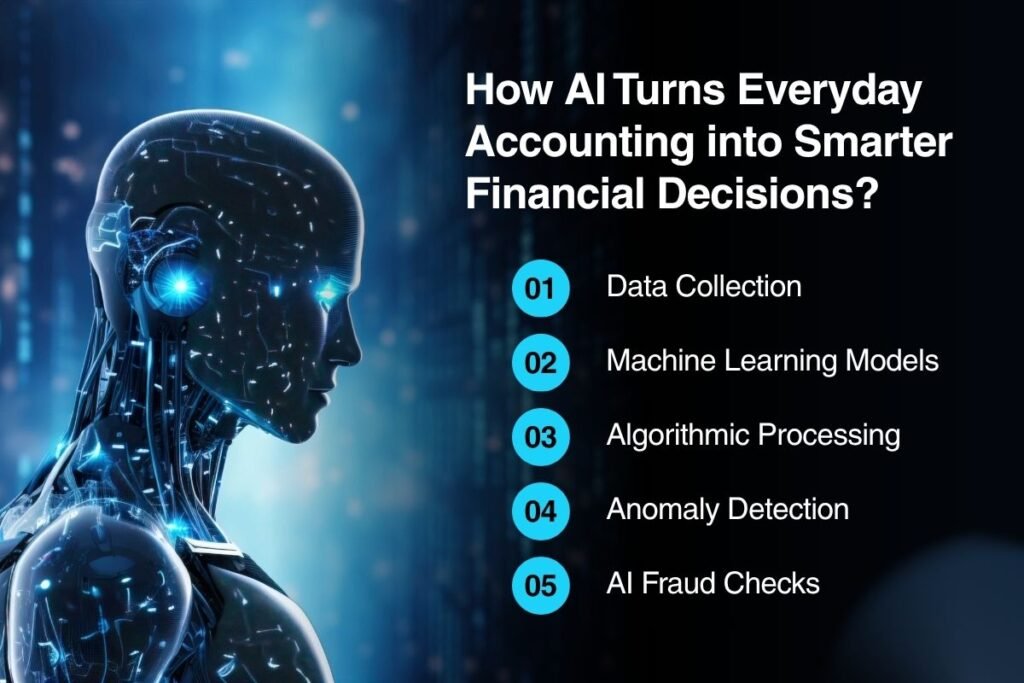
Artificial intelligence follows a structured process to transform raw financial information into meaningful business insights. Every transaction passes through several intelligent stages before becoming useful financial data.
1. Data collection
The first step is collecting financial information from multiple business systems. AI gathers data from invoices, purchase orders, receipts, payroll systems, bank feeds, ERP platforms, CRM software, and tax records.
Because the data comes from different sources, AI organizes it into one centralized financial view. This removes duplicate entries and reduces the time spent searching for information across multiple systems.
2. Machine learning models
Machine learning is the intelligence behind modern accounting systems.
Instead of relying only on predefined accounting rules, machine learning studies previous financial records to identify trends and improve future decisions.
Over time, the system learns:
- How vendors are categorized
- Seasonal spending patterns
- Customer payment behavior
- Tax classifications
- Cash flow trends
As more accounting data becomes available, the recommendations become increasingly accurate.
3. Algorithmic processing
One of the most powerful features of AI in accounting is algorithmic processing. Instead of requiring accountants to review every transaction manually, AI applies intelligent financial rules to process thousands of records within minutes.
Algorithmic processing combines predefined business rules with machine learning to automate repetitive accounting tasks such as invoice matching, journal entries, payment scheduling, tax categorization, and ledger updates.
Real-world example: Unilever
Unilever uses AI-powered ERP systems to automatically match supplier invoices with purchase orders and receipts. If everything matches, invoices are approved automatically. Only exceptions, such as pricing errors or missing documents, are sent to the finance team. This speeds up invoice processing, reduces manual errors, and improves efficiency.
Leading ERP platforms like SAP S/4HANA, Oracle Fusion Cloud ERP, and Microsoft Dynamics 365 Finance use similar AI-driven automation to streamline financial workflows, improve compliance, and help businesses close their books faster.
4. Anomaly detection
Businesses process thousands of financial transactions every month, making it difficult to spot errors or fraud manually. AI in Accounting uses anomaly detection to identify unusual transactions automatically.
AI learns normal spending patterns by analyzing past transactions, vendor payments, employee expenses, and payment history. If it finds something unusual, it alerts the finance team for review.
Unlike traditional software, AI keeps learning from new data, making it more accurate over time.
Real-world example: PwC Halo
PwC’s Halo is an AI-powered audit platform that analyzes millions of financial records to detect unusual transactions, duplicate payments, and compliance risks. This helps auditors identify problems faster and improve audit accuracy.
5. AI fraud checks
Financial fraud continues to cost businesses billions of dollars every year. According to the Association of Certified Fraud Examiners (ACFE), organizations lose an estimated 5% of their annual revenue to fraud, with occupational fraud cases causing a median loss of US$145,000 per case.
Modern AI in accounting systems provides continuous fraud monitoring instead of waiting for month-end reviews. AI analyzes every transaction in real time and compares it with historical financial behavior. When it detects suspicious activity, it generates instant alerts for accountants or auditors.
AI helps detect several types of fraud, including:
- Duplicate supplier invoices
- Fake vendor accounts
- Unauthorized payments
- Payroll fraud
- Expense reimbursement fraud
- Invoice manipulation
- Tax irregularities
Instead of checking only completed transactions, AI monitors financial activity continuously. This allows businesses to stop fraudulent payments before they are approved.
Real-world example: Mastercard Decision Intelligence
Mastercard uses an AI-powered platform called Decision Intelligence to evaluate payment transactions in milliseconds. The system compares each transaction with billions of previous payment patterns to identify suspicious activity while reducing false declines for legitimate customers. This technology helps financial institutions improve fraud detection without slowing down payment processing.
How can you successfully implement AI in your business?
Implementing AI in accounting doesn’t have to be complicated. Follow these steps:
Step 1: Identify repetitive accounting tasks like invoice processing, expense management, payroll, or reconciliations.
Step 2: Choose AI-powered accounting software that integrates with your existing ERP, CRM, and banking systems.
Step 3: Clean and organize financial data so AI can generate accurate insights.
Step 4: Start with one process, such as invoice automation or fraud detection, before expanding AI across finance operations.
Step 5: Train your finance team to use AI tools effectively and interpret AI-generated recommendations.
Step 6: Monitor performance regularly and refine workflows as AI learns from new financial data.
This step-by-step approach helps businesses reduce manual work, improve accuracy, strengthen compliance, and make faster financial decisions with AI.
Traditional accounting vs. AI in accounting: what’s the difference?
| Traditional Accounting | AI in Accounting |
| Manual data entry | Automated data capture |
| Fixed accounting rules | Learns from financial data |
| Periodic reporting | Real-time reporting |
| Manual reconciliations | Automated reconciliations |
| Reactive decisions | Predictive financial insights |
AI does not replace accountants. Instead, it helps them work more efficiently by reducing manual work and allowing them to focus on business strategy and financial planning.
Key applications of AI in accounting

The role of AI in accounting extends far beyond bookkeeping. Today, organizations use AI across almost every financial process to improve efficiency, accuracy, and decision-making.
1. Automated bookkeeping
Manual bookkeeping requires accountants to record transactions, classify expenses, and update ledgers regularly. AI automates these repetitive activities by capturing transaction data directly from bank feeds, invoices, and receipts. Automated bookkeeping categorizes expenses based on historical patterns and continuously improves its accuracy.
2. Accounts payable automation
Processing supplier invoices manually often leads to delays and duplicate payments. AI extracts invoice information using Optical Character Recognition (OCR), matches invoices with purchase orders, and routes them for approval automatically.
Businesses implementing AI-powered accounts payable automation systems often experience faster invoice approvals and fewer payment errors.
3. Accounts receivable automation
Collecting payments on time is essential for healthy cash flow. AI predicts which customers may delay payments, prioritizes collections, sends automated reminders, and recommends follow-up actions.
Instead of reacting to overdue invoices, accounts receivable automation allows finance teams to prevent payment delays before they occur.
4. Expense management
Employee expense reports consume significant administrative time. AI automatically reads receipts, verifies company policies, detects duplicate claims, and approves eligible expenses.
For multinational companies that handle thousands of travel expenses each month, this expense management technology automation saves hundreds of work hours and improves compliance.
5. Real-time financial reporting
Traditional financial reporting often depends on month-end closing. AI updates dashboards continuously by processing transactions as they occur. By using modern reporting systems and Real-Time Financial Reporting, finance leaders receive instant visibility into revenue, expenses, profitability, and cash flow without waiting for manual reports.
6. Financial forecasting
Forecasting no longer relies only on spreadsheets and assumptions. AI studies historical financial data, seasonal sales, customer behavior, and market trends to predict future revenue, expenses, and cash flow.
These insights help businesses make confident budgeting and investment decisions.
7. Tax compliance
Keeping up with changing tax regulations is challenging for every business. AI automatically classifies transactions, validates tax calculations, identifies missing tax information, and highlights compliance risks before tax returns are submitted.
This reduces manual work while improving regulatory compliance.
8. Audit preparation
Traditional audits require accountants to collect documents, reconcile accounts, and review large transaction samples. AI simplifies this process by organizing financial records, identifying unusual entries, and preparing supporting documentation automatically.
As a result, auditors spend more time analyzing financial risks instead of gathering data.
How fast is AI changing accounting? These statistics tell the story
The growing adoption of AI in accounting is supported by strong industry research.
According to McKinsey & Company, many finance activities have high automation potential, allowing finance professionals to shift their focus from routine processing to strategic analysis.
Deloitte’s State of AI in the Enterprise research reports that organizations increasingly use AI to improve financial planning, reporting accuracy, and operational efficiency across finance functions.
The Association of Certified Fraud Examiners (ACFE) estimates that organizations lose approximately 5% of annual revenue to occupational fraud, highlighting the importance of AI-powered fraud detection.
Research from Gartner also indicates that finance leaders continue to increase investments in AI-driven technologies to improve forecasting, reporting, and decision-making.
These trends show that AI is becoming a core capability in modern finance rather than an optional technology.
How AI in accounting improves accuracy, speed, and growth?
AI in accounting helps businesses automate routine tasks, improve accuracy, and support better financial decisions. It allows accountants to spend more time on strategy instead of manual work.
- Improves Accuracy: AI reduces typing mistakes, duplicate entries, and calculation errors by automatically checking financial data. This improves reporting, audits, and tax compliance.
- Saves Time: AI automates tasks like invoice processing, bank reconciliation, journal entries, and expense approvals. This helps finance teams complete work faster and focus on higher-value tasks.
- Detects Fraud Faster: AI monitors financial transactions in real time and quickly identifies unusual payments, duplicate invoices, or suspicious activity, helping businesses reduce fraud risks.
- Supports Better Decisions: AI analyzes financial data and provides real-time insights into revenue, expenses, cash flow, and profits. This helps businesses make faster and smarter decisions.
- Improves Compliance: AI checks transactions against accounting rules and tax regulations, reducing reporting errors and helping businesses stay compliant.
- Grows with Your Business: As transaction volumes increase, AI handles more financial work without reducing speed or accuracy, making it easier for businesses to scale.
Future of AI in accounting: trends that will transform finance

The future of AI in accounting goes beyond automation. Intelligent finance systems are becoming proactive advisors that help organizations predict risks, recommend actions, and improve strategic planning.
Several emerging technologies are shaping the next generation of accounting.
Generative AI is helping accountants prepare financial summaries, explain reports, and draft management insights faster.
Predictive Accounting uses historical data and machine learning to forecast revenue, expenses, and cash flow with greater accuracy.
Autonomous Finance is enabling systems to process invoices, reconcile accounts, generate journal entries, and prepare reports with minimal human intervention.
AI Agents are also becoming more common. These intelligent assistants can monitor financial activities, answer accounting queries, schedule approvals, and support finance teams throughout the accounting cycle.
As these technologies mature, accountants will spend less time processing transactions and more time providing strategic financial guidance to business leaders.
Conclusion
Remember the question from the beginning: What if your accounting software could think before you did?
AI in accounting is no longer the future; it’s transforming finance today. By automating routine tasks, detecting fraud, and delivering smarter insights, AI helps accountants focus on strategic decisions instead of manual work.
To build a future-ready finance function, businesses should combine AI with Accounting Technology, cloud accounting, and blockchain-based solutions. Together, these technologies improve accuracy, efficiency, compliance, and long-term business growth.
Frequently asked questions
1. What is AI in accounting?
AI in accounting uses artificial intelligence to automate financial tasks, reduce errors, and analyze data. It helps businesses save time and make smarter financial decisions.
2. Is AI replacing accountants?
No. AI handles repetitive tasks, while accountants focus on planning, analysis, compliance, and business decisions.
3. What are the biggest benefits of AI in accounting?
AI improves accuracy, saves time, detects fraud, and provides real-time financial insights. It also boosts productivity and supports better decision-making.
4. Which industries benefit the most from AI in accounting?
Industries like banking, healthcare, retail, manufacturing, IT, and logistics use AI to manage financial tasks more efficiently.
5. How does AI detect accounting fraud?
AI monitors transactions in real time and flags unusual activities like duplicate invoices or suspicious payments. This helps businesses detect fraud early.
6. What is the difference between AI in accounting and accounting automation?
Accounting automation follows fixed rules to complete tasks, while AI learns from data and improves over time. AI is smarter and more adaptable than traditional automation.