Choosing between an MBA vs executive education depends on your career stage, goals, experience, time, and learning needs.
An MBA covers major areas such as finance, marketing, strategy, operations, leadership, and business analytics. It is often useful for people who want to change careers or build a strong management foundation.
Executive education is more focused. It helps working professionals improve skills such as leadership, strategy, AI, digital transformation, finance, or business management.
The right choice is not about which option is more prestigious. It is about which programme solves your career needs.
This is especially important today. GMAC’s 2026 Corporate Recruiters Survey found that communication, problem-solving, and adaptability remain highly valued, while technology, AI, and data skills have grown strongly in importance.
What is the difference between an MBA vs executive education?
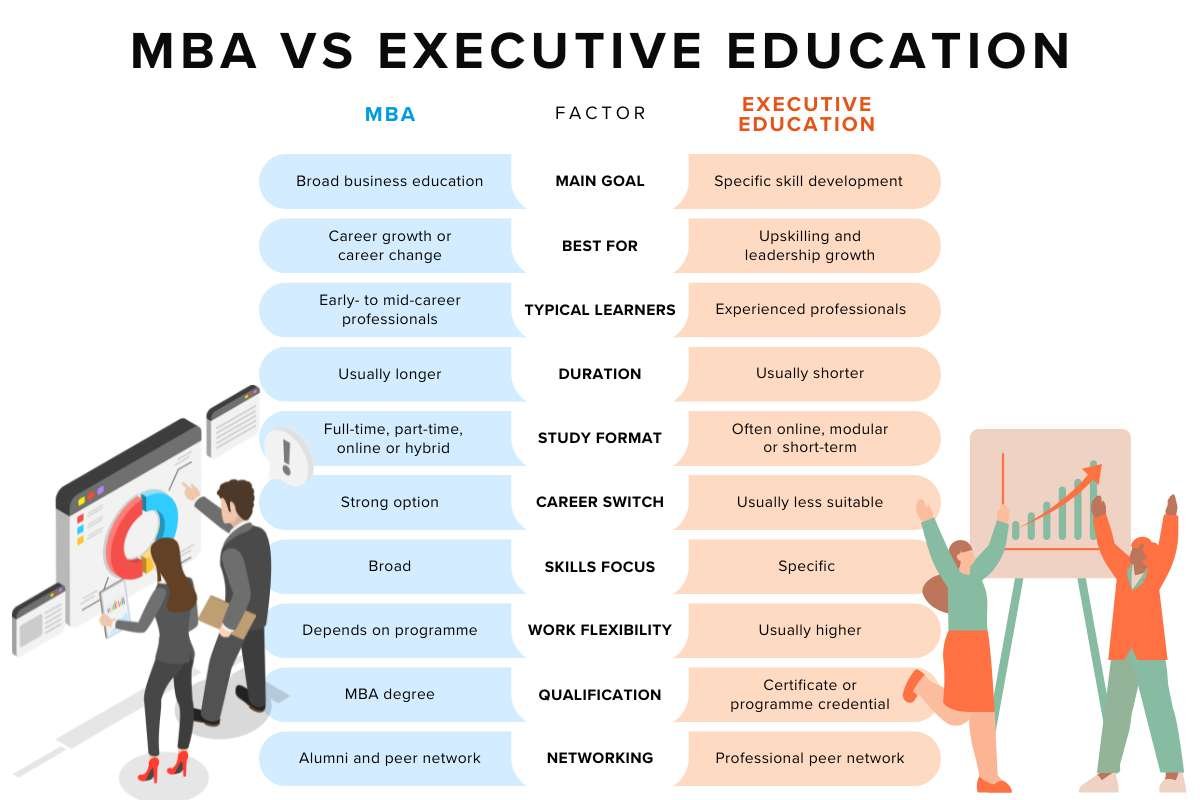
The main difference is simple: an MBA provides broad business education, while executive education provides focused learning for specific professional needs.
| Factor | MBA | Executive Education |
|---|---|---|
| Main Goal | Broad business education | Specific skill development |
| Best for | Career growth or career change | Upskilling and leadership growth |
| Typical Learners | Early- to mid-career professionals | Experienced professionals |
| Duration | Usually longer | Usually shorter |
| Study Format | Full-time, part-time, online or hybrid | Often online, modular or short-term |
| Career Switch | Strong option | Usually less suitable |
| Skills Focus | Broad | Specific |
| Work Flexibility | Depends on programme | Usually higher |
| Qualification | MBA degree | Certificate or programme credential |
| Networking | Alumni and peer network | Professional peer network |
MBA: An MBA gives you a broad view of how businesses work.
You may study:
- Finance
- Marketing
- Strategy
- Operations
- Leadership
- Business analytics
- Economics
This makes an MBA useful when you want to move into a new function or industry.
The value also depends heavily on the school, curriculum, network, career services, and your previous experience. An MBA should therefore be judged by its career fit and return on investment, not only by its name.
Executive Education: Executive education is usually more focused.
- A marketing manager may study digital transformation.
- A senior manager may study strategic leadership.
- A technology leader may study AI strategy.
- A business owner may study finance or growth strategy.
For example, the Indian School of Business currently offers executive programmes in leadership, strategy, general management, digital transformation, AI, and fintech. Its programmes range from short courses to longer programmes designed for experienced professionals. Professionals can also consider Online business courses when they need flexible learning that fits around their existing jobs and responsibilities. This makes executive education useful when you already know which skill you need to improve.
Which path fits different career stages and goals?

The best choice depends on your experience and career goal. An MBA is usually stronger for broad learning and career changes, while executive education works well for experienced professionals who need specific skills.
1. Early career: build a broad business foundation with an MBA
If you are early in your career and want to understand business beyond your current role, an MBA can be a strong choice.
It can help you build knowledge in:
- Finance and marketing
- Strategy and operations
- Leadership and management
- Business analytics
- Different industries and functions
Example: INSEAD reports that 65% of its MBA graduates changed their sector, function, or country after the programme. Its 2025 employment data also shows consulting as the leading post-MBA destination.
This shows why an MBA can suit professionals who want to expand their options or move into a new career path.
Best fit: Early-career professionals who want broad business knowledge, a new industry, or a management career.
2. Career changers: an MBA can support a major career move
If your main goal is to change your function, industry, or career direction, an MBA can offer more than a short skills programme. It combines business learning with career support, peer networking, alumni connections, and access to employers.
Example: INSEAD highlights MBA graduates who used the programme to move into consulting and other strategic roles. One graduate, Danny Murty, joined INSEAD to build general management and financial skills and moved into management consulting after his MBA.
INSEAD also works with more than 130 consulting firms through its Career Development Centre, helping MBA students prepare for consulting careers.
An MBA does not guarantee a career switch, but it can provide a broader platform for one.
Best fit: Professionals who want to move into consulting, strategy, finance, management, or another new field.
3. Mid-career: executive education can build the skills you need now
Professionals with several years of experience may already understand their industry. Their next challenge may be leading people, managing change, using AI, or making better business decisions.
This is where executive education can be useful.
Example: ISB’s Digital Business Transformation with AI programme is designed for professionals with 5+ years of experience. It focuses on AI, data analytics, digital transformation, and technology-led business decisions.
ISB also offers an Emerging Leaders Programme for professionals with 5+ years of experience who are preparing for wider responsibilities and leadership roles.
Best fit: Mid-career professionals who want to improve a specific skill without making a complete career reset.
4. Senior leaders: choose focused learning for bigger responsibilities
Senior managers and business leaders often do not need to learn every area of business again. They may need to solve a specific leadership or business challenge.
For example:
- A technology leader may need AI and digital transformation skills.
- A business head may need strategy and enterprise leadership.
- A functional leader may need cross-functional decision-making.
Example: Harvard Business School’s Senior Executive Leadership Program-India is designed for senior executives, functional leaders, general managers, and entrepreneurs preparing for new responsibilities or growth initiatives. It covers strategy, negotiation, digital transformation, AI, innovation, and leadership.
Similarly, ISB’s Senior Management Programme focuses on enterprise decisions, AI, digital change, strategic thinking, and leadership for senior professionals.
Senior professionals who want to build a business may also benefit from specialised business education for entrepreneurs focused on strategy, finance, leadership, and growth.
Best fit: Senior professionals preparing for larger teams, business units, transformation projects, or enterprise-level roles.
Conclusion
The MBA vs executive education comes down to your career goal.
Choose an MBA if you want broad business knowledge, a major career change, or a stronger management foundation.
Choose executive education if you already have experience and want to build a specific skill, improve your leadership ability, or prepare for a larger role while continuing your career.
There is no single best option.
Choose the MBA in Business Education when you need a broader career move. Choose executive education when you need focused professional growth.
Before making a decision, compare the programme’s curriculum, faculty, duration, cost, flexibility, alumni network, industry exposure, career support, and expected ROI.
FAQs
1. Is an MBA better than executive education?
An MBA is better for broad business knowledge and career changes, while executive education suits professionals seeking focused skills.
2. Can executive education replace an MBA?
No, executive education builds specific skills but does not offer the broad degree, curriculum, and career benefits of an MBA.
3. Is an MBA good for a career change?
Yes, an MBA can support career changes by building business knowledge, networks, and access to new industries and roles.
4. Who should choose executive education?
Experienced professionals and managers should consider executive education when they want to develop specific skills while continuing their careers.
5. What is better after 5-10 years of work experience?
Choose an MBA for a major career change and executive education for targeted skills, leadership growth, or career advancement.