Healthcare faces a critical challenge: delivering personalized, cost-effective care without overwhelming clinical teams. Solving this requires more than minor hardware upgrades; it demands a complete redesign of how devices collect and act on real-time patient data.
As the world’s largest standalone medical technology company, Medtronic is leading this shift by integrating artificial intelligence, real-time remote monitoring, and robotic automation into core therapies. Here is a look at how Medtronic’s approach to medical technology turns emerging medtech trends into scalable clinical realities.
The pillars of Medtronic’s approach to medical technology
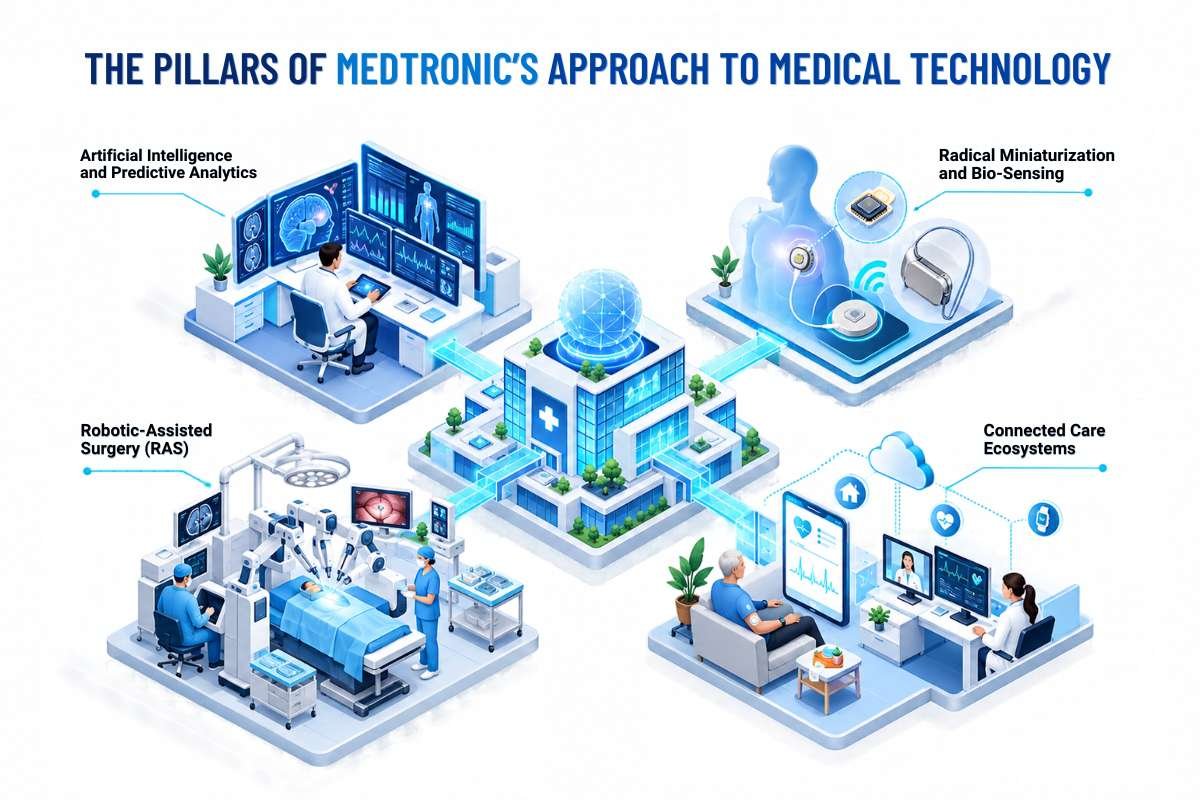
To scale life-saving therapies across more than 70 health conditions, Medtronic utilizes a structured engineering framework spanning core types of medical technology:
Medtronic Tech Platform Framework
AI & Predictive Analytics
↳ Early stroke detection
↳ Adaptive insulin dosing
Miniaturization & Bio-Sensors
↳ Micra™ leadless pacemaker
↳ Continuous glucose monitors
Robotics-Assisted Surgery (RAS)
↳ Hugo™ RAS platform
Connected Care Ecosystems
↳ Remote telemetry & patient-data pipelines
1. Artificial intelligence and predictive analytics
The integration of AI in medical technology is central to Medtronic’s approach to medical technology and it’s strategic vision. By embedding machine learning algorithms into imaging tools, continuous glucose monitors (CGMs), and cardiac platforms, devices can spot subtle biological signals long before clinical symptoms appear.
2. Radical miniaturization and bio-sensing
Advances in wearable medical technology are reshaping patient management outside hospital walls. Through advances in battery chemistry, micro-electronics, and biocompatible materials, Medtronic packs complex diagnostic and therapeutic capabilities into sub-gram implants.
3. Robotic-assisted surgery (RAS)
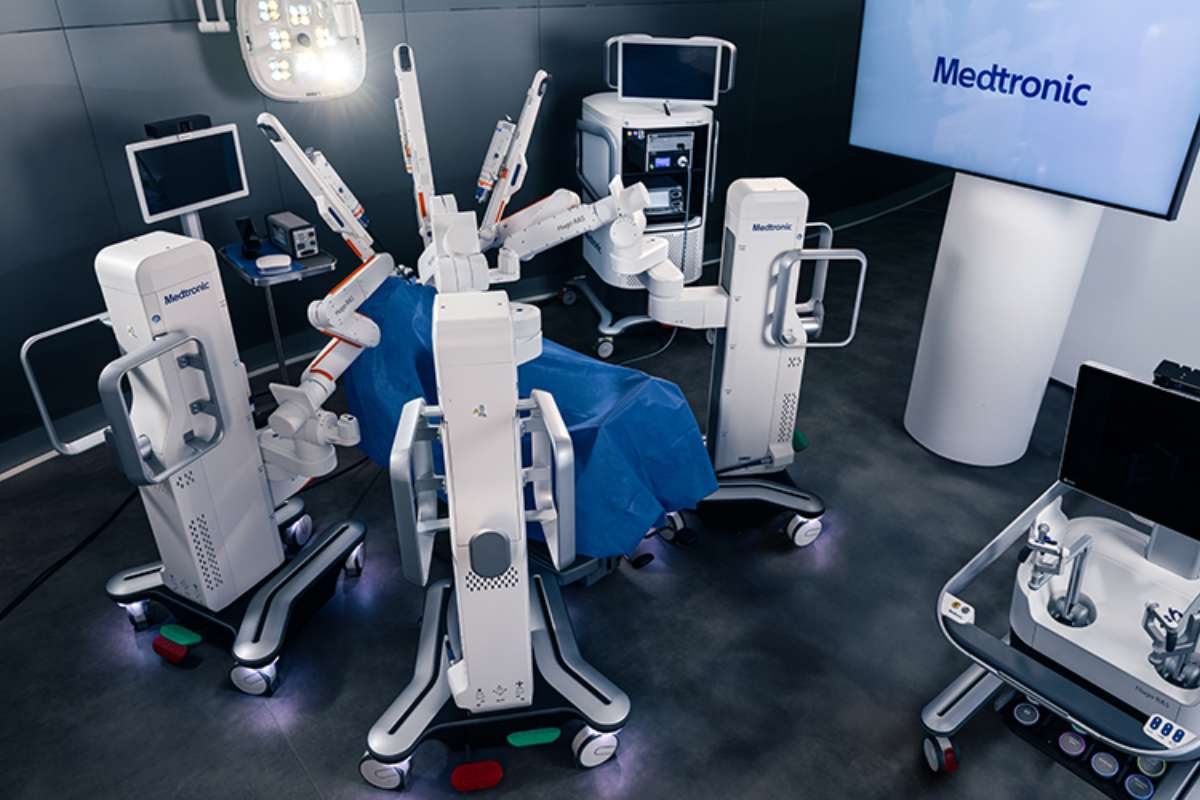
Complex surgical procedures require high precision, minimal invasiveness, and repeatable results. Medtronic’s robotic platforms give surgeons better visualization, greater wrist articulation, and real-time guidance, making advanced care more consistent across hospital networks.
4. Connected care ecosystems
A medical device provides maximum value when it shares insights across the care team. Through secure wireless telemetry, Medtronic’s approach to medical technology connects bedside devices to cloud infrastructure, enabling remote monitoring, early clinical interventions, and reduced emergency room visits.
Case study: How Medtronic develops and scales medical devices
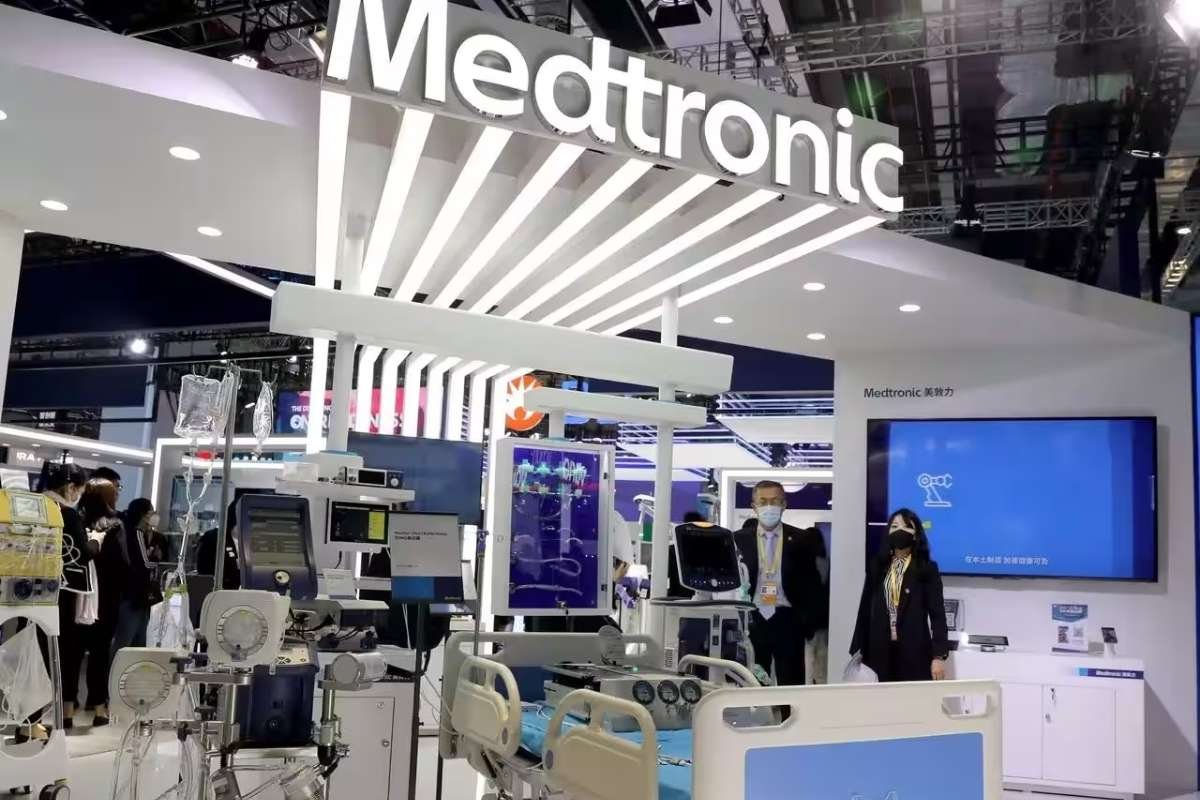
Examining how Medtronic takes concept-stage research to global commercial scale reveals the practical mechanics of Medtronic’s approach to medical technology.
Discovery & Concept Development
↓
Pre-Clinical Testing & Prototyping
↓
Global Clinical Trials (174+ Active Trials)
↓
Regulatory Approvals (FDA/CE Mark)
↓
Global Commercialization & LABS Deployment
1. Massive R&D commitment
Medtronic allocates roughly $2.7 billion annually to research and development, maintaining more than 174 active clinical trials worldwide. Navigating complex medical technology regulations (such as U.S. FDA clearances and European CE Mark certifications) is central to its product lifecycle, ensuring device safety and global compliance before market deployment.
“To innovate, improve, and make connected care successful, Medtronic is being systematic in our people-first approach… We need to continue listening to those receiving care, and their families and communities, so we’re better able to ensure they’re getting the full benefit of what’s available.”
- Dr. Laura Mauri, Senior Vice President and Chief Scientific, Medical, and Regulatory Officer at Medtronic
2. Clinical breakthrough: the Micra™ leadless pacemaker
Traditional pacemakers require transvenous leads and a surgical pocket in the chest, creating potential points of infection or mechanical failure.
To solve this, Medtronic’s approach to medical technology engineered the Micra™ Transcatheter Pacing System, a leadless pacemaker less than one-tenth the size of a standard device. Delivered directly into the heart’s right ventricle via a minimally invasive catheter, Micra eliminates chest incisions and lead-related complications, establishing a new standard for cardiac rhythm management.
3. Scaling global access: Medtronic LABS
Developing advanced hardware is only half the battle; getting it to under-resourced patient populations is equally critical. Through its Medtronic LABS initiative, the company deploys hyper-local digital health models across emerging markets:
- 1.8+ million patients screened in underserved regions.
- 235,000+ patients enrolled in tech-enabled chronic disease management programs.
- 85%+ of local LABS staff hired directly from the communities they serve.
By pairing localized software with scalable clinical hardware, Medtronic’s approach to medical technology bridges healthcare delivery gaps in high- and low-income regions alike.
Key medical device technology comparison
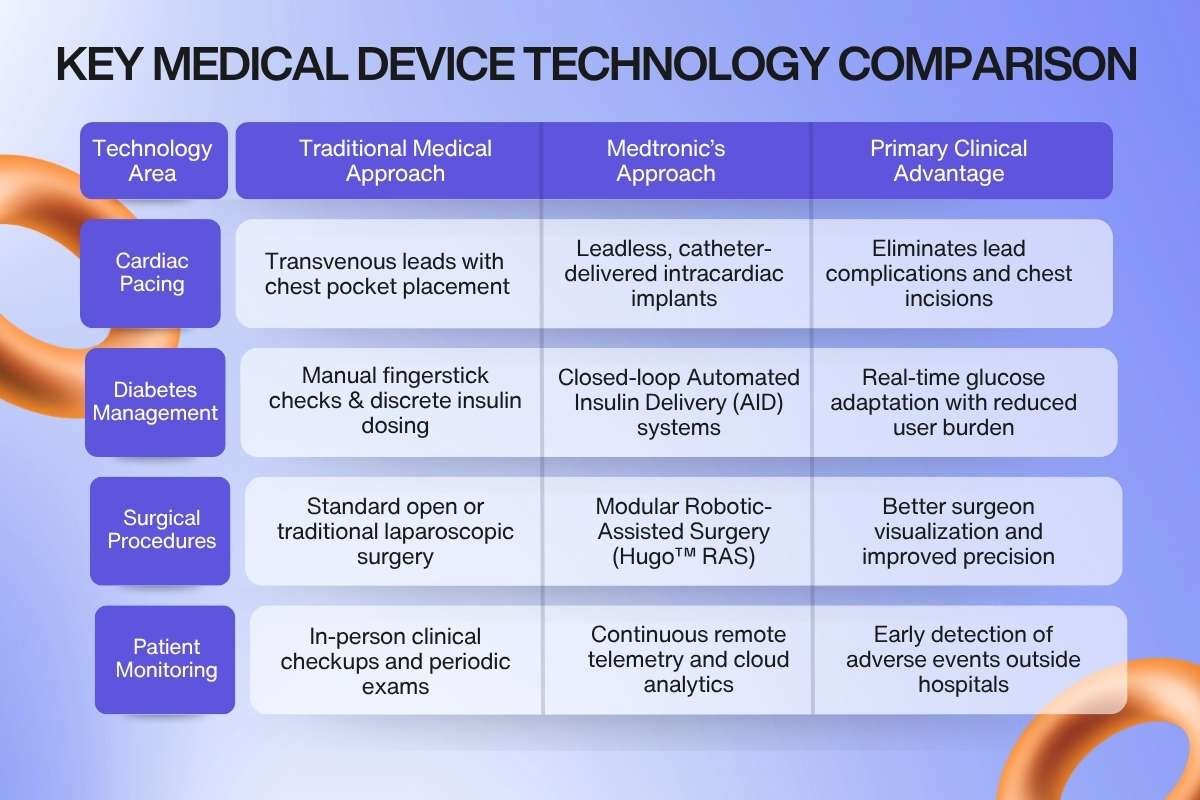
| Technology Area | Traditional Medical Approach | Medtronic’s Approach | Primary Clinical Advantage |
|---|---|---|---|
| Cardiac Pacing | Transvenous leads with chest pocket placement | Leadless, catheter-delivered intracardiac implants | Eliminates lead complications and chest incisions |
| Diabetes Management | Manual fingerstick checks & discrete insulin dosing | Closed-loop Automated Insulin Delivery (AID) systems | Real-time glucose adaptation with reduced user burden |
| Surgical Procedures | Standard open or traditional laparoscopic surgery | Modular Robotic-Assisted Surgery (Hugo™ RAS) | Better surgeon visualization and improved precision |
| Patient Monitoring | In-person clinical checkups and periodic exams | Continuous remote telemetry and cloud analytics | Early detection of adverse events outside hospitals |
Conclusion
Medtronic’s approach to medical technology demonstrates how continuous engineering, clinical evidence, and data-driven connectivity can modernize patient care. By shifting from standalone equipment to intelligent, connected health platforms, Medtronic consistently pushes medical engineering forward.
As artificial intelligence and bio-sensing evolve, the methodologies pioneered by Medtronic will remain central to the future of global medical technology.
FAQs
1. What is Medtronic’s core approach to medical technology?
Medtronic focuses on integrating artificial intelligence, device miniaturization, surgical robotics, and cloud connectivity into unified patient-care ecosystems that improve clinical outcomes.
2. What is an example of Medtronic’s miniaturization innovation?
The Micra™ Transcatheter Pacing System is a primary example. It is a leadless pacemaker less than one-tenth the size of traditional pacemakers, implanted directly into the heart without transvenous leads.
3. How does Medtronic support healthcare in underserved regions?
Through Medtronic LABS, the organization combines localized software applications with clinical care pathways, screening over 1.8 million patients in underserved communities across the globe.