Artificial intelligence is becoming an important part of modern business operations. Companies use AI to automate repetitive tasks, analyze large datasets, improve customer service, and support faster decisions. However, managing multiple AI tools across departments can create challenges related to security, data access, integration, and operating costs.
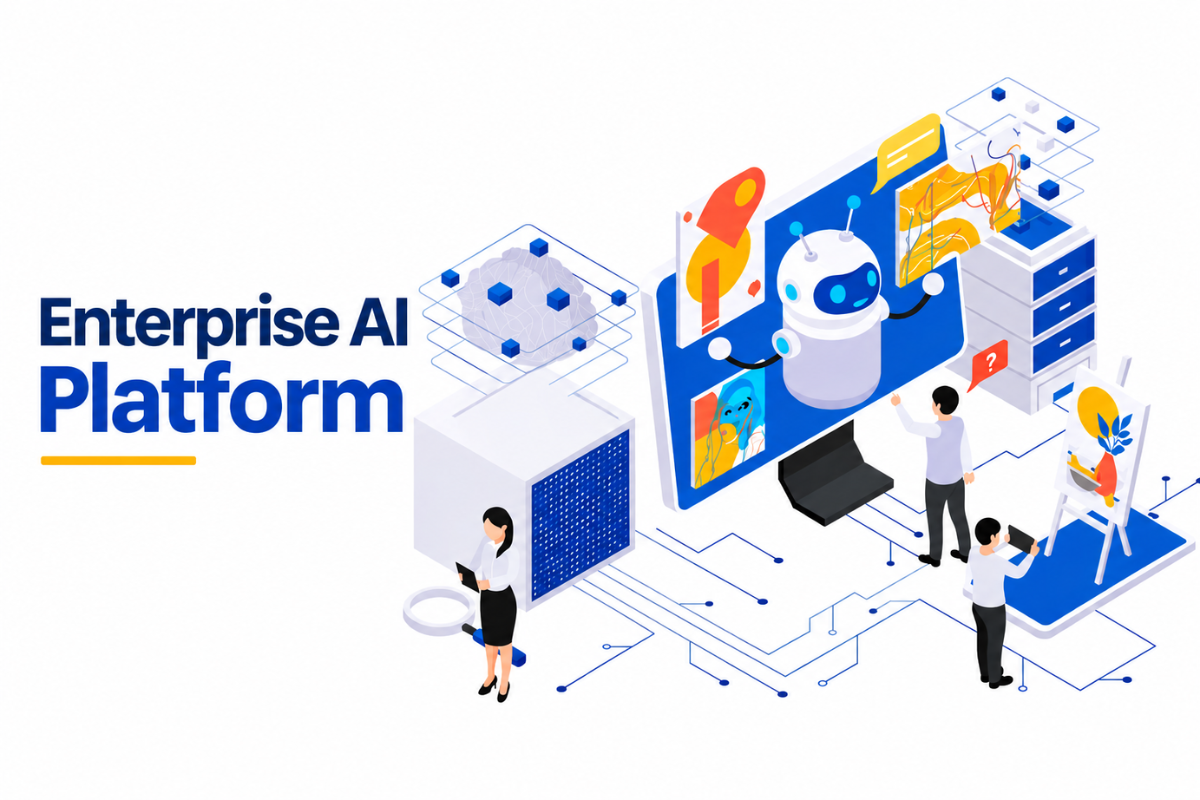
An enterprise AI platform provides a centralized environment where businesses can develop, deploy, and manage AI applications. It connects AI models with company data, software, and daily workflows while giving teams better control over performance and security.
Solutions such as Microsoft Foundry, Amazon Bedrock, IBM watsonx, and Databricks offer different capabilities for enterprise AI adoption. Choosing the right platform requires careful consideration of business needs, technical requirements, security, and long-term value.
What are the best enterprise AI platforms for your business?
Several technology companies offer enterprise AI platforms with different capabilities. Some focus on AI application development, while others support data analytics, business automation, and AI governance.
Here are eight leading platforms businesses can consider in 2026-2027.
1. Microsoft Foundry – Best for Microsoft-based businesses
Microsoft Foundry helps organizations build, deploy, and manage AI applications and agents within the Azure ecosystem.
Key features:
- Access to multiple AI models.
- AI agent development and deployment.
- Enterprise identity and role-based access controls.
- Model evaluation, tracing, and monitoring.
- Integration with Microsoft and Azure services.
It suits businesses already using Microsoft cloud infrastructure and business applications.
2. Amazon Bedrock – Best for AWS-based businesses
Amazon Bedrock provides access to foundation models through a managed AWS service. Businesses can build generative AI applications without managing the underlying model infrastructure.
Key features:
- Access to foundation models from multiple providers.
- AI agent development and workflow automation.
- Knowledge bases and retrieval-augmented generation (RAG).
- Model customization and evaluation.
- Security, privacy, and responsible AI guardrails.
It works well for organizations that want to add generative AI capabilities to their existing AWS applications.
3. Google Cloud Gemini Enterprise Agent Platform – Best for AI agent development
Google Cloud’s Gemini Enterprise Agent Platform helps technical teams build, deploy, govern, and optimize enterprise AI agents.
Key features:
- Low-code and code-based agent development.
- Access to more than 200 foundation models.
- Managed agent deployment and runtime.
- Agent identity, security, and governance.
- Performance monitoring and evaluation.
Businesses can use it to develop agents that retrieve information, automate workflows, and complete multi-step tasks.
4. IBM watsonx – Best for AI governance
IBM watsonx combines AI development, data management, and governance capabilities to support enterprise AI adoption.
Key features:
- Generative AI and machine learning development.
- Enterprise data management.
- AI model evaluation and monitoring.
- AI risk management and governance.
- AI assistants and agent orchestration.
It is a strong option for organizations that prioritize responsible AI, regulatory requirements, and controlled model management.
5. Databricks Mosaic AI – Best for data-driven organizations
Databricks Mosaic AI supports businesses that want to develop and deploy AI applications using their enterprise data.
Key features:
- Machine learning and generative AI development.
- Model serving and deployment.
- AI agent development.
- Model evaluation and monitoring.
- Data governance and workflow integration.
It is particularly useful for organizations with large datasets and teams working on advanced analytics and machine learning.
6. Snowflake Cortex AI – Best for AI-powered data analytics
Snowflake Cortex AI allows organizations to develop AI applications using their structured and unstructured enterprise data.
Key features:
- Large language model functions.
- AI-powered data analysis.
- Document processing and semantic search.
- AI agents and conversational applications.
- Enterprise data security and access controls.
It is a useful option for businesses that want to bring AI capabilities closer to their existing Snowflake data environment.
7. Palantir AIP – Best for operational AI
Palantir AIP connects AI models with enterprise data and operational workflows, helping organizations build AI-powered business applications.
Key features:
- AI-powered workflow development.
- Enterprise AI agents and automation.
- Integration with operational data.
- Model evaluation and performance testing.
- Data access controls and governance.
It can support businesses looking to connect AI applications directly with complex operational processes.
8. Salesforce Agentforce – Best for CRM and customer service
Salesforce Agentforce helps businesses create AI agents that support customer service, sales, employee assistance, and other business operations.
Key features:
- AI agents for customer interactions.
- Sales and service workflow automation.
- Integration with Salesforce CRM data.
- Multi-agent orchestration.
- Agent testing, monitoring, and optimization.
It is a suitable option for organizations that want to automate customer-facing processes while connecting AI agents with their CRM systems.
How to evaluate an enterprise AI platform before choosing one?

Selecting an enterprise AI platform requires businesses to assess their technical requirements and long-term goals. A platform with advanced features may not be the right choice if it does not integrate with existing systems or fit the company’s budget.
Use the following evaluation checklist before making a decision.
| Evaluation Criteria | What to Check |
|---|---|
| Business Requirements | Does it solve specific operational challenges? |
| AI capabilities | Does it support generative AI, machine learning, and agents? |
| Integration | Can it connect with existing business applications? |
| Security | Does it provide encryption, identity controls, and data protection? |
| Governance | Can administrators monitor AI activity and manage risks? |
| Scalability | Can it support growing users and workloads? |
| Performance | Does it deliver accurate and reliable results? |
| Pricing | Are subscription, API, infrastructure, and maintenance costs clear? |
| Vendor support | Are technical assistance and regular updates available? |
Conclusion
The right enterprise AI platform can help businesses improve productivity, automate daily operations, and make better use of organizational data. However, the best choice depends on existing technology, security requirements, business goals, and available budgets.
Companies should evaluate platform features, integration capabilities, scalability, governance, and overall costs before investing. A well-selected solution can support long-term AI adoption and prepare businesses for emerging technologies in 2027.
FAQs
1. What is an enterprise AI platform?
An enterprise AI platform helps businesses develop, deploy, integrate, and manage AI applications across their operations.
2. What are the key features of an enterprise AI platform?
Key features include AI model management, data integration, security, governance, scalability, and workflow automation.
3. Which enterprise AI platform is best for large businesses?
Microsoft Foundry, Amazon Bedrock, IBM watsonx, and Google Cloud Agent Platform are leading options based on business requirements.
4. How much does an enterprise AI platform cost?
Pricing depends on licensing, AI model usage, infrastructure, deployment requirements, and business scale.
5. How do enterprise AI platforms protect business data?
They use encryption, identity management, access controls, and governance policies to protect sensitive information.