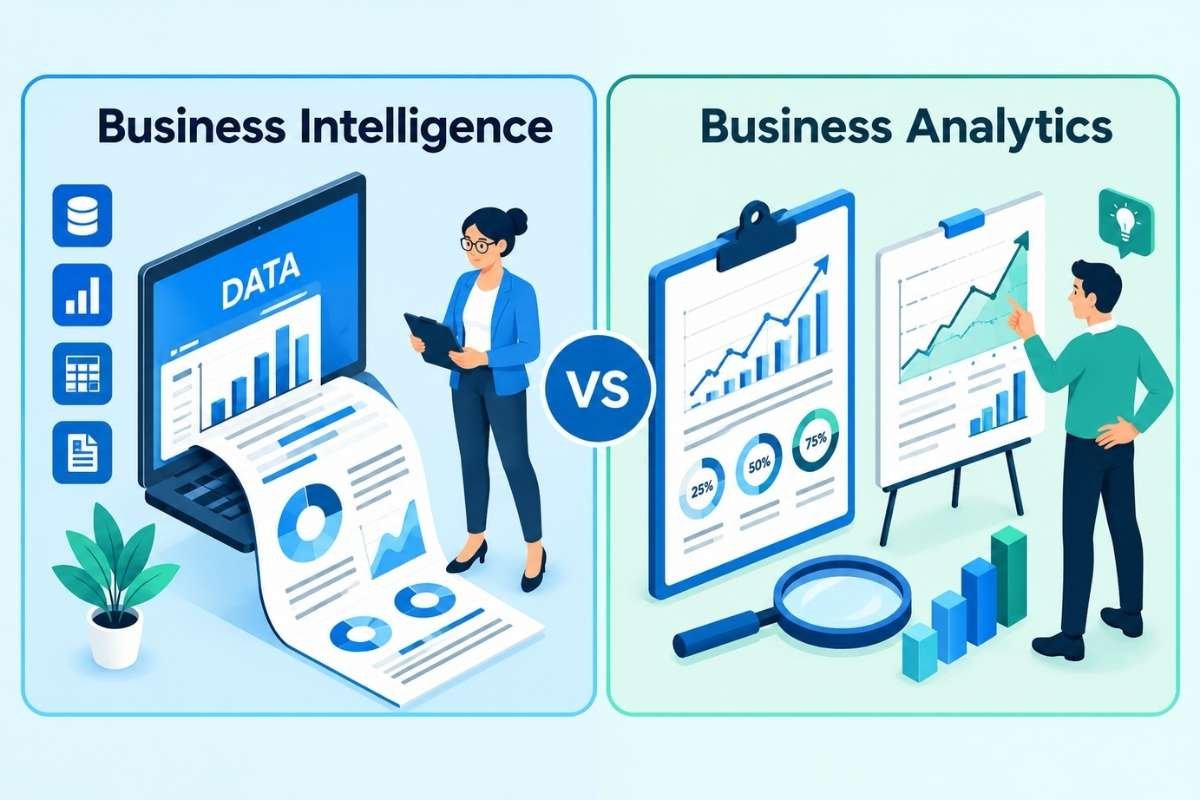
Businesses generate large amounts of data every day, but turning that data into useful decisions can be challenging. AI in Business Intelligence helps companies analyze information faster, identify trends, predict outcomes, and automate reporting.
It also allows employees to ask questions in simple language and get data-driven answers without relying on manual analysis for every report.
How does AI in business intelligence turn business data into actionable insights?
AI in Business Intelligence combines artificial intelligence with BI systems to help businesses analyze data, identify patterns, and make informed decisions. Traditional BI mainly focuses on reports and dashboards, while AI-powered BI can also explain trends, detect unusual activity, and predict possible outcomes.
For example, a retailer may notice declining sales in a dashboard. AI can help identify whether the decline relates to a particular product, region, pricing change, or seasonal pattern. Predictive analytics can then estimate future demand and help the retailer adjust inventory.
According to Gartner’s 2025 analysis of AI adoption, poor data quality remains a major barrier to advanced analytics. This highlights why businesses need reliable data before expecting AI to deliver useful insights.
What AI features are changing the way businesses use BI tools?
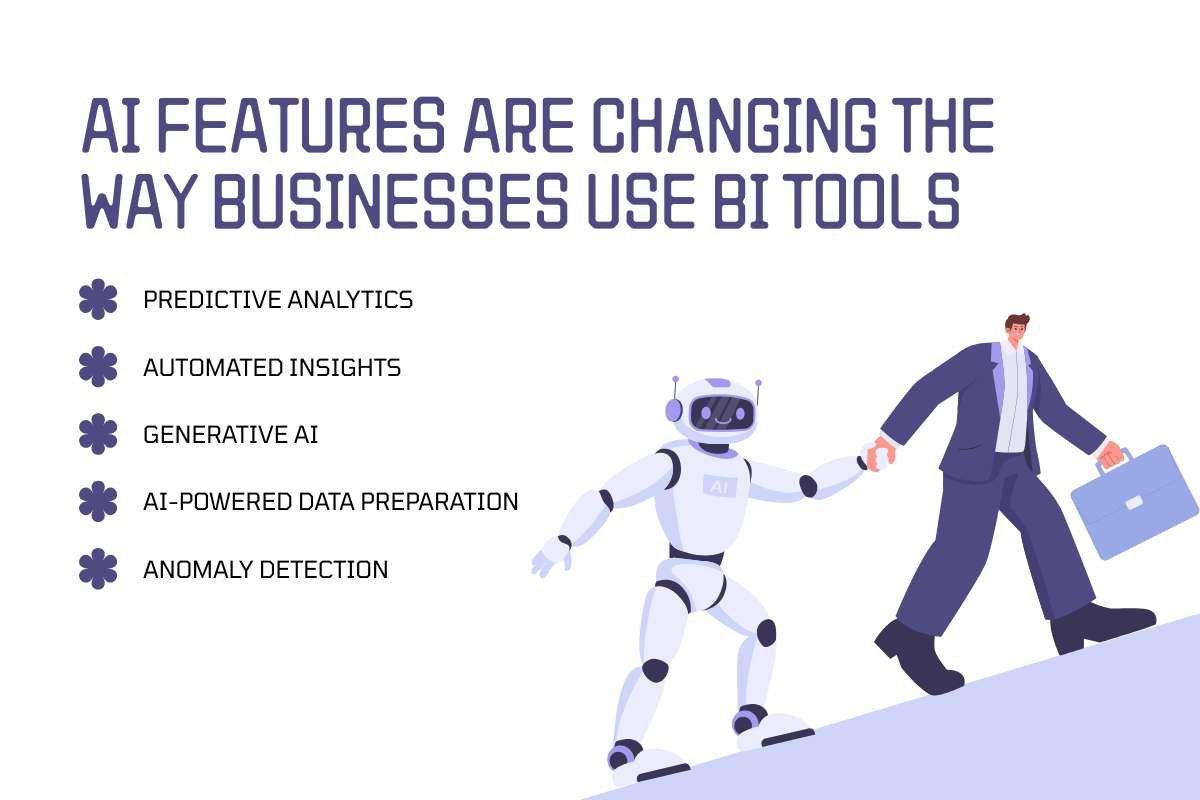
AI is making BI tools more useful by reducing manual analysis and helping employees work with business data more efficiently. Key features include:
- Predictive analytics: Uses historical data to forecast sales, demand, customer churn, and other business outcomes.
- Automated insights: Highlights unusual changes, emerging patterns, and performance gaps in reports.
- Generative AI: Helps users summarize findings, explain metrics, and create report descriptions.
- AI-powered data preparation: Helps organize data and identify inconsistencies before analysis.
- Anomaly detection: Flags unexpected changes, such as a sudden rise in operating costs or a drop in website conversions.
These features can reduce repetitive work and help teams focus on decisions rather than manual reporting. However, their usefulness depends on the quality of the underlying data and how well the system understands business definitions.
How are AI and natural language queries changing BI workflows?
Natural language queries allow employees to ask questions about business data using everyday language instead of writing SQL queries or relying on analysts to build every report.
For example, a sales manager could ask, “Which products had the highest sales growth last quarter?” An AI-enabled BI tool can interpret the question, query the relevant data, and present results in a table, chart, or summary.
This changes BI workflows in three ways:
1. Faster access to insights: Employees can ask questions and get answers without waiting for a custom report.
2. Easier data exploration: Non-technical teams can investigate sales, customer behaviour, and operational performance.
3. Follow-up analysis: Users can ask additional questions to examine a trend or investigate a performance gap.
Microsoft’s Copilot in Power BI tutorial demonstrates how users can ask questions about data and generate insights using natural language.
However, natural language queries are not automatically accurate. Poorly defined metrics, ambiguous questions, or incorrect data relationships can produce misleading answers. Businesses should define key metrics clearly and validate important findings before making decisions.
How are businesses using AI in business intelligence to improve decisions?

Businesses use AI in BI to connect data analysis with everyday decisions across departments.
| Business Functions | AI-powered BI application |
|---|---|
| Sales | Forecast demand and identify underperforming products. |
| Marketing | Analyze campaign performance and customer behavior. |
| Finance | Flag unusual expenses and improve financial forecasting. |
| Retail | Predict inventory needs and identify changing buying patterns. |
| Operations | Detect performance issues and identify process bottlenecks. |
A practical example comes from Reckitt, the consumer health and hygiene company. According to a Microsoft customer case study published in June 2025, Reckitt used Azure OpenAI and Copilot for Power BI to improve marketing workflows. The company reported a 60% efficiency boost within marketing, with human experts remaining involved in evaluating consumer insights.
This example shows how AI can support business intelligence by helping teams work through information more efficiently while retaining human judgement.
Can AI in business intelligence give misleading insights, and how can businesses prevent them?
Yes. AI-powered BI can generate inaccurate or incomplete insights when the underlying data is unreliable, the question is unclear, or the system misinterprets business metrics.
Common risks include:
- Poor data quality: Missing, outdated, or inconsistent records can distort analysis.
- Incorrect AI-generated answers: AI may misinterpret a question or generate an unsupported explanation.
- Biased predictions: Historical data may reflect existing business or customer biases.
- Data privacy risks: Sensitive financial, employee, or customer information requires appropriate access controls.
Businesses can reduce these risks by cleaning data regularly, setting clear metric definitions, restricting access to sensitive information, and checking important AI-generated findings against trusted reports.
The need for governance is supported by Gartner’s 2025 survey on AI maturity. It found that 29% of leaders in high-AI-maturity organizations identified data availability and quality among their top AI implementation challenges.
Gartner
The takeaway is simple: AI can speed up analysis, but businesses still need reliable data, proper controls, and human oversight.
How can businesses integrate AI into existing BI systems and measure ROI?

Businesses do not necessarily need to replace their existing BI systems to introduce AI. They can start by identifying repetitive reporting tasks or decisions that would benefit from faster analysis.
A practical implementation plan includes five steps:
1. Identify a business problem: Choose a specific goal, such as improving sales forecasts or reducing manual reporting.
2. Check data readiness: Ensure the data is accurate, accessible, consistent, and properly governed.
3. Choose compatible tools: Assess whether the existing BI platform supports relevant AI features and whether additional licensing or infrastructure is required.
4. Run a pilot project: Test AI on one workflow and compare its performance with the existing process.
5. Measure results: Track reporting time, forecast accuracy, error rates, adoption, and cost savings.
The return on investment (ROI) should include software costs, integration, employee training, data preparation, and ongoing governance, not just the time saved.
Businesses should expand the implementation only when the pilot demonstrates measurable value and acceptable accuracy.
Conclusion
AI in Business Intelligence helps businesses make faster, more informed decisions through predictive analytics, automated insights, and natural language queries. However, reliable results depend on accurate data, proper security, and human oversight.
By integrating AI into existing business intelligence systems and measuring its impact, businesses can improve reporting, save time, and make better decisions.
FAQs on AI in business intelligence
1. What is AI in Business Intelligence?
AI in Business Intelligence uses AI to analyze data, identify patterns, and support better decisions.
2. How does AI improve business intelligence?
AI improves BI through predictive analytics, automated reporting, and faster data analysis.
3. Can AI replace traditional BI tools?
No, AI enhances traditional BI tools with automation, predictions, and natural language queries.
4. What are the main challenges of AI in BI?
Key challenges include poor data quality, inaccurate outputs, privacy risks, and integration costs.
5. How can businesses measure the ROI of AI-powered BI?
Businesses can measure ROI through time savings, lower reporting costs, improved accuracy, and better outcomes.