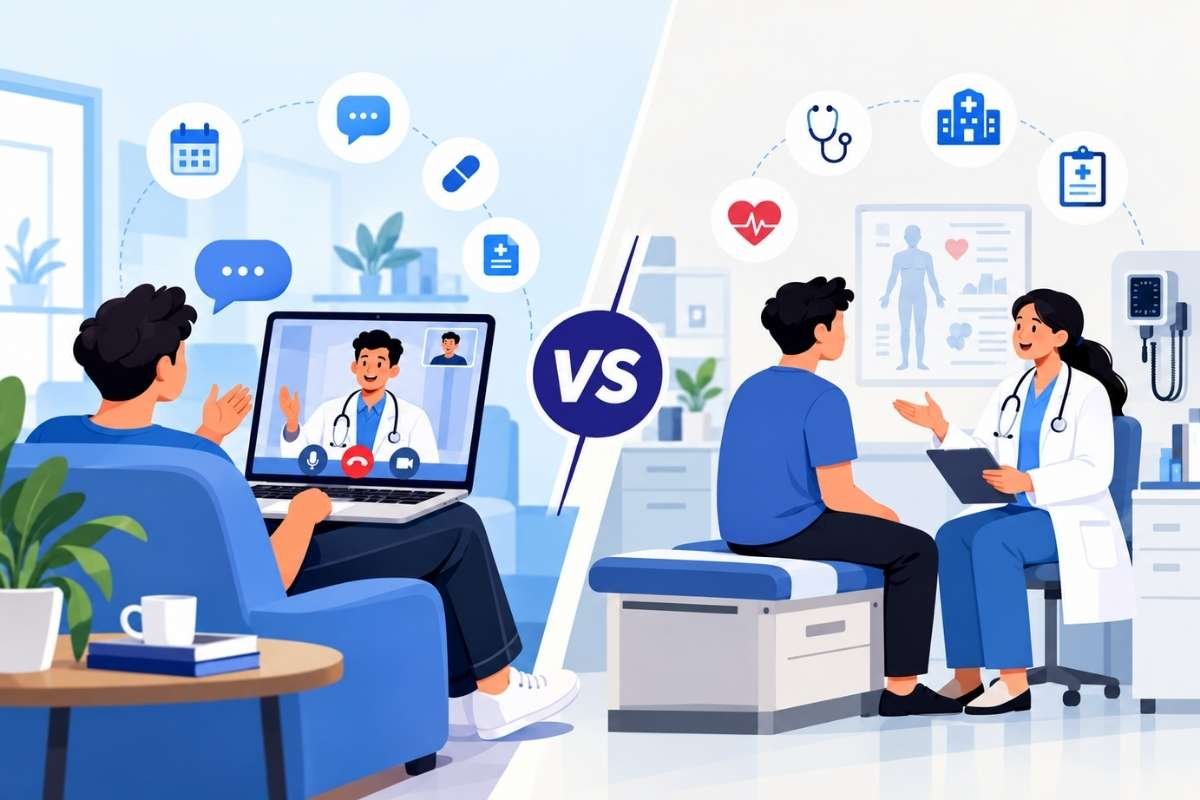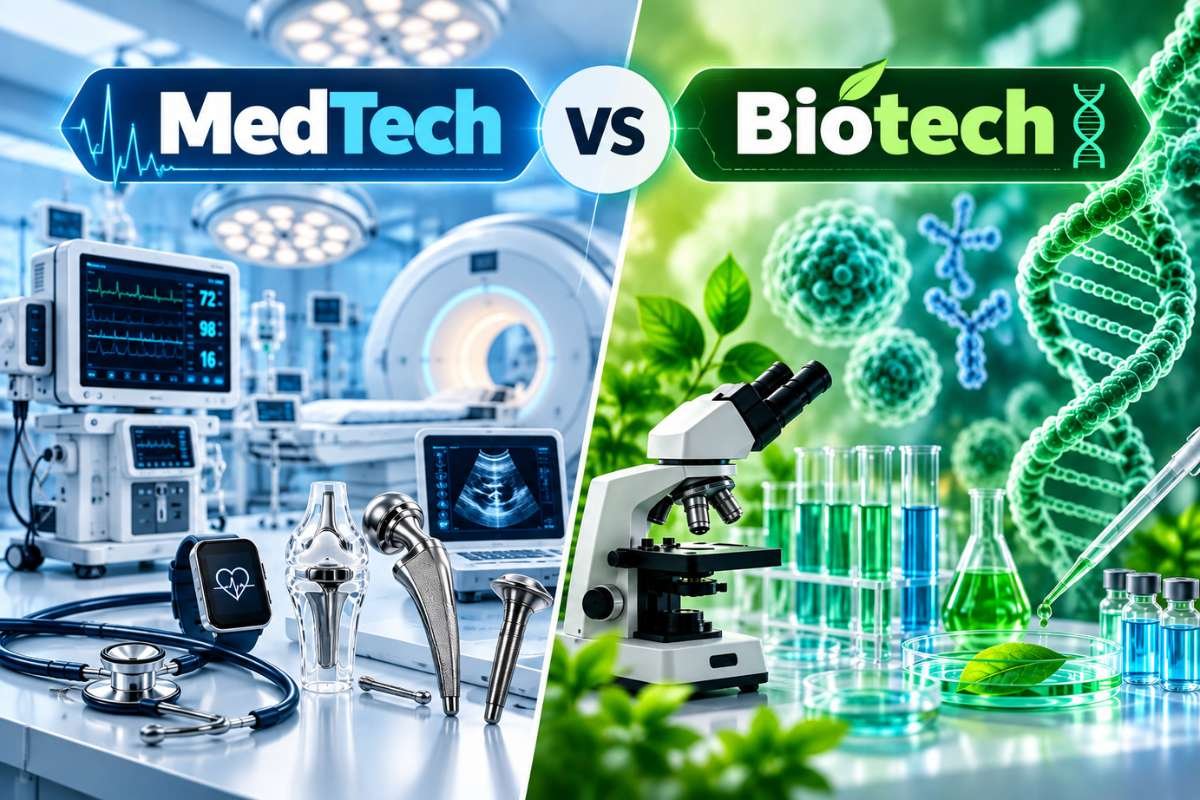
MedTech uses medical devices, hardware, and software to diagnose, monitor, or treat health conditions, while biotechnology uses cells, genes, and biological processes to develop drugs, therapies, and other biological solutions.
Understanding the difference between MedTech vs biotech is important for investors, founders, healthcare professionals, and businesses making decisions about funding, regulation, and market strategy. Although both sectors aim to improve patient outcomes and healthcare delivery, they differ in technology, development timelines, regulatory pathways, funding needs, and business models.
This guide explains the key differences, industry overlap, regulatory requirements, market landscape, and real-world applications of MedTech vs biotech.
What is MedTech? (Medical technology)
MedTech refers to applying engineering, electronics, computer science, and materials science to build physical devices, diagnostic software, and healthcare infrastructure. MedTech products aim to diagnose, monitor, or treat medical conditions through physical or digital mechanisms rather than biological or chemical actions inside the body.
“Medical devices include all the health technologies (except for vaccines and medicines) required for prevention, diagnosis, treatment, monitoring, rehabilitation and palliation.”
MedTech focus:
- Hardware & Electronics (MRI, pacemakers, surgical robots)
- Digital Health & Software (AI in medical technology diagnostics, telehealth, SaMD)
- Mechanical Interventions (stents, prosthetic limbs, orthopedics)
Core characteristics of MedTech:
Mechanism: Mechanical, physical, optical, electrical, or software-driven.
Development Timeline: 3 to 7 years from concept to market entry.
Target Outcome: Immediate physical intervention, diagnostic measurement, or operational automation.
What is biotech? (Biotechnology)
Biotechnology leverages biological processes, organisms, cell cultures, and molecular engineering to develop therapeutic products, vaccines, and advanced living drugs. Rather than building hardware or digital tools, biotech research works directly at the biological level to target disease pathways inside human cells.
Biotech focus
- Gene Therapy & CRISPR (genetic editing, biological repair)
- Monoclonal Antibodies & Biologics (targeted cellular therapy)
- Vaccines & Cell Therapies (mRNA, CAR-T cell manufacturing)
Core characteristics of biotech:
Mechanism: Molecular, genetic, biochemical, or cellular interaction.
Development Timeline: 10 to 15 years from bench research to commercialization.
Target Outcome: Disease modification, cellular repair, or immune response modulation.
The ultimate MedTech vs biotech comparison matrix
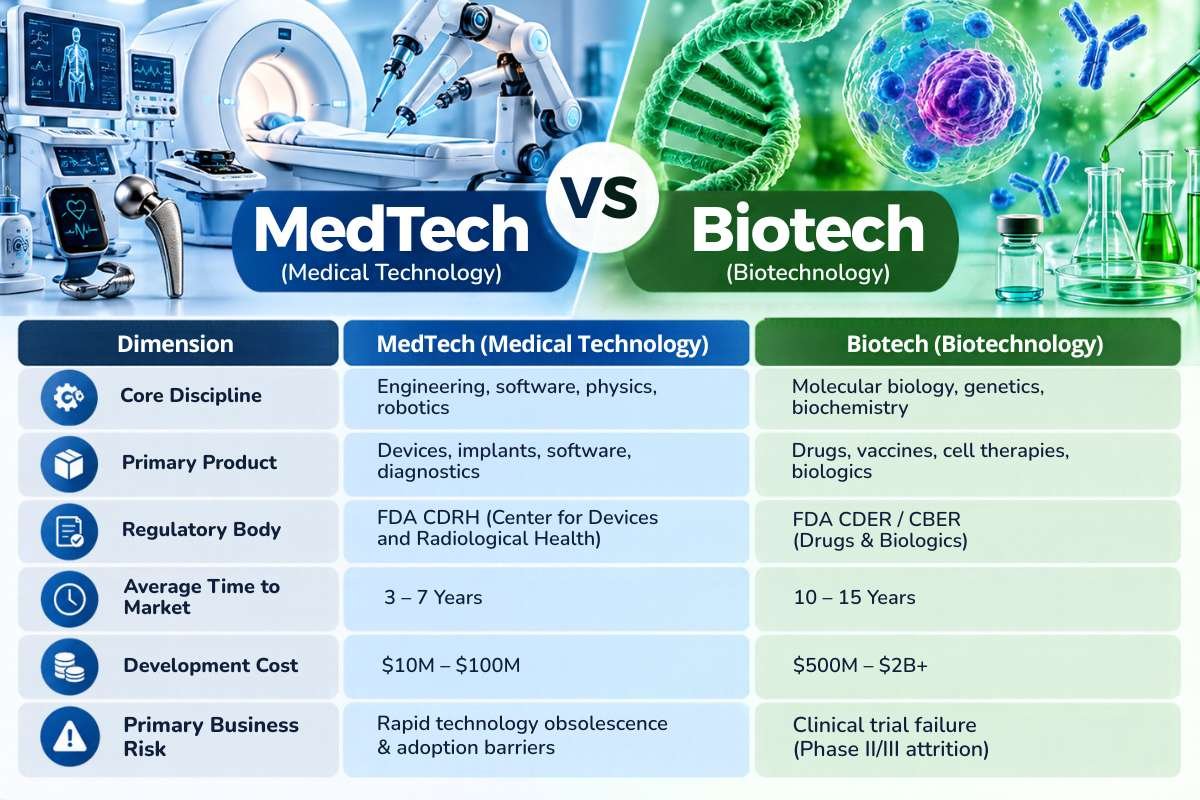
To evaluate MedTech vs biotech accurately, it helps to examine their specific operational drivers across five primary categories.
| Dimension | MedTech (Medical Technology) | Biotech (Biotechnology) |
|---|---|---|
| Core Discipline | Engineering, software, physics, robotics | Molecular biology, genetics, biochemistry |
| Primary Product | Devices, implants, software, diagnostics | Drugs, vaccines, cell therapies, biologics |
| Regulatory Body | FDA CDRH (Center for Devices and Radiological Health) | FDA CDER / CBER (Drugs & Biologics) |
| Average Time to Market | 3 – 7 Years | 10 – 15 Years |
| Development Cost | $10M – $100M | $500M – $2B+ |
| Primary Business Risk | Rapid technology obsolescence & adoption barriers | Clinical trial failure (Phase II/III attrition) |
Deep-dive comparison of how regulatory rules and risk factors shift your ROI
1. Regulatory frameworks: FDA clearances vs. drug approvals
The Medical Technology Regulation approval pathways showcase the core difference between medical devices and biological products:
- MedTech Clearance (510(k) & PMA): MedTech products governed by the FDA’s CDRH use pathways tailored to risk. Class II devices frequently gain market entry via 510(k) clearance by proving substantial equivalence to a predicate device. High-risk Class III devices (like artificial hearts) require Premarket Approval (PMA) involving clinical testing.
- Biotech Approvals (IND, NDA, & BLA): Biotech therapeutics regulated by CDER or CBER must complete strict multi-phase clinical trial programs. Companies file an Investigational New Drug (IND) application, followed by Phase I, II, and III clinical trials, concluding with a New Drug Application (NDA) or Biologics License Application (BLA).
| REGULATORY APPROVAL TRAJECTORIES MedTech (Class I510 (k)0k): [ Concept ] → [ Bench Testing ] → [ 510(k) Submission ] → [Market Entry (3-5 Yrs) ] Biotech (Therapeutic): [ Target Discovery ] → [ Preclinical ] → [ Phase I-III Trials ] → [BLA/NDA Approval (10-12+ Yrs) ] |
2. Market size, R&D costs, and investment risk profiles
- Capital Velocity: MedTech companies achieve commercial revenues faster due to lower capital expenditure during early development. The global MedTech market stands at over $574 billion.
- R&D Expense & Binary Risk: Biotech projects demand massive upfront investment, with clinical development costs often exceeding $1 billion per approved asset. However, successful novel biologics offer extended patent protection and high profit margins.
Real industry data explaining the difference clearer than ever
Examining industry leaders demonstrates how MedTech vs biotech functions in practice across global healthcare markets.
Real-world market-leading MedTech champions
- Intuitive Surgical (da Vinci System): A representative MedTech company combining mechanical engineering, robotics, and software to assist surgeons in complex procedures.
- Medtronic: Global provider of cardiac pacemakers, insulin pumps, and surgical instruments that rely on electrical and mechanical mechanisms.
- Dexcom: Developer of continuous glucose monitoring (CGM) hardware and connected software applications for real-time diabetes tracking.
Real-world market-leading biotech champions
- Moderna: A biological research pioneer using messenger RNA (mRNA) platforms to instruct human cells to produce immunizing proteins.
- Vertex Pharmaceuticals: Developer of small-molecule medicines and gene-editing therapies that target underlying genetic defects like cystic fibrosis.
- Regeneron: Specialist in antibody engineering, producing targeted biologics for oncology and inflammatory diseases.
Key verified industry statistics
- Global Market Size: The global MedTech market reached $574 billion, while the biotechnology sector exceeds $1.3 trillion, driven by gene therapies and biopharmaceuticals.
- Trial Success Rates: Less than 10% of drug candidates entering Phase I clinical trials achieve final FDA approval, whereas lower-risk Class II MedTech devices clear 510(k) reviews at a significantly higher rate.
Why modern MedTech vs biotech are fusing into hybrid tech (The hybrid era)

The boundary between MedTech vs biotech is blurring due to digital health, personalized medicine, and smart drug delivery systems.
| HYBRID HEALTHCARE INNOVATION | |||
|---|---|---|---|
| MedTech (Hardware/Software) | BioTech (Therapeutics) | ||
| Smart Insulin Pumps AI Companion Tools Lab-on-a-Chip Tech | |||
Key areas of convergence:
Smart Drug Delivery Systems: Wearable technology in healthcare injectors and microfluidic pumps (MedTech) programmed to deliver biologic drugs (Biotech) based on real-time body readings.
AI-Driven Biomarker Diagnostics: Machine learning software analyzing blood samples or genomic sequencing data to match patients with targeted cell therapies.
Bioengineered Implants: Mechanical scaffolding coated with biological growth factors to accelerate tissue regeneration inside the body.
Conclusion
Understanding MedTech vs biotech comes down to recognizing their core mechanisms, regulatory tracks, and capital needs. MedTech Medical Technology relies on engineering, software, and physical devices to diagnose and treat patients with shorter development cycles. Biotech leverages cellular biology, genetics, and biochemistry to produce therapies through longer clinical trials.
Both sectors remain essential to modern medicine. As smart diagnostics and targeted biologics continue to converge, understanding these distinct domains will empower investors, founders, and clinical professionals to navigate the future of healthcare innovation.
FAQs on MedTech vs biotech
1. Is MedTech considered a subsector of biotech?
No, MedTech centers on physical hardware, electronics, and medical software, whereas biotech focuses on living organisms, cellular chemistry, and genetic engineering.
2. Which sector involves higher overall investment risk?
Biotech carries higher risk due to high failure rates during Phase II and Phase III human clinical trials.
3. How do FDA regulatory pathways differ between MedTech vs biotech?
MedTech products are cleared via CDRH using 510(k) or PMA tracks, while biotech therapies are approved via CDER or CBER through IND applications and BLAs/NDAs.
4. What is an example of a product combining MedTech vs biotech?
A wearable smart insulin pump (MedTech) delivering targeted biologic insulin (Biotech) based on continuous sensor algorithms represents a hybrid solution.