Scaling customer acquisition while maintaining personal touchpoints is one of the hardest balancing acts in growth marketing. Modern consumers interact with brands across an average of six touchpoints, expecting tailored experiences at every step. Managing these interactions manually is no longer viable.
Marketing automation tools solve this issue by converting raw lead activity into structured, revenue-driving behavioral workflows. According to industry research, the global marketing automation market size has reached $8.9 billion, driven primarily by hyper-personalization, autonomous AI agents, and account-based marketing (ABM).
Choosing the wrong automation stack leads to fragmented data, low adoption rates, and wasted budget. This guide breaks down the best marketing automation tools, evaluating them on core functionality, pricing, real-world case studies, and practical deployment strategies.
The 5 non-negotiable features every high-ROI automation stack needs
To earn a spot in your technology stack, the best marketing automation tools must do more than send scheduled broadcast emails. Evaluate solutions using these core pillars:
- Behavioral Visual Workflow Builders: Look for drag-and-drop engines capable of multi-branch conditional logic based on user engagement, website visits, custom events, and CRM field changes.
- Native CRM & Cross-Channel Integration: Siloed marketing data cripples performance. The tool must sync seamlessly with your sales CRM, e-commerce backend, SMS, and WhatsApp networks.
- Omnichannel Messaging Capabilities: Unified messaging across email, SMS, push notifications, and messaging apps ensures consistent brand touchpoints.
- Predictive Analytics & AI Lead Scoring: AI models should score leads dynamically, optimize send times, and forecast deal closures to give sales teams high-intent prospects.
- Measurable ROI & Transparent Attribution: Advanced multi-touch attribution reporting is crucial to track exactly which workflows drive first-touch, multi-touch, and closed-won revenue.
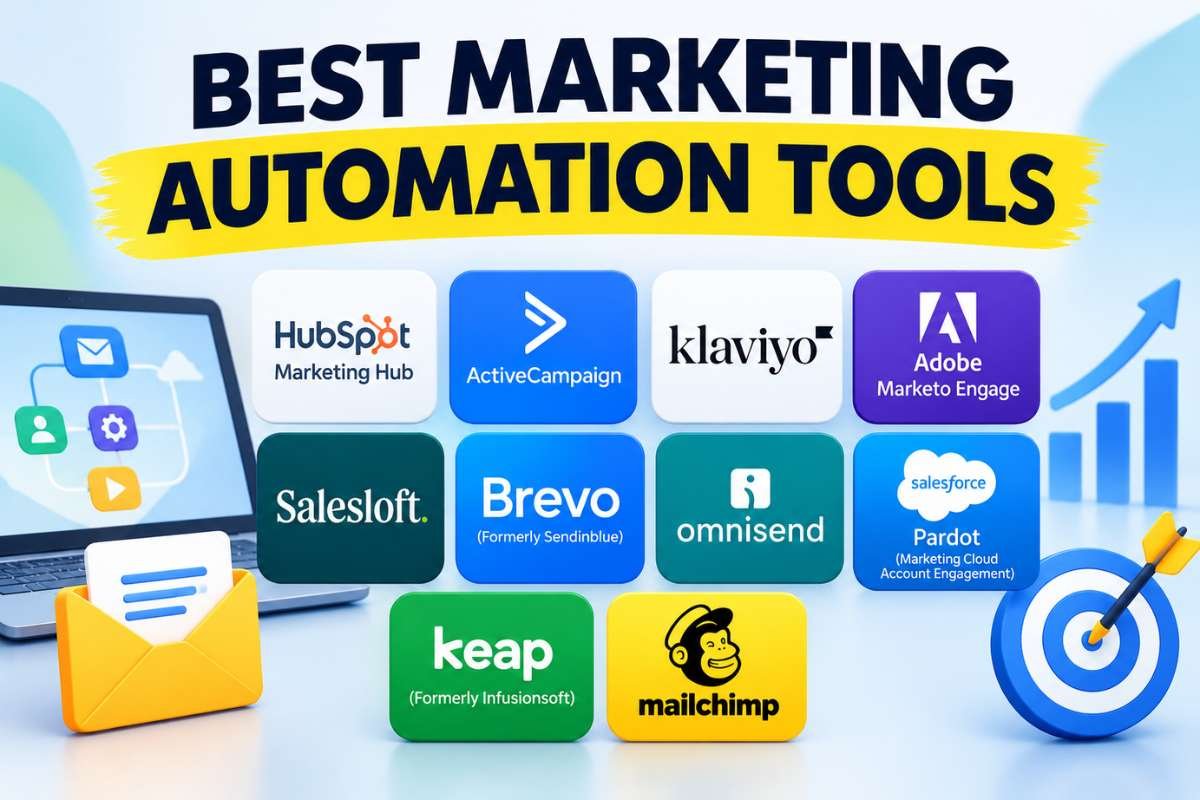
10 best marketing automation tools tested for features, ROI, and pricing
1. HubSpot Marketing Hub
HubSpot is the industry standard for all-in-one inbound marketing and CRM-native automation. It unifies lead generation, content management, email marketing, and deal pipeline management under a single database.
- Key Features: Multi-branch workflow builder, predictive lead scoring, native CRM sync, Smart Content personalization, dynamic reporting dashboards.
- Pricing: Free tier available; Professional plan starts at $800/month; Enterprise plan starts at $3,600/month (billed annually).
- Best For: Mid-market to enterprise B2B teams looking for a unified CRM and inbound marketing hub.
- Real-World Impact: Forrester’s Total Economic Impact study showed HubSpot users achieve an average ROI of $6.30 for every $1 spent.
2. ActiveCampaign
ActiveCampaign focuses on Customer Experience Automation (CXA), combining email marketing, visual automation, CRM pipelines, and multi-channel messaging.
- Key Features: Machine-learning win-probability scoring, Active Intelligence predictive automation, native WhatsApp messaging, site-tracking triggers, 900+ pre-built recipe templates.
- Pricing: Lite plan starts at $29/month; Plus starts at $49/month; Professional starts at $149/month (billed annually).
- Best For: Growing SMBs, SaaS companies, and digital creators needing deep split-testing and behavioral sequences.
- Real-World Impact: Audio manufacturer Morrow Audio recovered over 26% of lost sales by deploying ActiveCampaign’s automated abandoned cart and touchpoint flows. Furthermore, automated WhatsApp triggers helped software provider Contalink cut first-response times from 1 hour to 15 minutes.
3. Klaviyo
Klaviyo is built specifically for e-commerce brands, integrating directly with Shopify, WooCommerce, BigCommerce, and Magento to leverage transaction and real-time behavioral data.
- Key Features: Real-time predictive analytics (CLV and churn probability), dynamic back-in-stock and abandoned cart flows, native SMS/MMS, granular customer cohort segmentation.
- Pricing: Free up to 250 contacts; paid email plans start at $20/month for up to 500 contacts.
- Best For: Direct-to-Consumer (D2C) and high-growth e-commerce storefronts.
- Real-World Impact: Digital marketing agency Mapplinks scaled an e-commerce client’s revenue by over $34,000 within 30 days of implementing optimized Klaviyo split-tested email flows and automated campaigns, increasing email revenue contribution from 12% to 23% of total sales.
4. Adobe Marketo Engage
Adobe Marketo Engage is a high-powered enterprise B2B marketing automation platform designed for complex buyer journeys, multi-channel lead management, and Account-Based Marketing (ABM).
- Key Features: Advanced account-based experience (ABX) tools, multi-touch attribution, revenue modeling, deep Salesforce/Microsoft Dynamics CRM integrations.
- Pricing: Custom enterprise pricing based on database size (typically starting around $2,000+/month).
- Best For: Enterprise B2B organizations with long, multi-stakeholder sales cycles.
5. Salesloft
Salesloft focuses on sales engagement and revenue orchestration, helping revenue generation teams automate cadences across phone, email, and social channels.
- Key Features: Cadence automation, AI conversation intelligence, deal tracking, pipeline forecasting.
- Pricing: Custom tier-based quote pricing.
- Best For: B2B sales development representative (SDR) and account executive (AE) outreach alignment.
- Real-World Impact: Teams adopting Salesloft report up to a 30% reduction in sales cycle lengths by keeping touchpoints automated yet personalized.
6. Brevo (formerly Sendinblue)
Brevo offers an affordable, modular marketing suite combining email, SMS, WhatsApp, chat, and basic CRM capabilities into a pay-as-you-send model.
- Key Features: Transactional email API, WhatsApp campaign builder, live chat, visual pipeline management.
- Pricing: Free plan available (300 emails/day); Starter plan begins at $9/month; Business plan starts at $18/month.
- Best For: Budget-conscious SMBs, non-profits, and startups needing transactional and promotional email automation.
7. Omnisend
Omnisend is an e-commerce-focused automation platform tailored for merchants who want ready-to-use email and SMS automation templates without complex setup.
- Key Features: One-click e-commerce integration, pre-built cart recovery sequences, interactive email elements (scratch cards, gift boxes), SMS/web push integration.
- Pricing: Free plan for up to 250 contacts; Standard plan starts at $16/month; Pro plan starts at $59/month.
- Best For: Bootstrapped Shopify and WooCommerce stores seeking fast setup.
- Real-World Impact: Merchants migrating to Omnisend report an average 27% increase in revenue generated from automated campaigns compared to standard newsletter broadcasts.
8. Pardot (Salesforce Marketing Cloud Account Engagement)
Pardot is Salesforce’s B2B marketing automation engine, engineered to operate seamlessly within the native Salesforce CRM ecosystem.
- Key Features: Native Salesforce object mapping, Pardot Einstein AI lead scoring, dynamic landing pages, B2B marketing analytics (BMA).
- Pricing: Growth plan starts at $1,250/month; Plus plan starts at $2,750/month (billed annually).
- Best For: Companies heavily invested in the Salesforce CRM architecture.
- Real-World Impact: Enterprise teams using Pardot with Salesforce CRM achieve up to a 34% increase in sales pipeline velocity due to synchronized lead routing.
9. Keap (formerly Infusionsoft)
Keap combines CRM, email marketing, automated appointments, and invoicing into an all-in-one platform engineered for small service-based businesses.
- Key Features: Automated payment reminders, pipeline management, client onboarding automation, text message marketing.
- Pricing: Ultimate plan starts at $299/month for up to 1,500 contacts and 3 users.
- Best For: Small business owners, agencies, consultants, and service providers.
- Real-World Impact: Service providers using Keap report saving up to 10 hours a week on manual billing, client follow-ups, and scheduling.
10. Mailchimp
Mailchimp has evolved from an email tool into an integrated customer platform with intuitive automation builders, generative AI content suggestions, and basic CRM capabilities.
- Key Features: Customer Journey Builder, predictive demographic targeting, AI copy drafting, dynamic content blocks.
- Pricing: Free tier available; Essentials plan starts at $13/month; Standard starts at $20/month; Premium starts at $350/month.
- Best For: Beginners, small businesses, and content creators looking for an accessible interface.
- Real-World Impact: Small businesses using Mailchimp’s multi-step Customer Journey workflows achieve up to 127% higher click-through rates compared to single-email blasts.
Side-by-side comparison: features, pricing, and best use cases
| Tool | Core Strength | Free Tier | Starting Paid Price | Best Fit |
|---|---|---|---|---|
| HubSpot | CRM-native inbound automation & reporting | Yes | $800/mo (Professional) | Mid-Market & Enterprise B2B |
| ActiveCampaign | Complex behavioral messaging & CXA | Free Trial | $29/mo (Lite) | Growth SMBs & SaaS |
| Klaviyo | E-commerce data triggers & SMS | Yes | $20/mo | D2C / E-Commerce Brands |
| Marketo Engage | Enterprise ABM & multi-touch attribution | No | Custom (~$2,000+/mo) | Large Enterprise B2B |
| Salesloft | Sales cadence & SDR revenue orchestration | No | Custom Quote | Sales & Revenue Teams |
| Brevo | Budget transactional email & messaging | Yes | $9/mo | Cost-Conscious SMBs |
| Omnisend | Pre-built e-commerce email & SMS flows | Yes | $16/mo | Shopify/WooCommerce Merchants |
| Pardot | Native Salesforce B2B automation | No | $1,250/mo | Salesforce CRM Organizations |
| Keap | Service business CRM, billing & booking | Free Trial | $299/mo | Service Providers & Agencies |
| Mailchimp | User-friendly email journeys & basic CRM | Yes | $13/mo | Beginners & Creators |
How industry leaders deploy automation to avoid the 50% failure trap
Deploying marketing automation requires careful preparation to prevent data quality issues and low adoption. Research indicates that 42- 54% of marketing automation and AI initiatives face delays or failure due to bad data and integration issues.
Follow this phased implementation process to ensure immediate time-to-value:
- Clean and Standardize CRM Data First: Audit duplicate entries, unverified emails, missing lifecycle stages, and erratic formatting. Standardizing fields before platform migration prevents up to 80% of downstream segment and reporting failures.
- Map Real Lifecycle Stages: Align automation triggers to your buyer’s actual journey, from initial download to product demo and renewal, rather than relying on default vendor lifecycle stages.
- Roll Out High-Impact Workflows in Phases: Launch 3 to 5 fundamental core workflows first (e.g., Lead Welcome Series, Abandoned Cart/Trial Nurture, Post-Purchase Onboarding). A structured 6-to-12-week phased rollout consistently outperforms rushed deployments.
- Establish Baseline Lead Scoring: Implement rules combining firmographic fit (company size, role) and digital intent signals (pricing page visits, content downloads) to pass qualified leads directly to sales.
Conclusion
Choosing the best marketing automation tools depends directly on your business model, contact volume, tech stack complexity, and revenue targets. High-growth B2B teams often find their highest ROI in platforms like HubSpot or ActiveCampaign, while e-commerce storefronts thrive on data-dense platforms like Klaviyo.
Prioritize clean data hygiene, clear lifecycle stage definition, and cross-channel message consistency over complex workflow trees. By matching your operational needs to the right platform, you turn manual outreach into a continuous engine for customer acquisition and retention.
FAQs on best marketing automation tools
1. What is the best marketing automation tool for small businesses?
ActiveCampaign and Brevo offer the best mix of flexible automation, affordable pricing, and fast setup for small teams.
2. How do marketing automation tools improve ROI?
They automatically convert leads, cut manual data entry, recover abandoned carts, and send timely follow-ups.
3. What is the difference between email marketing and marketing automation?
Email marketing sends manual broadcasts to lists, while marketing automation triggers personalized messages based on user behavior.
4. Do I need a separate CRM if I use a marketing automation tool?
Not always; all-in-one tools like HubSpot include native CRMs, while tools like Pardot pair with external systems like Salesforce.
5. How long does it take to implement marketing automation software?
Simple setups take 1 to 2 weeks, while full enterprise CRM deployments take 6 to 12 weeks.