Technology investments do not always translate into business growth. Despite adopting AI, cloud computing, and automation, businesses may face disconnected systems, low employee adoption, and rising costs. A clear digital transformation roadmap helps address these challenges by aligning technology with business priorities.
Boston Consulting Group estimates that 70% of digital transformations fail to achieve their objectives. A structured roadmap defines what needs to change, when to implement it, who is responsible, and how success will be measured, turning modernization efforts into measurable business outcomes.
What is a digital transformation roadmap and why does it matter?
A digital growth framework is a strategic plan that outlines how an organization will use technology to improve its operations, customer experiences, decision-making, and business models.
It goes beyond purchasing software or replacing legacy infrastructure. It connects technology investments with specific business objectives and defines how different departments will adapt to new ways of working.
Understanding the three stages of digital maturity is essential before developing a roadmap for digital transformation.
| Stage | What It Involves | Business Example |
|---|---|---|
| Digitization | Converting physical information into digital formats | Scanning paper invoices into digital records |
| Digitalization | Using technology to improve existing processes | Automating invoice approvals through an ERP system |
| Digital transformation | Redesigning business operations and value creation | Introducing predictive supply chain management |
Without a structured roadmap for digital transformation, departments may invest in separate platforms that cannot communicate with one another. This creates data silos, duplicated work, higher costs, and inconsistent customer experiences.
The four phases of a digital transformation roadmap
Enterprise transformation is generally a gradual process. Depending on organizational size, infrastructure, and complexity, a comprehensive digital growth framework may take 18 to 36 months.
| Phase | Timeline | Primary Focus | Key Deliverables |
|---|---|---|---|
| Discovery and Readiness | Months 1–3 | Assess current capabilities | Technology audit, maturity assessment, baseline KPIs |
| Foundation and Quick Wins | Months 3–6 | Strengthen infrastructure | Cloud migration, system integration, pilot projects |
| Process and Customer Experience Scaling | Months 6–18 | Improve business operations | ERP integration, CRM modernization, employee training |
| Optimization and Innovation | Month 18 onward | Enable continuous improvement | Predictive analytics, AI adoption, legacy system retirement |
Each phase of the digital transformation roadmap should have clear milestones and approval checkpoints. Organizations should move forward only after validating the outcomes of the previous stage.
How inclusive leadership strengthens digital transformation

Technology adoption is also a workforce transformation challenge. Employees need the right training, leadership support, and opportunities to participate in decisions about changing workflows.
Women remain underrepresented in the technology workforce. According to the World Economic Forum’s Global Gender Gap Report 2025, women’s representation in technology-related roles remains a significant area for improvement. For organizations, this creates an opportunity to make digital transformation more inclusive.
A diverse leadership team can bring different perspectives to technology procurement, product development, customer experience, and AI governance. For example, involving women in AI oversight and product testing can help teams identify potential blind spots in datasets and automated decision-making. A people-focused roadmap for digital transformation should therefore include:
- Inclusive leadership: Ensure women and underrepresented employees have opportunities to participate in transformation steering committees.
- Equitable upskilling: Provide accessible training in AI, data analytics, cybersecurity, and digital operations.
- Transparent advancement: Connect digital training with leadership development and internal career opportunities.
- Employee participation: Involve frontline teams when redesigning processes and introducing new platforms.
Transformation becomes more sustainable when employees are treated as participants rather than recipients of technological change.
6 steps to build an effective digital transformation roadmap
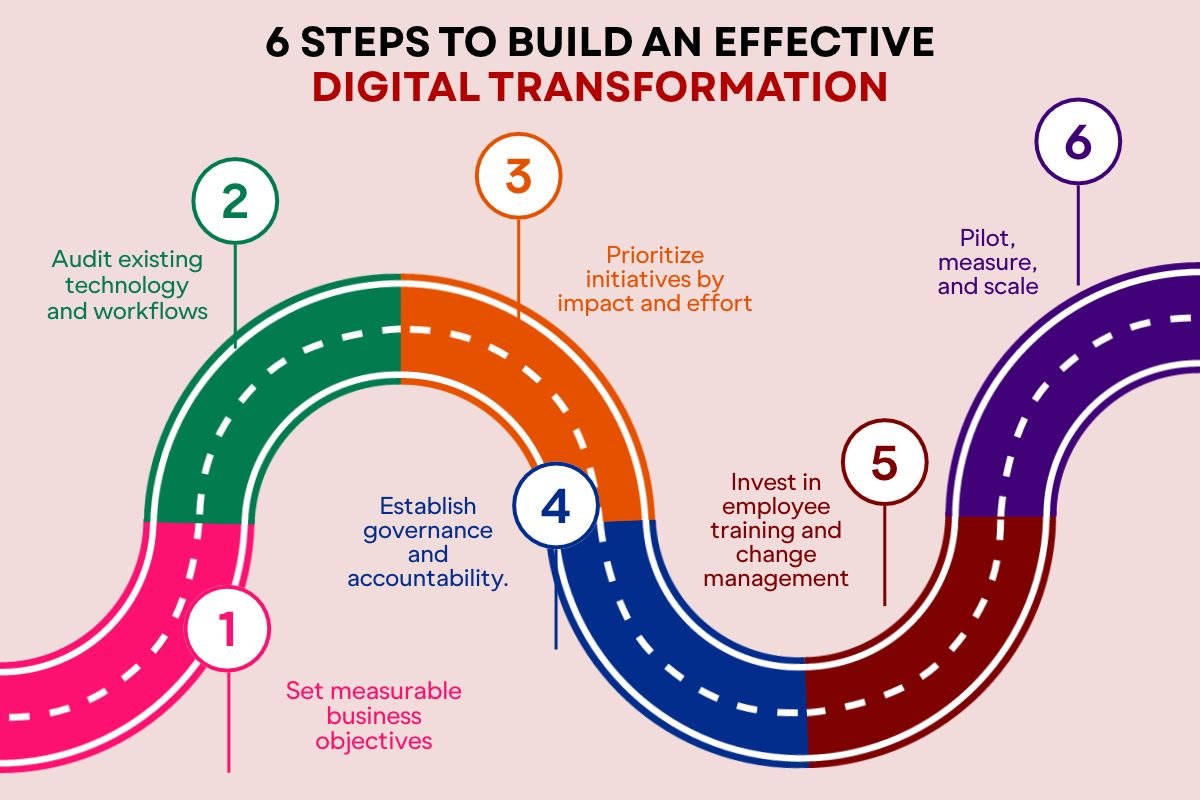
A successful digital growth framework needs more than a timeline. It requires clear priorities, accountable teams, realistic budgets, and measurable targets.
1. Set measurable business objectives.
Begin by identifying three to five outcomes the organization wants to achieve. Avoid technology-focused goals such as implementing AI. Instead, establish business targets such as reducing order-processing time by 40%, improving customer retention, or increasing digital sales.
2. Audit existing technology and workflows
Assess current ERP, CRM, cloud infrastructure, cybersecurity systems, and data management practices. Identify outdated applications, duplicated information, manual processes, and integration gaps. This assessment helps determine where technology investments can deliver the greatest value.
3. Prioritize initiatives by impact and effort.
Use an impact-versus-effort matrix to rank proposed projects. Start with initiatives that offer high business value and require relatively little implementation effort. More complex projects, such as enterprise-wide AI integration, can be divided into smaller implementation stages.
4. Establish governance and accountability.
Assign business owners to individual initiatives and define responsibilities across IT, finance, HR, operations, and customer experience teams. Establish cybersecurity requirements, data privacy policies, access controls, and procurement standards before introducing new platforms.
5. Invest in employee training and change management.
Technology adoption depends on whether employees can use new systems effectively. Include role-based training, internal digital champions, leadership communication, and employee feedback mechanisms in the digital transformation roadmap. Allocate a dedicated portion of the transformation budget to workforce development.
6. Pilot, measure, and scale
Test new platforms within a department or business unit before introducing them across the organization. Run pilots for 60–90 days, assess adoption and performance, address implementation gaps, and scale successful initiatives. Review the digital growth framework quarterly to accommodate changing business priorities.
Digital transformation KPIs to measure business performance
A digital transformation roadmap needs measurable indicators to establish whether technology investments are delivering meaningful results.
Rather than tracking the number of tools deployed, leadership teams should measure improvements in productivity, customer experience, employee adoption, and financial performance.
| KPI Category | Metrics to Track | What They Measure |
|---|---|---|
| Operational Efficiency | Process cycle time, automation rate, manual hours saved | Productivity improvements |
| Customer Experience | Net Promoter Score (NPS), customer effort score, digital adoption | Customer satisfaction and engagement |
| Workforce Adoption | Active user rate, training completion, time to proficiency | Employee readiness and usage |
| Financial Performance | Return on investment (ROI), cost per transaction, payback period | Financial value of technology investments |
Organizations should establish baseline figures before implementation and set targets according to their industry, business size, and operational requirements. For instance, a company might aim to reduce invoice processing from six days to four hours rather than adopting an arbitrary industry-wide benchmark.
Digital transformation roadmap template for businesses
The following digital growth framework template can help leadership teams assign responsibilities, organize initiatives, and track progress across implementation stages.
| Phase | Initiative | Business Objective | Accountable Team | KPI |
|---|---|---|---|---|
| Q1 | Technology and data audit | Identify system gaps | CTO and Data Team | 100% core systems mapped |
| Q2 | Automated invoice processing | Reduce manual work | Finance Team | Processing time reduced |
| Q2 | CRM integration | Improve customer visibility | Sales and IT | Faster lead response |
| Q3 | Digital self-service portal | Improve customer experience | Customer Experience Team | Increased digital orders |
| Q4 | Employee digital training | Improve technology adoption | HR and IT | Training completion rate |
| Year 2 | AI-powered demand forecasting | Improve inventory planning | Operations Team | Fewer stockouts |
Note: This is an illustrative template. Organizations should customize timelines, budgets, ownership, and KPI targets according to their requirements.
4 common mistakes that can derail digital transformation

Even a well-planned roadmap for digital transformation can encounter challenges when organizations overlook implementation fundamentals.
- Automating inefficient processes: Introducing automation without redesigning existing workflows can increase errors instead of improving productivity.
- Ignoring data quality: Migrating incomplete, duplicated, or inconsistent data can undermine analytics and AI initiatives.
- Underinvesting in employees: Insufficient training often leads to low adoption and underutilized technology investments.
- Treating the roadmap as a fixed document: Business priorities, technology capabilities, and customer expectations change. The plan must evolve accordingly.
Conclusion:
A successful digital transformation roadmap aligns technology, business strategy, and employee capabilities to deliver measurable value. With women holding fewer than one in five CIO positions and fewer than one in ten CTO positions, as highlighted by the World Economic Forum’s 2026 research, inclusive technology leadership also matters. For businesses, assessing existing systems, prioritizing improvements, assigning ownership, and tracking KPIs can turn digital modernization into sustainable growth.
Frequently Asked Questions:
1. What are the four phases of a digital transformation roadmap?
The four phases are discovery and readiness, foundation and quick wins, process and customer experience scaling, and optimization and innovation.
2. How long does a digital transformation roadmap take to implement?
Implementation typically takes 18 to 36 months, depending on business size, technology infrastructure, and organizational readiness.
3. How do businesses measure digital transformation success?
Businesses track KPIs such as operational efficiency, employee adoption, customer satisfaction, automation rates, and return on investment (ROI).