Your business collects customer transactions, website clicks, product images, and sales records, yet only a fraction of that data ever drives a decision. IDC estimates 92.9% of data generated worldwide in 2023 was unstructured, so a storage-only approach leaves most of it untapped. What you need is an architecture that organizes, processes, and makes information useful. That is why the data warehouse vs data lake decision matters.
This guide explains how each handles structured and unstructured data, how they compare on query speed, cost, and flexibility, and when a hybrid approach works best. By the end, you’ll know which architecture fits your analytics goals, budget, and growth plans.
Table of Contents
Data warehouse vs data lake: key differences?
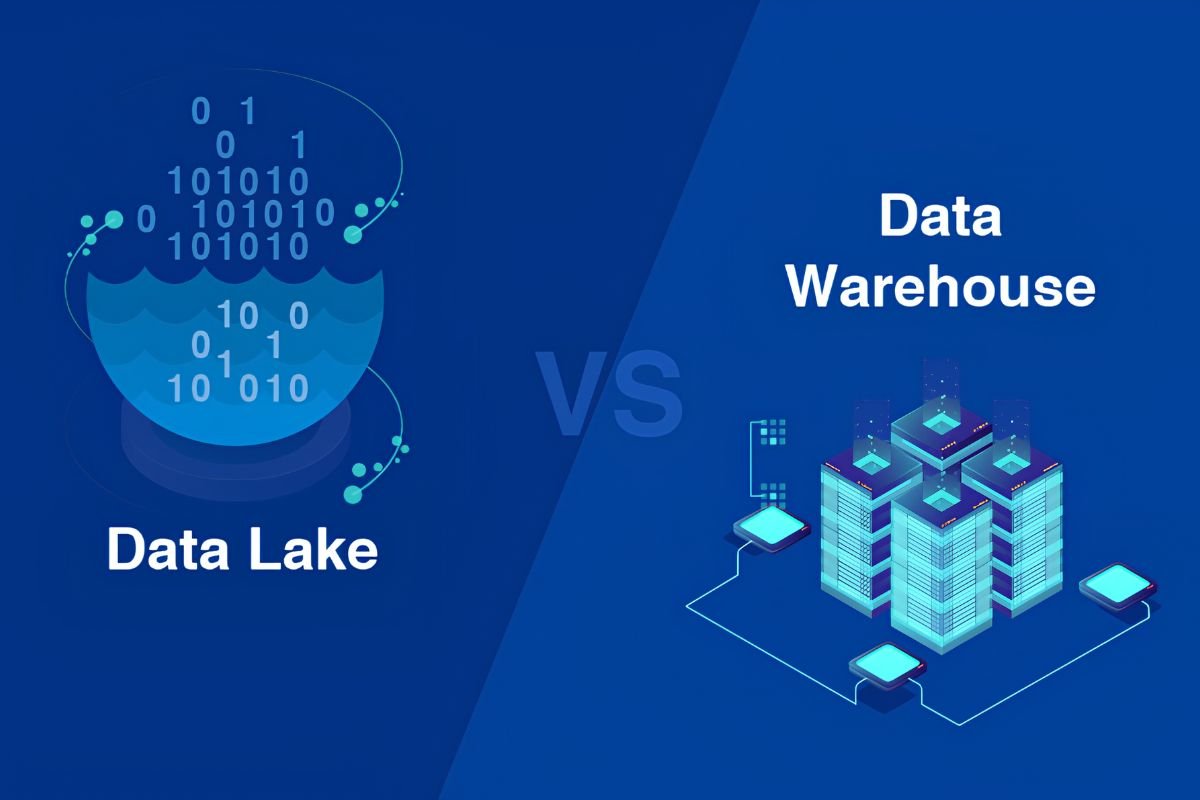
A data warehouse is designed for structured, processed data and fast business reporting. A data lake stores raw data in multiple formats for flexible processing, analytics, and machine learning. AWS describes a data warehouse as optimized for fast analytics and BI tools. A data lake is a centralized repository for structured, semi-structured, and unstructured data.
What is a data warehouse?
A data warehouse is a centralized repository for structured, processed data. It uses schema-on-write, so data is defined and transformed before loading, typically through ETL (extract, transform, load) pipelines. It powers SQL queries, BI dashboards, and historical reporting, and because data is standardized before storage, teams share consistent definitions, metrics, and reports.
What is a data lake?
A data lake stores raw data in its original format, including structured, semi-structured, and unstructured data like logs, images, text, and sensor data. It uses schema-on-read, applying structure only when data is queried. Lakes typically follow ELT workflows, loading data first and transforming it later, which makes them well suited to data exploration, advanced analytics, and machine learning.
| Comparison factor | Data Warehouse | Data Lake |
|---|---|---|
| Data format | Primarily structured | All data formats |
| Data processing | Processed before storage | Often stored before transformation |
| Schema | Schema-on-write | Schema-on-read |
| Processing approach | Typically ETL | Typically ELT |
| Primary users | Analysts and business teams | Data engineers and scientists |
| Best suited for | BI and reporting | Data science and AI workloads |
| Storage cost | Often higher | Often lower |
| Query performance | Optimized for defined analytical queries | Depends on tools, format, and optimization |
| Data governance | Defined schemas and access controls | Needs metadata, access, and ownership policies |
| Data quality | Cleaned before loading | Raw; validate before use |
| Scalability | Scales with analytical workloads | Scales to large, diverse data |
| Typical workloads | SQL, reporting, BI dashboards | Exploration, log analysis, machine learning |
When comparing data warehouse vs data lake, lower storage costs do not automatically mean lower total ownership costs. Data lakes may require more investment in processing, governance, and technical expertise.
When should businesses choose a data lake or data warehouse?

Businesses should choose based on workload, data maturity, technical expertise, and governance requirements, not simply company size. In the data warehouse vs data lake decision, a warehouse suits consistent reporting, while a lake suits flexible, large-scale analysis. AWS notes that many organizations need both because they serve different use cases.
Choose a data warehouse when:
Your main need is financial reporting, sales analysis, or business intelligence. It suits mostly structured data from established business applications, where teams need consistent metrics and reliable dashboards. For example, a retail company can consolidate sales, inventory, and revenue data into monthly performance reports.
Choose a data lake when:
You collect large volumes of diverse data and need to keep it raw for future analysis, especially for machine learning, IoT, or predictive analytics. It requires technical resources to manage governance and processing. For example, a manufacturer can combine sensor readings, machine logs, and equipment images to support predictive maintenance.
Example: how an e-commerce business can use both architectures
An e-commerce company collects customer clicks, product images, browsing activity, and transaction records. It can store this diverse, raw information in a data lake for future analysis. Data engineers can then clean and transform relevant datasets, validate transaction records, and transfer curated information into a data warehouse. Business teams can use the warehouse to generate sales dashboards, track customer purchasing patterns, and monitor product performance. This approach allows the company to retain diverse raw data while maintaining reliable datasets for business reporting.
Can businesses use both through a data lakehouse?

Yes. Businesses can use a data lake and data warehouse together. It can also adopt a data lakehouse architecture to bring several capabilities into one environment. A lakehouse combines the flexible raw-data storage of a lake with the management and analytical capabilities commonly associated with a warehouse. It is not simply another name for a data lake.
Data typically follows this workflow: data sources → data lake → data processing and transformation → business intelligence and machine learning. The lake preserves diverse raw information, while processed datasets support consistent reporting in warehouse-style analytics.
In the data warehouse vs data lake discussion, a lakehouse is worth considering when teams need BI and AI workloads without maintaining separate storage environments. Open table formats such as Apache Iceberg, transaction support, schema enforcement, and centralized governance make lake-based analytics more reliable.
Implementation still requires appropriate governance, workload optimization, and platform capabilities.
Common mistakes to avoid when choosing a data architecture
When deciding between data warehouse vs data lake, avoid choosing based only on immediate needs. The right architecture should support present workloads while remaining adaptable to future requirements.
- Choosing based on storage costs alone: Storage is only one expense; compute, maintenance, transformation, and staffing costs also matter.
- Ignoring data governance: Without quality checks, ownership, access controls, and classification, data lakes can become unmanaged “data swamps.”
- Overlooking future workloads: Do not select an architecture based only on current reporting needs; consider AI, machine learning, and growing data volumes.
A practical architecture balances current reporting needs with flexible storage, governance, and room for advanced analytics.
Conclusion:
The data warehouse vs data lake decision comes down to how you plan to use your data. A warehouse delivers fast, reliable reporting from structured data. A lake offers flexibility for raw, diverse information and advanced analytics like machine learning. Many businesses find that a lakehouse, or a mix of both, balances current reporting needs with future growth.
Whichever route you choose, look beyond storage costs. Governance, processing, and technical expertise shape the real value you get. Start by listing your key workloads, data types, and team skills, then match them to the architecture that supports both today’s reporting and tomorrow’s analytics goals.
FAQ:
1. Is data warehouse vs data lake an either-or choice?
No. A company can use a data lake for raw and diverse datasets and a warehouse for processed information used in reporting and business intelligence.
2. Which is cheaper, a data lake or a data warehouse?
Data lakes often have lower storage costs, but total expenses depend on processing, compute, governance, maintenance, and staffing requirements.
3. Can a data lakehouse replace a data warehouse?
In some environments, yes. A lakehouse can support BI and analytical workloads.