Customer Acquisition Cost (CAC) measures how much a business spends to gain a new customer and reveals whether its growth is efficient or unsustainable. This article explains how to calculate CAC accurately. It also outlines practical ways to reduce CAC by improving conversions, optimizing channels, refining targeting, and strengthening organic growth, while highlighting current trends
Let’s be honest for a second. Getting customers is exciting. Watching signups go up, traffic spike, and sales come in feels like progress. But somewhere behind all that momentum, there’s a quieter question that matters just as much. What did it actually cost you to get those customers in the first place?
That’s where Customer Acquisition Cost (CAC) starts to shift from being just another metric to something you can’t ignore. It forces you to look past the surface-level wins and examine how efficient your growth really is. Are you building something sustainable, or are you spending more than you should just to keep the numbers moving?
Understanding CAC is about reading the story behind your marketing efforts, your channels, and your decisions. Once you see it clearly, it becomes much easier to spot what is working. In this article, we will cover everything you need to know about CAC.
How to calculate customer acquisition cost?
CAC is simple to calculate. You divide your total spending on sales and marketing by the number of customers you gained in that period.
The formula looks like this:
Customer Acquisition Cost = Total Sales and Marketing Spend ÷ Number of New Customers
Your total spend includes everything tied to acquiring customers. This covers ad spend, salaries of marketing and sales teams, software tools, agency fees, and campaign costs. If money goes into getting customers, include it.
For example, if you spend 10,000 and gain 100 customers, your CAC is 100. The math is simple, but the accuracy depends on what you include.
Time frame matters here. You should calculate this over a fixed period like a month or a quarter. Mixing timelines gives you a distorted number. You also need to separate acquisition from retention. Do not include costs spent on existing customers. That will inflate your numbers and hide real performance.
Many businesses go deeper. They calculate Customer Acquisition Cost by channel. This means you track how much each channel costs and how many customers it brings. Paid ads, organic search, referrals, and email will all show different results.
This level of detail helps you see what works. You can then stop guessing and start making clear decisions.
What factors influence customer acquisition cost?

Several factors influence your CAC, and each one changes how much you spend to gain a new customer. These factors do not work in isolation. They connect and influence each other, which makes it important to understand them as a system. They are as follows:
1. Marketing channels:
Different channels drive very different costs. Paid ads often get quick traffic, but they become expensive as competition rises. Organic channels like search and content take time to build, but they reduce cost over time. If you rely too much on paid channels, your Customer Acquisition Cost will stay high. A balanced mix helps control spending while keeping growth steady.
2. Target audience:
Who you target affects both cost and conversion. A broad audience is cheaper to reach, but many users may not convert. A niche audience costs more per click, but they often show stronger intent. If your targeting is unclear, you waste money on the wrong users. Clear targeting improves conversion and reduces cost.
3. Product pricing:
Your pricing decides how much cost you can afford. High-priced products allow a higher Customer Acquisition Cost because each sale brings more revenue. Low-priced products need strict control over spending. If your acquisition cost gets close to your product price, your margins shrink fast.
4. Conversion rate:
Conversion rate directly impacts your cost. When more visitors become customers, your cost drops. When fewer people convert, your cost rises quickly. Small changes in landing pages, messaging, or user flow can improve conversions and reduce CAC.
5. Sales cycle length:
A longer sales cycle increases cost. You need more follow-ups, more content, and more time to close a deal. Each step adds to your spending. A shorter cycle reduces effort and helps you acquire customers faster, which keeps costs lower.
6. Brand strength:
A strong brand builds trust before the first interaction. People are more likely to convert when they recognize your name. This reduces the effort needed to acquire them. A weak brand needs more spending to build that trust, which increases CAC.
7. Competition level:
Competition affects how much you pay across channels. When many brands target the same audience, ad costs rise. This pushes your Customer Acquisition Cost higher. In less crowded markets, you can acquire customers at a lower cost.
8. Team efficiency:
The way your team works has a direct impact. Skilled teams test faster, optimize better, and reduce waste. Poor execution leads to higher spending without better results. The same budget can perform very differently based on how well it is managed.
Each of these factors connects with the others. When you improve them together, your Customer Acquisition Cost becomes easier to control.
How to reduce customer acquisition cost?
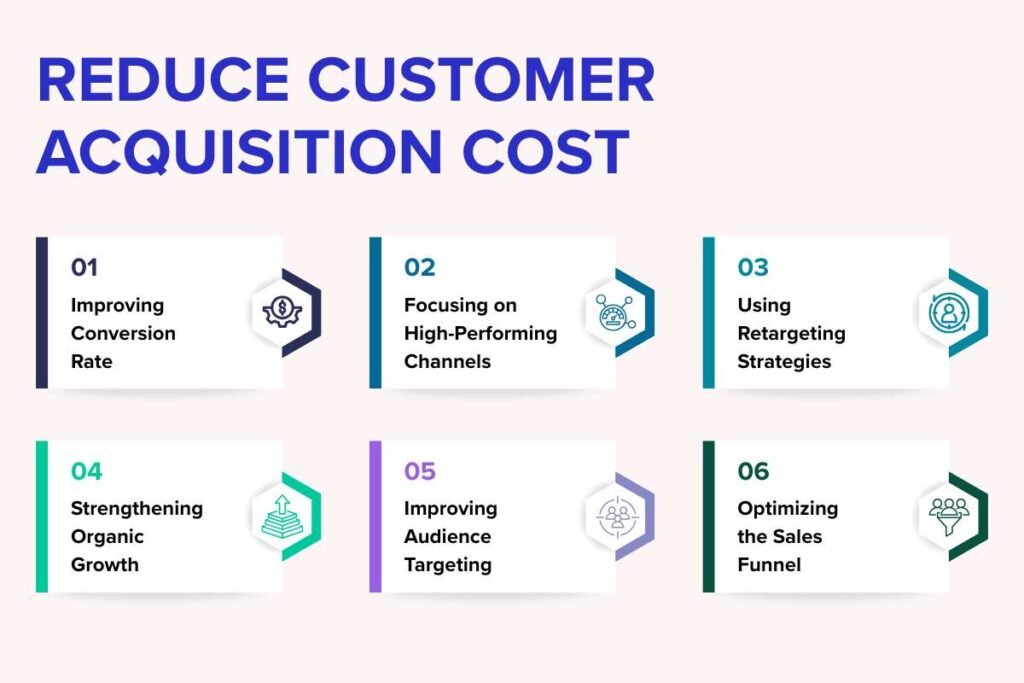
CAC can rise fast if left unchecked. Many factors push it up, from channel choice to weak conversions. The good part is that you can control most of these factors with the right actions. Instead of cutting spend blindly, focus on improving how each dollar works.
When you fix inefficiencies and strengthen your process, you reduce CAC without slowing growth.
1. Improving conversion rate:
Start with the point where users take action. If more visitors convert, your cost drops without increasing spend. Improve your landing pages, simplify forms, and sharpen your messaging. Clear value and smooth user flow help users decide faster, which reduces Customer Acquisition Cost.
2. Focusing on high-performing channels:
Not all channels give the same results. Some bring cheaper and better customers. Track performance by channel and double down on what works. Cut or reduce spend on channels that drain budget without strong returns. This shift alone can lower your overall cost.
3. Using retargeting strategies:
Many users do not convert on the first visit. Retargeting brings them back at a lower cost than acquiring new users. Show relevant ads, reminders, or offers to people who already engaged with your brand. This improves conversion and reduces the need for fresh spending.
4. Strengthening organic growth:
Organic channels like search, content, and referrals reduce long-term cost. They take time, but they keep bringing users without constant spending. A strong content base or SEO presence lowers your dependency on paid channels.
5. Improving audience targeting:
Better targeting reduces waste. Focus on users who are more likely to convert instead of reaching everyone. Use data to refine your audience segments. When you reach the right people, you spend less to acquire each customer.
6. Optimizing the sales funnel:
Look at every step in your funnel. Find where users drop off and fix those points. A smoother funnel moves users faster from interest to purchase. This reduces the effort and cost needed to acquire each customer.
Reducing CAC comes from small improvements across multiple areas. When you fix leaks and focus on what works, your cost becomes easier to manage.
Why is customer acquisition cost important today?

CAC does not stay fixed. It shifts as markets change, channels evolve, and competition grows. To understand where CAC is heading, you need to look at the current patterns shaping how companies acquire customers.
CAC keeps rising, and recent benchmark data makes this clear. A 2026 dataset based on 939 B2B companies shows that the average CAC is around $300. The same data shows sharp differences across channels. Paid ads average about $350 per customer, outbound sales reach close to $400, and events can go as high as $500. This gap highlights a key trend. Channel mix now has a direct impact on how fast your costs grow.
Another clear trend is the shift toward efficiency over scale. Companies no longer try to be everywhere. They test channels, measure results, and cut what does not work. High-cost channels now face tighter control, while lower-cost channels get more focus. At the same time, teams look beyond the first purchase. They connect acquisition with long-term value, which helps balance rising costs and maintain steady growth.
Conclusion:
At some point, every growth effort circles back to the same question. Is this actually worth what we are spending? Customer acquisition cost helps answer that without the noise.
It does not tell you to stop investing or to scale faster. It simply shows you the tradeoffs behind each decision. When the number starts to drift too high, it signals friction somewhere in your strategy. When it stays balanced, it reflects a system that is working with intention rather than guesswork.
Looking at CAC this way shifts the focus from chasing more customers to building a process that brings them in efficiently and consistently. That is where real, steady growth starts to take shape.
People also ask
1. What is customer acquisition cost?
It is the total amount a business spends to acquire a new customer, including marketing, sales, and related expenses.
2. How do you calculate CAC?
It is calculated by dividing total acquisition costs by the number of new customers gained in a specific period.
3. What is considered a good CAC?
It depends on the industry and business model, but it is generally evaluated in relation to the revenue or lifetime value a customer brings.