Generative AI for business uses AI tools to create content, generate code, summarize information, answer questions, and automate everyday tasks. Businesses use it to save time, improve productivity, and simplify operations. According to Stanford’s 2026 AI Index Report, 88% of surveyed organizations used AI in 2025, while 70% used generative AI in at least one business function.
Generative AI is helping teams across marketing, finance, HR, and customer support work faster and handle repetitive tasks more efficiently. This article covers its business uses, benefits, costs, challenges, and implementation.
What does generative AI mean for business?
Generative AI for business is a technology that creates new content, ideas, text, images, and code based on user instructions. It uses AI models to understand requests and generate useful responses.
Businesses use generative AI to:
- Write emails, reports, and content.
- Answer customer questions.
- Summarize documents and meetings.
- Generate code and ideas.
- Analyze information and support decisions.
Unlike traditional automation, generative AI can respond to different instructions and create new outputs instead of following only fixed rules.
How generative AI is changing the way businesses work
Generative AI is helping businesses manage everyday work more efficiently.
- Faster work: Helps employees complete writing, research, and documentation tasks.
- Better customer service: Supports faster and more personalized responses.
- Easy access to information: Helps employees find answers from documents and internal resources.
- Content creation: Generates content, ideas, images, and presentations.
- Improved productivity: Reduces repetitive work and supports employees.
According to Stanford’s 2026 AI Index Report, global corporate AI investment reached $581.69 billion in 2025. This reflects growing business interest in AI technology.
7 powerful ways generative AI is transforming business operations
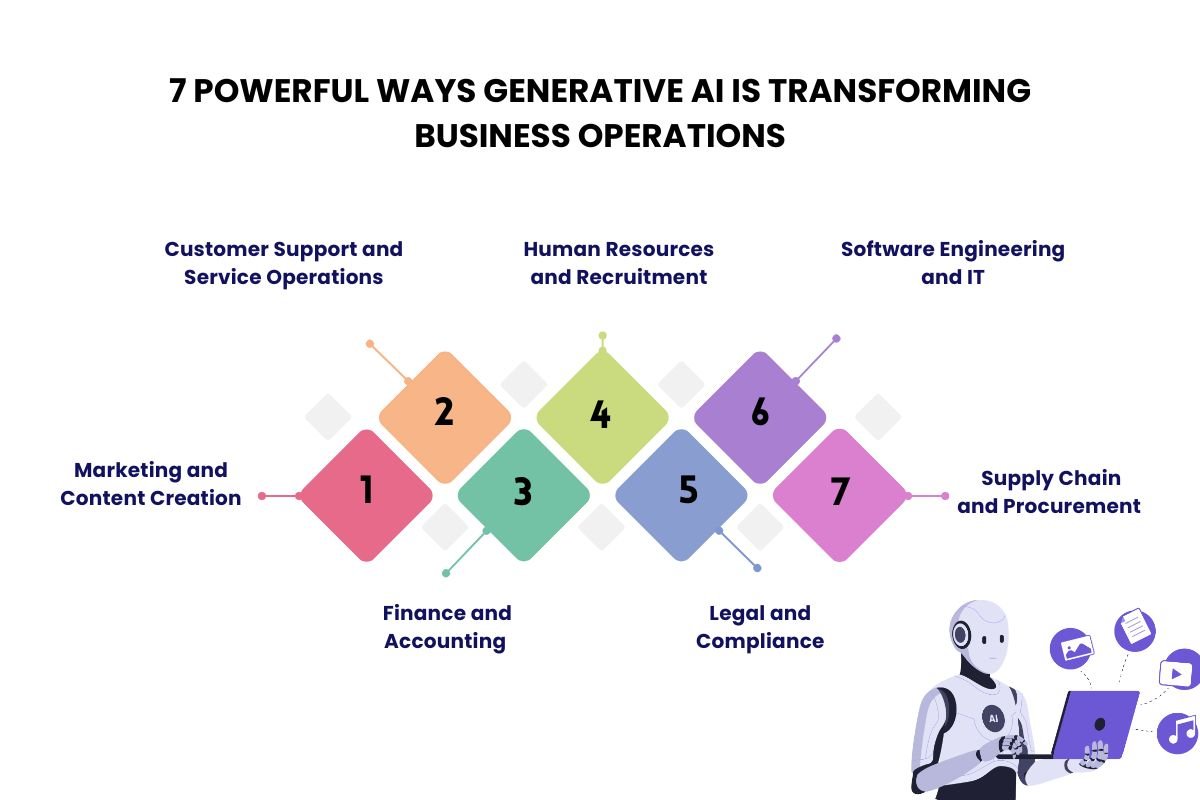
Generative AI can support different departments depending on their goals, processes, and data requirements. The greatest value often comes from applying AI to repetitive, time-consuming tasks while keeping employees involved in important decisions.
1. Marketing and content creation
Marketing teams can use generative AI to create content faster, develop campaign ideas, and personalize customer communication. It can help produce first drafts without replacing the research, strategy, and creative judgment required for quality marketing.
Business applications include:
- Writing blogs, emails, and social media posts.
- Creating product descriptions and ad copy.
- Generating campaign ideas.
- Summarizing customer feedback.
Business impact: AI helps marketing teams save time on content creation and focus more on strategy and creativity.
2. Customer support and service operations
Generative AI can improve customer support by helping service teams respond to questions, access information, and manage repetitive inquiries. AI-powered chat assistants can provide answers using approved product documentation and support resources.
Business applications include:
- Answering frequently asked questions.
- Summarizing customer conversations.
- Drafting customer responses.
- Helping customers solve common problems.
Business impact: AI helps reduce repetitive support work and improve response times.
According to Stanford’s 2025 AI Index, 49% of surveyed organizations reporting AI-related cost savings in service operations indicated savings in that function. Although savings vary, AI-assisted support can reduce repetitive workloads and help teams manage service requests more efficiently.
3. Finance and accounting
Finance teams handle invoices, financial reports, expense documentation, forecasts, and compliance-related paperwork. Generative AI for business can assist with information extraction, summaries, report preparation, and financial documentation.
Business applications include:
- Summarizing financial reports.
- Extracting information from invoices.
- Drafting budget reports.
- Supporting financial analysis.
Business impact: AI can reduce manual documentation and help finance teams manage information faster.
4. Human resources and recruitment
HR teams can use generative AI to simplify recruitment, employee communication, training, and documentation. AI assistants can also help employees access company policies without repeatedly contacting HR.
Business applications include:
- Creating job descriptions.
- Drafting interview questions.
- Preparing onboarding documents.
- Answering common employee questions.
Business impact: HR teams can streamline administrative tasks and spend more time on employee engagement, recruitment strategy, and workplace development.
AI should not independently make hiring, promotion, disciplinary, or termination decisions. Human review is important to reduce bias and protect employee rights.
5. Legal and compliance
Legal teams often work with lengthy contracts, regulations, agreements, and documentation. Generative AI can help organize and summarize information, making legal research and document review more efficient.
Business applications include:
- Summarizing contracts.
- Drafting standard documents.
- Identifying clauses for review.
- Organizing legal research.
Business impact: AI can speed up document review, but legal professionals must verify its outputs.
6. Software engineering and IT
Software development is one of the areas where generative AI can directly support technical workflows. AI coding assistants can help developers write code, understand existing systems, troubleshoot errors, and prepare technical documentation.
Business applications include:
- Generating code suggestions.
- Finding and fixing coding errors.
- Creating test cases.
- Explaining existing code.
- Preparing technical documentation.
According to Stanford’s 2025 AI Index, 41% of surveyed organizations reporting AI-related cost savings in software engineering indicated savings in this function.
Business impact: AI can reduce repetitive coding work and help developers complete tasks faster.
7. Supply chain and procurement
Supply chains involve purchasing, inventory management, logistics, supplier communication, and demand planning. Generative AI for business can help teams interpret operational data and simplify communication between suppliers, employees, and business systems.
Business applications include:
- Summarizing supplier documents.
- Drafting purchase-related emails.
- Supporting inventory analysis.
- Summarizing shipment reports.
- Helping with demand planning.
Business impact: AI helps teams manage information, reduce paperwork, and support planning.
Key benefits of generative AI for businesses that everyone should know
Generative AI offers several benefits to businesses when used correctly.
- Better productivity: Generative AI helps employees complete tasks faster by drafting emails, summarizing reports, preparing documents, and supporting routine work.
- Reduced workload: AI handles repetitive tasks such as documentation, data summaries, basic queries, and content drafts, giving employees more time for important responsibilities.
- Improved customer experience: AI-powered chatbots and assistants provide quick responses, personalized recommendations, and round-the-clock support to improve customer interactions.
- Better decision support: Generative AI summarizes large amounts of information, highlights patterns, and helps teams organize insights to support business decisions.
- More creativity: AI supports brainstorming, content creation, campaign ideas, product concepts, and design suggestions, helping teams develop ideas more quickly.
- Scalable operations: Businesses can use AI to handle growing workloads, support more customer queries, and streamline processes without increasing manual effort for every task.
Top generative AI tools every business can use
Businesses can choose AI tools based on their needs, budgets, and existing software.
| AI Tool | Business Use |
|---|---|
| ChatGPT | Writing, Research, Analysis, and Coding |
| Microsoft Copilot | Emails, Documents, Meetings, and Productivity |
| Google Gemini | Writing, Research, and Analysis |
| Claude | Writing, Document Analysis, and Coding |
| GitHub Copilot | Coding and Software Development |
| Adobe Firefly | Image Generation and Creative Design |
How much does generative AI cost for business?

Generative AI costs depend on the tool, number of users, integrations, and business requirements.
| Implementation | Cost Structure | Best For |
|---|---|---|
| Basic AI tools | Monthly or annual subscription | Small businesses |
| Team AI plans | Per-user subscription | Growing teams |
| AI API integration | Usage-based pricing | Applications and workflows |
| Custom AI solutions | Development and maintenance costs | Large enterprises |
| AI automation | Software, integration, and usage costs | Businesses automating tasks |
Businesses may also spend on employee training, data preparation, security, integration, and maintenance. The total cost should be considered before implementation.
Can businesses trust generative AI with enterprise data?
Generative AI can be used safely when businesses choose approved tools and follow proper security policies.
Businesses should:
- Use AI tools with suitable data protection policies.
- Avoid sharing confidential information with unapproved tools.
- Restrict access to sensitive data.
- Check AI-generated information before using it.
- Train employees on responsible AI use.
NIST’s Generative AI Risk Management Profile provides guidance on identifying and managing AI-related risks.
7 simple steps to implement generative AI in business

Businesses can follow these simple steps to introduce AI into their operations.
- Step 1: Identify a problem – Choose a repetitive or time-consuming task that AI can help improve.
- Step 2: Select the right tool – Choose an AI platform based on your budget, needs, and security requirements.
- Step 3: Prepare your data – Organize relevant documents and ensure the data is accurate and approved for use.
- Step 4: Test AI – Start with a small project before introducing AI across the company.
- Step 5: Train employees – Teach employees how to use AI tools and verify their outputs.
- Step 6: Measure results – Track time saved, work quality, costs, and productivity.
- Step 7: Expand carefully – Introduce AI to more departments after reviewing the results.
Major challenges businesses must consider before using AI
Generative AI for business also has challenges that businesses must manage.
- Incorrect information: AI may generate inaccurate answers.
- Data security: Sensitive information may be exposed if tools are used incorrectly.
- Integration issues: AI may require changes to existing systems.
- Employee concerns: Employees may need training and support.
- Unclear ROI: AI investments may not deliver expected results.
- Bias: AI outputs may contain unfair or biased information.
Businesses can reduce these risks through regular testing, human review, clear policies, and proper training.
What does the future of generative AI look like for businesses?
Generative AI is moving toward more connected, context-aware, and task-oriented business applications. Companies are increasingly exploring AI assistants and AI agents that can interact with business systems, retrieve information, and perform multiple steps within approved workflows.
Future business applications may include AI agents that help manage customer requests, prepare procurement documents, analyze operational reports, coordinate internal workflows, and support employees with real-time information.
However, the future of business AI will not depend only on more powerful models. Reliable data, responsible AI practices, employee skills, cybersecurity, and measurable business outcomes will remain important.
Businesses that focus on practical implementation rather than adopting AI simply because it is a trend may be better positioned to build sustainable value. Generative AI for business is becoming a business capability that can support innovation, efficiency, and better-informed decisions when used responsibly.
Conclusion
Generative AI for business is helping businesses improve productivity, reduce repetitive work, create content, and support decision-making. It can be used across marketing, finance, HR, customer support, IT, legal, and supply chain operations.
However, successful AI adoption requires the right tools, reliable data, employee training, security, and human review. When used responsibly, generative AI can help businesses work smarter, improve efficiency, and support growth.
FAQs:
1. What is generative AI used for in business?
Generative AI helps businesses create content, automate tasks, support customers, analyze information, and improve productivity.
2. Is generative AI safe for enterprise data?
Yes, when businesses use secure, approved AI tools, proper access controls, and data protection policies.
3. How much does it cost to implement?
Costs depend on subscriptions, usage, integration, training, and security, ranging from basic AI plans to custom enterprise solutions.