Something has started to shift in how marketing feels behind the scenes. Campaigns move with a kind of speed that did not exist before, and decisions seem to happen in the background without waiting for constant input. There is a sense that systems are learning, adjusting, and pushing things forward on their own.
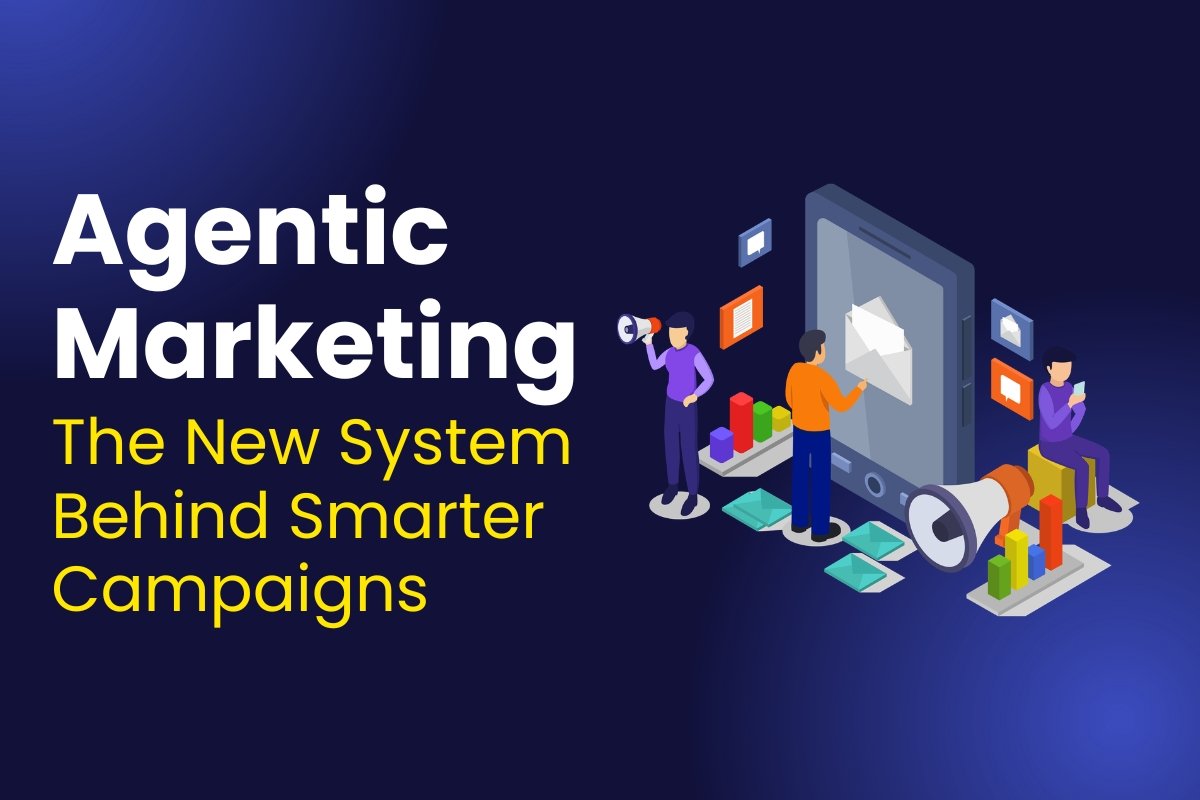
This evolving approach is often described as agentic marketing, where AI agents take on active roles in decision making, optimization, and execution. These systems can analyze data, respond to behavior, and refine campaigns continuously, creating a more adaptive and responsive way to reach and engage audiences.
In this article, we will take a deep dive into agentic marketing
What is Agentic Marketing?
Agentic marketing is a system where AI agents plan, act, and learn to run marketing tasks with little human input. These agents make decisions based on goals, data, and context.
An agent can study user behavior, test ideas, and adjust campaigns across channels like email, ads, and websites. It reacts as data changes and improves with each action. Teams set the goal, and the agent finds the best way to reach it.
This model shifts marketing from static execution to adaptive systems. Instead of running preset campaigns, brands use agents that learn, optimize, and act on their own.
5 Core Components of Agentic Marketing
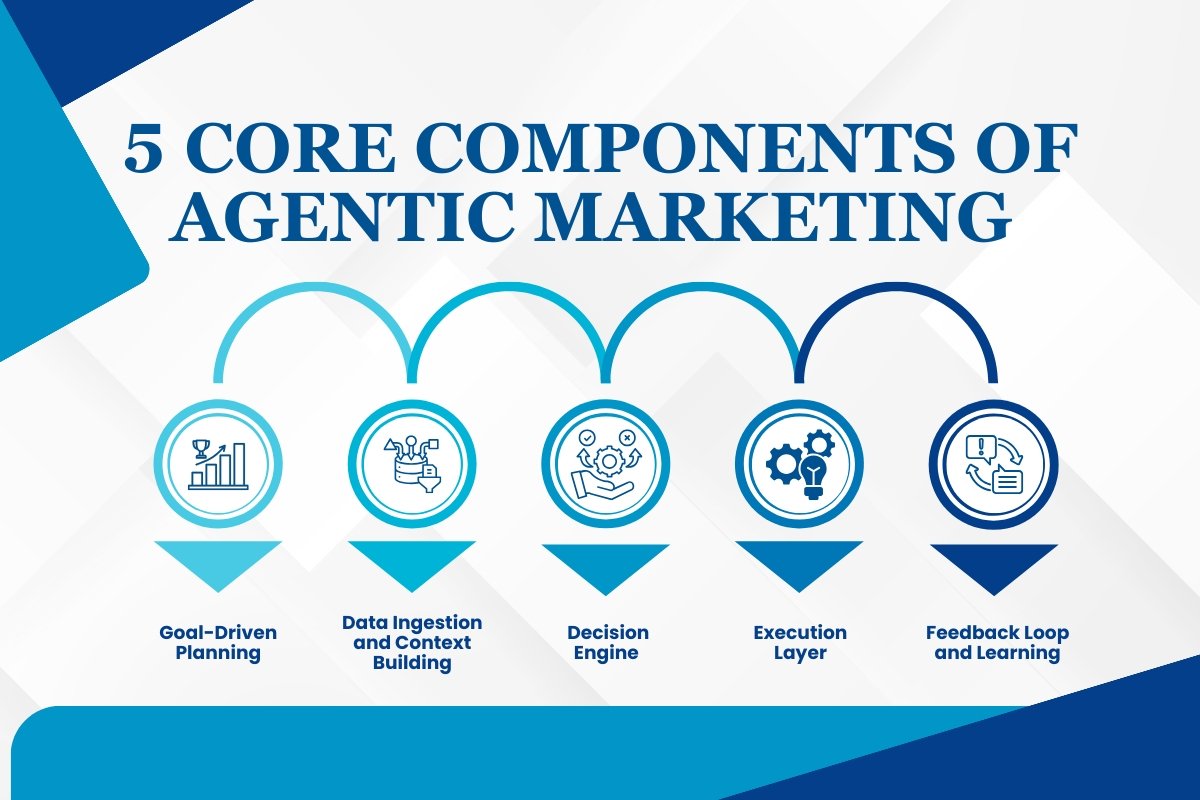
Agentic marketing runs on a set of connected systems. Each part has a clear role. Together, they create a loop where the system plans, acts, learns, and improves.
1. Goal-Driven Planning
Everything starts with a goal. This could be more sign-ups, higher sales, or better retention. The system breaks this goal into smaller tasks. It decides what actions to take and in what order.
Instead of fixed campaign plans, the agent builds its own path. It may test ads, change copy, or shift budget across channels. The plan is not static. It evolves as new data comes in.
2. Data Ingestion and Context Building
The agent needs a steady flow of data. It pulls data from user behavior, CRM tools, website activity, and past campaigns. It also reads signals like clicks, time spent, and purchase history.
This data builds context. The agent uses it to understand user intent and patterns. It does not just store data. It connects signals to form a clear view of what users want.
3. Decision Engine
This is the core of the system. The decision engine studies the data and picks the best action. It may choose which audience to target, what message to send, or when to send it.
The engine uses models and logic to compare options. It weighs risk, reward, and past outcomes. Then it makes a choice in real time. This allows faster and sharper decisions than manual work.
4. Execution Layer
Once a decision is made, the system acts. It launches ads, sends emails, updates landing pages, or changes offers. It works across multiple channels at the same time.
Execution is fast and continuous. The agent does not wait for approval at each step. It acts within the limits set by the team. This keeps campaigns active and responsive.
5. Feedback Loop and Learning
Every action creates new data. The system tracks results and measures performance. It checks what worked and what failed.
This feedback feeds back into the system. The agent updates its models and improves future decisions. Over time, it becomes more accurate and efficient.
How It All Works Together
The process runs in a loop. The agent sets a plan based on the goal. It gathers data and builds context. It makes decisions and executes actions. Then it learns from the results.
This loop never stops. Each cycle makes the system better. That is what makes agentic marketing adaptive and self-improving.
Agentic Marketing vs Traditional Marketing: Difference Explained
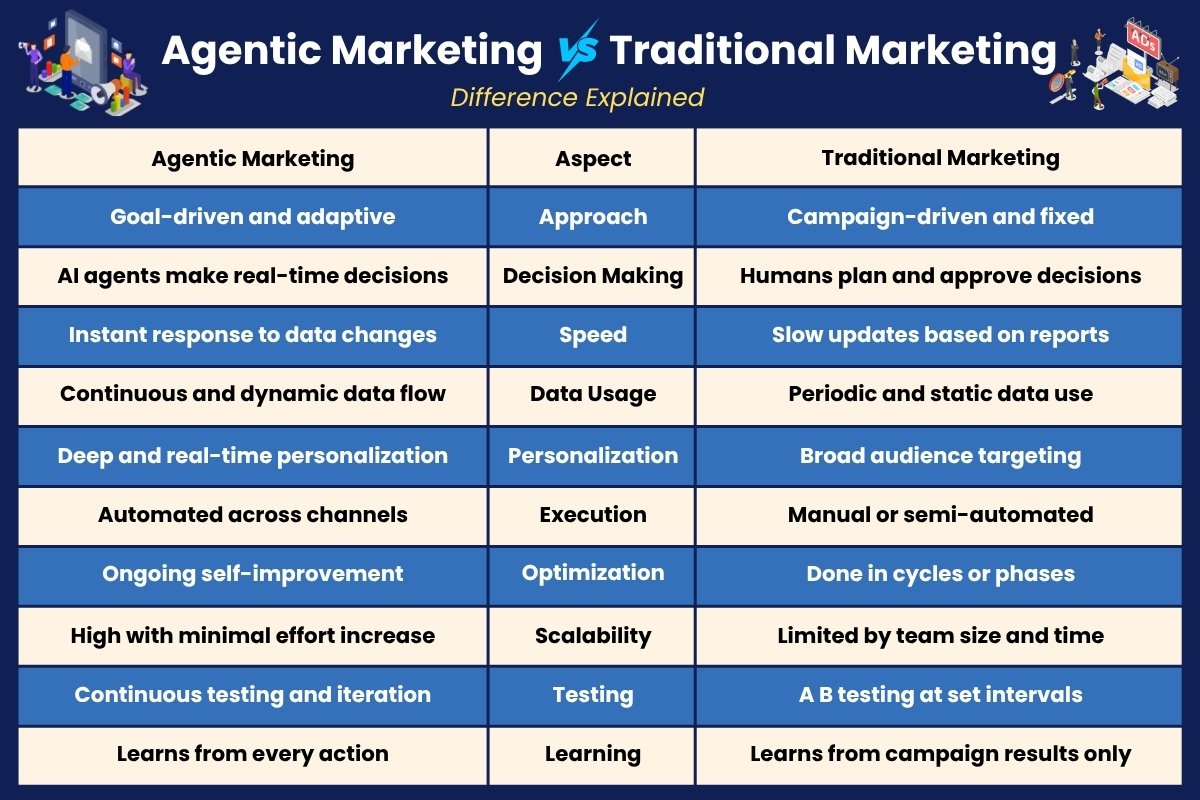
Before comparing both models, it helps to see how they approach the same goal in different ways. One relies on fixed plans and manual control. The other adapts as data changes and acts on its own.
This difference shapes how fast teams move, how they use data, and how they scale campaigns. The table below breaks down these differences in a clear and simple way.
| Agentic Marketing | Aspect | Traditional Marketing |
| Goal-driven and adaptive | Approach | Campaign-driven and fixed |
| AI agents make real-time decisions | Decision Making | Humans plan and approve decisions |
| Instant response to data changes | Speed | Slow updates based on reports |
| Continuous and dynamic data flow | Data Usage | Periodic and static data use |
| Deep and real-time personalization | Personalization | Broad audience targeting |
| Automated across channels | Execution | Manual or semi-automated |
| Ongoing self-improvement | Optimization | Done in cycles or phases |
| High with minimal effort increase | Scalability | Limited by team size and time |
| Continuous testing and iteration | Testing | A B testing at set intervals |
| Learns from every action | Learning | Learns from campaign results only |
The main difference lies in how decisions are made. In agentic systems, AI agents choose actions based on live data. In traditional setups, teams decide in advance and adjust later. This creates a delay.
Speed is another clear gap. Agentic systems react in real time. They shift budgets, change messages, and test ideas as users interact. Traditional methods depend on reports, which slows down action.
Personalization also changes at a deep level. Agentic systems tailor messages for each user based on behavior and intent. Traditional marketing often targets broad segments with the same message.
Finally, learning is continuous in agentic systems. Every action feeds into the next decision. Traditional marketing learns in batches after campaigns end. This makes improvement slower and less precise.
What are the Benefits of Agentic Marketing?
Agentic marketing changes how teams run and scale campaigns. It reduces manual work and improves how decisions are made. The system keeps learning, which helps it perform better over time.
1. Faster Decision Making
The system reacts as soon as new data appears. It does not wait for reports or manual review. This helps teams act at the right moment.
Quick decisions can improve results across channels. Campaigns stay active and aligned with user behavior. This reduces missed opportunities.
2. Better Personalization
The system studies each user in detail. It tracks intent and past actions. Then it adjusts messages for each user.
This leads to more relevant content. Users see what matches their needs. That often improves engagement and conversions.
3. Continuous Optimization
The system keeps testing and improving. It does not stop after a campaign ends. Every action becomes a learning point.
This creates steady growth over time. Small gains add up across many cycles. Performance improves without constant manual input.
4. Higher Efficiency
Teams spend less time on routine tasks. The system handles execution, testing, and adjustments. This frees up time for strategy.
Fewer manual steps also reduce errors. Work becomes more consistent and easier to scale.
5. Real-Time Adaptability
The system adjusts to changes as they happen. It can respond to market shifts, user trends, or campaign signals.
This keeps campaigns relevant. Brands can stay aligned with user needs without delay.
6. Scalable Growth
The system can handle large volumes of data and tasks. It does not slow down as demand increases.
This allows teams to grow without adding equal effort. Campaigns can expand across channels and audiences with ease.
Case Study: Amazon and Autonomous Marketing Systems
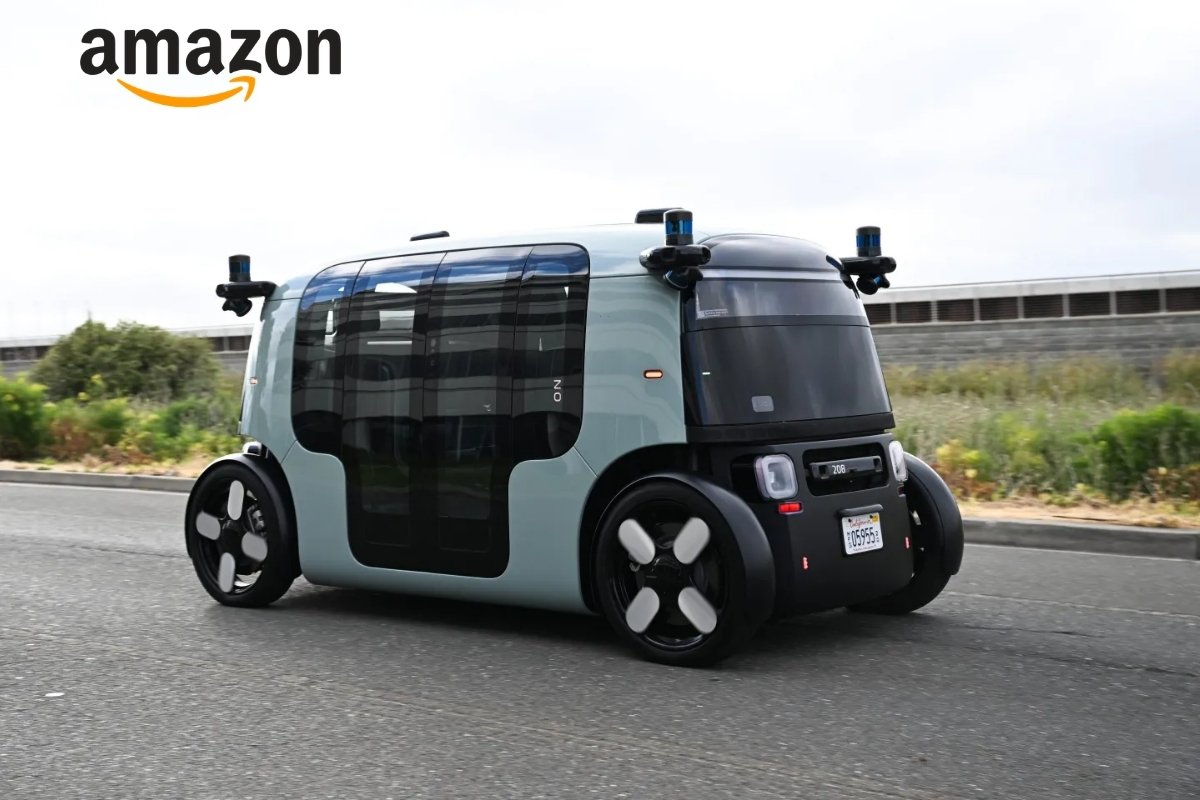
Amazon uses agent-like systems across its marketing and recommendation engine. The goal is clear. Increase conversions and keep users engaged through highly relevant product suggestions.
The system studies user behavior in real time. It tracks searches, clicks, purchases, and time spent on products. It also uses signals like price sensitivity, browsing patterns, and past interactions. This builds a detailed view of each user.
Based on this data, the system decides what to show. It selects products, adjusts rankings, and personalizes recommendations for each user. These decisions change constantly as new data comes in.
Execution happens instantly. Product suggestions update across the homepage, search results, emails, and ads. The system runs tests in the background and shifts toward what performs best.
Each action feeds back into the system. If users click or buy, the system reinforces those patterns. If they ignore suggestions, it adapts. This loop runs at a massive scale.
What This Shows
This is a real-world example of agentic marketing in action. The system sets a goal, uses data to make decisions, executes actions, and learns from results.
It also shows how brands move beyond simple automation. The system does not just follow rules. It adapts, optimizes, and improves on its own over time.
Future of Agentic Marketing
Agentic marketing will move from experiments to core strategy. Brands will rely on AI agents to run full marketing cycles, not just support tasks. These systems will plan, execute, and optimize campaigns with minimal human input.
One clear trend is scale. The number of AI agents is growing fast, and their role in business is expanding. According to industry estimates, the AI agents market could grow from about $7.6 billion in 2025 to nearly $183 billion by 2033. This shows how quickly businesses are investing in autonomous systems.
Another shift will come from hyper-personalization. Agents will move from segment-based targeting to true one-to-one marketing. Each user will see different messages, offers, and journeys based on live behavior.
Multi-agent systems will also rise. Instead of one system, brands will use networks of agents. One agent may handle data, another handles creative, and another manages channels. These agents will work together to reach shared goals.
The future is autonomy at scale. Marketing will shift from managing campaigns to managing intelligent systems that run on their own.
Conclusion:
As you step back and look at how marketing is evolving, the shift becomes hard to ignore. The pace, the precision, and the ability to adapt in real time are no longer future ideas. They are already shaping how brands connect with people every day.
With that shift, agentic marketing brings a new level of control through intelligent systems that can act, learn, and improve without constant direction. When used well, it allows you to focus less on managing every step and more on shaping strategy, while the execution continues to evolve in the background.
People Also Ask
1. What are the best agentic marketing platforms?
Platforms that combine automation with AI decision-making stand out, such as tools for customer data, campaign optimization, and real-time personalization. The best choice depends on your scale and marketing goals.
2. How to develop an agentic marketing strategy?
Start by defining clear goals and identifying areas where automation can add value. Then use AI tools to analyze data, test campaigns, and continuously refine your approach based on performance.
3. Can you make use of AI?
Yes, AI plays a central role by helping analyze large data sets, predict behavior, and automate decisions. It allows marketing systems to respond faster and improve results over time.