A good business idea is only the beginning.
To build, manage, or grow a company, people need to understand customers, money, marketing, operations, people, technology, and strategy. This is where business education becomes useful.
It is no longer limited to an MBA classroom. Today, people can learn through business schools, online courses, founder communities, case studies, apprenticeships, executive programs, and real work.
This matters because the workplace is changing quickly. The World Economic Forum says employers expect about 39% of key job skills to change by 2030. It also identifies analytical thinking, leadership, creative thinking, resilience, and technological skills among the capabilities gaining importance.
So, business education is not simply about earning a qualification. It is about developing the knowledge and judgment needed to make better business decisions.
Business education explained: What it is and why it matters
It is structured learning that helps people understand how businesses work and develop the skills needed to start, manage, or grow an organization. It combines business knowledge with practical skills used in real workplace situations.
It can include:
- Accounting and finance: Understanding budgets, costs, profits, and cash flow.
- Marketing and sales: Learning how to reach customers and increase sales.
- Business strategy: Making long-term plans and responding to competition.
- Entrepreneurship: Learning how to develop, test, and grow a business idea.
- Operations: Managing processes, resources, and daily business activities.
- Human resources: Hiring, managing, and developing employees.
- Leadership: Building teams and making effective decisions.
- Business analytics: Using data to understand performance and make better decisions.
- Economics: Understanding markets, demand, pricing, and wider economic factors.
- Technology and AI: Using modern tools to improve productivity and business decisions.
- Communication and negotiation: Communicating clearly and reaching better agreements.
Business Education Happens Beyond the Classroom
Business education is not limited to colleges or business schools. Companies also use structured learning programs to develop their employees.
For example, Google provides learning and leadership-development programs for employees, managers, and senior leaders. Its programs cover areas such as management, leadership, and organizational development.
Google also offers business-focused apprenticeship programs that can include business development, sales, campaign strategy, analytics, and AI in digital marketing.
This shows that it does not end after graduation. Professionals and companies continue using education and training to build skills, improve performance, and prepare for changing business needs.
6 types of business education: Which one is right for you?
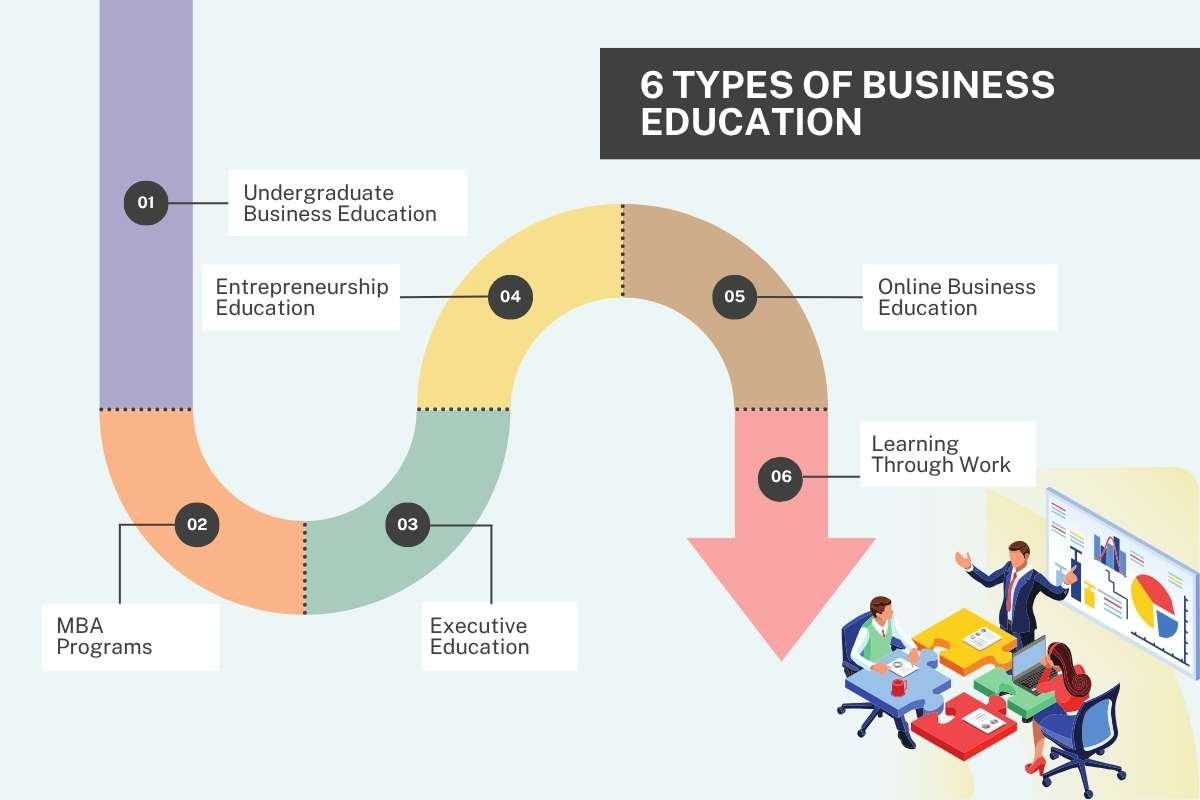
There is no single type that works for everyone. The right choice depends on your career stage and goal.
1. Undergraduate business education
Bachelor’s programs introduce students to core areas such as accounting, finance, marketing, economics, management, and operations.
They are useful for people starting their careers and building a broad foundation.
2. MBA Programs
An MBA usually goes deeper into leadership, strategy, finance, marketing, operations, and decision-making.
It can be useful for professionals who want to move into management, change industries, build networks, or prepare for senior roles.
However, an MBA is not automatically the best choice for everyone. Cost, experience, career goals, and expected return should all be considered.
3. Executive education
Executive programs are designed mainly for working professionals.
They often focus on specific skills such as:
- Strategic leadership
- Digital transformation
- Finance
- Innovation
- Negotiation
- AI and technology
- Change management
Unlike a full degree, executive education can often be completed in a shorter period.
4. Entrepreneurship education
Entrepreneurship-focused programs teach founders how to identify opportunities, test ideas, understand customers, manage money, and build teams.
This can be especially useful when combined with real business projects.
5. Online business education
Online learning is more flexible.
Platforms such as Coursera offer thousands of business courses covering leadership, financial management, marketing, entrepreneurship, and related subjects.
6. Learning through work
Work itself is also a powerful classroom.
Managing a project, handling a difficult customer, preparing a budget, negotiating with a supplier, or leading a team can teach lessons that a textbook cannot fully reproduce.
How business education helps entrepreneurs make better decisions
Entrepreneurs do not need to know everything before starting a company. But they do need enough knowledge to avoid expensive mistakes.
Business Education can help founders understand:
Customers → Market → Business Model → Money → Operations → People → Growth
For example, a founder may have a strong product but weak cash-flow management. Another may attract customers but struggle with pricing. Someone else may have funding but lack a clear growth strategy.
Learning basic principles of business for entrepreneurs can help founders ask better questions before making major decisions.
Enterprise Wired’s guide on building a business mindset also highlights strategic thinking, resilience, networking, problem-solving, and continuous learning as important entrepreneurial qualities.
The key lesson is simple: education should support action, not replace it.
Are online business courses worth it? Here’s what to consider
Yes, online business courses can be worth it when they match a clear career or business goal. They offer a flexible way to build specific skills without the time and cost of a full degree.
For example, an entrepreneur can learn financial management, a marketer can improve analytics, a manager can develop leadership skills, and a business owner can learn digital marketing.
4 Online business courses to consider:
1. Introduction to Business – University of California, Irvine | Coursera
This course covers business strategy, marketing, financial accounting, leadership, business planning, and cash-flow forecasting. It is a useful starting point for beginners.
2. Launch and Grow Your Business – Coursera
This four-course series focuses on entrepreneurship, pricing, marketing, operations, cash management, and business planning. It is suitable for people who want to start or grow a business.
3. Business Foundations – University of British Columbia | edX
This course helps learners build a foundation in important business areas and is listed by edX among its business administration learning options.
4. MBA Essentials – LSE Executive Education | edX
This program is designed for learners who want to understand core management and business concepts without enrolling in a traditional MBA. It is particularly relevant for professionals looking to strengthen their management skills.
The biggest mistake is collecting certificates without applying the knowledge.
A better approach is: Learn → Apply → Measure → Improve.
For example, after a digital marketing course, use the skills in a real campaign and track the results. After studying finance, create a simple cash-flow plan for a real business.
This turns online courses into practical business education that can support better decisions and real-world results.
What should a modern online business curriculum include?
A useful online business curriculum should cover both business fundamentals and modern skills.
Core subjects
- Accounting and finance
- Marketing
- Sales
- Business strategy
- Operations
- Economics
- Leadership
- Entrepreneurship
Modern business skills
- Data analysis
- AI and automation
- Digital marketing
- Cybersecurity awareness
- Sustainability
- Communication and negotiation
This combination matters because technical and human skills are becoming increasingly connected. The World Economic Forum’s 2025 research highlights growing demand for AI, big data, cybersecurity, technological literacy, creative thinking, resilience, leadership, and analytical thinking.
A strong business curriculum should therefore teach people how to think and decide, not just what to memorize.
Is business education worth the cost? Understanding its ROI
ROI in business measures whether the financial, career, and professional benefits of learning justify its cost in money, time, and effort.
| A simple formula is: ROI = (Benefits − Cost) ÷ Cost × 100 |
But business education ROI is not only about salary.
It can also include:
- Higher income
- Promotion
- Better job opportunities
- New business opportunities
- Stronger professional networks
- Better leadership skills
- Improved decision-making
- Greater confidence
GMAC’s 2026 research describes business-school ROI across financial, career, and emotional dimensions.
The financial side can still be significant. GMAC reports that 85% of graduates in one study said their graduate management education had a positive return, while around two-thirds reported advancing at least one job level after their degree.
However, ROI varies widely.
A high-cost MBA may make sense for someone targeting a major career change. A short online course may offer a better ROI for someone who needs only one specific skill.
6 business education mistakes that can waste your time and money

When you focus more on degrees and certificates than on useful skills and real-world experience. These common mistakes in business education can reduce the value of your time, money, and learning investment.
Mistake 1: Choosing a program only for its brand
A well-known university or business school can offer strong resources and networking, but its reputation does not guarantee that the program matches your career goals.
What to do: Check the curriculum, faculty experience, practical projects, industry exposure, alumni outcomes, and the skills you will gain before enrolling.
Mistake 2: Ignoring practical experience
Business concepts are easier to understand when you apply them. Reading about leadership, marketing, or finance is not the same as handling a real business problem.
What to do: Look for internships, case studies, simulations, live projects, startup experience, or workplace opportunities where you can apply what you learn.
Mistake 3: Learning outdated skills
Business changes quickly. AI, data analytics, automation, digital marketing, customer expectations, and new business models are changing how companies operate.
What to do: Choose programs that regularly update their curriculum and combine core business knowledge with relevant technology and analytical skills.
Mistake 4: Collecting certificates instead of building skills
A long list of certificates may look impressive, but certificates alone do not prove that you can use the knowledge in real situations.
What to do: Focus on skills and evidence of ability. Build projects, portfolios, case studies, or measurable work outcomes alongside your certifications.
Mistake 5: Ignoring ROI
The cost of education is more than tuition. You also invest your time and may give up income or other career opportunities while studying.
What to do: Compare the total cost, time commitment, career opportunities, networking benefits, expected salary or business impact, and opportunity cost before making a decision.
Mistake 6: Treating failure as wasted time
Not every business experiment will succeed. A failed project, rejected idea, or unsuccessful campaign can still provide useful information.
What to do: Review what went wrong, identify what you learned, and use that knowledge to improve your next decision. Failure becomes valuable when it improves future performance.
Business education vs. Work experience vs. MBA vs. Executive education (comparison)
Each learning path serves a different purpose. The right choice depends on your career stage, goals, budget, and the skills you want to build.
| Path | Best for | Main strength | Main limitation |
| Business Education | Students and professionals | Broad business knowledge | Can be theoretical |
| Work Experience | Working professionals | Practical learning | Learning can be uneven |
| MBA | Career changers and future leaders | Broad knowledge + network | High cost and time |
| Executive Education | Experienced managers | Focused leadership skills | Usually narrower |
| Online Courses | Skill-focused learners | Flexible and affordable | Requires self-discipline |
- Business Education: This gives learners a strong foundation in areas such as finance, marketing, strategy, operations, leadership, and entrepreneurship. It is useful for people who want to understand how different parts of a business work together.
- Work Experience: Work experience teaches business through real tasks, problems, customers, deadlines, and decisions. For example, managing a project can teach leadership and problem-solving in ways that classroom learning alone cannot.
- MBA: An MBA provides structured business knowledge while also offering opportunities to build leadership skills, professional networks, and industry connections. It can be useful for people planning a career change or moving toward management roles.
- Executive Education: Executive Education is generally designed for experienced professionals who want to strengthen a particular skill. Programs may focus on strategic leadership, finance, innovation, digital transformation, or other specialized areas.
- Online Courses: Online courses are useful when someone wants to learn a specific business skill without committing to a full degree. They offer flexibility, but learners need to practice the skills instead of simply collecting certificates.
Which is the Best Option?
There is no single best path for everyone. Business education builds the foundation, while work experience shows how to use that knowledge in real situations.
For example, someone may learn strategic planning through a business course and then develop a deeper understanding by applying that strategy to a real project at work.
The strongest combination is often education + experience.
Top business schools in the US: What makes them stand out?
The US is home to several leading business schools known for strong teaching, research, alumni networks, and connections with industry. Some well-known names include:
- Harvard Business School (HBS) – Known for its case-based learning and strong focus on leadership and general management.
- Stanford Graduate School of Business – Strong in entrepreneurship, innovation, and technology.
- The Wharton School – Known for finance, business analytics, and management education.
- MIT Sloan School of Management – Focuses on technology, innovation, analytics, and entrepreneurship.
- Kellogg School of Management – Well-known for marketing, leadership, and management.
- Columbia Business School – Offers strong exposure to finance, entrepreneurship, and New York’s business ecosystem.
- Chicago Booth – Recognized for analytical and data-driven approaches to business.
- Tuck School of Business – Focuses strongly on leadership, teamwork, and general management.
- Yale School of Management – Combines management education with broader social and economic issues.
One important example is Harvard Business School’s Case Method.
One of the best-known approaches is Harvard Business School’s Case Method. HBS introduced the method in 1925, making real business situations a central part of classroom learning. Students study business cases, discuss different solutions, and make decisions instead of simply memorizing theories.
HBS says MBA students read about 500 cases during the two-year program. The method helps students practice analyzing incomplete information, discussing different viewpoints, and defending their decisions.
This makes case-based business education practical because business leaders rarely have complete information or a single correct answer. Instead, they must assess risks, compare options, and make decisions under uncertainty.
4 Business education lessons from successful founders featured by Enterprise Wired

Business education becomes more memorable when it is connected to real founders.
1. Sara Blakely: Start before you know everything
Sara Blakely founded Spanx without traditional fashion or business experience. Enterprise Wired highlights her determination, willingness to experiment, and persistence.
Lesson: You do not need to know everything before taking the first step. Learn, test, and improve.
2. Bombas Founders: Solve a real problem
David Heath and Randy Goldberg founded Bombas after learning that socks were one of the most requested items at homeless shelters. Their idea connected a product with a clear social need.
Lesson: Strong businesses often begin by noticing a real problem and solving it well.
3. James Martin: Vision needs flexibility
Copa Di Vino founder James Martin became known for refusing offers on Shark Tank. Enterprise Wired’s case study shows how his strong belief in his product helped him build the business, but also raises an important question about flexibility when investors offer different growth paths.
Lesson: Believe in your vision, but listen carefully to people who see risks you may miss.
4. Steve Jobs: Focus on What creates value
Enterprise Wired’s business-leader coverage includes Steve Jobs among influential business leaders whose decisions shaped modern technology and consumer products.
Lesson: Business growth is not only about adding more products or features. It is also about knowing what deserves attention and creating meaningful customer value.
These stories show why business education lessons from successful founders should connect theory with real decisions. Founders learn not only from what worked, but also from mistakes, uncertainty, competition, and difficult choices.
Conclusion: The best business education never really ends
Business education is much bigger than a degree.
It includes formal study, online courses, executive programs, case studies, mentorship, work experience, and lessons from building real businesses.
The most valuable approach is practical: Learn the concept. Apply it. Measure the result. Learn again.
For students, business education can build a strong career foundation. For professionals, it can support career growth and new skills. For entrepreneurs, it can improve decision-making and reduce avoidable mistakes.
The workplace will continue to change. The World Economic Forum expects major shifts in jobs and skills through 2030, making continuous learning increasingly important.
The goal, therefore, is not to finish learning business.
It is to become better at understanding businesses, solving problems, making decisions, and creating value.
FAQs about business education
1. What is Business Education?
Business Education teaches the knowledge and skills needed to manage, operate, or grow a business. It covers areas such as finance, marketing, strategy, leadership, and entrepreneurship.
2. Why is Business Education important?
Business Education helps people understand how businesses work and make better decisions. It also builds practical skills for managing money, people, customers, and growth.
3. Is Business Education useful for entrepreneurs?
Yes, it helps entrepreneurs understand customers, markets, finance, strategy, and business operations. Applying these skills to real business problems can improve decision-making and growth.
4. Are online business courses useful?
Yes, online business courses can build specific skills in areas such as marketing, finance, leadership, and entrepreneurship. They are especially useful when learners apply the knowledge to real-world situations.
5. What is the difference between Business Education and an MBA?
Business Education is a broad term covering different forms of business learning, including courses and degrees. An MBA is a specific graduate-level business qualification focused on management and leadership.