
A business degree is not only about learning how to run a company.
Students also need to understand money, customers, markets, people, technology, risks, and business decisions. That is why a good business education curriculum combines business knowledge with practical and transferable skills.
The exact subjects can differ by university, degree, specialization, and country. A BBA may provide broad business foundations, while an MBA may focus more on strategic decision-making and leadership. Specialized programs may go deeper into areas such as finance, marketing, business analytics, entrepreneurship, or human resources.
Modern business education is also changing. The Association to Advance Collegiate Schools of Business (AACSB) says business curricula should integrate theory and practice while responding to technological, organizational, and social changes. Its 2026 standards also place greater emphasis on digital and analytical skills, innovation, experiential learning, ethics, and continuous curriculum review.
This makes the business education curriculum more than a list of subjects. It is a framework for developing the knowledge, judgment, and skills students need in the workplace.
What is a business education curriculum, and why is it important?
A business education curriculum is a planned set of subjects, activities, and skills that teaches students how businesses work and how to make better decisions.
In simple terms, it helps students:
- Build business knowledge
- Develop useful skills
- Apply what they learn in real situations
For example, a marketing student may learn customer segmentation and then create a target market plan for a food-delivery business.
Why does the curriculum matter?
Business is changing quickly because of AI, technology, data, and changing customer needs. A strong curriculum keeps students ready for these changes.
It should develop more than technical knowledge. Students also need problem-solving, teamwork, communication, adaptability, and ethical decision-making skills.
The value of this education can also be considered through business education ROI/ROI in business education (T2), which looks at how education contributes to skills, career opportunities, earning potential, and professional growth.
Core subjects and skills covered in most business programs
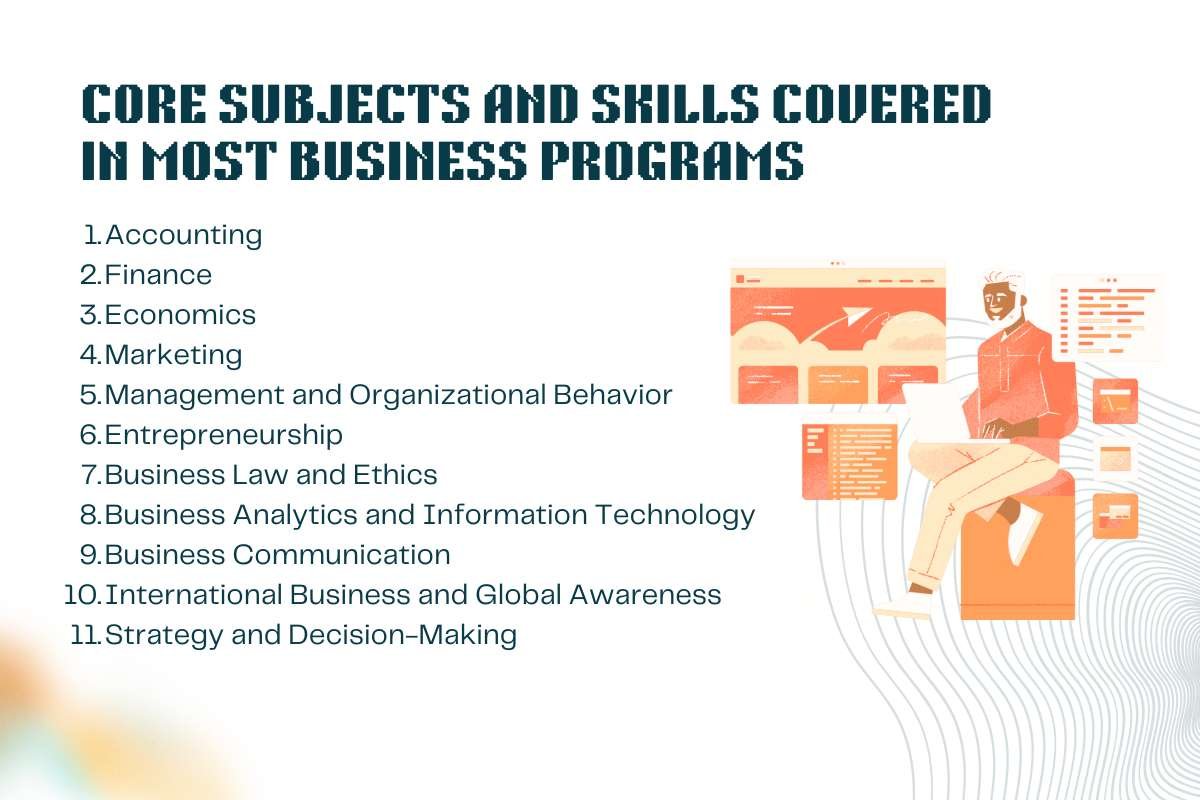
There is no single business education curriculum used by every institution. However, most programs cover key areas such as accounting, finance, economics, marketing, management, entrepreneurship, technology, communication, and international business.
The National Business Education Association (NBEA) identifies 10 major areas in its latest 2023 standards, including accounting, business law, communication, economics, entrepreneurship, information technology, international business, management, and marketing.
Here are the main subjects, with simple real-world examples:
1. Accounting
Accounting teaches students how businesses record, organize, and interpret financial information. Students may learn financial statements, bookkeeping, cost accounting, budgeting, and financial reporting.
Example: Apple publishes financial statements and annual reports that show its sales, expenses, profits, and other financial information. Students can use such reports to understand how accounting supports business decisions.
Key skills: Financial reporting, budgeting, cost analysis, and interpreting financial statements.
2. Finance
Finance focuses on how organizations manage money and make investment decisions. Common topics include financial planning, capital budgeting, risk, investment, corporate finance, and financial markets.
Example: Tesla publishes quarterly and annual financial information for investors. Studying these reports can help students understand revenue, investment, cash flow, and financial performance.
Key skills: Financial planning, investment analysis, risk management, and decision-making.
3. Economics
Economics helps students understand how markets and economic forces influence businesses. Students may study demand and supply, inflation, interest rates, competition, unemployment, and economic policy.
Key skills: Market analysis, demand and supply, economic trends, and business forecasting.
4. Marketing
Marketing teaches students how organizations understand customers and create, communicate, and deliver value. Subjects can include consumer behavior, branding, market research, advertising, digital marketing, pricing, and marketing analytics.
Example: Amazon operates across multiple customer-facing businesses and publishes detailed information about its operations and business segments. Students can use company reports to examine customers, products, markets, and business growth.
Key skills: Customer research, branding, pricing, advertising, digital marketing, and market analysis.
5. Management and organizational behavior
Management courses focus on how people and resources are organized to achieve business goals. Students commonly study planning, leadership, decision-making, organizational structure, motivation, teamwork, and change management.
Example: Apple has separate leaders for areas such as operations, finance, marketing, sales, software, and people. Its leadership structure shows how large organizations divide responsibilities and coordinate different functions.
Key skills: Leadership, teamwork, planning, motivation, problem-solving, and change management.
6. Entrepreneurship
Entrepreneurship prepares students to identify opportunities, test business ideas, understand customers, and manage uncertainty. Students may study business models, startup finance, innovation, product development, and venture planning.
Example: Airbnb has supported entrepreneurship through its Airbnb Entrepreneurship Academy in Goa. The program provides aspiring hosts with business and hospitality skills to help turn homes into income-generating ventures.
Key skills: Business planning, innovation, opportunity assessment, customer research, and risk-taking.
7. Business law and ethics
Business law introduces students to the legal environment in which organizations operate. Topics may include contracts, employment law, intellectual property, corporate structures, consumer protection, and regulatory requirements.
Ethics adds another important layer: What should a business do, even when a decision may be legal?
Example: The U.S. Securities and Exchange Commission (SEC) requires many public companies to provide regular financial and business reports. This gives students a practical example of how companies operate within reporting and regulatory rules.
Key skills: Legal awareness, compliance, ethical reasoning, privacy, and responsible decision-making.
8. Business analytics and information technology
Technology is now closely connected with almost every business function. A modern business education curriculum may include information systems, spreadsheets, databases, business intelligence, data visualization, analytics, AI, and digital transformation.
Key skills: Data analysis, digital tools, business intelligence, AI awareness, and technology-based decision-making.
9. Business communication
Strong business decisions have little value if people cannot communicate them clearly. Business communication may cover presentations, professional writing, negotiation, reports, teamwork, and interpersonal communication.
Example: Apple has a dedicated Worldwide Communications function responsible for global communications, public relations, employee communications, and Apple events.
Key skills: Business writing, presentations, negotiation, teamwork, and professional communication.
10. International business and global awareness
Businesses increasingly operate across borders. International business courses can introduce students to global markets, trade, cultural differences, international strategy, foreign exchange, and geopolitical risks.
Example: Apple operates across more than 200 countries and territories, making global market strategy an important part of its business.
Key skills: Global strategy, cultural awareness, international markets, trade, and cross-border decision-making.
11. Strategy and decision-making
Strategic management brings many business subjects together. Students learn how organizations analyze competitors, identify opportunities and threats, allocate resources, and create long-term plans.
Key skills: Strategic thinking, competitive analysis, problem-solving, resource planning, and long-term decision-making.
What skills should a strong business education curriculum build?

A strong business education curriculum should build skills such as critical thinking, problem-solving, communication, teamwork, leadership, data analysis, digital skills, adaptability, and ethical decision-making.
Students should also get practical exposure through case studies, internships, projects, simulations, and industry activities. This helps them apply classroom knowledge to real business problems.
As AI and technology change the workplace, business education is also evolving. Modern programs increasingly combine AI, data, digital tools, and business strategy with human skills such as judgment, communication, and leadership. AACSB recommends experiential learning and regular curriculum updates to keep business education relevant.
How to choose the right business education curriculum

Students should not judge a business program only by its course titles or institution name.
Before choosing a program, check:
- Core subjects: Does it cover essential business foundations?
- Specializations: Can students study areas that match their career goals?
- Practical exposure: Are internships, projects, simulations, or industry assignments included?
- Technology: Does the program teach relevant digital and analytical skills?
- Faculty: Do instructors have strong academic and industry experience?
- Career support: Does the institution provide internships, placements, mentoring, or career services?
- Curriculum updates: Does the program respond to changes in business and technology?
- Learning outcomes: Does it show what students will actually be able to do after completing the program?
A strong curriculum should connect knowledge → skills → application → outcomes.
Conclusion
A business education curriculum gives students the foundation they need to understand organizations and make informed business decisions.
Its core areas usually include accounting, finance, economics, marketing, management, entrepreneurship, business law, technology, communication, international business, and strategy.
However, modern business education must go further by building critical thinking, analytics, communication, adaptability, leadership, and ethical judgment.
The strongest programs connect classroom concepts with real business problems through projects, internships, case studies, simulations, and industry engagement.
For students, the right curriculum is not necessarily the one with the longest subject list. It is the one that builds useful knowledge, practical skills, and the ability to keep learning as business changes.
FAQs on business education curriculum:
1. What is a business education curriculum?
A business education curriculum is a structured plan that teaches students business knowledge, skills, and practical concepts.
2. What subjects are included in a business education curriculum?
Common subjects include accounting, finance, economics, marketing, management, entrepreneurship, analytics, and business law.
3. Why is a business education curriculum important?
It builds business knowledge, practical skills, problem-solving ability, and decision-making skills for the workplace.
4. Does every business degree have the same curriculum?
No, the curriculum varies by degree, institution, specialization, country, and career goals.
5. What skills should students gain from business education?
Students should develop communication, critical thinking, teamwork, leadership, analytical, digital, and problem-solving skills.
6. Is practical experience important in business education?
Yes, internships, projects, case studies, and simulations help students apply business concepts to real situations.
7. How is AI changing business education?
AI is increasing the need for digital and analytical skills while making critical thinking, judgment, communication, and ethics more important.