Business education is no longer limited to getting an MBA from a business school.
Today, a student can start with a bachelor’s degree, a working professional can take a short finance or leadership course, an experienced manager can join executive education, and someone interested in research can pursue a PhD.
The important question is not simply which business education is best. It is which type fits your current career goal.
The different types of business education serve different purposes. Some build a broad foundation in accounting, marketing, finance, management, and economics. Others focus on practical skills such as leadership, analytics, entrepreneurship, or digital transformation.
This guide explains the major types, who they suit, what they teach, and how to choose between them.
What are the types of business education and why do they matter?
Business education includes different learning paths that build business knowledge, practical skills, leadership, or research expertise. Key types include degrees, executive programs, certifications, online courses, apprenticeships, and PhDs.
These options differ in:
- Career stage: From students to senior executives
- Duration: From short courses to multi-year degrees
- Depth: From basic business knowledge to advanced research
- Focus: From general management to specialized skills
- Learning style: From classroom and case studies to online and workplace learning
For example, Wharton’s undergraduate business curriculum combines business fundamentals with leadership, technology, analytics, and global business.
Why does business education matter?
A qualification provides structured knowledge, but its real value comes from how well learners can apply that knowledge. Business professionals use these skills to:
- Manage financial performance
- Understand customers and markets
- Lead teams and make decisions
- Improve operations
- Manage risks and competition
- Support growth and innovation
Harvard Business School uses real-world cases to help students analyze business problems, make decisions, and build communication and leadership skills. GMAC’s 2025 Corporate Recruiters Survey found that employers increasingly value AI skills alongside broader business capabilities.
In simple terms, modern business education combines business knowledge, practical experience, decision-making, and technology skills.
7 Types of business education every learner should know
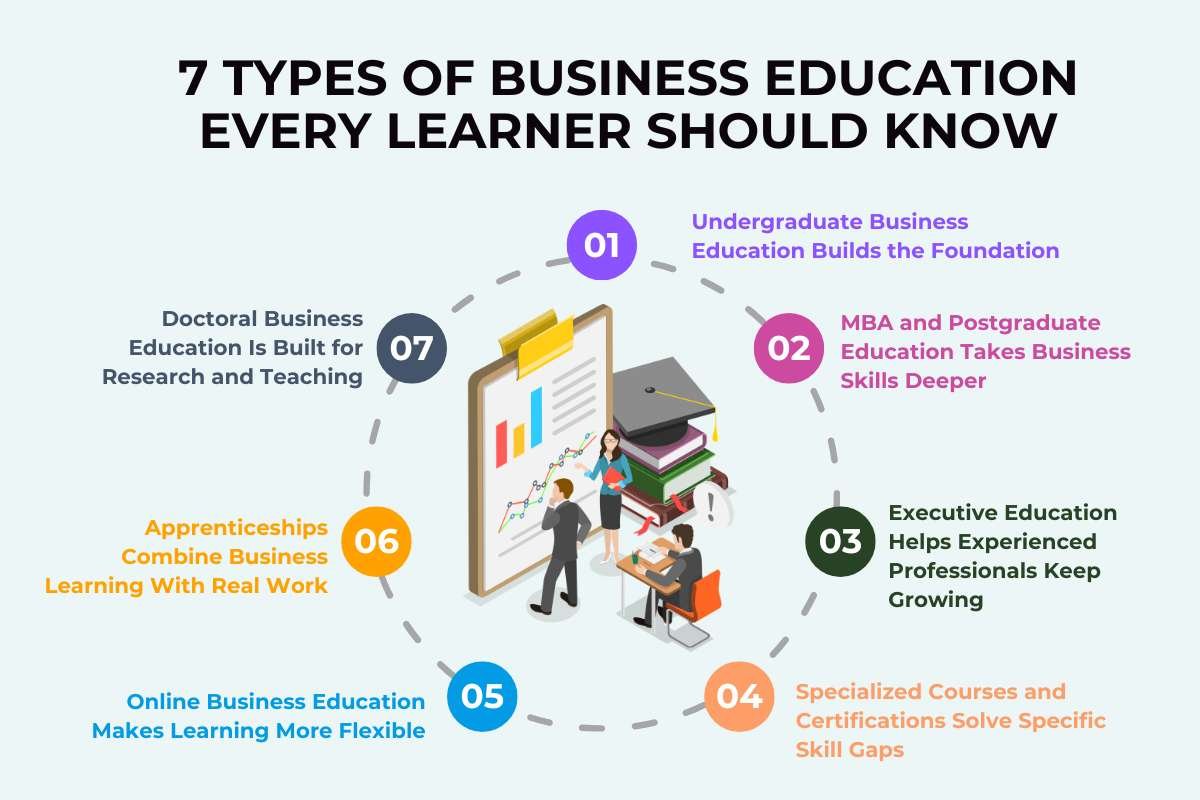
1. Undergraduate business education builds the foundation
Undergraduate business education is usually the starting point for students who want a broad understanding of business.
Common degrees include:
- Bachelor of Business Administration (BBA)
- Bachelor of Commerce (BCom)
- Bachelor of Science in Business
- Bachelor of Science in Management
- Business-related economics degrees
Students normally study subjects such as accounting, finance, marketing, management, economics, statistics, operations, and business law.
For example, NYU Stern’s BS in Business is a four-year program that combines business fundamentals with liberal arts, global business, social impact, and specialized concentrations.
Best for: Students starting their professional journey.
Main benefit: It creates a broad business foundation before a learner enters a specific career or pursues advanced education.
2. MBA and postgraduate education takes business skills deeper
An MBA is one of the best-known forms of postgraduate business education.
It is generally designed for people who want to strengthen their management knowledge, change careers, move into leadership, or develop a stronger understanding of how organizations work.
MBA programs can cover:
- Finance
- Marketing
- Strategy
- Operations
- Leadership
- Entrepreneurship
- Business analytics
- Technology
- Organizational behavior
Harvard Business School’s current MBA curriculum, for example, includes finance, financial reporting, leadership, marketing, strategy, technology and operations management, data science and AI, entrepreneurship, and a global capstone experience.
MBA education can also use highly practical teaching methods.
- Best for: Professionals and graduates seeking broader management or leadership skills.
- Main benefit: It combines business fundamentals with decision-making, teamwork, leadership, and strategic thinking.
- Important: An MBA is not automatically the best option for everyone. A short specialized program may make more sense if you only need one specific skill.
3. Executive education helps experienced professionals keep growing
Executive education is designed mainly for managers, executives, founders, and experienced professionals.
Unlike a traditional degree, these programs often focus on a specific business challenge or skill.
Examples include:
- Leadership
- General management
- Corporate strategy
- Digital transformation
- Finance for executives
- Corporate governance
- Change management
- Entrepreneurship
INSEAD’s executive education portfolio includes programs covering general management, corporate governance, leadership, strategy, finance, digital transformation, and other business areas. It offers both open programs for individuals and customized programs for organizations.
This type of learning can be useful when a professional does not want to leave work for a full-time degree.
- Best for: Managers, executives, business owners, and experienced professionals.
- Main benefit: It targets practical business problems and allows professionals to apply learning directly at work.
4. Specialized courses and certifications solve specific skill gaps
Not everyone needs a full degree. Sometimes, the better choice is a focused course or professional certification.
For example, someone working in marketing may need to improve:
- Digital marketing
- SEO
- Data analytics
- Brand management
- Customer research
A finance professional may instead need financial modeling, risk management, or business analytics.
This is one of the most flexible types of business education because learners can choose education based on a specific skill gap.
- Best for: Students and professionals who need targeted skills.
- Main benefit: Shorter learning time and a more focused curriculum.
The key is to evaluate the quality and relevance of the credential, rather than assuming every certificate has equal career value.
5. Online business education makes learning more flexible
Online business education has changed how people access business knowledge.
Learners can take:
- Online degree programs
- Business certificates
- Short courses
- Executive programs
- Professional training
- Self-paced courses
- Cohort-based programs
INSEAD, for example, offers online executive programs designed around flexibility, peer interaction, faculty access, and action-learning projects that can be applied to real workplace situations.
The major advantage is flexibility. A working professional can continue working while studying. However, online learning works best when learners have a clear goal and can consistently apply what they learn.
- Best for: Working professionals, entrepreneurs, career changers, and learners who need flexible schedules.
- Main benefit: Access and flexibility without necessarily requiring a full-time campus experience.
6. Apprenticeships combine business learning with real work
Business education does not always have to happen inside a classroom. Apprenticeships combine structured learning with workplace experience.
The U.S. Department of Labor describes Registered Apprenticeship as a career pathway combining paid work, mentorship, classroom instruction, progressive wage increases, and a recognized credential.
This makes apprenticeships particularly valuable for learners who prefer learning by doing.
For example, an apprentice may develop skills while working in areas such as business administration, financial services, technology, operations, or other business-related fields.
The model also benefits employers because they can develop workers around real organizational needs.
- Best for: People who want hands-on experience while learning.
- Main benefit: It connects education directly with workplace skills.
The U.S. Department of Labor reported more than 702,000 active apprentices and more than 26,000 active apprenticeship programs in FY2025.
7. Doctoral business education is built for research and teaching
Doctoral education is the most research-focused path among the major types of business education.
Common options include:
- PhD in Business
- PhD in Management
- Doctoral programs in Finance
- Doctoral programs in Marketing
- Doctoral programs in Operations
- DBA programs
A business PhD is very different from an MBA.
An MBA mainly develops management knowledge and professional capabilities. A PhD focuses heavily on creating new knowledge through research.
Stanford Graduate School of Business says its PhD program prepares students for careers in research and teaching and offers study across seven fields.
- Best for: People who want academic, research, or teaching careers.
- Main benefit: Deep expertise in a specific business research area.
Which type of business education is right for you?

There is no single best option.
| Your Goal | Suitable Options |
| Starting a business career | Undergraduate business degree |
| Moving into management | MBA or postgraduate program |
| Developing leadership skills | Executive education |
| Learning one specific skill | Specialized course/certification |
| Studying while working | Online business education |
| Learning through real work | Apprenticeship |
| Becoming a business researcher | PhD/doctoral education |
The decision should start with your goal, not the name of the qualification.
Ask yourself:
- What skill am I missing?
- How much work experience do I have?
- Do I need a degree or only a specific skill?
- How much time can I invest?
- What is my education budget?
- Will the program provide practical experience?
- Does the curriculum match current employer needs?
This approach can prevent a common mistake: choosing a program because it sounds prestigious rather than because it solves a real career need.
How business education is changing in the AI era

Business education is moving beyond traditional subjects such as finance, marketing, and management. Modern programs increasingly include AI, data analytics, digital tools, technology, and technology-driven decision-making.
Harvard Business School’s 2026 MBA curriculum includes Data Science & AI for Leaders along with core areas such as finance, marketing, strategy, and operations.
Employer expectations are changing too. GMAC research shows that recruiters increasingly value AI skills alongside communication, problem-solving, and other core business skills.
The future of business education combines technology skills with human judgment. Learners need to understand business concepts and know how to apply AI, data, and digital tools to make better decisions.
Conclusion
Business education includes degrees, MBAs, certifications, executive programs, online courses, and PhDs. Each serves a different career need.
The best choice depends on your career stage, goals, time, and budget. As technology changes business, programs that combine business knowledge with AI, analytics, and practical skills can offer greater value.
FAQs about types of business education
1. What are the main types of business education?
The top types of business education include undergraduate degrees, MBAs, executive education, specialized courses, and online programs.
2. Which type is best for beginners?
An undergraduate business degree is a strong starting point for learning core areas such as finance, marketing, accounting, and management.
3. Is an MBA a type of business education?
Yes, an MBA is a postgraduate business program that develops management, leadership, analytical, and strategic skills.
4. Is online business education useful?
Yes, online business education offers flexible learning for students and professionals while developing relevant business and digital skills.
5. How should I choose business education?
Choose a program based on your career goal, experience, skills needed, time, budget, curriculum, and career opportunities.