Accounting technology for small businesses uses digital software and automation to simplify bookkeeping, manage cash flow, reduce errors, and improve financial decision-making. The right solution helps businesses save time, stay compliant, and support long-term growth.
Still counting numbers manually while your business races ahead?
Every extra hour spent updating spreadsheets is an hour taken away from winning new customers, improving your products, or growing your business.
A single missed invoice, a forgotten payment, or one small calculation error can quietly turn into a costly problem. Meanwhile, invoices keep piling up, suppliers expect payments, employees wait for salaries, and tax deadlines refuse to slow down. Managing everything manually quickly becomes overwhelming.
That’s exactly why accounting technology for small businesses has become a game-changer. Instead of drowning in paperwork and endless calculations, modern accounting solutions automate repetitive tasks, organize financial records, track cash flow in real time, and generate accurate reports within minutes.
The result? Less time fixing numbers. More time building your business.
Whether you own a café, retail store, startup, or service-based company, this technology helps you reduce costly errors, improve financial visibility, stay tax-ready, and make faster, smarter business decisions. In a competitive market, it’s no longer just about keeping your books balanced; it’s about giving your business the technology it needs to grow with confidence.
What is accounting technology for small business and why is it important?
Accounting Technology for Small Business refers to digital accounting software, cloud platforms, and automation tools that help businesses record, manage, and analyze their financial data more efficiently. Instead of relying on manual bookkeeping, these solutions automate routine financial tasks while providing real-time insights for better decision-making.
Modern accounting technology can:
- Automatically record daily transactions
- Generate invoices and financial reports
- Track income, expenses, and cash flow
- Calculate taxes and support compliance
- Connect with bank accounts
- Securely store financial records in the cloud
Small businesses need accounting technology because it replaces manual work with accurate, real-time financial information. Owners can quickly monitor profits, expenses, unpaid invoices, and cash flow, making it easier to manage budgets, plan growth, and make informed business decisions.
According to the U.S. Small Business Administration (SBA), maintaining accurate financial records is essential for budgeting, tax compliance, and long-term business success.
Real-world example: How cloud accounting helped a small business scale faster
A great example comes from Xero, one of the world’s leading cloud accounting providers.
Australian bookkeeping firm Two Sides Accounting migrated its clients from manual accounting to cloud-based accounting with Xero. The transition reduced paperwork, improved collaboration with clients, and allowed accountants to access financial data from anywhere. Instead of spending hours collecting documents, advisors focused on helping clients improve business performance.
As a result, the firm scaled its client services while improving efficiency for small businesses.
This example shows how accounting technology for small businesses is not only about software; it changes how businesses work with accountants and financial advisors.
Major benefits of accounting technology for small businesses
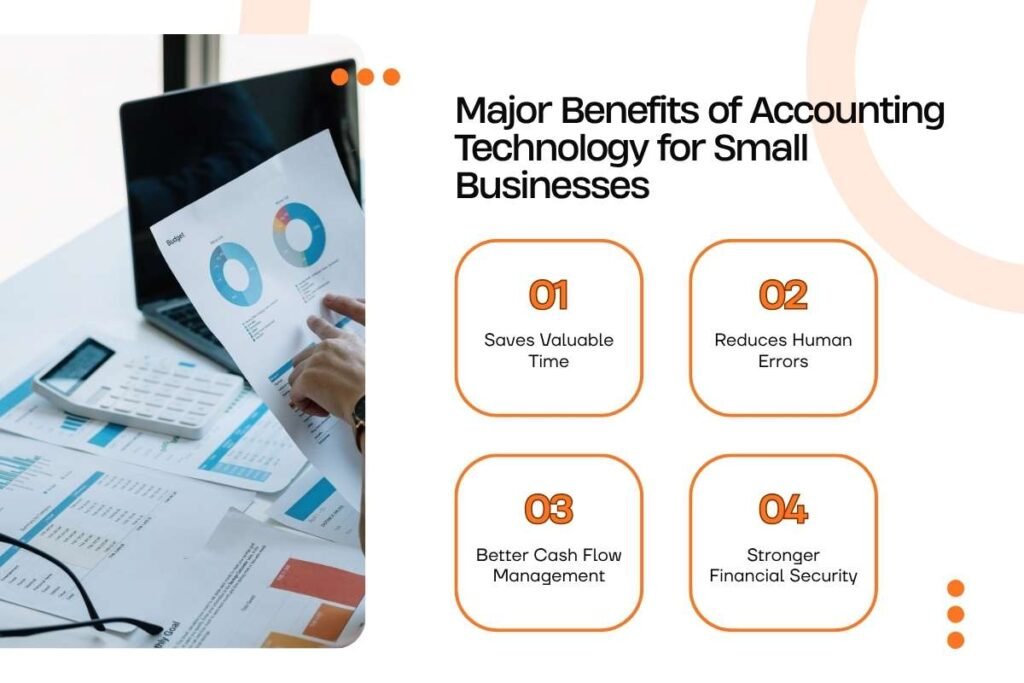
The biggest advantage is not simply automation. It is better control over the entire business.
1. Saves valuable time
Many accounting tasks repeat every week.
These include:
- Recording expenses
- Sending invoices
- Matching bank transactions
- Preparing reports
Modern accounting software performs these activities automatically. Instead of spending five hours every week on bookkeeping, owners can use that time to meet customers, improve products, or build marketing campaigns.
2. Reduces human errors
Typing hundreds of financial entries manually increases the chance of mistakes. A missing decimal point or incorrect invoice amount may create serious financial issues.
Accounting technology for small businesses reduces manual work by importing transactions directly from banks, payment gateways, and POS systems. Automation improves accuracy while reducing costly errors.
Many modern accounting platforms also use blockchain in accounting to strengthen transaction security, improve transparency, and create tamper-resistant financial records.
According to Intuit QuickBooks, automated bookkeeping significantly reduces repetitive manual entry and improves record accuracy for small businesses.
3. Better cash flow management
Cash flow is one of the biggest reasons small businesses struggle. Many companies earn profits on paper but still face cash shortages because customer payments arrive late.
Modern accounting software provides:
- Real-time cash balances
- Upcoming bills
- Outstanding invoices
- Payment reminders
- Revenue forecasts
Business owners know exactly when money enters and leaves the business. That visibility helps prevent unexpected financial problems.
4. Stronger financial security
Paper records can be lost. Hard drives may fail. Local computers can be damaged.
Cloud-based accounting technology for small businesses stores encrypted financial data across secure servers with automatic backups.
Leading accounting providers also use:
- Multi-factor authentication
- User permissions
- Data encryption
- Continuous backups
- Fraud monitoring
These security features protect sensitive financial information while allowing authorized users to access records safely.
According to the National Institute of Standards and Technology (NIST), strong authentication and encrypted data storage play an important role in protecting business information systems.
How small businesses use accounting technology to automate operations?

High-density firms scaling pipelines and client-facing portals
These scalable financial systems represent the next stage of accounting technology, where accounting software integrates with CRM, ERP, payment gateways, and customer portals to automate complete business workflows.
This is where accounting technology for small business becomes more than bookkeeping software. It acts as the financial backbone that connects sales, customer service, invoicing, and reporting into one streamlined system.
1. What are scaling pipelines?
Scaling pipelines are automated workflows that move customers smoothly through different business stages, such as:
- New customer inquiry
- Sales quotation
- Contract approval
- Invoice generation
- Payment collection
- Customer support
- Financial reporting
Instead of switching between multiple spreadsheets, businesses manage these activities through connected software.
For example, when a customer accepts a quotation in a CRM (Customer Relationship Management) system, the accounting software can automatically create an invoice, record expected revenue, and notify the finance team. This reduces delays and eliminates duplicate data entry.
2. Client-facing financial portals
Many modern accounting platforms also offer secure client portals where customers can:
- View invoices
- Download payment receipts
- Check account balances
- Make online payments
- Upload financial documents
- Communicate with accountants securely
These portals improve transparency and reduce the number of support emails.
Real-world examples
Zoho Books helps small businesses connect accounting with CRM, inventory, banking, and payment gateways through the Zoho ecosystem. When a sales opportunity is converted into a customer, invoices can be generated automatically, payments tracked, and financial reports updated without entering the same information twice.
Oracle NetSuite enables fast-growing businesses to manage accounting, inventory, procurement, customer relationships, and financial reporting from a single cloud platform. Companies with multiple locations or expanding operations use NetSuite to automate workflows, monitor performance in real time, and scale efficiently.
FreshBooks is widely used by freelancers, marketing agencies, consultants, and creative professionals. It simplifies client billing by automating invoices, tracking billable hours, sending payment reminders, and allowing customers to pay online through secure client portals.
These platforms enable growing businesses to handle larger customer volumes, automate financial operations, and deliver a better client experience without significantly increasing administrative staff.
Best accounting technology for small business tools in 2026

Choosing the right software can make daily financial work easier, improve cash flow, and save valuable time. However, no single platform fits every business. The best choice depends on your company size, industry, budget, and plans.
Below are some of the most trusted solutions that support accounting technology for small businesses in 2026.
| Software | Best For | Key Features |
|---|---|---|
| QuickBooks Online | Small and growing businesses | Invoicing, payroll, reporting, bank feeds. AI-powered insights. |
| Xero | Startups and service businesses | Cloud accounting, inventory, client collaboration, automation. |
| Zoho Books | Small businesses and freelancers | GST compliance, automation, customer portal, workflow rules. |
| FreshBooks | Consultants and agencies | Time tracking, invoicing, expense management. |
| Sage Accounting | Small retailers and SMEs | Cash flow tracking, VAT, support, bank reconciliation. |
Each of these platforms continues to improve automation, security, and reporting, making small business more accessible than ever.
Conclusion:
Running a small business already comes with enough challenges. Managing finances should not be one of them. Accounting technology for small businesses gives owners the tools to automate routine work, improve financial accuracy, strengthen security, and make better business decisions.
Whether you run a retail store, consultancy, online business, or local service company, investing in the right accounting technology saves time and creates opportunities for long-term growth. Businesses that adopt digital financial systems today are better prepared for tomorrow’s challenges. The right technology does not replace smart business owners; it helps them work smarter, serve customers better, and grow with confidence.