Business education builds business knowledge, while work experience teaches you how to use that knowledge in real situations. Both can support career growth, but their value depends on your goals, experience, and career stage.
Business education covers areas such as finance, marketing, strategy, operations, leadership, and management. Work experience builds practical skills through real customers, deadlines, budgets, teamwork, and business problems.
The comparison between business education vs work experience shows that you do not always have to choose one over the other. In many careers, education and experience work best together. The World Economic Forum expects nearly 40% of workers’ key skills to change by 2030, making continuous learning and practical experience increasingly important.
What is the difference between business education vs work experience?
The key difference is simple: Business education teaches business concepts and frameworks. Work experience teaches you how to apply them.
Business education can include a business degree, MBA, executive education, professional course, or online program. These options form part of the broader types of business education available to learners.
It gives learners a structured understanding of how different parts of a business work together.
Common areas include:
- Finance and accounting
- Marketing and sales
- Business strategy
- Operations
- Leadership
- Entrepreneurship
- Business analytics
- Negotiation and communication
- Technology and AI
A strong business education curriculum can bring these areas together and help learners understand how different business functions connect.
Work experience, on the other hand, develops skills through real tasks and decisions. For example, a course may teach customer segmentation, but a marketing professional learns its real impact by running a campaign and responding to customer results.
Similarly, a business student may study leadership theories, while a manager develops leadership skills by handling deadlines, team conflicts, and difficult decisions.
Business education vs work experience at a glance
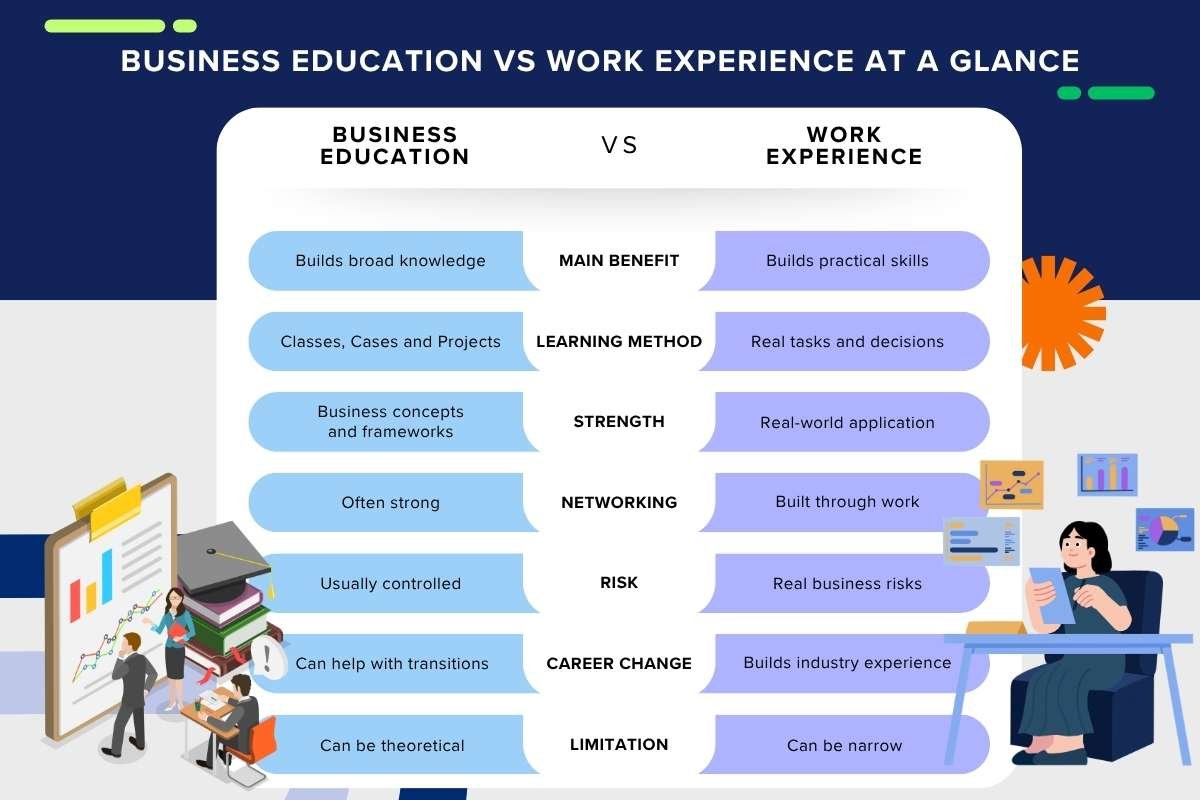
| Factor | Business Education | Work Experience |
|---|---|---|
| Main Benefit | Builds broad knowledge | Builds practical skills |
| Learning Method | Classes, Cases and Projects | Real tasks and decisions |
| Strength | Business concepts and frameworks | Real-world application |
| Networking | Often strong | Built through work |
| Risk | Usually controlled | Real business risks |
| Career change | Can help with transitions | Builds industry experience |
| Limitation | Can be theoretical | Can be narrow |
Neither path is automatically better.
Someone with years of experience may have strong practical knowledge but limited exposure to areas such as strategy or finance. Likewise, someone with a business degree may understand business concepts but lack experience applying them.
The strongest approach is often a combination of education and experience.
Why work experience teaches what classrooms cannot
Real work comes with uncertainty and pressure.
A course can teach cost management, but a manager must decide what to cut when revenue falls. A class can explain negotiation, but a professional must handle a difficult supplier or customer.
This is why experience remains valuable even for highly educated professionals.
According to the U.S. Bureau of Labor Statistics, prior work experience was required for 97% of management workers in 2025, while a bachelor’s degree was required for 51.5%.
This highlights an important point: formal education and work experience often complement each other rather than compete.
When does formal education add more value than on-the-job learning?

Formal education adds more value when you need broad business knowledge, structured learning, new perspectives, or skills outside your current role. Work experience is important, but it may not cover every area of business.
1. When you need a strong business foundation
Formal education is useful when you need to understand how different parts of a business work together.
Work experience usually focuses on your specific role. Business education can give you knowledge of finance, marketing, operations, strategy, leadership, and business analysis.
This broader view helps you understand how one business decision can affect several areas at once.
2. When you want to change careers
Formal education can help you build skills for a new career path.
For example, an engineer moving into consulting or product management may need knowledge of finance, strategy, marketing, and leadership. A structured business program can help fill these gaps.
GMAC’s 2026 research shows that employers continue to value problem-solving, strategic thinking, communication, adaptability, and teamwork.
3. When you need structured strategic thinking
Formal education can expose you to different business problems and ways of solving them.
Harvard Business School’s Case Method (Supporting) is a relevant example. Students study real business situations, evaluate different options, and make decisions with incomplete information. HBS states that MBA students read about 500 cases during the two-year program.
This type of learning helps students develop structured thinking and make decisions when there is no simple answer.
4. When you need knowledge outside your current role
Work experience can give you deep knowledge in one area but limited exposure to others.
Formal business education can help you understand multiple functions, including finance, marketing, operations, strategy, and leadership. This becomes particularly useful when preparing for management roles, where decisions often involve more than one department.
It can also help professionals understand the wider business education curriculum instead of focusing only on one business function.
5. When you need new perspectives and networks
Formal education brings together people with different professional and industry backgrounds.
This can expose you to new ideas, business approaches, and ways of solving problems. It can also create professional connections that may support future career opportunities.
GMAC’s research identifies career opportunities, skill development, professional networks, and leadership growth as important parts of business education’s value.
For students comparing institutions, business schools in the US can also be considered based on factors such as program quality, career goals, cost, curriculum, and networking opportunities.
6. When you need to understand business risks before making costly mistakes
Experience teaches through real situations, but some mistakes can be expensive. Formal education can provide frameworks that help you evaluate costs, risks, competition, customers, and growth opportunities before making major decisions.
For example, strategic management models such as SWOT, PESTEL, Porter’s Five Forces, and the Ansoff Matrix provide structured ways to assess business situations.
These frameworks do not replace experience or judgment. They simply give you a better starting point for decision-making.
7. When your industry is changing quickly
Business and technology are changing rapidly. Professionals need to update their skills as new tools, technologies, and business practices emerge.
The World Economic Forum expects many core skills to change by 2030, with technology skills, creative thinking, resilience, flexibility, and leadership becoming increasingly important.
Formal learning can help professionals stay current. This does not always require a full degree. A certification, short course, workshop, or executive program may be enough for a specific skill gap.
Business education vs work experience: which matters more?

There is no single winner.
Choose formal education when you need structured knowledge, broader business understanding, or a career transition. Choose work experience when you need practical judgment, industry knowledge, and hands-on skills.
Formal education is useful for:
- Building broad business knowledge
- Changing careers
- Developing strategic thinking
- Earning a recognized qualification
- Learning outside your current role
- Building professional networks
Work experience is useful for:
- Developing practical judgment
- Building leadership skills
- Understanding customers and industries
- Making decisions under pressure
- Developing operational knowledge
- Showing what you can deliver
For most professionals, the strongest approach is not education versus experience.
It is: Learn → Apply → Measure → Improve → Learn again.
Education provides knowledge and frameworks. Experience teaches you how to apply them in real situations. Together, they can build stronger and more practical business skills.
Conclusion
The business education vs work experience is not about choosing one over the other. Business education provides knowledge, structure, and broader business understanding. Work experience builds practical skills, judgment, and real-world confidence.
Education helps you learn. Experience helps you apply what you learn.
The strongest approach is to combine both: Learn → Apply → Improve → Keep Learning.
In a changing business world, continuous learning and practical experience can help professionals stay relevant and grow.
FAQs
1. Is business education better than work experience?
Neither is always better. Education builds knowledge, while experience builds practical skills.
2. Can work experience replace a business degree?
Sometimes, but some roles still require or prefer formal qualifications.
3. When is business education more valuable?
It is useful when you need broad business knowledge, a career change, or management skills.
4. Is an MBA more valuable than work experience?
They offer different benefits. An MBA provides structured learning, while experience builds real-world judgment.
5. Can you succeed in business without formal education?
Yes, business success is possible without formal education through experience, practical skills, and continuous learning.
6. Should I get a business degree or gain work experience first?
A business degree builds foundational knowledge, while work experience develops practical skills, so the better choice depends on your career goals.