
Highlights:
- Forex trading involves exchanging currencies online to profit from exchange rate fluctuations, operating 24/7 as the world’s largest financial market.
- Beginners should follow a structured roadmap: learn fundamentals, choose a regulated broker, practice with a demo account, prioritize risk management, start with a small live account, and commit to continuous learning.
- Key terms like pip, spread, lot size, and leverage are essential, and common mistakes like trading without a plan or ignoring risk management must be avoided to ensure long-term success.
Trading Forex for beginners is the buying and selling of currencies on the Internet to profit from changes in the exchange rate. It is the largest financial market in the world, with a market value of $0.94 trillion in 2026, offering 24/7 access across the globe.
For the curious beginner with a basic understanding of finance, there is much to be gained but also much to be lost with volatility. You will learn the essentials, key terms, simple strategies, and risk tips to start safely.
What Trading Forex for Beginners Actually Is?
Trading forex for beginners simply means exchanging one currency for another online to profit from shifts in their exchange rates. Imagine you’re at a global marketplace: banks, big companies, governments, and everyday traders buy euros. While they are selling U.S. dollars, or vice versa. It is based on news like interest rate changes or economic reports that sway values up or down.
Everything happens through currency pairs, like EUR/USD (euro versus U.S. dollar). The first is the “base” currency, the second the “quote.” If EUR/USD jumps from 1.10 to 1.12, buying low euros early lets you sell high later for a gain.
That’s why forex tops all markets. With $7.5 trillion traded daily, far bigger than stocks. It is open 24 hours a day, five days a week. Across major hubs like New York, London, Tokyo, and Sydney. Banks hedge risks, corporations handle international payments, governments balance trade, and retail traders like you jump in using user-friendly apps and brokers.
The 2026 Beginner Roadmap to Start Forex Trading:
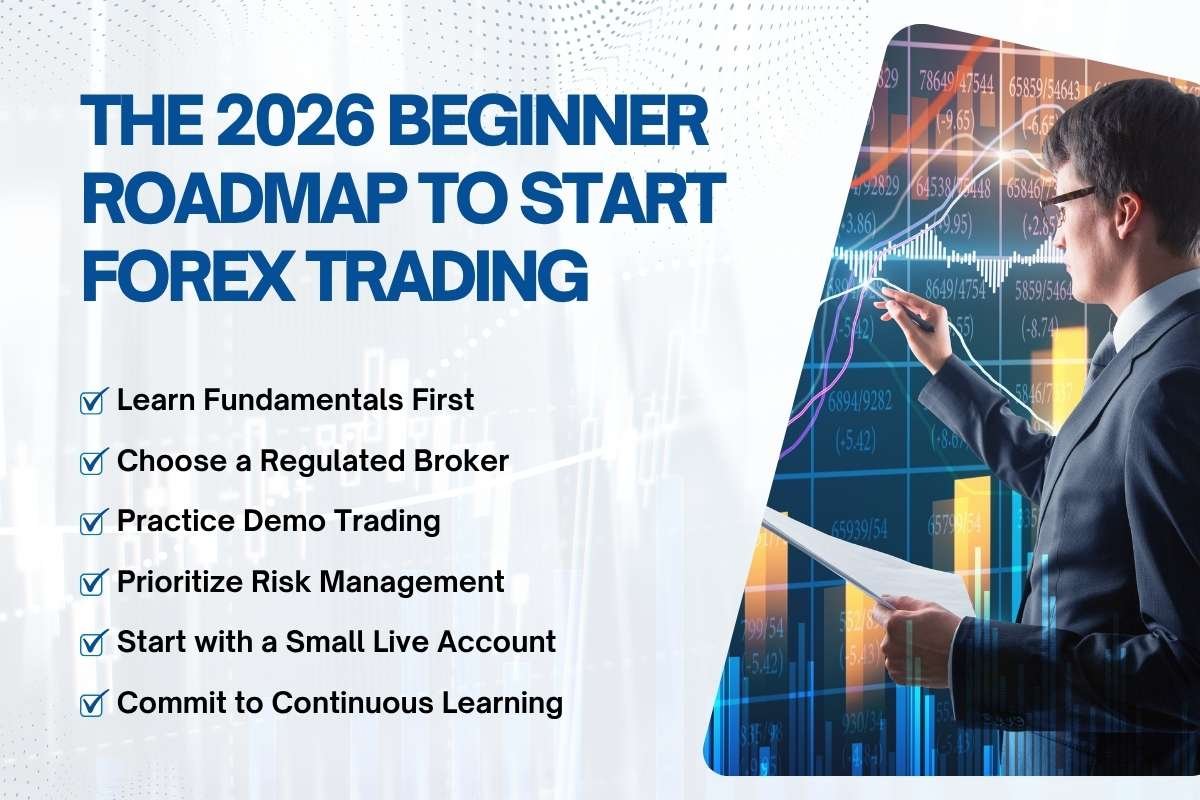
Trading forex for beginners follows a clear 2026 roadmap to build skills safely and confidently. This numbered workflow turns novices into informed traders through structured steps, emphasizing education over quick wins.
1. Learn Fundamentals First
Master basics like currency pairs (e.g., EUR/USD), pips, leverage, and market drivers. Such as interest rates or economic news. Spend 2-4 weeks on free resources: watch Khan Academy videos, read BabyPips.com lessons, or follow Investopedia guides. Quiz yourself daily to grasp how global events move prices. Knowledge prevents costly errors.
2. Choose a Regulated Broker
Pick a U.S.-based broker overseen by the CFTC and NFA. Like Interactive Brokers or OANDA, for fund safety and fair pricing. Compare spreads, platforms (e.g., MetaTrader 5), and mobile apps via sites like BrokerChooser. Verify low minimum deposits ($100-500) and U.S. client protections, no offshore risks.
3. Practice Demo Trading
Open a free demo account to trade virtual $10,000+ without real money. Simulate real conditions for 1-3 months: test strategies like trend-following on EUR/USD during New York sessions. Track wins/losses in a journal to spot patterns. It aims for consistent 1-2% monthly gains before going live.
4. Prioritize Risk Management
Never risk more than 1-2% of your account per trade. Use stop-loss orders to cap losses automatically, and apply the 1:2 risk-reward ratio (risk $10 to make $20). Learn position sizing: for a $1,000 account, max $10-20 risk. This rule protects capital during inevitable losing streaks.
5. Start with a Small Live Account
Fund $200-500 once demo-proven. Trade micro-lots (0.01) on 1-2 pairs only, like GBP/USD. Focus on high-probability setups during active hours (8 AM-12 PM ET). Withdraw profits monthly to build discipline. Scale up only after 3 profitable months.
6. Commit to Continuous Learning
Join communities like Forex Factory forums or Reddit’s r/Forex. Review trades weekly. Study books like “Trading in the Zone,” and track 2026 news via Bloomberg apps. Adapt to changes like AI-driven analysis tools. The lifelong learners thrive in volatile markets.
Essential Forex Terms Every Beginner Must Know:
Trading forex for beginners requires mastering key terms to avoid confusion. Here’s a simple glossary with short definitions.
- Pip: The smallest price move in a currency pair, usually 0.0001 (e.g., EUR/USD from 1.1050 to 1.1051 is 1 pip). It measures your profit or loss.
- Spread: The difference between buy (ask) and sell (bid) prices, your broker’s fee. Tight spreads (1-2 pips) save money on trades.
- Lot Size: Trade volume, like a standard lot (100,000 units), mini (10,000), or micro (1,000). Beginners start small to limit risk.
- Leverage: Borrowed funds to amplify trades (e.g., 50:1 means $1 controls $50). High leverage boosts gains but magnifies losses.
- Margin: Deposit needed to open a leveraged trade (e.g., 2% of a $10,000 lot is $200). It’s your “good faith” money.
- Bid/Ask: Bid is the price to sell. And ask the price to buy. EUR/USD bid 1.1050/ask 1.1052 means you buy high, sell low.
- Liquidity: How easily you trade without price shifts. Majors like EUR/USD have high liquidity for fast, stable deals.
- Volatility: Price swings from news or events. High volatility creates opportunities but raises risk. This needs to be managed wisely.
Here is the Forex Account Setup Checklist for Beginners:
Trading forex for beginners starts with a smooth account setup. Follow this simple checklist to get going safely and confidently. No rush needed.
1. Choose a Trading Platform
Pick a beginner-friendly one like MetaTrader 4/5 or TradingView-integrated brokers (e.g., OANDA or IG). Check mobile apps, charting tools, and free education. Test their demo first to ensure it feels right.
2. Complete KYC Verification
Upload your ID (passport/driver’s license), proof of address (utility bill), and SSN if U.S.-based. This takes 1-2 days for security. Regulated brokers like those under the CFTC need it to protect you.
3. Deposit Safely
Use bank transfers, cards, or PayPal for small amounts ($100-500). Enable 2FA and stick to trusted methods. Avoid crypto deposits unless verified.
4. Start Demo Account First
Practice with fake money for 1-3 months. Mimic real trades, track results, then switch to live.
Quick Tip: Avoid dumping large sums upfront. Start tiny to learn without stress. Build up as you gain wins.
These are Some Smart Risk Management Before Strategy:

Trading forex for beginners demands smart risk management before any strategy—it’s your shield against big losses in this volatile market. Treat it like seatbelts: non-negotiable for long-term success.
Core Risk Rules
- Risk 1-2% Per Trade: Never bet more than 1-2% of your total account on one position. On a $1,000 account, that’s $10-20 max risk. This keeps you in the game through rough patches.
- Always Use Stop-Loss Orders: Set automatic exits to cap losses (e.g., 20 pips below entry). Without them, one bad news event wipes out weeks of gains.
- Avoid High Leverage: Skip 100:1 ratios; stick to 10:1 or less. It tempts overtrading but explodes losses. Low leverage forces discipline.
- Protect Capital First: Profits come second. Aim for steady 1% monthly growth over home runs; surviving losing streaks builds real wealth.
Simple Example Calculation
Say your $5,000 account risks 1% ($50 max). Trading EUR/USD at 1.1000, you set a stop-loss 50 pips away (1.0950). Position size: $50 / (50 pips x $10/pip) = 0.1 lot. Loss hits? You’re down just 1%; it is an easy recovery.
Expert insights:
Before choosing indicators or strategies, beginners must understand risk. As Dominion Markets CEO Raja Zahoor explains in an interview with The Enterprise World.
“Success in trading doesn’t come from shortcuts but from discipline, risk understanding, and consistent execution over time.”
Beginner Trading Styles Compared:
Trading forex for beginners offers various styles to match your schedule and goals. Each suits different lifestyles, from quick action to patiece holding. Pick based on your time and risk tolerance.
| Style | Time Needed | Suitable For |
| Scalping | High | Full-time traders who thrive on rapid, small wins (minutes per trade) |
| Day Trading | Medium | Active learners closing all positions by day’s end (hours of focus) |
| Swing Trading | Low | Working professionals catching multi-day trends with weekly checks |
| Position Trading | Very Low | Long-term traders riding big moves over weeks or months |
A Simple Chart Reading Framework:
Trading forex for beginners gets easier with a simple chart-reading framework. Use platforms like MetaTrader 4 or TradingView. They both offer free charts, custom indicators, and mobile access for spotting setups fast.
1. Candlestick Basics
Candlesticks show price action in four points: open, high, low, and close. A green (bullish) candle means close > open, buyers won. Red (bearish) means close < open, sellers dominated. Wicks reveal rejected highs/lows. Fat bodies signal strength.
2. Support & Resistance
Support is a price floor where buying bounces prices up (e.g., prior lows). Resistance is a ceiling where selling caps rallies (prior highs). Draw horizontal lines connecting 2+ touches. The prices often reverse there.
3. Trend Direction
Link swing highs/lows: higher highs/lows = uptrend (draw up-sloping line); lower highs/lows = downtrend. Trade with the trend. Buy uptrends at support, sell downtrends at resistance.
4. Entry vs Exit Ideas
Enter buys on bullish candles at support in uptrends (e.g., hammer pattern). Exit at resistance or set take-profit 1:2 risk-reward. Use a stop-loss below support for protection.
The First Trade Workflow (Step-by-Step):
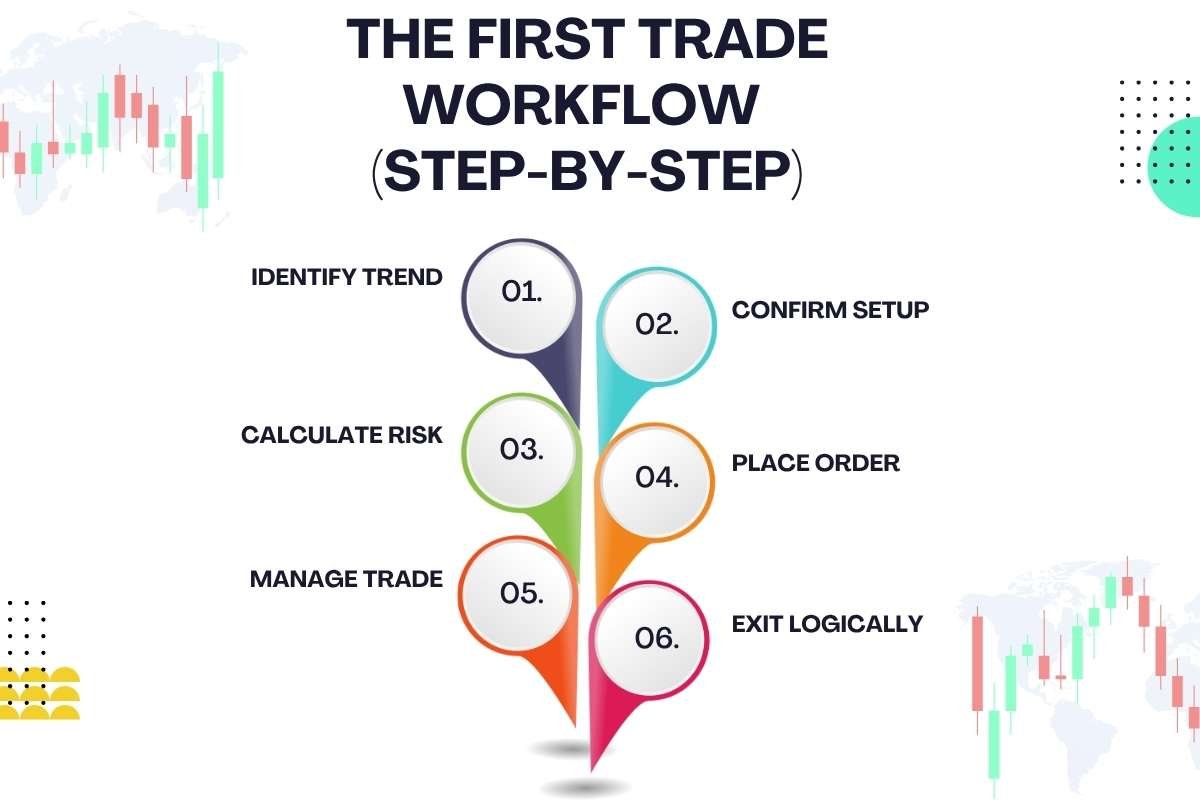
Trading forex for beginners culminates in your first trade workflow. A step-by-step model to execute calmly and cut emotions. Follow this numbered sequence every time for consistent results.
1. Identify Trend
Scan your chart (EUR/USD 1-hour) for direction: higher highs/lows signal an uptrend; lower highs/lows mean a downtrend. Use a 50-period moving average. Price above it favors buys, below favors sells.
2. Confirm Setup
Wait for alignment at support/resistance. Look for a bullish hammer candle in uptrends or a bearish shooting star in downtrends. Add RSI (above 50 for buys) to avoid fakeouts.
3. Calculate Risk
Risk 1% of the account ($10 on a $1,000 balance). Measure stop-loss distance (e.g., 30 pips below entry). Position size: $10 / (30 pips x $10/pip) = 0.03 lots. Set take-profit at 1:2 ratio (60 pips).
4. Place Order
Use a market or limit order on MetaTrader/TradingView. Enter long at 1.1050, stop-loss 1.1020, take-profit 1.1110. Double-check size and levels before hitting “buy.”
5. Manage Trade
Monitor without staring. Check every 15-30 minutes. Trail stop to entry after +20 pips profit. Ignore news urges to tweak; stick to the plan.
6. Exit Logically
Hit take-profit, stop-loss, or end-of-day if day trading. Journal: “What worked? Next fix?” No revenge trades, walk away.
These are Some Common Beginner Mistakes That Destroy Accounts:
Trading forex for beginners often ends in blown accounts from avoidable mistakes. Don’t let these trip you up. Spot them early to protect your capital and trade smarter.
- Trading Without a Plan: Jumping in on hunches or hot tips leads to random entries/exits. Fix: Write rules for trends, setups, and risk before every session. No plan, no trade.
- Using Excessive Leverage: 100:1 ratios turn $100 into $10,000 positions, but one pip wipes you out. Fix: Cap at 10:1; small accounts need tiny sizes for survival.
- Copy Trading Blindly: Following “gurus” without understanding their style loses big during their off days. Fix: Demo-test signals first; use as education, not autopilot.
- Revenge Trading: Chasing losses with bigger bets after a stop-out spirals into disaster. Fix: Step away for 24 hours post-loss. Emotion clouds judgment.
- Ignoring Risk Management: Skipping stop-losses or over-risking (5%+ per trade) erases months of gains. Fix: 1% rule always; capital preservation trumps profits.
Conclusion:
Trading forex for beginners is not a get-rich-quick scheme. It is a skill that is built upon patience, practice, and discipline. Turn volatility into your opportunity, not your wipeout. Work on education and rock-solid risk control.
Take it slowly. Use a demo account, risk only small sums, and grow your account slowly over months. Learn from anywhere, like New York to Tokyo. With 24/7 access from anywhere in the world. Along with MetaTrader and other apps.
Avoid the common pitfalls and watch the wins stack up consistently by following this guide. Commit today. Your profitable journey awaits you.
People Also Ask:
1. Is $100 enough to start forex?
Long story short, yes, you can start trading forex with just $100. But just because it’s possible, it doesn’t mean it’s easy. With a small trading account, every decision is big.
2. Is trading forex good for beginners?
Forex trading is generally not recommended for beginners without significant education, as it is highly volatile and risky, often resulting in losses for inexperienced traders. While accessible with small capital, success requires disciplined technical analysis, risk management, and psychology, not just luck.
3. What is the 5-3-1 rule in forex?
The numbers five, three and one stand for: Five currency pairs to learn and trade. Three strategies to become an expert on and use with your trades. One time to trade, the same time every day.