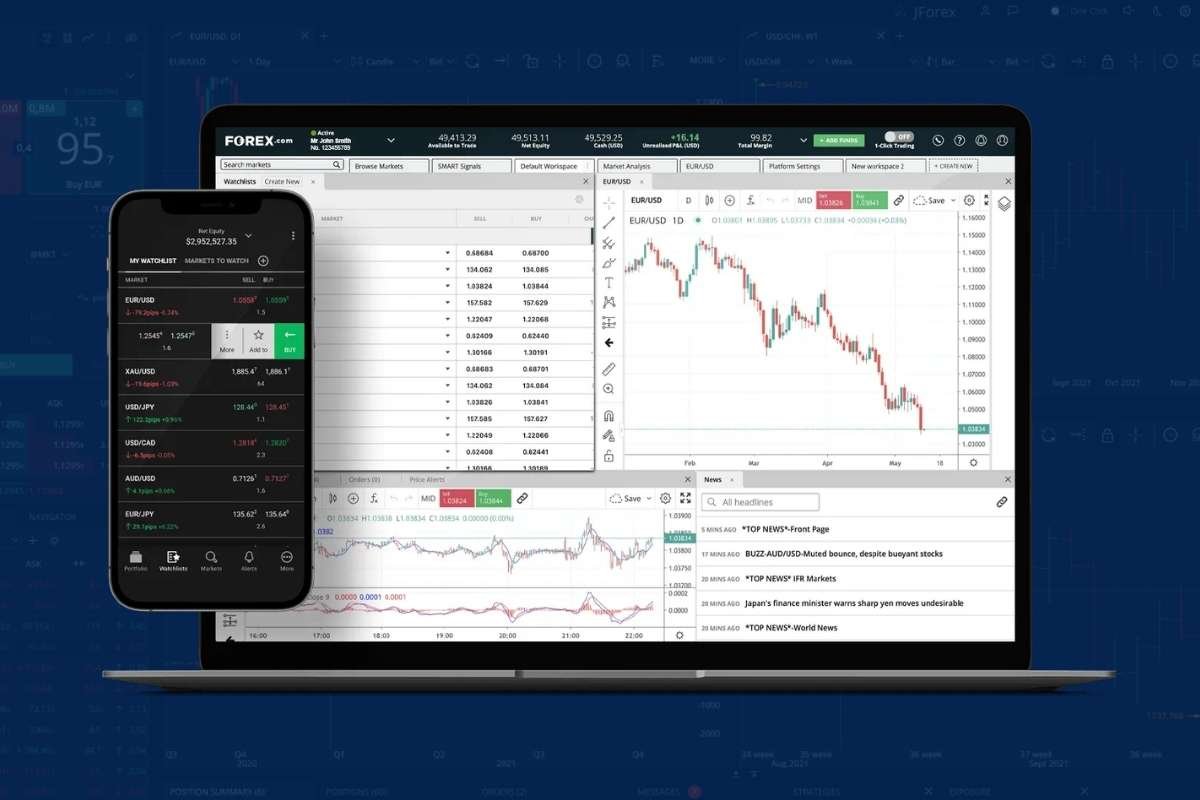
A Forex Trading platform is user-friendly software that lets you buy, sell, and manage currencies online, connecting traders to the vast global forex market.
Without one, traders can’t access real-time quotes, execute trades, or use vital tools like charts and leverage. This makes direct forex trading impossible. Beginners, investors, and professionals all need it to start safely. This guide helps you choose safely and trade smarter by prioritizing globally regulated platforms from trusted brokers.
What a Forex Trading Platform Actually Is?
In plain language, it’s a computer program or mobile app that shows you live currency prices and gives you the “Buy” and “Sell” buttons to execute trades. Without it, you’d have no way to interact with the global network of banks that trade money.
Platform vs. Broker: Why People Get Confused
People often use these terms interchangeably. But they serve different roles:
- The Broker: This is the financial institution (the “firm”) that holds your money and has the legal license to trade.
- The Platform: This is the technology (the “tool”) you use to send your orders to that broker.
- Analogy: Think of the broker as your bank account, and the forex trading platform as the banking app on your phone.
How Trades Are Executed Behind the Scenes?
When you click “Buy” on your forex trading platform, it doesn’t just happen instantly by magic.
The platform sends a digital request to your broker.
The broker matches your order with a seller in the interbank market (a global network of banks like JPMorgan or HSBC).
This all happens in milliseconds via electronic communication networks (ECNs).
Real-World Workflow: How to Use One
How do I start?
First, you open an account with a regulated broker. Once your identity is verified and you deposit funds, they provide you with login credentials for the forex trading platform.
How do I find a trade?
Next, you analyze the market. You’ll look at charts on the platform to see if the EUR/USD (Euro vs. US Dollar) is trending up or down.
How do I buy or sell?
You then place a trade. You choose your position size and click “Buy.” The platform records this entry price immediately.
How do I protect my money?
Finally, you manage risk. You set a “Stop Loss” order on the platform. This is an automated instruction that closes your trade if the price moves against you, preventing you from losing more than you planned.
These are Some Types of Forex Trading Platforms:
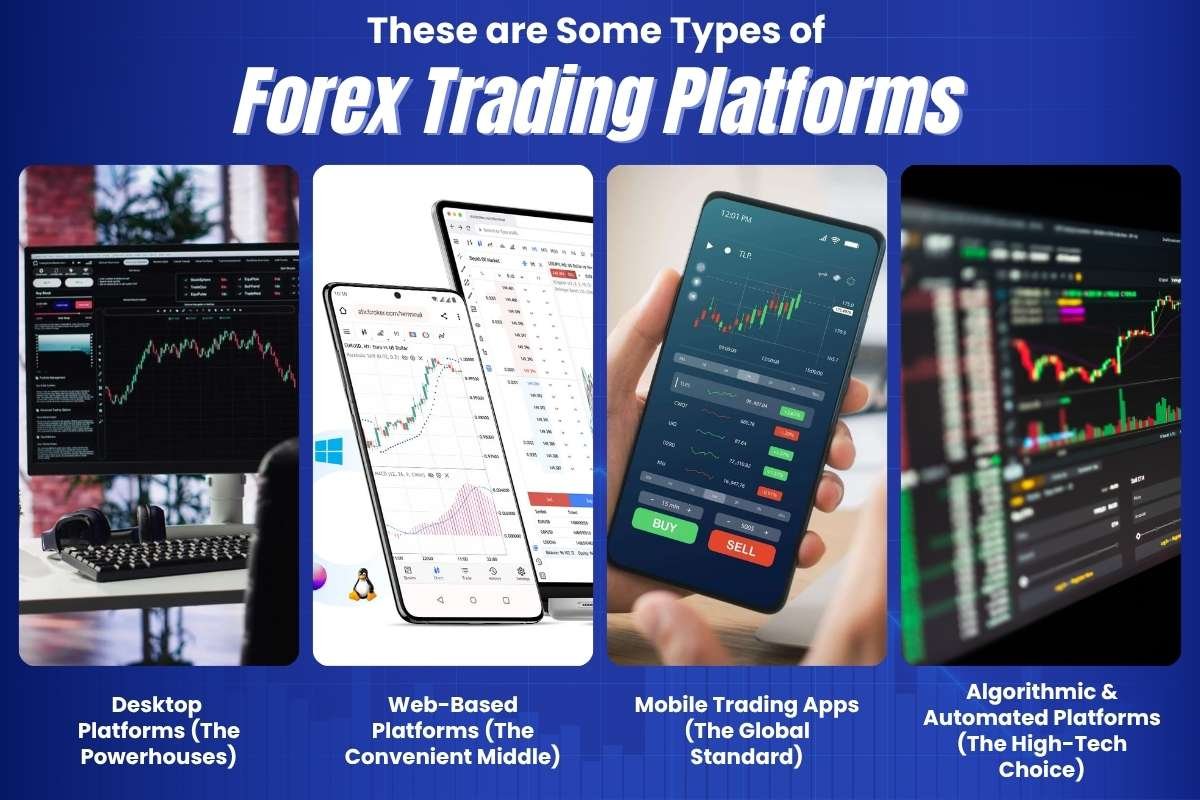
Beyond being a simple “trading app,” a forex trading platform is categorized by its technical architecture and the specific needs of the person using it. Brokers usually offer several versions of their software to cater to different environments.
1. Desktop Platforms (The Powerhouses)
These are downloadable programs built for high performance. Because they reside directly on your computer’s hard drive, they can use your CPU and RAM to process complex data faster than a browser can.
- Best for: Professional day traders and technical analysts.
- Key Feature: Multi-monitor support and advanced charting tools.
2. Web-Based Platforms (The Convenient Middle)
These run entirely in your internet browser (Chrome, Safari, or Edge) using technologies like WebAssembly to ensure they are fast. You don’t need to install anything, which makes them highly portable.
- Best for: Traders who switch between computers or use public devices.
- Key Feature: Cross-device access with a single login.
3. Mobile Trading Apps (The Global Standard)
Mobile apps are no longer just “lite” versions; they are becoming the primary forex trading platform for millions, especially in emerging markets where smartphones are the main gateway to the internet.
- Best for: Monitoring active trades and reacting to breaking news on the go.
- Key Feature: Real-time push notifications for price alerts.
4. Algorithmic & Automated Platforms (The High-Tech Choice)
Some platforms focus on “Headless” or API-first trading. Instead of a person clicking buttons, an AI or a pre-programmed script (often called an Expert Advisor or “Bot”) executes trades based on logic.
- Best for: Quantitative traders and those interested in “Copy Trading.”
- Key Feature: 24/7 market participation without human emotion.
Comparison Table: Which Platform Suits You?
| Feature | Desktop | Web-Based | Mobile App | Algorithmic |
| Speed | Ultra-Fast | Fast | Moderate | Instant (API) |
| Analysis | Advanced | Standard | Basic | Automated |
| Portability | Low | High | Ultra-High | N/A (Runs on Server) |
| User Level | Professional | Intermediate | Beginner | Specialized |
Which Platform Type Fits You Best?
Choosing the right forex trading platform is like picking a car; the “best” one depends entirely on where you are going and how fast you want to get there.
1. For Beginners (The Learners)
If you are just starting, you need a forex trading platform that doesn’t feel like the cockpit of a jet. Look for “Proprietary” platforms designed by brokers specifically for ease of use.
- Must-haves: A clean, simple UI and integrated educational videos.
- The Secret Weapon: Demo accounts. These allow you to trade with “fake money” in real market conditions so you can practice without risk.
2. For Active Day Traders (The Professionals)
If you plan to enter and exit trades dozens of times a day, speed and data are your best friends.
- Must-haves: One-click trading and lightning-fast execution.
- The Secret Weapon: Advanced charting. You need the ability to draw trend lines, use Fibonacci tools, and view multiple timeframes simultaneously to catch small price movements.
3. For Mobile Traders (The Busy Movers)
If you have a full-time job or travel frequently, your forex trading platform must live in your pocket.
- Must-haves: Biometric security (FaceID) and low-latency price feeds.
- The Secret Weapon: Push alerts. You can set the app to ping your phone the moment a currency hits a specific price, so you never miss a move while away from your desk.
4. For Algorithmic Traders (The Tech-Savvy)
If you prefer logic and math over manual clicking, you need a platform built for code.
- Must-haves: Robust API access and VPS (Virtual Private Server) hosting support.
- The Secret Weapon: Strategy testers. These allow you to run your automated “bot” against years of historical data to see if it would have been profitable in the past.
How do Forex Trading Platforms Work Globally?
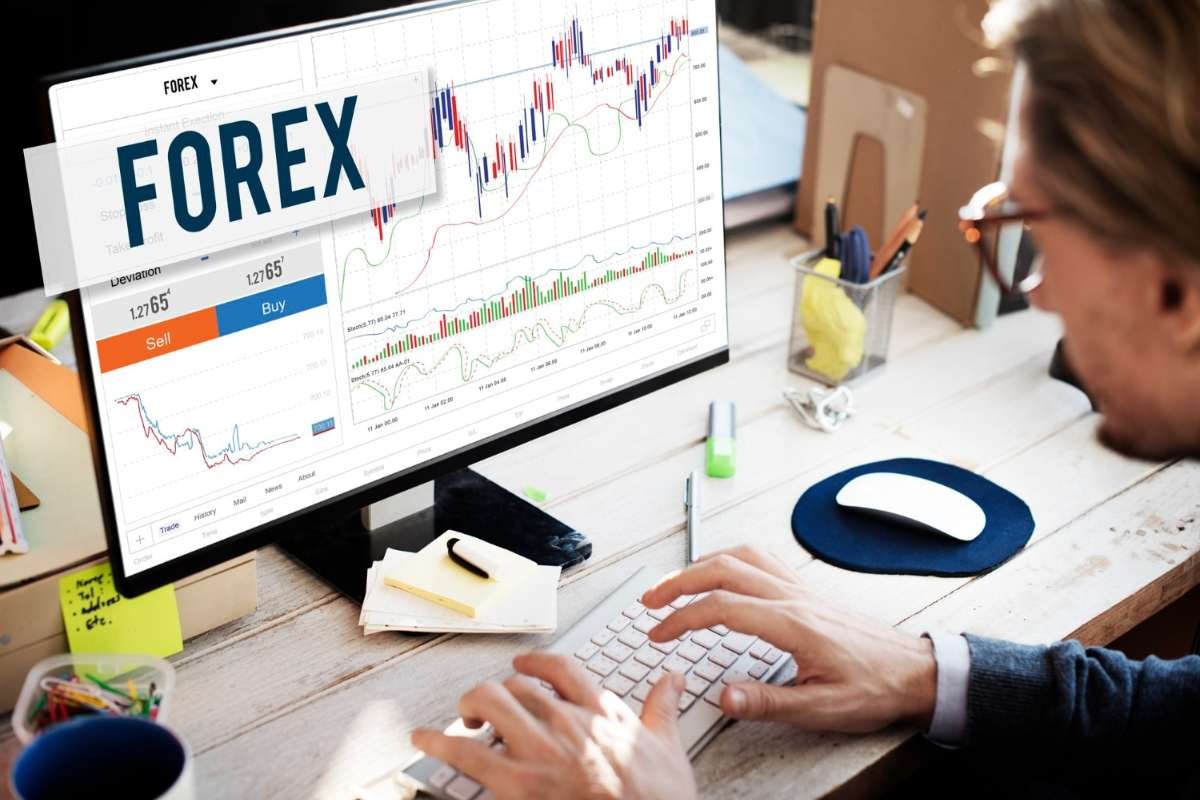
To understand a forex trading platform fully, you have to look past the “Buy” button and into the global digital engine that powers it. It is a high-speed relay system connecting your home office to the world’s largest banks.
1. Who provides the prices?
Your platform gets its data from Liquidity Providers (LPs). These are Tier-1 banks (like JPMorgan or Deutsche Bank) and non-bank institutions that constantly quote prices. The more LPs your broker connects to, the better the prices you see.
2. How does the platform make money?
Instead of a flat fee, most platforms use Spreads & Commissions.
- The Spread: The tiny difference between the Buy (Ask) and Sell (Bid) price.
- The Commission: A small fixed fee per trade, usually found on “ECN” platform types that offer raw market spreads.
- When is the market open?
The forex market is a 24-hour machine because it follows the sun across four major sessions: Sydney, Tokyo, London, and New York. When one city goes to sleep, another wakes up, ensuring your forex trading platform is always live from Sunday night to Friday night.
3. Why do servers matter?
Professional trading servers are physically located in major financial hubs like London (LD4) or New York (NY4). The closer your broker’s server is to the Liquidity Provider’s server, the faster your trade happens.
Here Are Some Important Security and Trust Checks:
Since a forex trading platform handles your hard-earned money, security isn’t just a feature—it is the foundation. To protect yourself, you must ensure the platform is backed by a reputable broker under strict oversight.
1. Regulatory Bodies Traders Should Know
The world’s most secure platforms are regulated by “Tier-1” authorities. These organizations set the rules that keep brokers honest and your money safe.
- FCA (UK): The Financial Conduct Authority is known for the strictest investor protections in the world.
- CFTC (USA): The Commodity Futures Trading Commission oversees the massive US market with rigorous reporting rules.
- ASIC (Australia): The Australian Securities and Investments Commission provides high-level oversight for the Asia-Pacific region.
- CySEC (Cyprus): A common regulator for European-based platforms, providing a gateway to the EU market.
2. The Ultimate Safety Checklist
Before you deposit a single dollar, verify that the forex trading platform and its broker provide these four pillars of security:
- Segregated Client Funds: Your money must be kept in a separate bank account from the broker’s corporate funds. This ensures that if the broker goes bankrupt, your money remains safe.
- SSL Encryption: Look for the padlock icon in your browser or high-level encryption in the app. This prevents hackers from intercepting your login details or financial data.
- Negative Balance Protection: This is a vital safety net. It ensures that you can never lose more money than you have in your account, even during extreme market crashes.
- Transparent Fees: A trustworthy platform will clearly list its spreads, commissions, and “swap” (overnight) fees. If the costs are hidden, the platform isn’t safe.
3. Official Risk Warning
Forex trading carries a high level of risk to your capital and is not suitable for all investors. Most retail investor accounts lose money when trading CFDs. You should consider whether you understand how forex works and whether you can afford to take the high risk of losing your money. Never trade with funds you cannot afford to lose.
Demo vs Live Trading: When Should You Switch?
The final step in mastering a forex trading platform is moving from practice to reality. While the buttons look the same, the experience is entirely different.
1. The Role of the Demo Account
A demo account is a “sandbox” version of a forex trading platform that uses virtual money.
- Zero Risk: You can make massive mistakes without losing a cent.
- Tool Mastery: It’s the best way to learn where the “Stop Loss” and “Take Profit” buttons are.
- Strategy Testing: You can see if your trading plan actually works over dozens of trades.
2. The Psychological Gap
The biggest shock for traders is that live trading feels different. When real money is on the line, your brain triggers a “fight or flight” response. You may feel tempted to close winning trades too early out of fear, or let losing trades run too long out of hope. A demo account cannot simulate this emotional pressure.
3. Demo Trading Mistakes
Even without real money, beginners often fall into these traps:
- The “Lottery” Mindset: Trading with massive positions you would never afford in real life.
- Ignoring the Rules: Not using a Stop Loss because “it’s just fake money.”
- Over-Trading: Clicking buttons constantly just because there is no financial consequence.
4. Signs You’re Ready for Live Trading
You shouldn’t switch until you can check these boxes:
- Platform Fluency: You can navigate your forex trading platform and place orders in your sleep.
- Consistent Results: You have been “profitable” on demo for at least one to three months.
- Written Plan: You have a set of rules for when to enter and exit, and you follow them every time.
- Capital You Can Lose: You have extra savings that won’t impact your rent or groceries if lost.
The Pro Strategy: When you switch, start with a “Micro Account.” This allows you to trade with very small amounts of real money, giving you the emotional experience of live trading without the high stakes.
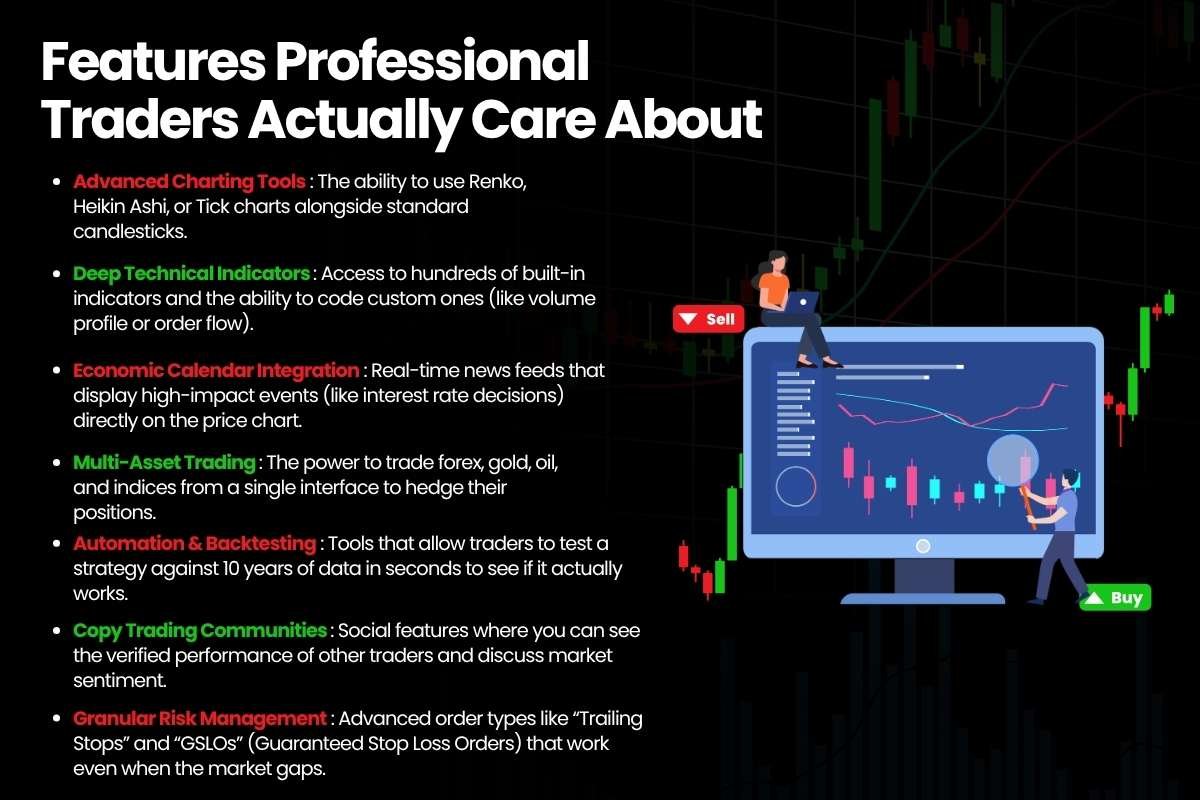
Features Professional Traders Actually Care About:
Professional traders don’t choose a forex trading platform based on flashy marketing or sign-up bonuses. They focus on the specific tools that help them find an “edge” and protect their capital.
High-Performance Feature Set
- Advanced Charting Tools: The ability to use Renko, Heikin Ashi, or Tick charts alongside standard candlesticks.
- Deep Technical Indicators: Access to hundreds of built-in indicators and the ability to code custom ones (like volume profile or order flow).
- Economic Calendar Integration: Real-time news feeds that display high-impact events (like interest rate decisions) directly on the price chart.
- Multi-Asset Trading: The power to trade forex, gold, oil, and indices from a single interface to hedge their positions.
- Automation & Backtesting: Tools that allow traders to test a strategy against 10 years of data in seconds to see if it actually works.
- Copy Trading Communities: Social features where you can see the verified performance of other traders and discuss market sentiment.
- Granular Risk Management: Advanced order types like “Trailing Stops” and “GSLOs” (Guaranteed Stop Loss Orders) that work even when the market gaps.
Why These Matter
For a professional, the forex trading platform is a surgical instrument. If the data is delayed by even a few seconds, or if the charting tools are too basic to see hidden patterns, they can’t compete with the algorithms used by big banks. Professional-grade platforms prioritize data accuracy and customization above all else.
7-Day Forex Trading Platform Testing Plan:
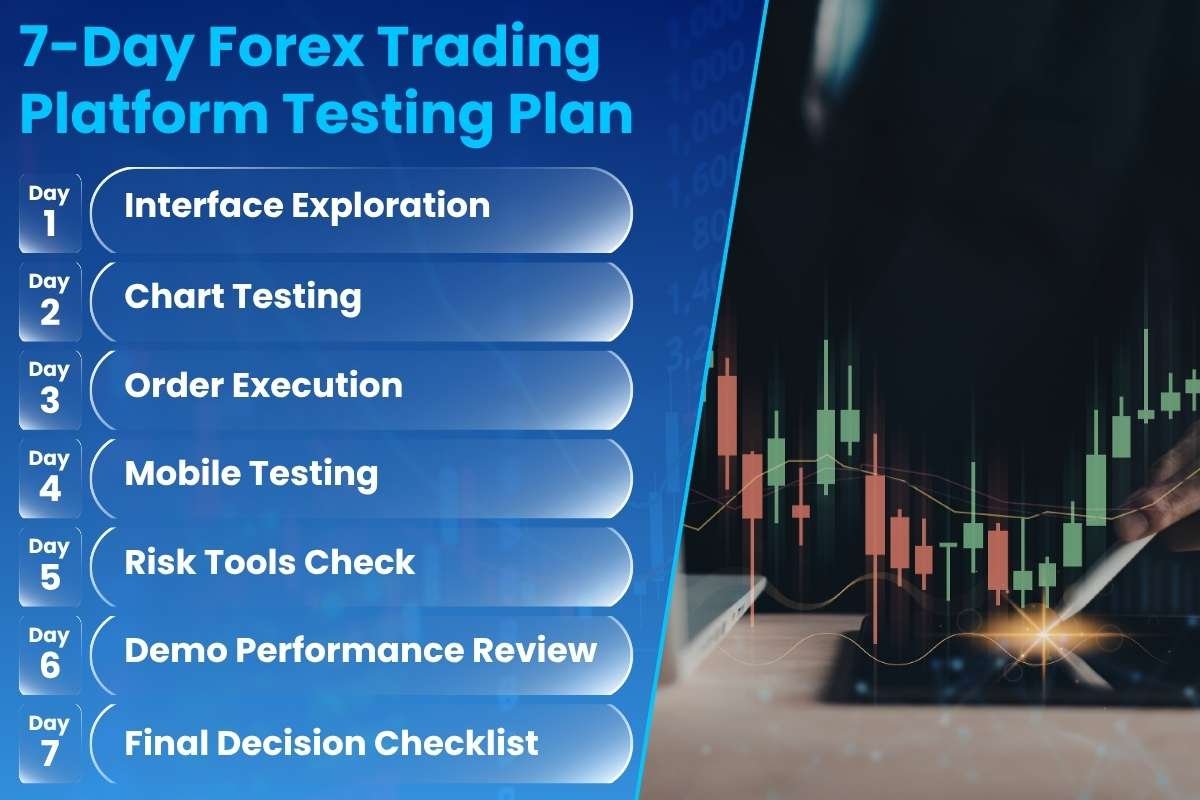
Before you trust a forex trading platform with your capital, you should put it through a “stress test.” This 7-day plan ensures you evaluate the tech, the speed, and the support before going live.
The 7-Day Road Test:
- Day 1: Interface Exploration Spend an hour customizing the layout. Can you move the windows? Is the “dark mode” easy on your eyes? If the workspace feels clunky now, it will be frustrating during a fast trade.
- Day 2: Chart Testing Open multiple currency pairs at once. Add five different indicators. Does these trading platform slow down or lag? High-quality software should remain snappy even with heavy data loads.
- Day 3: Order Execution Place several “Market” and “Limit” orders on your demo account. Notice the time it takes from clicking the button to the trade appearing on the screen. Speed is everything.
- Day 4: Mobile Testing Download the app version. Try to set a price alert and close a trade while using cellular data (not Wi-Fi). A reliable mobile trading platform must work well on the move.
- Day 5: Risk Tools Check Practice setting “Stop Loss” and “Take Profit” levels. Change them while the trade is active. Ensure you understand exactly how to “Flatten” (close) all positions in an emergency.
- Day 6: Demo Performance Review. Look at your trade history. Does the platform provide clear statistics on your wins and losses? Good platforms offer “Trading Journals” or performance analytics to help you improve.
- Day 7: Final Decision Checklist Review the support. Send a quick question to the help desk. If they respond quickly and the software has passed the previous six days, you’ve found your platform.
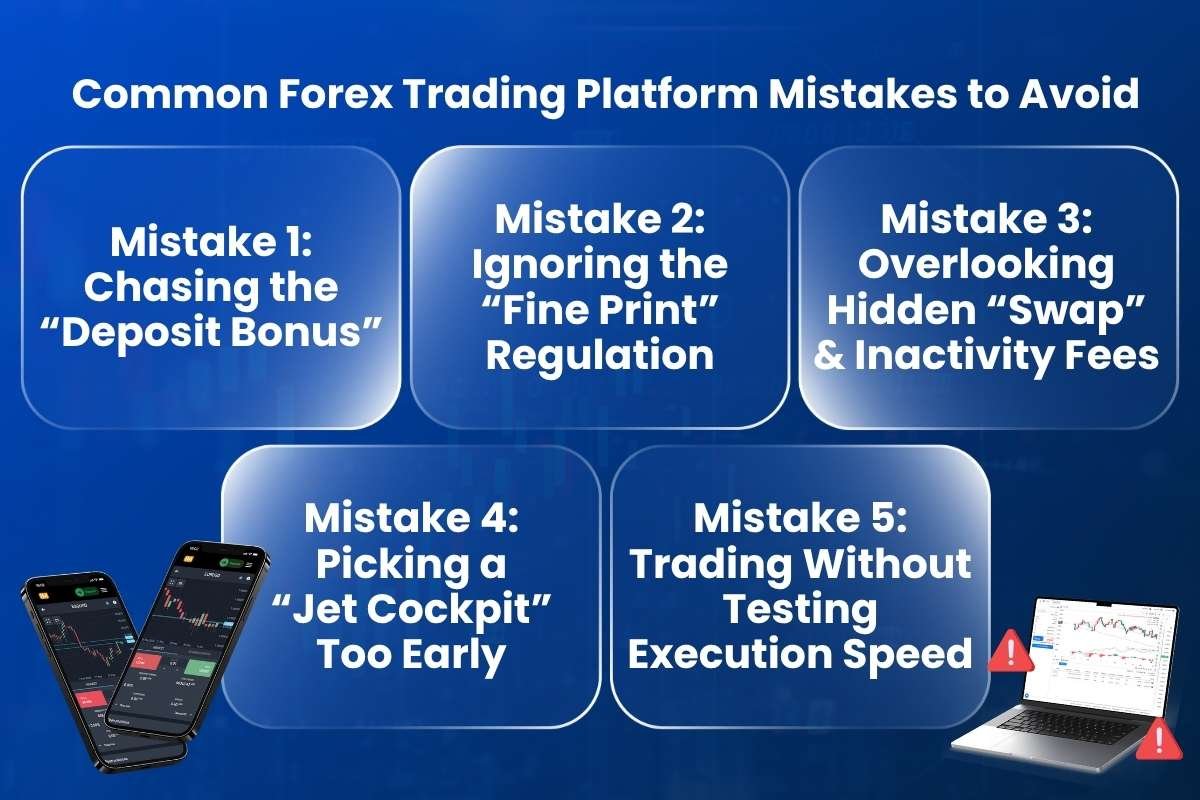
Common Forex Trading Platform Mistakes to Avoid:
Even the best strategy can fail if you are using the wrong forex trading platform. Many traders lose money not because of the market, but because of avoidable technical or administrative traps.
Mistake 1: Chasing the “Deposit Bonus”
Many unregulated brokers offer massive “100% deposit bonuses” to lure you in.
- The Reality: These bonuses often come with “lock-in” clauses that prevent you from withdrawing your own profit until you trade an impossible amount of volume.
- The Lesson: Choose a platform based on its regulation and technology, not its freebies.
Mistake 2: Ignoring the “Fine Print” Regulation
Just because a trading platform looks professional doesn’t mean it is safe.
- The Reality: Some platforms operate from offshore islands with zero oversight. If they disappear with your money, you have no legal recourse.
- The Lesson: Always verify the license number on the official regulator’s website (like the FCA or ASIC).
Mistake 3: Overlooking Hidden “Swap” & Inactivity Fees
Trading costs aren’t just the spread.
- The Reality: Some platforms charge high “swap” fees (interest for holding a trade overnight) or “inactivity fees” if you don’t trade for a month. Over time, these can eat 10% to 20% of your account.
- The Lesson: Check the “Fee Schedule” before you fund your account.
Mistake 4: Picking a “Jet Cockpit” Too Early
Beginners often download professional-grade platforms because they look “cool.”
- The Reality: If a platform is too complex, you are more likely to make a “fat-finger” error. Like accidentally buying 10 times more than you intended or forgetting to set a Stop Loss.
- The Lesson: Start with a simple, user-friendly trading platform and upgrade as your skills grow.
Mistake 5: Trading Without Testing Execution Speed
You might see a price of 1.0800, but by the time you click, the trade fills at 1.0805.
- The Reality: Slow execution (latency) acts like a hidden tax on every trade you make.
- The Lesson: Use your 7-day demo period to ensure trades are “filled” instantly. If there is a constant delay, find a different platform.
Future Trends in Forex Trading Platforms:
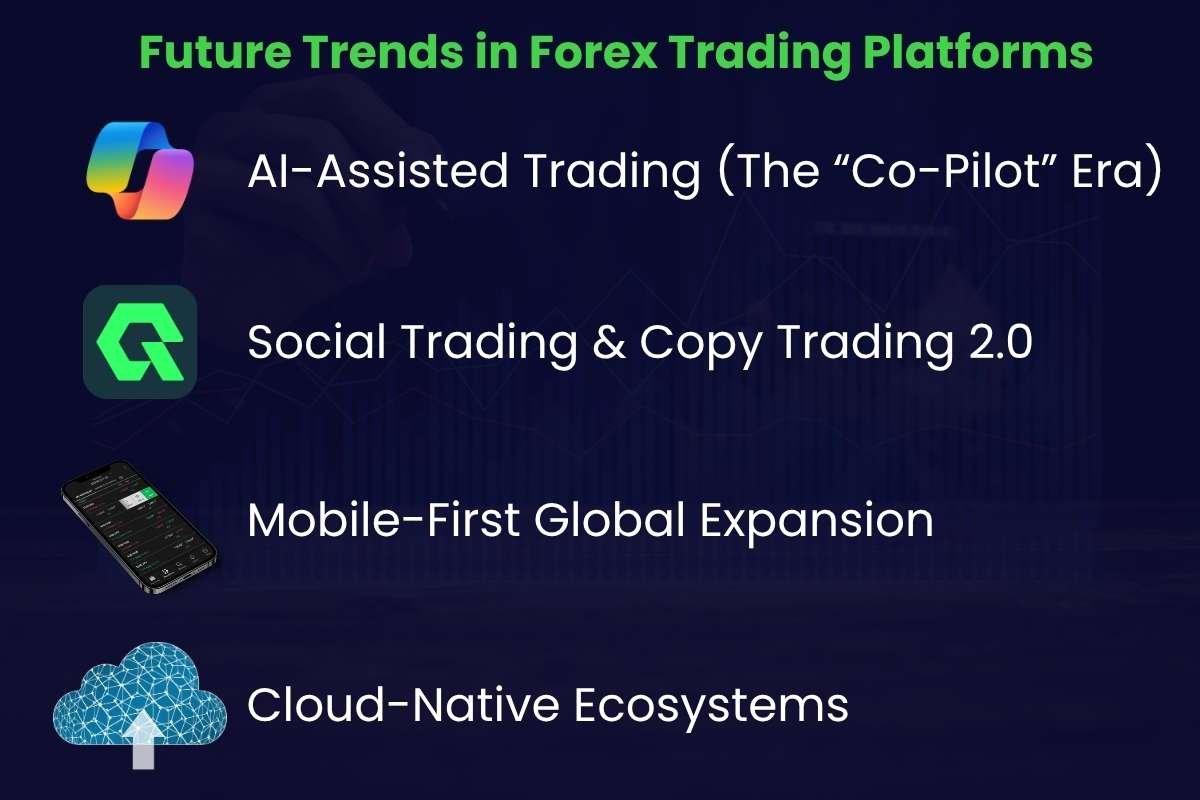
As we move through 2026, the forex trading platform is evolving from a simple execution tool into a highly intelligent, cloud-native assistant. Technology is bridging the gap between retail hobbyists and institutional professionals.
1. AI-Assisted Trading (The “Co-Pilot” Era)
In 2026, AI is no longer just for automated bots. Modern platforms now feature “Agentic AI,” integrated assistants that can read central bank statements in real-time, detect “hawkish” or “dovish” tones, and instantly alert you to the potential price impact.
Predictive Risk: Platforms now use AI to scan your personal trading journal, identifying emotional patterns like “revenge trading” before you click the button.
2. Social Trading & Copy Trading 2.0
Social trading has matured into a multi-billion-dollar ecosystem. Instead of just following “top gainers,” 2026 platforms allow you to copy strategies based on risk-adjusted returns and specific market conditions (e.g., “Copy this trader only during high-volatility news”).
3. Mobile-First Global Expansion
More than 80% of new traders now start their journey on a smartphone. This has pushed developers to create ultra-low-latency mobile apps that offer the same technical power as desktop versions, specifically tailored for emerging markets in Asia and Africa.
4. Cloud-Native Ecosystems
The era of heavy software downloads is ending. The next-generation forex trading platform is built on cloud infrastructure, ensuring that your charts, indicators, and automated scripts stay “hot” and active on a server 24/7, even when your devices are turned off.
Conclusion:
Choosing a forex trading platform is the most important technical choice you will make as a trader in the end. It’s not just a piece of software; it’s your direct link to the world economy and the main way to protect your money.
You can set yourself up for long-term success by putting regulation first, testing execution speeds, and making sure the platform’s features are right for your level of experience. Whether you like the power of a desktop setup or the freedom of a mobile app, make sure your forex trading platform is safe and open. Begin with a demo, stick to your plan, and always put risk management at the center of your strategy.
People Also Ask:
1. Which platform is best for forex trading?
The best forex trading platforms in 2026 include IG, tastyfx, OANDA, and FOREX.com, favored for their strong regulation, low spreads, and robust technology. IG is rated top overall, while tastyfx and OANDA are leading choices for U.S. traders due to ease of use and competitive pricing.
2. Is it possible to make $1000 a day in forex?
In summary, making $1000 a day in forex happens for experienced traders with sizable accounts, strong strategies, and ironclad risk management, but it is far from typical or easy. Most successful traders prioritize survival and steady growth over flashy daily numbers.
3. How much money do I need to start forex?
You can start forex trading with as little as $1 to $100 using micro-accounts, but a more realistic, recommended minimum is $500 to $1,000 for effective risk management. While low capital allows entry, higher amounts (e.g., $2,500+) provide more flexibility and reduce the risk of immediately losing your entire account.