At 2 a.m., while most of the country sleeps, a silent conversation is happening across the power grid. Thousands of sensors tucked into substations and power lines are mapping the flow of electricity in real time, tracking where a neighborhood needs more juice and where solar panels are feeding a surplus back into the wires. This isn’t being managed by a flickering wall of monitors in a control room anymore; it’s being guided by an invisible nervous system of smart tech that routes power where it’s needed most, cutting waste and preventing blackouts before they start. This is the reality of sustainable IoT, increasingly shaped by the Sustainable IoT policy USA approach: a quiet, high-tech overhaul of how America manages its energy.
Interestingly, this shift didn’t come from one massive, “all-in-one” piece of legislation. There was no single “Sustainable IoT Act” passed with a victory lap on the Capitol steps. Instead, the change happened through a quiet patchwork of policy: tax credits for clean energy, new cybersecurity standards from NIST, and the massive wave of infrastructure funding from the 2022 Inflation Reduction Act. By making sensors and smart controls affordable, the government effectively built the foundation for a modern grid without ever needing a flashy headline. Now, the industry is left with a pressing question: is the country ready to manage the sophisticated, interconnected system it has just finished building?
The Policy Backbone of a Smarter, Cleaner Grid
The shift toward a smarter, more sustainable grid isn’t happening by accident. It is being built on three specific policy pillars: money, security, and physical infrastructure. Together, these forces have turned smart technology from an expensive “nice-to-have” into the standard way of doing business, reinforcing the impact of Sustainable IoT policy USA across industries.
1. The Financial Spark: The Inflation Reduction Act (IRA)
The IRA is essentially the largest climate investment in U.S. history, but it works through a simple carrot-and-stick approach: if you build clean energy, the government helps pick up the tab. Tax credits now cover up to 30% of project costs for solar, wind, and battery storage.
However, there’s a catch that rarely makes the headlines: you can’t run a modern wind farm or a massive battery site without IoT. Without sensors to monitor temperature, output, and grid demand in real-time, these multi-billion dollar investments are useless. Because the IRA made the hardware affordable, it effectively forced the adoption of the “nervous system” required to run it.
2. The Security Floor: NIST Standards
While the money flowed in, the National Institute of Standards and Technology (NIST) worked on keeping the doors locked. New federal mandates now prevent government agencies from buying any IoT device that doesn’t meet strict cybersecurity benchmarks.
This created a massive ripple effect. Since manufacturers want those lucrative government contracts, they’ve started building security, like encrypted communication and better patching, into all their devices by default, a shift strongly aligned with Sustainable IoT policy USA priorities. Programs like the “U.S. Cyber Trust Mark” now give companies and homeowners the confidence that the smart sensors they’re installing aren’t leaving them vulnerable to hackers.
3. The Physical Backbone: Infrastructure Funding
Finally, the Bipartisan Infrastructure Law provided the raw capital to upgrade the actual wires and substations. We’re seeing a surge in “grid-enhancing technologies” – smart sensors that allow utilities to squeeze more power out of existing lines by monitoring their temperature and capacity in real-time.
Major players like Duke Energy are already using this funding to pair sensors with AI, allowing them to predict demand spikes and manage their $145 billion modernization plans with surgical precision, reflecting how Sustainable IoT policy USA is translating into real infrastructure upgrades.
Inside the Grid’s Invisible Nervous System
When you move past the policy talk, you can see this “invisible nervous system” actually at work. It’s not just a concept; it’s tangible technology making three specific sectors much cleaner and more efficient.
1. The Power Grid: From Reactive to Predictive
Modern electric companies are turning into tech companies. Take Duke Energy, which is using AI to crunch real-time data on weather and usage patterns to decide exactly where to send power.
This isn’t just about efficiency; it’s about survival. During a massive heatwave in June 2024, the Mid-Atlantic grid nearly hit its breaking point. We’ve learned that if we had more hyper-local sensors and AI-driven forecasts in place, operators could have shifted power around before the crisis hit, avoiding price spikes and potential blackouts. It turns the grid from a system that reacts to disasters into one that anticipates them, aligning with the goals of Sustainable IoT policy USA.
2. Buildings: Making Every Watt Count
Buildings are responsible for nearly 40% of energy-related emissions in the U.S., and half of that goes toward heating and cooling. IoT is changing the math here.
- Smart Sensors: Instead of heating an empty office, occupancy sensors tell the HVAC system to power down when people leave. This alone can cut energy use by 20%.
- Smart Thermostats: For homeowners, devices like the Nest aren’t just gadgets; they are “carbon accountants.” They learn your habits and adjust to the weather, saving billions of kilowatt-hours nationwide, reflecting how Sustainable IoT policy USA is shaping everyday energy efficiency.
3. Industry: Efficiency on the Factory Floor
In factories, IoT is the ultimate waste-killer. Sensors on motors and compressors can tell an engineer a machine is about to fail before it actually breaks. This “predictive maintenance” doesn’t just save money, it prevents the massive energy spikes and material waste that come with equipment breakdowns. Even delivery fleets are getting in on it, using real-time routing to cut fuel consumption by up to 15%.
The Big Picture: A Silent Revolution
The beauty of this shift is that it’s becoming “business as usual.” A utility company doesn’t install smart meters because they want a headline; they do it because, thanks to the current incentives tied to Sustainable IoT policy USA, it’s now the most profitable way to operate.
The real question moving forward isn’t whether the technology works; it clearly does. It’s whether we can keep these incentives consistent across political cycles and ensure our cybersecurity stays one step ahead of the grid’s growth.
The Incentive Engine: Why Money is the Ultimate Motivator?
If policy is the blueprint, then money is the fuel. The shift toward a smarter grid isn’t happening because of a sudden surge in corporate altruism; it’s happening because the government made it profitable.
The Inflation Reduction Act (IRA) is the heavy hitter here. It offers a 30% tax credit for renewable energy and storage projects. But there’s a clever catch: to get that money, the projects have to actually work efficiently, which makes IoT sensors and smart controllers a requirement, not an option—another reason why Sustainable IoT policy USA continues to shape investment decisions.
Key Financial Shifts:
- Tax Credit Selling: Since 2023, even nonprofits and small towns that don’t pay much in taxes can sell their credits to bigger companies for cash. This opened the door for local schools and small-town utilities to afford the same smart tech as giant corporations.
- The Manufacturing Boom: 2. Billions are pouring into American factories to build batteries and sensors right here. By keeping the supply chain local, the cost of these high-tech components is finally dropping, a trend accelerated by Sustainable IoT policy USA initiatives.
- The “Shadow” of Uncertainty: The only real threat is political. Companies making 10-year bets on new factories are constantly looking over their shoulders, wondering if a change in administration will pull the rug out from under these tax breaks.
IoT in the Wild: Three Major Wins
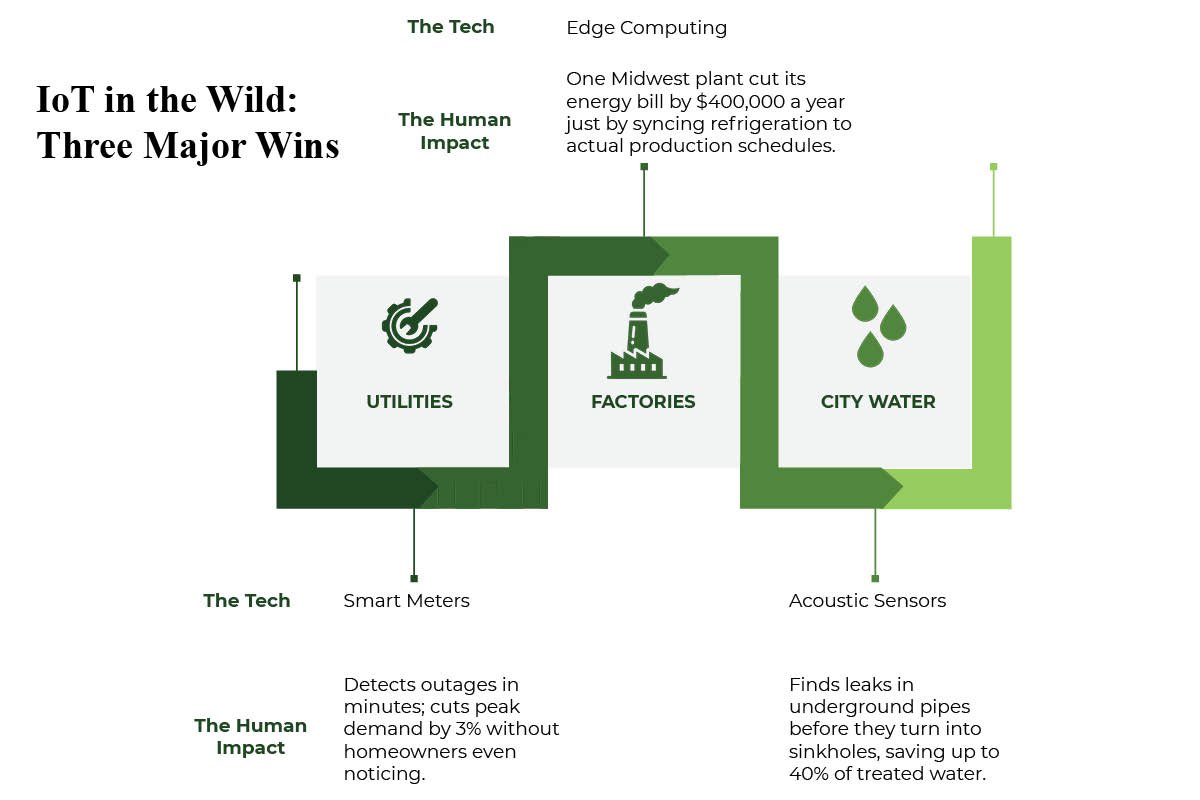
We are past the “pilot program” phase. Here is where the data shows IoT is actually moving the needle:
| Sector | The Tech | The Human Impact |
| Utilities | Smart Meters | Detects outages in minutes; cuts peak demand by 3% without homeowners even noticing. |
| Factories | Edge Computing | One Midwest plant cut its energy bill by $400,000 a year just by syncing refrigeration to actual production schedules. |
| City Water | Acoustic Sensors | Finds leaks in underground pipes before they turn into sinkholes, saving up to 40% of treated water. |
The Reality Check: No Free Lunch
Despite the excitement, sustainable IoT has a “dark side” that experts are starting to worry about. If we aren’t careful, the cure could become its own disease.
1. The E-Waste Problem
Every smart sensor has a battery and a circuit board. Manufacturing them creates carbon, and throwing them away creates toxic waste. Some studies suggest that the “cost” of making and disposing of these devices could eat up 15% of the carbon they actually save. We need better recycling, and we need it fast.
2. The Cybersecurity Gap
More sensors mean more “doors” for hackers to kick in. A “smart” grid is a more vulnerable grid. Even with NIST standards, a 2023 survey found that 40% of federal IoT devices still had unpatched security holes, raising concerns even within frameworks like Sustainable IoT policy USA.
3. The Rebound Effect
This is a classic human behavior problem. When we make energy cheaper through efficiency, people often just use more of it. If a factory saves 20% on its power bill, the manager might just decide to run an extra shift. If we don’t pair efficiency with actual limits or carbon pricing, we might just be running faster to stay in the same place.
Sustainable IoT: The Progress in Numbers
The abstract policy talk becomes concrete when you look at the measurable wins across the U.S. grid, factories, and cities. We are seeing a transition from “experimental pilots” to essential infrastructure.
[Sector Impact: Where We’re Winning]
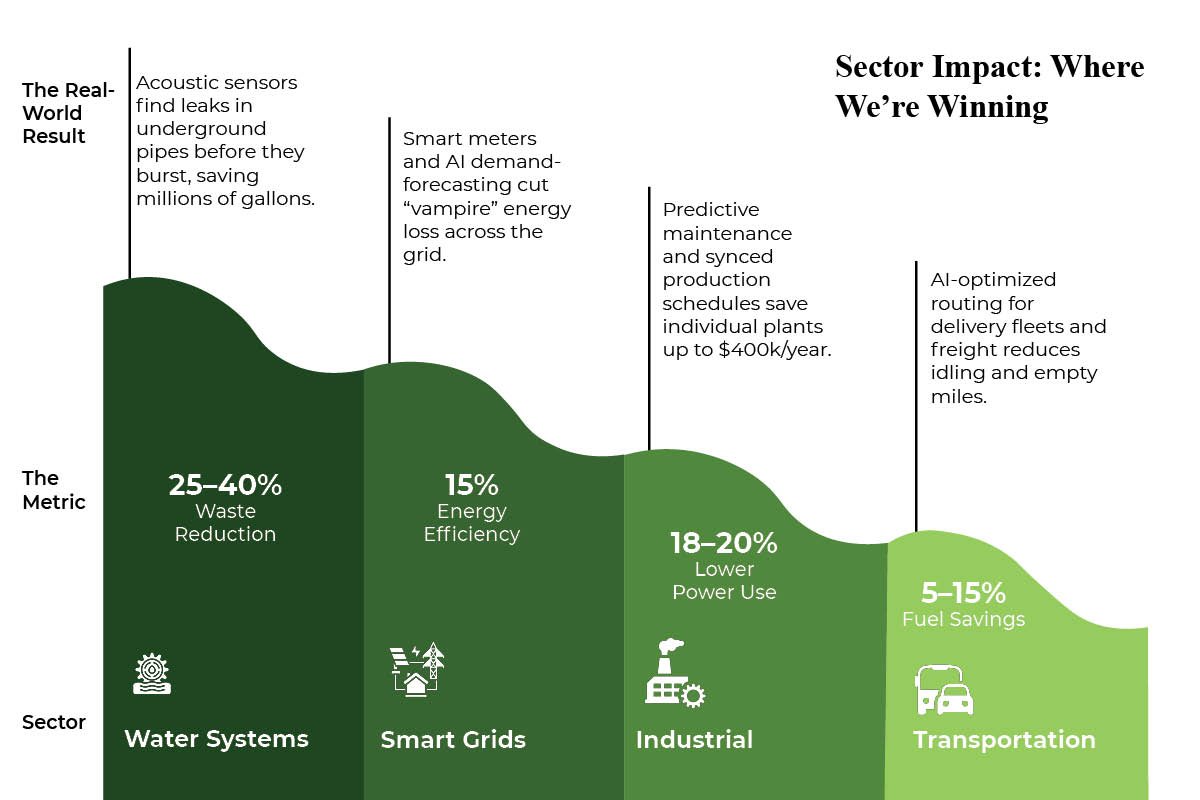
If current momentum holds, the potential for cutting emissions and resource waste by 2030 is staggering:
| Sector | The Metric | The Real-World Result |
| Water Systems | 25–40% Waste Reduction | Acoustic sensors find leaks in underground pipes before they burst, saving millions of gallons. |
| Smart Grids | 15% Energy Efficiency | Smart meters and AI demand-forecasting cut “vampire” energy loss across the grid. |
| Industrial | 18–20% Lower Power Use | Predictive maintenance and synced production schedules save individual plants up to $400k/year. |
| Transportation | 5–15% Fuel Savings | AI-optimized routing for delivery fleets and freight reduces idling and empty miles. |
[U.S. Case Map: Cities Leading the Revolution]
- Pittsburgh: AI-optimized traffic signals have already reduced vehicle emissions by 21% and cut travel times by nearly half, showcasing the real-world impact of Sustainable IoT policy USA.
- Chattanooga: Uses a “Digital Twin” of the city to analyze freight traffic, optimizing trucking routes to slash urban congestion.
- Columbus: Winner of the Smart City Challenge; has connected 600+ emergency vehicles to traffic lights to cut response times by 15%.
- Portland: Uses 20,000 smart streetlights that dim based on weather and pedestrian activity, cutting lighting energy by 35%.
- Austin: A digital meter system that allows homeowners to feed solar energy back into the grid seamlessly.
[Policy Timeline: 2021–2026]
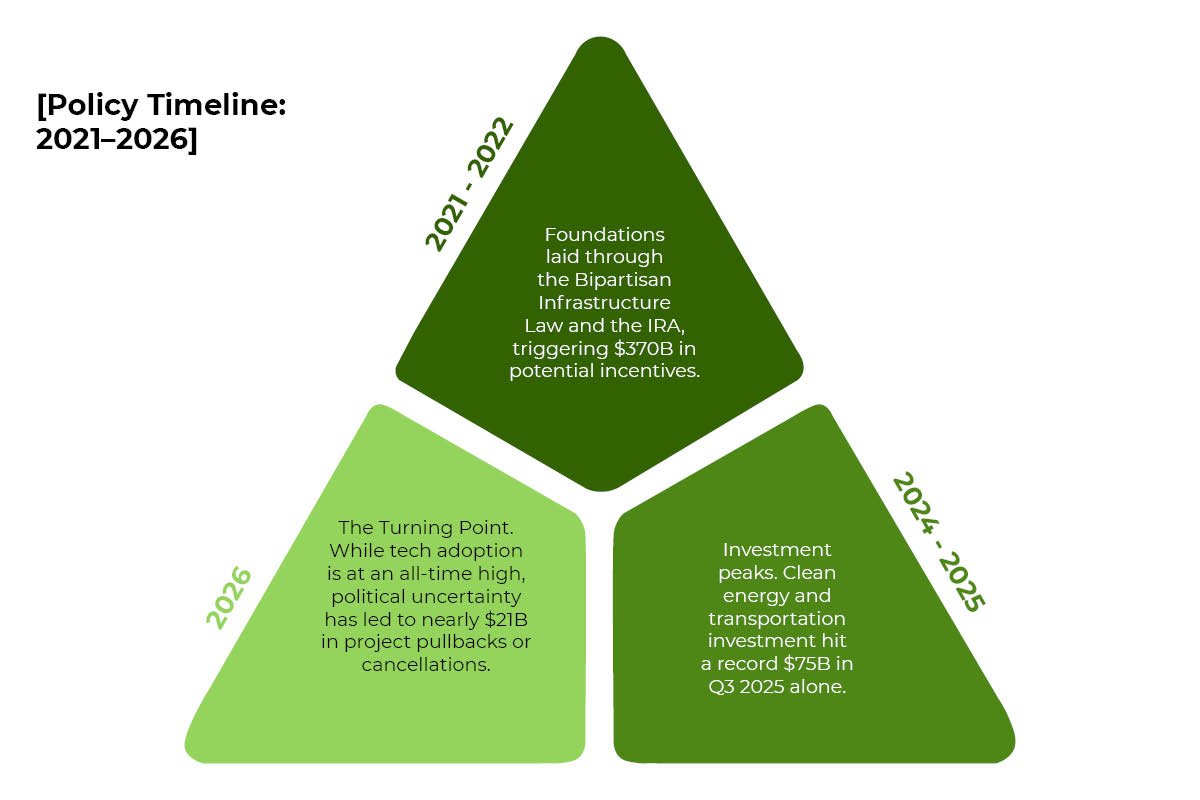
- 2021-2022: Foundations laid through the Bipartisan Infrastructure Law and the IRA, triggering $370B in potential incentives.
- 2024-2025: Investment peaks. Clean energy and transportation investment hit a record $75B in Q3 2025 alone.
- 2026: The Turning Point. While tech adoption is at an all-time high, political uncertainty has led to nearly $21B in project pullbacks or cancellations.
The Horizon and the Call: What Happens Next?
The United States is currently standing at a fork in the road. On one hand, the policy scaffolding is already built. We have the tax incentives, the cybersecurity benchmarks, and the funding that have made billions of sensors economically viable for the first time. This has led to the creation of hundreds of thousands of jobs in new manufacturing hubs across the country, transforming regions that were once industrial wastelands into centers of the energy transition.
However, this “invisible nervous system” is more fragile than it looks. The political shifts observed in 2025 have already caused some investors to hesitate. Ultimately, the technology is ready, the economics are clear, and the results are already visible—but the long-term success of Sustainable IoT policy USA will depend on consistency, security, and sustained commitment.
Ultimately, the technology is ready, the economics are clear, and the results are already visible in cities like Pittsburgh and Austin. The next few years will determine if these innovations become the national standard or remain “islands of excellence” in a sea of stalled capital. The only thing left to decide is whether the U.S. has the sustained collective will to keep these incentives in place long enough to finish the job.