What if the hospital could see what you can’t?
A nurse is looking for an IV pump. It could be in a storage room, on another floor, or somewhere nobody remembers leaving it. Finding it can mean phone calls, hallway searches, and time away from patients.
Now imagine a hospital where the pump has a digital trail. A monitor sends patient readings, a smart bed detects movement, and room sensors detect activity. Connected systems move those signals through the hospital.
This is where smart hospitals begin to look different. Rather than adding technology simply to make a facility look futuristic, they use connected systems to address practical problems: knowing what is happening to patients, finding equipment, noticing changes sooner, and reducing unnecessary manual work.
A smart hospital starts with what it can sense

At the heart of smart hospitals is the Internet of Things, or IoT. Sensors and connected devices gather information, networks move it, and software brings it together so people or systems can act on it.
What is smart healthcare? Smart healthcare uses connected technologies, data, and digital systems to support healthcare delivery, monitoring, and operations. Smart hospitals put this approach into practice across the physical hospital environment.
Heart monitors can send patient information to clinical systems. Wearables can transmit health data, while tagged equipment can report its location. Smart beds and remote monitoring systems can also join the wider network.
IoT does not have to mean one giant system controlling the hospital. It can be a collection of connected systems solving different problems, which is what makes smart hospitals more than a collection of individual devices.
The smart hospital at a glance
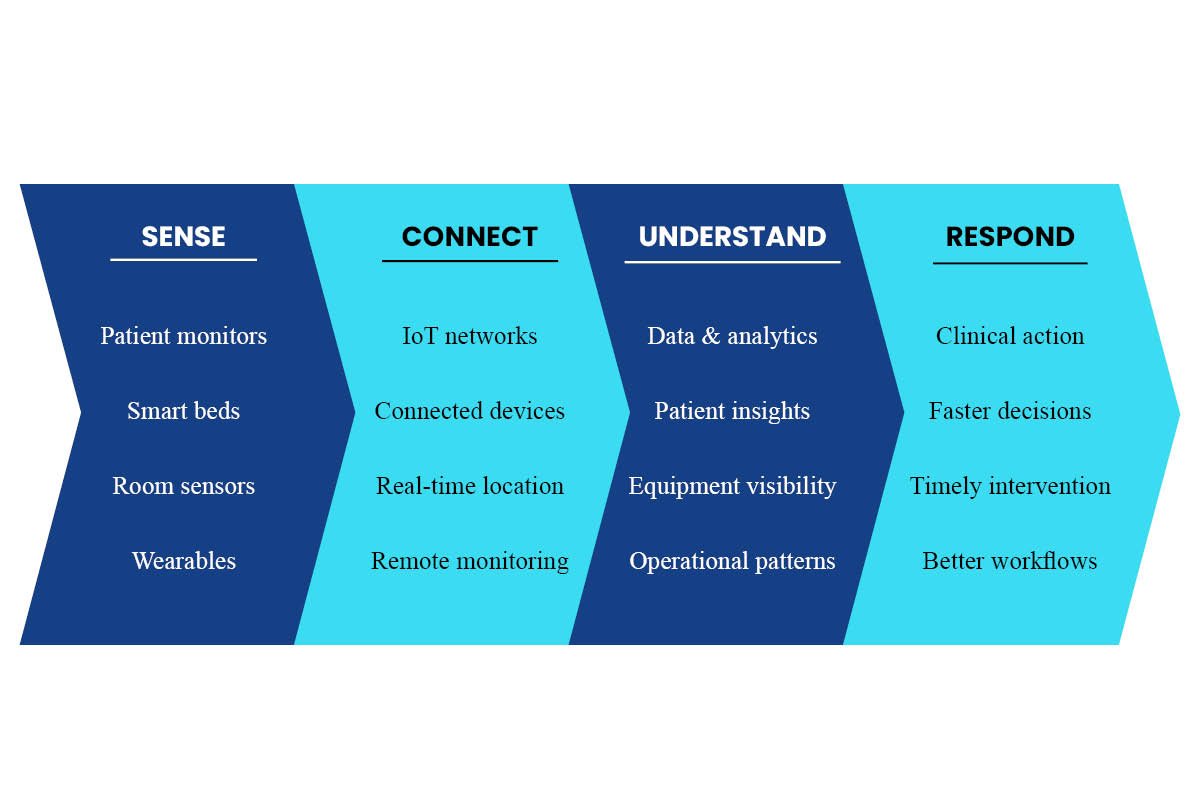
Sense → Connect → Understand → Respond
| SENSE | CONNECT | UNDERSTAND | RESPOND |
|---|---|---|---|
| Patient monitors | IoT networks | Data & analytics | Clinical action |
| Smart beds | Connected devices | Patient insights | Faster decisions |
| Room sensors | Real-time location | Equipment visibility | Timely intervention |
| Wearables | Remote monitoring | Operational patterns | Better workflows |
The ICU: where every second produces data
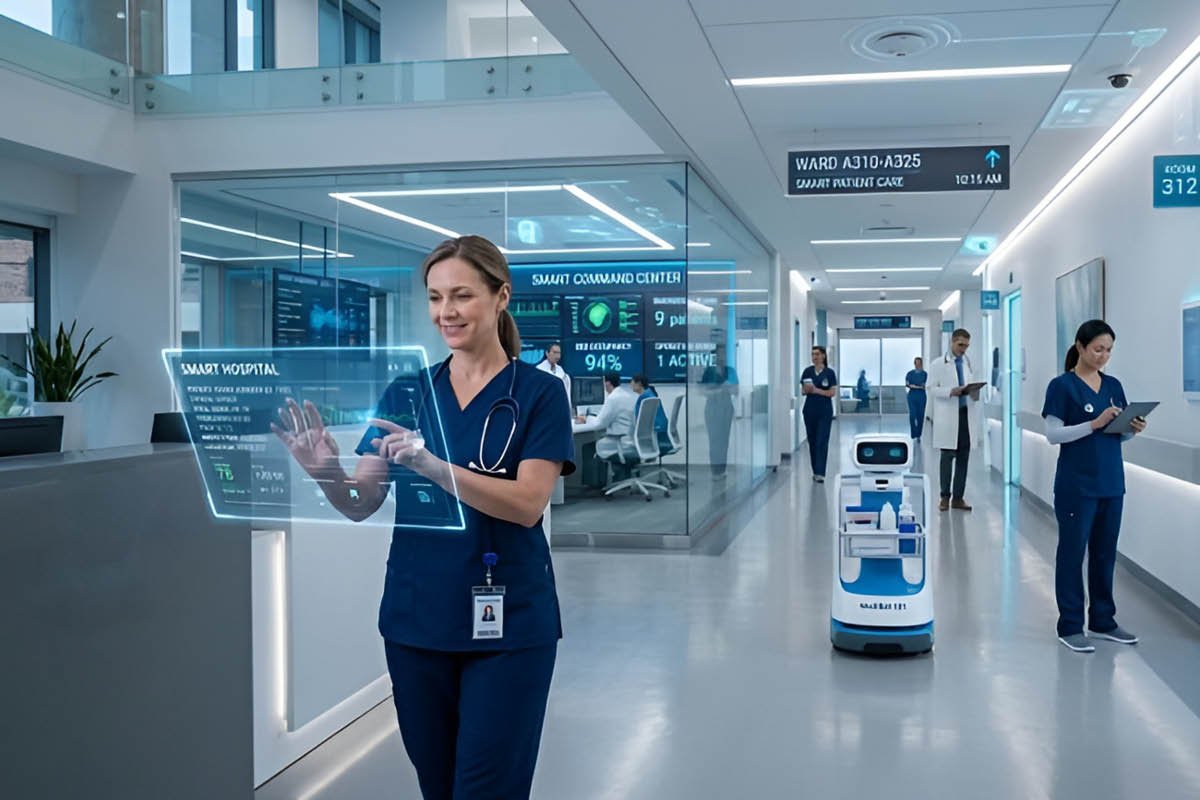
Few places demonstrate the value of smart hospitals more clearly than an ICU. Patients can be surrounded by equipment measuring heart rate, blood pressure, oxygen levels, and other vital signs.
IoT-enabled devices can collect and transmit data in real time, helping teams identify changes and respond to them.
Houston Methodist offers a U.S. example through its connected virtual-care approach, bringing together virtual ICU services, virtual nursing, and telemonitoring. Biosensor-based monitoring allows clinicians to track a large number of patients from a central setting.
The value of connected monitoring is not simply more readings. It is making useful information visible when it matters.
When the room becomes part of the care system
In smart hospitals, connectivity does not stop at the bedside. The room itself can become part of the network.
Virtua Health partnered with care.ai to convert more than 1,000 inpatient beds into AI-enabled smart rooms, using ambient sensing for fall detection alongside virtual nursing, tele-sitting, and tele-ICU services.
Thomas Jefferson University Hospital offers an earlier example. Its 2016 pilot of “cognitive hospital rooms” used IBM Watson’s IoT platform, allowing patients to control lighting, temperature, and music through voice commands.
These examples show how these hospitals can extend connected technology beyond machines attached to patients and into the environment around them.
The other problem hospitals need to solve: where is the equipment?
Equipment moves. Wheelchairs, IV pumps, ventilators, beds, and other mobile devices can move between rooms and floors or disappear into the daily shuffle of a busy hospital.
Real-time location systems, or RTLS, give smart hospitals a way to track those assets. IoT-enabled asset management can record where equipment is, how it is used, and information related to maintenance.
One case involved a 380-bed regional medical center with 1,200 IV pumps. Utilization reportedly rose from 30% to 65% after RTLS deployment. A subsequent purchase was reduced from 1,200 to 780 pumps, with the case reporting savings of more than $1 million.
Where did all the IV pumps go?
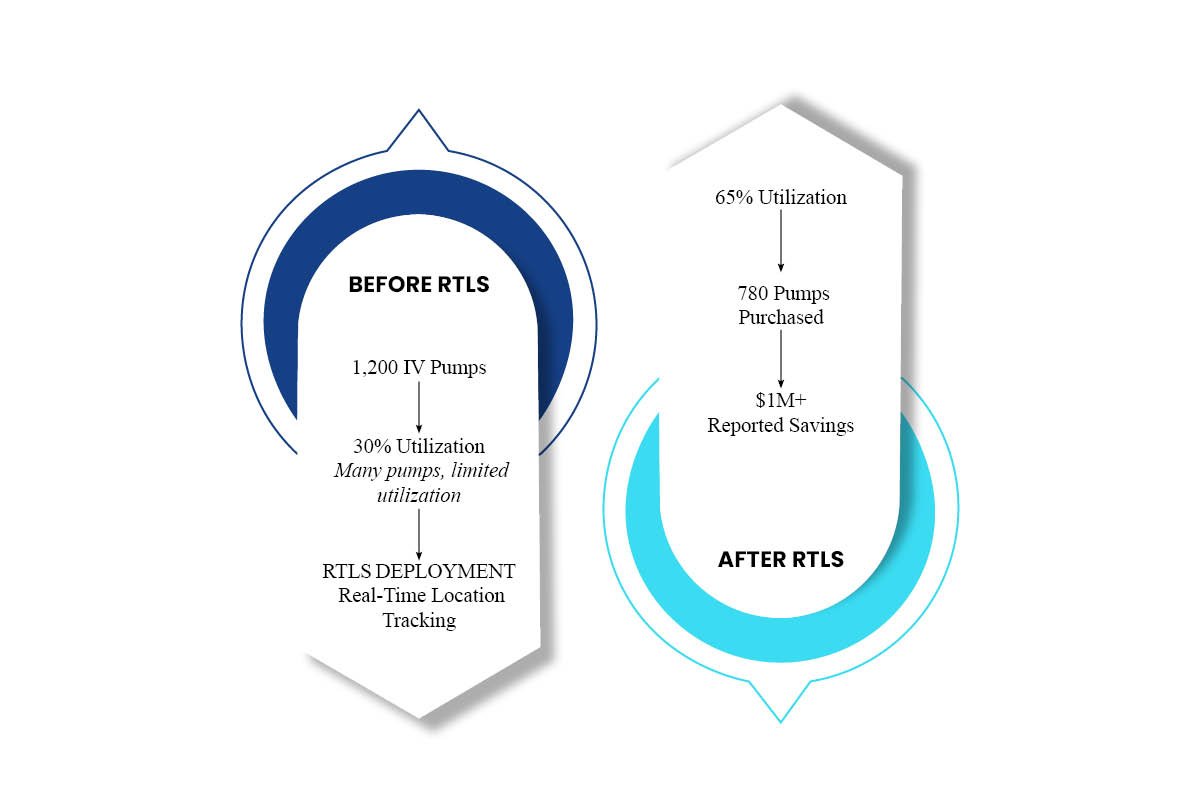
How RTLS improved equipment visibility and utilization
BEFORE RTLS
1,200 IV Pumps
↓
30% Utilization
Many pumps, limited utilization
RTLS DEPLOYMENT
Real-Time Location Tracking
↓
AFTER RTLS
65% Utilization
↓
780 Pumps Purchased
↓
$1M+
Reported Savings
One hospital. Many connected systems.
Stanford Hospital provides a clear large-scale example of smart hospitals in practice. When its current building opened in November 2019, Stanford Medicine described it as an Internet of Things hospital with roughly 180 applications spanning connected biomedical devices, real-time location sensors, and autonomous robots that move linens and supplies.
The story is not one impressive device, but many technologies working across the same environment. A hospital can monitor patients while tracking equipment, moving supplies, and supporting staff workflows.
Stanford’s connected hospital
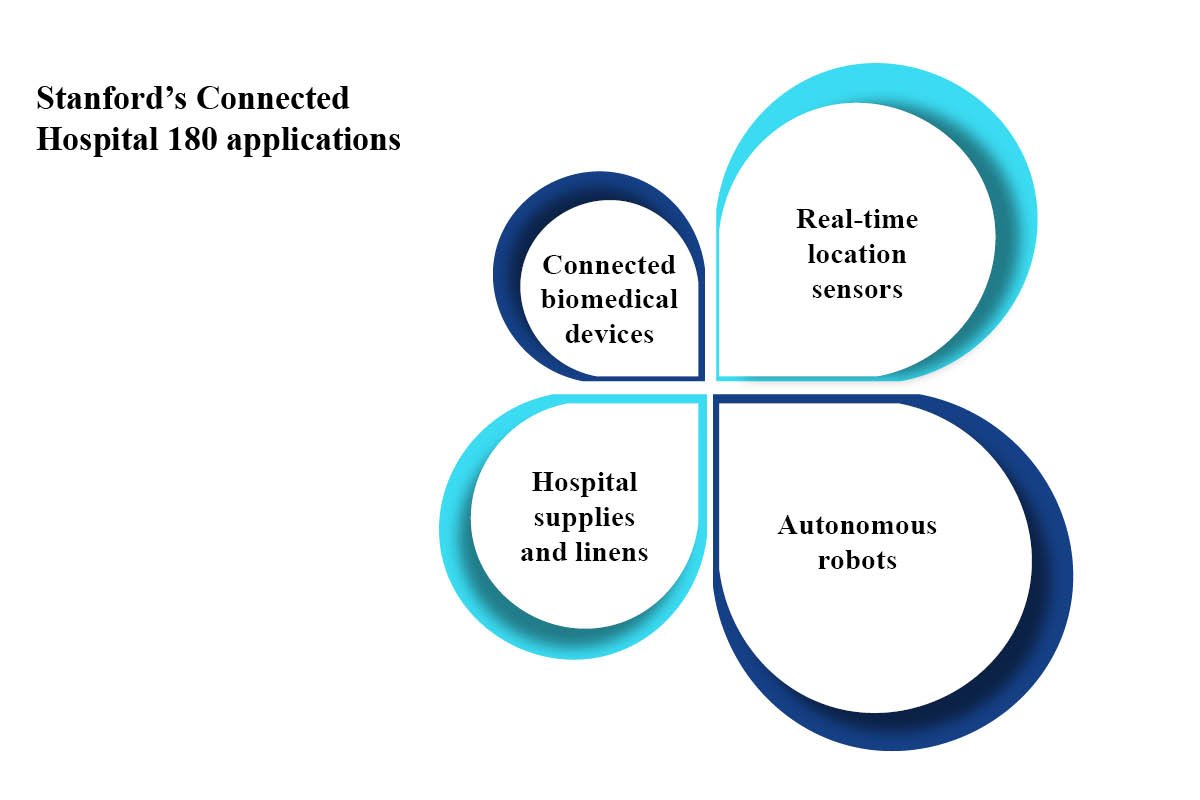
- 180 applications
Connected biomedical devices + Real-time location sensors + Autonomous robots + Hospital supplies and linens
When devices start talking to each other
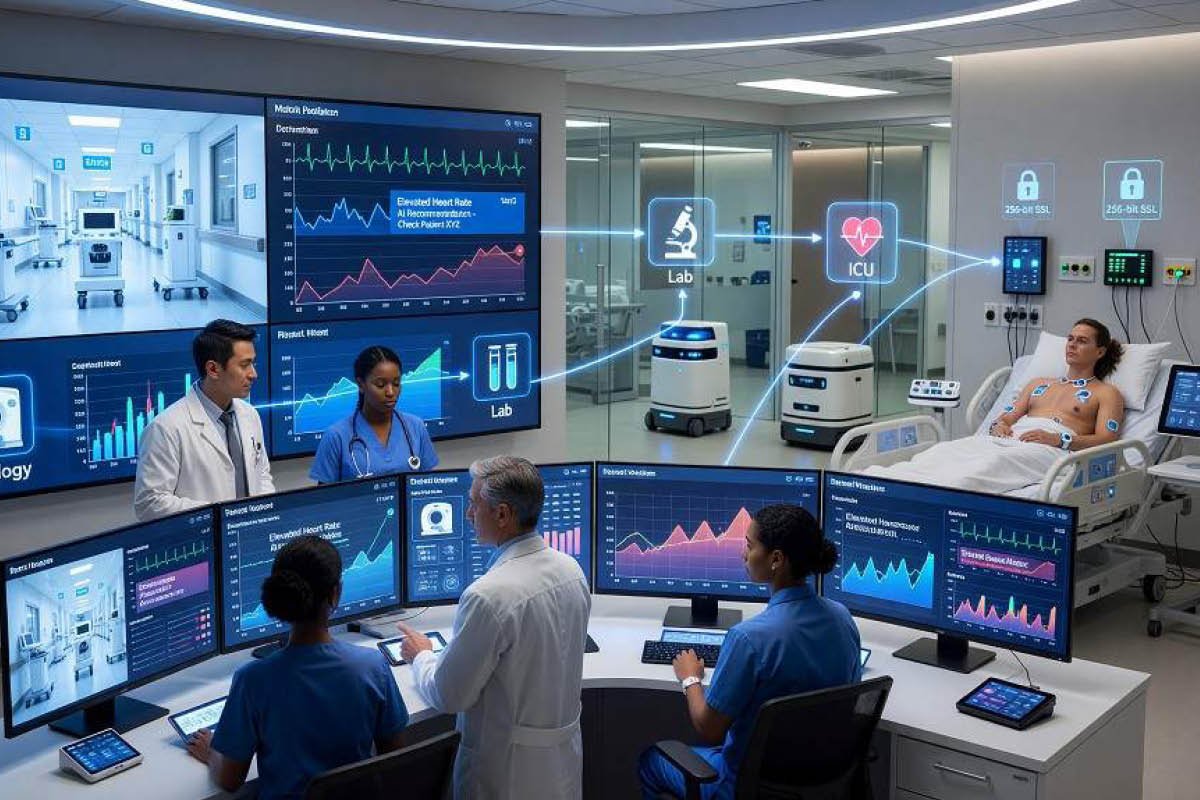
A connected device becomes more useful when it can share information with other systems. That is why interoperability matters to smart hospitals.
Hospitals already run electronic medical records, nurse-call systems, monitoring equipment, imaging systems, and other technologies. Adding another device does not automatically make them work together. The challenge is moving information between systems without creating another isolated technology island.
IoT provides the connections, while data platforms, electronic medical records, and analytics provide places for that information to go.
When data becomes useful
Continuous data creates another possibility: spotting patterns.
Predictive maintenance uses monitoring and analytics to identify potential equipment problems before they become larger failures. Sensors can provide information about equipment condition and help maintenance teams decide when attention may be needed.
AI can sit on top of IoT data, but the two are not the same.
IoT gathers and moves information. AI can help analyze it.
The useful question for smart hospitals remains simple: What problem does the information help someone solve?
The more connected the hospital becomes, the more it has to protect
More connected devices mean more connections to manage. Patient information is sensitive, medical devices can be critical to care, and hospital networks contain systems that cannot simply be switched off when something goes wrong.
That makes cybersecurity, privacy, and interoperability important parts of building smart hospitals.
A connected hospital needs reliable technology and people who understand what is connected, what information is moving, and who should have access to it.
What makes a hospital actually smart?
A hospital should not be measured by the number of devices it has. Sensors in every room mean little if nurses still search for equipment or staff must dig through multiple systems to find useful information.
The better test for smart hospitals is simple:
Can the technology help the hospital see something sooner, find something faster, use something better, or reduce unnecessary work?
Smart doesn’t mean more gadgets
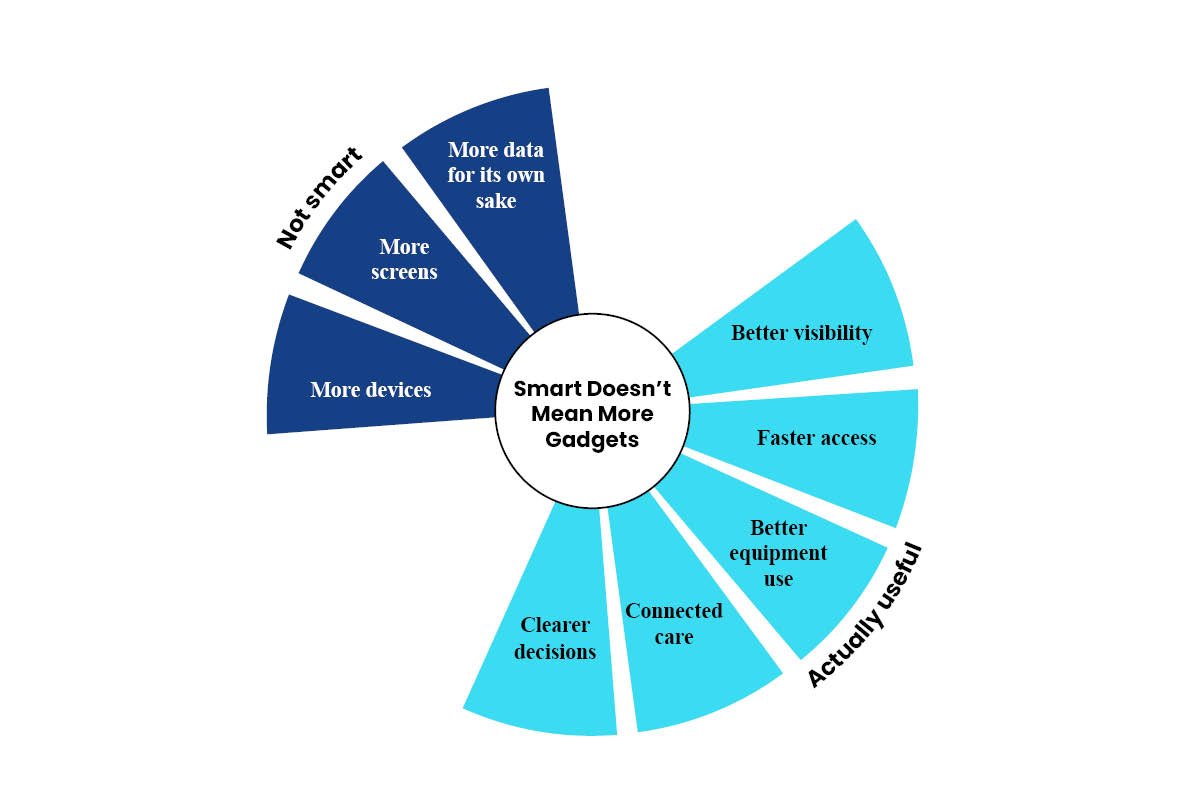
Not smart:
- More devices
- More screens
- More data for its own sake
Actually useful:
- Better visibility
- Faster access
- Better equipment use
- Connected care
- Clearer decisions
The hospital is becoming a connected system
The most interesting thing about smart hospitals in the U.S. may not be any single technology. It is how connected systems increasingly work across the same environment.
What is smart healthcare in practice? These connected environments offer a clear answer: using technology and information to support better visibility, care, and hospital operations.
A patient monitor can become part of a clinical system. A room can sense activity. An IV pump can become a trackable asset. A robot can move supplies. A remote-care platform can bring patient information to clinicians outside the room.
Put together, these technologies change what smart hospitals can see.
The question is no longer whether a hospital can collect the data. It is whether it can put that information to work.