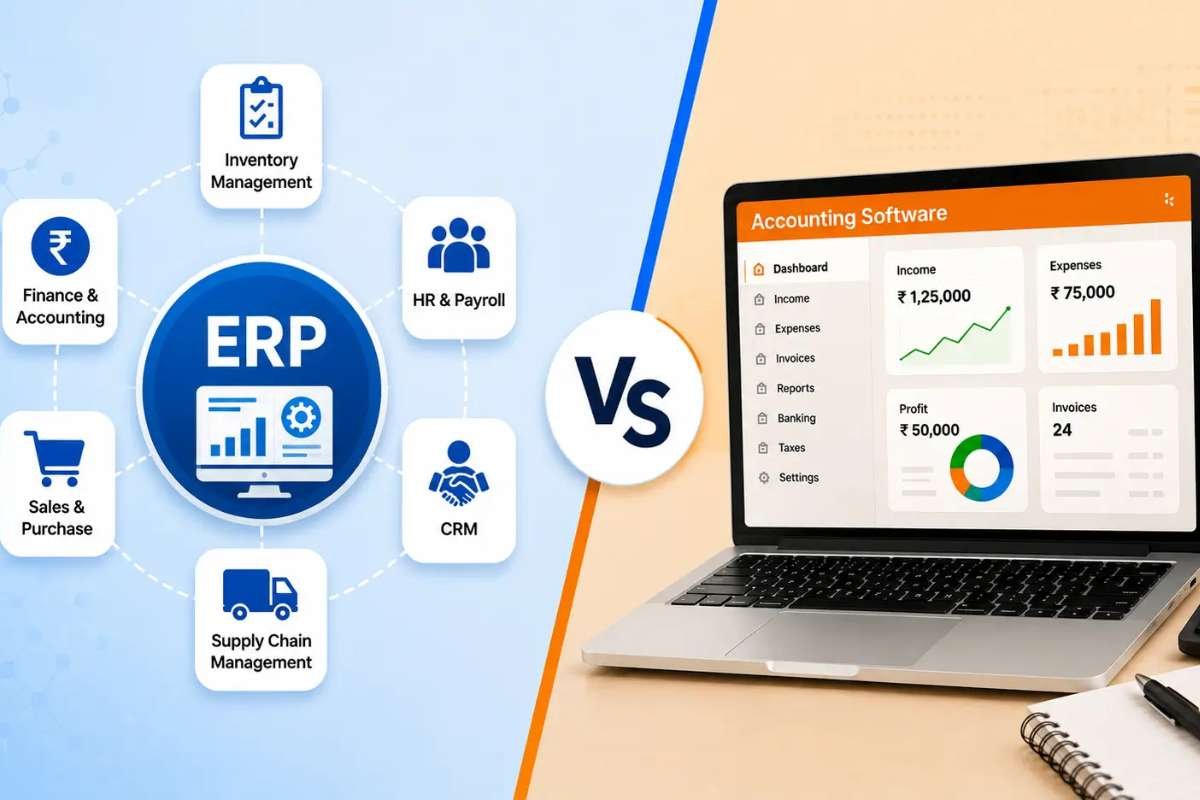
ERP and accounting software serve different business needs. Accounting software is ideal for managing finances in small businesses, while ERP connects finance, inventory, HR, sales, and operations in one system. This guide compares their features, costs, scalability, benefits, and upgrade signs to help you choose the right solution for your business in 2026.
Choosing the right business software is no longer just an IT decision; it directly affects your company’s growth, efficiency, and profitability. As businesses expand, they often struggle to decide whether they need accounting software or a complete Enterprise Resource Planning (ERP) system.
While both solutions help businesses manage financial operations, they serve very different purposes. Accounting software focuses primarily on recording financial transactions, whereas an ERP platform connects finance with other business functions such as inventory, purchasing, manufacturing, sales, customer relationship management (CRM), and human resources.
Understanding these differences can help businesses avoid expensive software migrations, eliminate data silos, and prepare for future growth.
This ERP vs Accounting Software guide compares key differences, costs, scalability, and implementation to help you choose the right solution. It also explains when to upgrade to ERP, with real-world examples and practical recommendations for 2026.
ERP vs Accounting software: Which one is the right choice for your business?

Accounting software helps businesses manage their daily financial tasks, such as recording transactions, creating invoices, tracking expenses, processing payroll, preparing taxes, reconciling bank accounts, and generating financial reports. Modern cloud-based accounting software also includes automation, AI-driven expense categorization, bank integrations, and real-time financial dashboards. It is an ideal choice for startups and small businesses that mainly need to manage their finances without handling complex business operations.
ERP (Enterprise Resource Planning) software is a complete business management system that goes beyond accounting. It connects finance, inventory, procurement, sales, manufacturing, HR, CRM, supply chain, projects, and other business functions through one centralized database. This allows every department to share the same real-time data, reducing manual work, eliminating duplicate entries, and improving collaboration. For example, when a customer places an order, the ERP system automatically updates inventory, creates invoices, triggers procurement if stock is low, and refreshes management dashboards.
In simple terms, accounting software focuses on managing your finances, while ERP software manages your entire business, including finance, in one integrated platform. Accounting software is usually the better fit for accounting technology for small businesses with simple operations, whereas ERP is designed for growing organizations that need to manage multiple departments, locations, or complex workflows efficiently.
ERP vs Accounting software at a glance: The biggest differences explained
Although both solutions handle financial data, their scope is completely different.
Research from Deloitte also shows that digital transformation and enterprise-wide system integration remain among the top priorities for businesses looking to improve productivity, reduce manual work, and make faster data-driven decisions.
| Feature | Accounting Software | ERP Software |
| Primary Purpose | Manage financial records | Manage the entire business |
| Finance Management | Yes | Yes |
| Inventory | Basic or limited | Advanced |
| Procurement | Limited | Comprehensive |
| Manufacturing | No | Yes |
| CRM Integration | Basic | Advanced |
| HR Management | No or limited | Yes |
| Supply Chain | No | Yes |
| Business Intelligence | Limited | Advanced analytics |
| Department Integration | Finance only | Organization-wide |
| Best For | Small businesses | Growing and enterprise businesses |
The biggest difference is that accounting software manages finances, while ERP manages business operations with finance at its core.
Has your business outgrown accounting software? Here’s how to know

One of the most important factors in the ERP vs Accounting Software is understanding where each solution reaches its practical limit.
As businesses grow, software that once worked perfectly may no longer support increasing operational complexity.
A PwC Digital Finance Survey found that businesses investing in integrated digital platforms improve decision-making by providing leaders with real-time financial and operational insights instead of relying on disconnected systems.
The following scaling boundaries help define when businesses typically outgrow accounting software and when ERP becomes the better investment.
Scaling boundary of accounting software
Accounting software performs exceptionally well for businesses with straightforward financial operations.
It is generally suitable when a company has:
- One legal entity
- One office or branch
- Simple inventory requirements
- Limited employees
- Standard accounting workflows
- Few third-party integrations
- Basic financial reporting needs
At this stage, finance teams can efficiently manage operations without needing enterprise-level automation.
Common Growth Challenges
As businesses expand, accounting software often reaches its operational limits.
Organizations may begin experiencing:
- Duplicate data entry across departments
- Spreadsheet dependency
- Disconnected inventory systems
- Separate CRM and payroll platforms
- Manual approval processes
- Delayed reporting
- Inconsistent business data
- Limited automation
These challenges reduce productivity and make it harder to maintain data accuracy.
Scaling boundary of ERP software

ERP systems are designed to support businesses as operational complexity increases.
Organizations typically benefit from ERP when they manage:
- Multiple business units
- Several company entities
- Multiple warehouses
- Manufacturing operations
- Large procurement networks
- Global suppliers
- Thousands of SKUs
- Multiple currencies
- International tax regulations
- Department-wide workflows
- Enterprise reporting requirements
Instead of relying on disconnected software, ERP creates a unified operational environment where all departments access the same real-time information.
This enables leadership teams to make faster, data-driven decisions while reducing operational risk.
Visualizing the scaling boundary
Think of business software as a growth journey.
| Business Stage | Recommended Solution |
| Freelancer | Accounting Software |
| Startup | Accounting Software |
| Small Business | Accounting Software |
| Growing SME | Accounting Software with integrations or Entry-Level ERP |
| Mid-sized Company | ERP |
| Large Enterprise | ERP |
| Multi-location Business | ERP |
| Manufacturing Company | ERP |
| Global Organization | ERP |
Rather than replacing accounting software because it stops working, businesses typically upgrade because their operations become too interconnected for standalone financial tools.
5 key differences between ERP and accounting software you should know
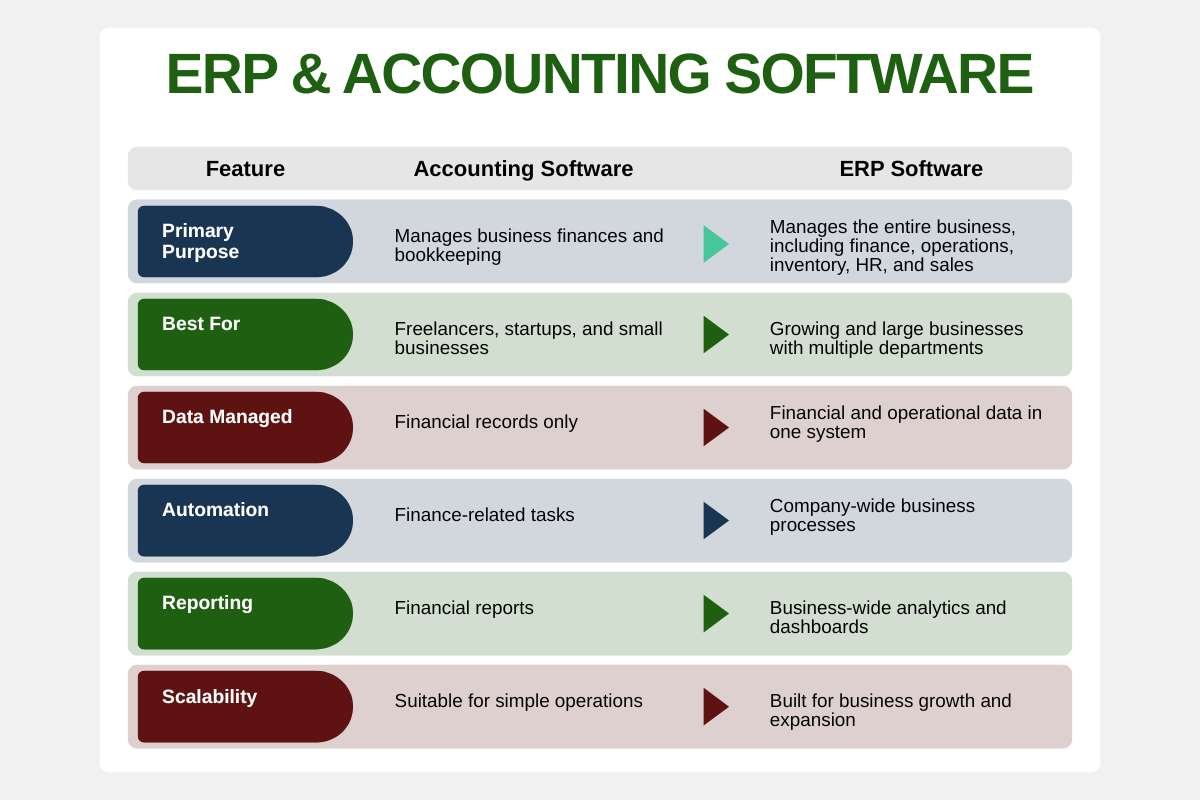
Choosing between ERP and accounting software depends on your business size, operations, and growth plans. Accounting software is designed to manage financial activities, while ERP connects your entire business on a single platform. The comparison below explains the biggest differences with real-world examples.
| Feature | Accounting Software | ERP Software |
| Primary Purpose | Manages business finances and bookkeeping | Manages the entire business, including finance, operations, inventory, HR, and sales |
| Best For | Freelancers, startups, and small businesses | Growing and large businesses with multiple departments |
| Data Managed | Financial records only | Financial and operational data in one system |
| Automation | Finance-related tasks | Company-wide business processes |
| Reporting | Financial reports | Business-wide analytics and dashboards |
| Scalability | Suitable for simple operations | Built for business growth and expansion |
- Business Scope: Accounting software manages financial tasks like bookkeeping, invoicing, payroll, taxes, and reporting. ERP software manages the entire business by connecting finance, inventory, sales, HR, procurement, and operations on one platform.
Example: A small agency may use QuickBooks for accounting, while Toyota uses ERP to manage manufacturing, inventory, finance, and suppliers across its global operations. - Data Management: Accounting software stores only financial data, whereas ERP stores financial and operational data in one centralized database. This reduces duplicate entries and improves data accuracy.
Example: Nestlé uses ERP to unify business data across global teams, helping departments work with the same real-time information. - Automation Capabilities: Accounting software automates financial tasks like invoicing, bank reconciliation, payroll, and tax reporting. ERP automates business-wide processes such as inventory replenishment, purchase approvals, production scheduling, and sales orders.
- Reporting and Decision-Making: Accounting software provides financial reports such as Profit & Loss statements, Balance Sheets, and Cash Flow reports. ERP combines financial and operational data to provide real-time business insights for better decision-making.
Example: Unilever uses ERP to monitor inventory, procurement, and financial performance through integrated dashboards. - Business Integration: Accounting software can integrate with payroll, CRM, and inventory tools, but managing multiple applications becomes difficult as a business grows. ERP replaces separate systems with one unified platform where all departments share the same data.
ERP vs Accounting software: advantages and limitations
| Accounting Software | ERP Software |
| Advantages | Advantages |
| • Lower cost and quick setup | • Centralizes all business data |
| • Easy to use and manage | • Real-time reporting and insights |
| • Automates bookkeeping and tax compliance | • Automates workflows across departments |
| • Generates financial reports quickly | • Improves collaboration and productivity |
| • Best for startups and small businesses | • Scales easily as the business grows |
| Limitations | Limitations |
| • Limited automation beyond accounting | • Higher upfront implementation cost |
| • Basic inventory and reporting features | • Longer deployment time |
| • Requires separate tools for HR and CRM | • Requires employee training |
| • Integration becomes difficult as business grows | • Data migration and process changes can be complex |
| • Limited support for multi-company operations | • Needs careful planning for successful implementation |
5 clear signs it’s time to upgrade from accounting software to ERP

Many businesses don’t start with an ERP system, and that’s perfectly normal. Accounting software often meets the needs of startups and small businesses during their early stages. However, as operations become more complex, relying on standalone financial software can create inefficiencies.
The following signs indicate it may be time to move to an ERP solution.
Recent studies show that upgrading to an ERP system delivers measurable business benefits. Around 94% of businesses use ERP software to manage their operations, and many report productivity improvements of about 20% by automating routine tasks and improving collaboration. ERP also helps reduce operating costs by minimizing manual work, lowering errors, and giving businesses better control over resources. These benefits make ERP a smart investment for growing organizations.
1. You’re managing multiple business locations
If your business operates across several branches, warehouses, or offices, maintaining separate financial records can become time-consuming and error-prone.
An ERP system centralizes data, giving leadership a unified view of operations across all locations.
2. Teams use too many separate applications
Businesses often use different tools for:
- Accounting
- Inventory
- CRM
- Payroll
- HR
- Procurement
- Project management
As the number of applications grows, so does the risk of duplicate data, integration issues, and manual work.
Businesses often begin with Cloud Accounting software, but growing operational complexity eventually requires a centralized ERP platform.
3. Reporting takes too long
If your finance team spends days collecting spreadsheets from different departments before creating monthly reports, your reporting process is likely slowing decision-making.
ERP software automatically consolidates data into real-time dashboards and reports.
4. Inventory errors are increasing
Inventory discrepancies can lead to stock shortages, delayed deliveries, or excess inventory.
ERP systems provide real-time inventory visibility across warehouses, helping businesses improve stock accuracy and order fulfillment.
5. Manual processes are slowing growth
As businesses expand, manual approvals, repeated data entry, and spreadsheet-based workflows become difficult to manage.
ERP automates these routine processes, allowing employees to focus on higher-value work.
Conclusion
The choice between ERP and accounting software depends on your current business needs and future growth plans. Accounting software is ideal for startups and small businesses that need affordable, simple financial management and tax compliance.
ERP software represents the next stage of Accounting Technology, bringing together Accounting Automation, AI in Accounting, Expense Management Technology, and Real-Time Financial Reporting to support long-term business growth.
Frequently asked questions
1. What is the main difference between ERP and accounting software?
Accounting software manages finances, while ERP connects finance with HR, inventory, sales, procurement, and other business functions.
2. Can small businesses use ERP software?
Yes. Cloud ERP solutions are suitable for small businesses, but accounting software is often more affordable for simpler needs.
3. Does ERP include accounting features?
Yes. ERP includes accounting features such as general ledger, invoicing, accounts payable/receivable, budgeting, and financial reporting.
4. When should a business switch to ERP?
Upgrade to ERP when your business outgrows accounting software and needs automation, integrated systems, or better reporting.
5. Which solution is more scalable?
ERP is more scalable for growing businesses, while accounting software is best for basic financial management.