
Early stages of business growth refer to the phase where a business is still testing its idea, building its first version, and trying to understand how real users respond in the market. This article explores how businesses move through these initial stages, what decisions shape early direction, and why this period often feels unpredictable and high-pressure.
You launch something, and for a brief moment, every signal feels louder than it should.
One customer says yes, and it feels like validation. Another ignores you, and it feels like rejection. A small feature request starts to shape your roadmap. A single complaint makes you question the whole offer. There is no buffer yet. Every response hits directly.
You are not managing scale at this point. You are dealing with raw, unfiltered reality. What people actually want, what they are willing to pay for, and how they behave when no brand reputation is carrying you.
The early stages of business growth sit inside that intensity. It is where patterns are not obvious yet, but every interaction leaves a mark, forcing you to adjust faster than you planned.
In this article, we will take a look at these stages and how they can impact the entire trajectory of your business and influence where your business ends up in the future.
What are the early stages of business growth?
Every business starts small. The early stages of business growth shape how far it can go. Founders test ideas, face pressure, and make fast decisions. Each of the following stages builds the base for the next step. Here is how they all work:
1. Idea validation
This stage starts with a simple idea. You test if people want what you plan to sell. Many founders talk to users, run surveys, or build a basic version. The goal is clear. You need proof that your idea solves a real problem.
You also look at how people solve this problem today. This helps you spot gaps and position your idea better. Early signals like sign-ups or interest clicks give direction before you invest more.
You keep costs low here. You avoid heavy investment and focus on learning fast. Feedback matters more than perfection. Quick changes help you stay on track.
Challenges faced:
- Lack of clear market demand
- Biased feedback from close circles
- Limited funds for testing
- Fear of idea failure
- Difficulty in defining the target audience
2. Product development
Once the idea shows promise, you build the product. This version is often simple. Many call it an MVP. It should solve the main problem without extra features.
You focus on core functionality first. This helps you launch faster and gather real user data. Early iterations may not look polished, but they give clarity on what works.
You work on usability and function. Small teams move fast but face limits. You must balance speed with quality. Early users help you improve through real feedback.
Challenges faced:
- Limited technical resources
- Scope creep during development
- Bugs and performance issues
- Difficulty in prioritizing features
- Time pressure to launch quickly
3. Market entry
You take the product to real users. This stage focuses on getting attention and first sales. You test pricing, messaging, and channels. Early traction matters a lot.
You experiment with different acquisition channels. Some may fail, but a few will show promise. These early wins help shape your go-to-market direction.
Then you also build your brand voice here. Strong positioning helps you stand out. Every user interaction shapes how people see your business.
Challenges faced:
- Low brand awareness
- High customer acquisition cost
- Ineffective marketing channels
- Weak initial traction
- Difficulty in the pricing strategy
4. Early growth stage
The business starts to grow. You see repeat users and steady demand. Now you focus on scaling what works. Systems and processes start to form.
You begin tracking key metrics like retention and revenue trends. These numbers help you make better decisions and avoid guesswork. Growth becomes more predictable with data.
You also begin to build a team. Roles become clearer. Growth brings new pressure. You must manage both operations and expansion.
Challenges faced:
- Cash flow management issues
- Hiring the right talent
- Maintaining product quality at scale
- Operational inefficiencies
- Balancing growth with stability
5. Expansion readiness
At this stage, the business prepares to scale faster. You refine systems, improve workflows, and strengthen your team. Data guides most decisions now.
You also test new opportunities, like new markets or added features. These moves need careful planning to avoid spreading resources too thin. Strong systems support this shift.
You also explore new markets or products. The focus shifts from survival to structured growth. Planning becomes more detailed and long-term.
Challenges faced:
- Scaling operations efficiently
- Managing increased costs
- Entering new markets with risk
- Maintaining company culture
- Handling competition pressure
What are some strategies to use in the early stages of business growth?
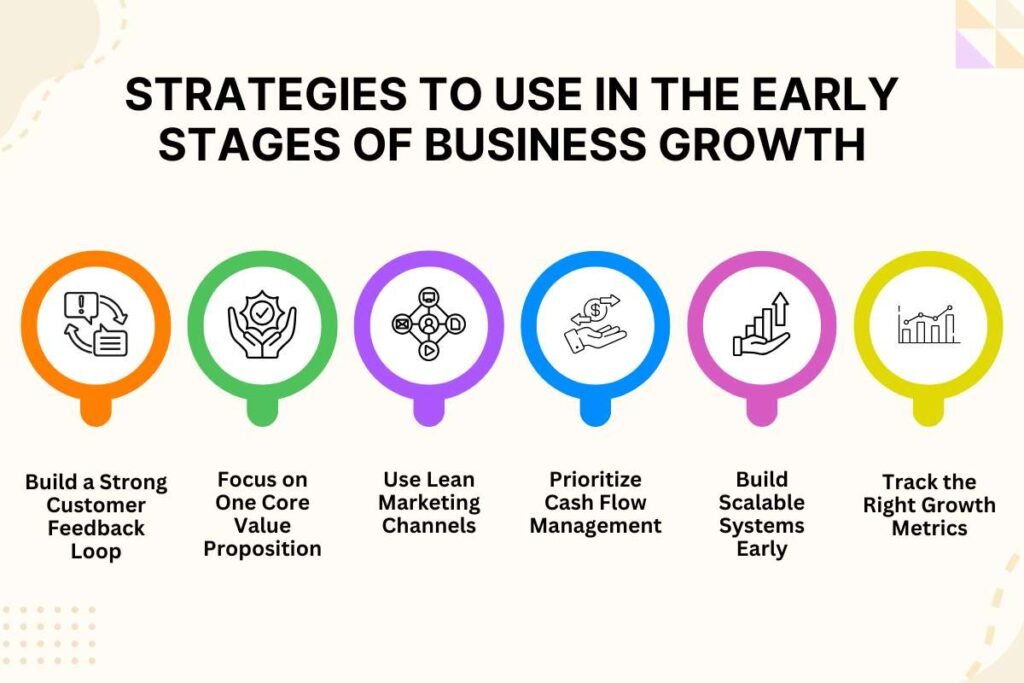
Once the early stages of business growth are clear, the focus shifts to action. Strategy defines how a business moves through uncertainty and limited resources. Strong early decisions reduce risk and improve learning speed. The right strategies help convert early progress into stable growth.
1. Build a strong customer feedback loop
Early growth depends on fast learning. Feedback shows what works and what needs to change. It helps you fix issues before they scale and impact growth.
A steady feedback loop keeps your product aligned with real user needs. You learn continuously and adjust based on real behavior instead of assumptions.
Tips to implement:
- Collect feedback from onboarding, usage, and support
- Combine surveys with real user behavior data
- Act quickly on repeated issues
- Ignore isolated or emotional opinions
- Keep feedback collection ongoing and structured
2. Focus on one core value proposition
A clear value proposition helps users understand your product quickly. It reduces confusion and builds stronger positioning in a crowded market. It also keeps your team aligned. Every decision should support one clear outcome for the user.
Tips to implement:
- Define one clear problem your product solves
- Align all features with that core problem
- Keep messaging simple and consistent
- Remove features that do not support core value
- Test clarity directly with users
3. Use lean marketing channels
Early-stage marketing works best when it stays focused. Lean channels help you test what brings users without wasting budget. You avoid spreading efforts too thin. Instead, you double down on what shows early traction.
Tips to implement:
- Start with 2–3 focused channels only
- Track customer acquisition cost closely
- Avoid large, unfocused campaigns
- Repurpose content across platforms
- Scale only channels with proven results
4. Prioritize cash flow management
Cash flow stability keeps the business running. Even strong demand cannot fix poor financial control. Early discipline helps you survive uncertainty and make better decisions in the early stages of business growth.
Tips to implement:
- Track income and expenses weekly
- Reduce unnecessary spending early
- Maintain a financial buffer for slow periods
- Match expenses with the growth stage
- Avoid over-hiring before stable revenue
5. Build scalable systems early
Growth creates operational pressure. Simple systems reduce chaos and help teams stay aligned. Good systems make scaling smoother and reduce dependency on individuals.
Tips to implement:
- Document core business processes early
- Use tools that can scale with growth
- Keep workflows simple and clear
- Review and improve systems regularly
- Train team members with clear guidelines
6. Track the right growth metrics
Metrics show whether your business is moving in the right direction. In the early stages of business growth, decisions can become guesswork. The right metrics help you react early and improve performance consistently.
Tips to implement:
- Focus only on a few key metrics
- Avoid tracking unnecessary data
- Review metrics on a fixed schedule
- Connect metrics to clear actions
- Use data to guide decisions, not assumptions
Early stage business growth trends in 2026

Early-stage business growth is becoming more disciplined and efficiency-focused. Founders now prioritize validation, cash flow control, and repeatable systems over fast scaling. Investors prefer startups that show strong unit economics and clear product-market fit early. Execution quality now matters more than aggressive expansion.
AI adoption has reached mainstream global usage, but the depth of integration still varies. According to the Microsoft Global AI Diffusion Report 2026, AI usage among the global working-age population reached 17.8% in early 2026. It is up from 16.3% in the previous quarter, showing steady but uneven global diffusion of AI technologies. This indicates that AI is spreading quickly across countries and industries. But full integration into daily workflows remains in early stages of business growth for most users and organizations.
At the same time, businesses are shifting from experimentation to structured implementation. Companies that embed AI into core operations early are improving speed and efficiency, while others remain stuck at the pilot level. The gap between early adopters and slow movers continues to widen, especially in competitive startup environments where execution speed defines survival.
Conclusion:
Nothing in the beginning stays as stable as it first appears. Ideas shift once they meet real users, and outcomes often reveal gaps that were not visible during planning.
What defines this stage is not how polished the system is, but how quickly it can respond to feedback. Some directions get reinforced, others fade out, and a few unexpected signals end up shaping the path forward more than anything else.
The early stages of business growth are about learning what deserves to be built further. Clarity develops through repetition and paying attention to what actually holds up in practice.
People also ask
1. What happens in the early stages of business growth?
Businesses test ideas, gather feedback, and refine their product or service based on real user responses.
2. Why is this stage considered unstable?
Because assumptions are still being validated, and customer behavior often differs from expectations.
3. What is the main focus during early growth?
The focus is on learning what works, improving quickly, and identifying sustainable direction.