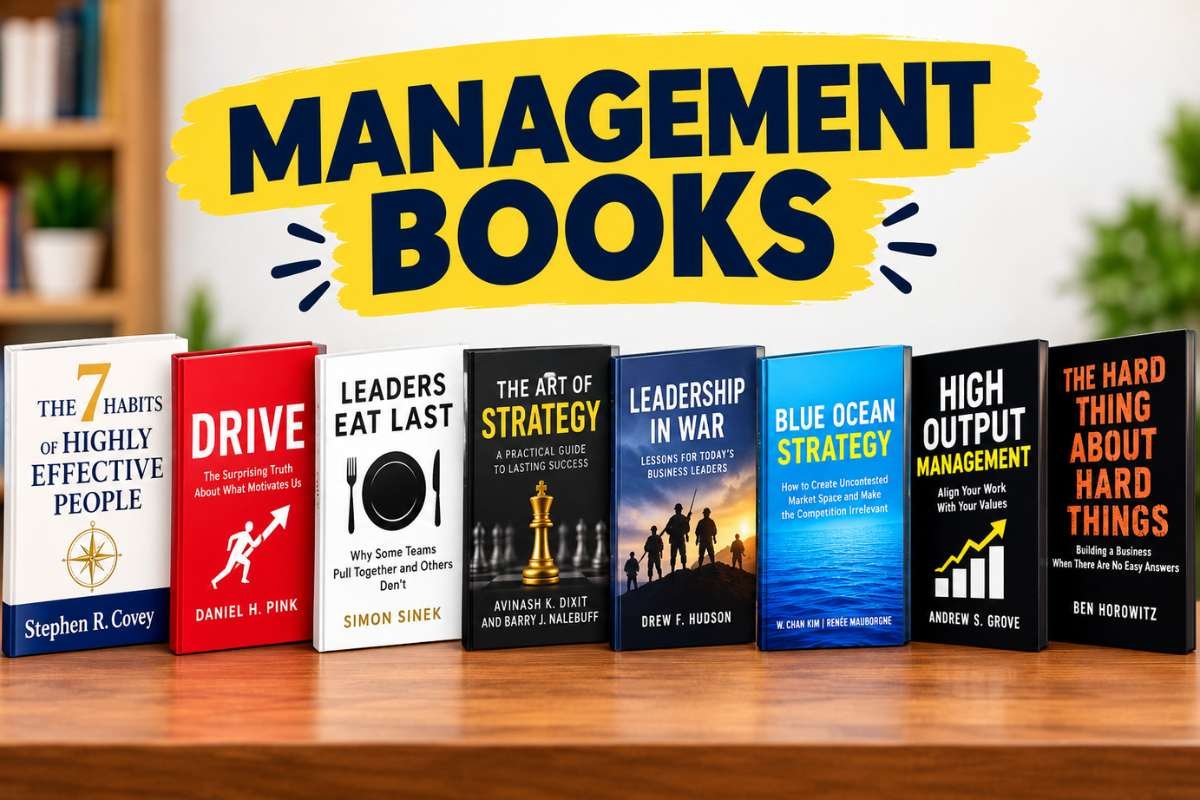
Strong businesses need more than good ideas. They need leaders who can make better decisions, build high-performing teams, improve operations, and adapt to change.
That is why the right management books can be valuable business tools. They offer practical frameworks for strategy, innovation, leadership, productivity, and decision-making.
In 2026, this matters even more. 90% of C-suite leaders say their roles require continuous skill-building, while 82% say AI is already creating new roles. Yet, McKinsey found that while 80% of respondents report improved individual productivity from AI, only 37% report positive EBIT impact, showing that technology alone does not guarantee business results.
The 20 management books below focus on one goal: helping business leaders turn better thinking into better business performance.
Quick comparison: 20 management books for business leaders
| # | Management Book | Author | Primary Business Focus | Key Management Lesson |
| 1 | The 7 Habits of Highly Effective People | Stephen R. Covey | Productivity | Prioritize what matters |
| 2 | Good to Great | Jim Collins | Business performance | Build disciplined organizations |
| 3 | The Lean Startup | Eric Ries | Innovation | Test before scaling |
| 4 | Drive | Daniel H. Pink | Employee motivation | Build autonomy and purpose |
| 5 | Leaders Eat Last | Simon Sinek | Team culture | Build trust |
| 6 | Thinking, Fast and Slow | Daniel Kahneman | Decision-making | Challenge cognitive bias |
| 7 | The Innovator’s Dilemma | Clayton M. Christensen | Disruption | Prepare for market change |
| 8 | Radical Candor | Kim Scott | People management | Give direct, useful feedback |
| 9 | The Art of Strategy | Avinash K. Dixit and Barry J. Nalebuff | Competitive strategy | Anticipate reactions |
| 10 | First, Break All the Rules | Marcus Buckingham and Curt Coffman | Talent management | Manage individual strengths |
| 11 | Leadership in War | Andrew Roberts | Crisis leadership | Make decisions under pressure |
| 12 | Emotional Intelligence 2.0 | Travis Bradberry and Jean Greaves | Leadership effectiveness | Manage yourself and relationships |
| 13 | Blue Ocean Strategy | W. Chan Kim and Renée Mauborgne | Growth strategy | Create new market value |
| 14 | The Goal | Eliyahu M. Goldratt | Operations | Identify business constraints |
| 15 | Dare to Lead | Brené Brown | Organizational leadership | Build courage and accountability |
| 16 | High Output Management | Andrew S. Grove | Management systems | Multiply team output |
| 17 | Good Strategy/Bad Strategy | Richard Rumelt | Corporate strategy | Focus on the real challenge |
| 18 | Measure What Matters | John Doerr | Performance management | Connect goals with results |
| 19 | The Hard Thing About Hard Things | Ben Horowitz | Entrepreneurship | Manage through difficult decisions |
| 20 | The Five Dysfunctions of a Team | Patrick Lencioni | Team performance | Fix the causes of dysfunction |
20 must-read management books from a business perspective
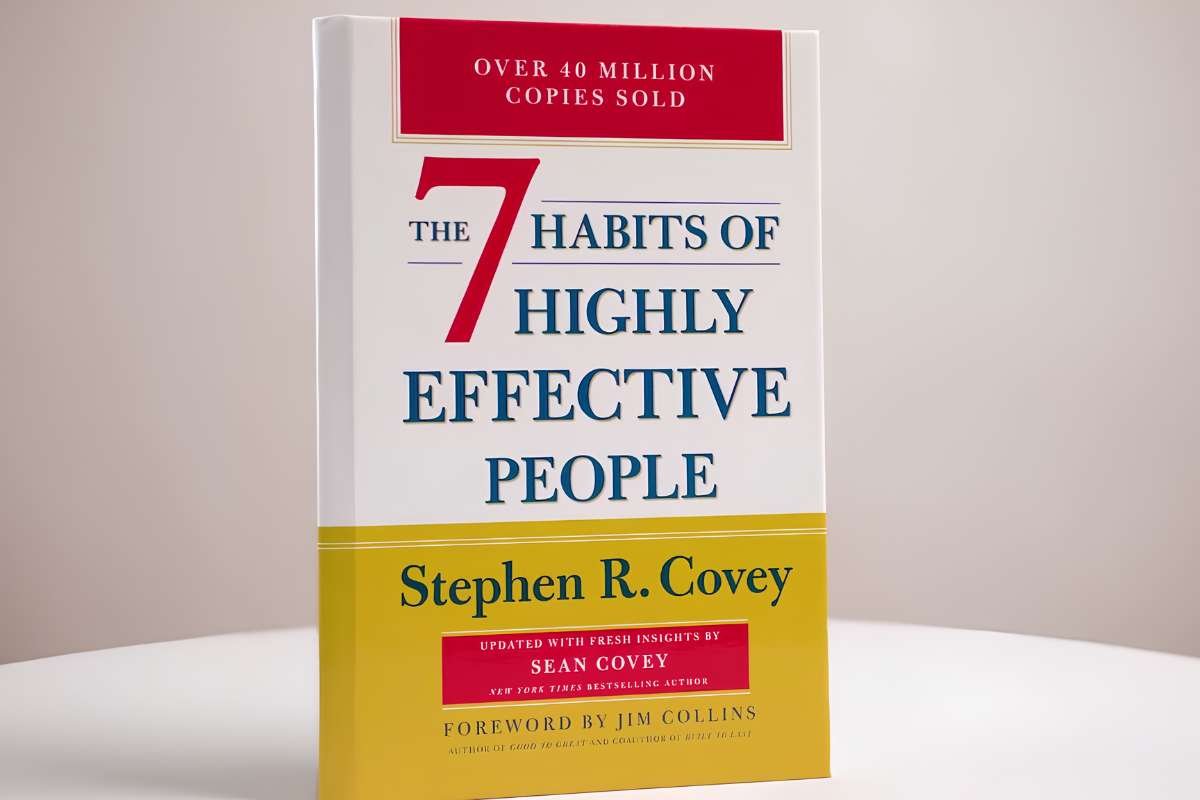
1. The 7 Habits of Highly Effective People by Stephen R. Covey
Best for: Productivity, leadership discipline, and prioritization
Businesses lose time when managers spend too much energy reacting to urgent issues and too little on strategic priorities.
Covey’s The 7 Habits of Highly Effective People provides a framework for personal effectiveness built around concepts such as proactivity, prioritization, accountability, and continuous improvement.
Business perspective:
The real business value of this book is its connection between individual effectiveness and organizational execution. A manager who cannot prioritize will struggle to help a team prioritize.
In an environment filled with AI-generated information, notifications, meetings, and competing priorities, knowing what not to do is becoming increasingly valuable.
Business takeaway: Better management starts with better allocation of attention.
2. Good to Great by Jim Collins
Best for: Organizational performance and sustainable growth
Jim Collins examines why some companies achieve sustained high performance while others struggle to move beyond average results.
The book focuses on disciplined people, disciplined thought, disciplined action, leadership, and organizational consistency.
Business perspective:
Good to Great is particularly relevant to companies trying to scale. Growth can create complexity, but adding people, technology, and processes does not automatically create better performance.
McKinsey’s 2026 research illustrates the same challenge with AI: improving individual productivity does not necessarily produce equivalent financial results.
Business takeaway: Sustainable growth requires disciplined execution, not simply more resources.
3. The Lean Startup by Eric Ries
Best for: Innovation, product development, and new ventures
Businesses frequently spend significant resources developing products before knowing whether customers actually want them.
The Lean Startup challenges that approach through experimentation, customer feedback, validated learning, and the build-measure-learn cycle.
Business perspective:
The book is valuable beyond startups. Large organizations can use its principles when testing new products, AI applications, services, or business models.
Instead of asking, “How quickly can we launch?” managers can ask, “What is the cheapest and fastest way to test whether this idea works?”
Business takeaway: Reduce the cost of being wrong by testing assumptions early.
4. Drive by Daniel H. Pink
Best for: Employee performance and motivation
Employee performance cannot be managed effectively through targets and incentives alone.
In Drive, Daniel Pink focuses on three major drivers of motivation: autonomy, mastery, and purpose.
Business perspective:
For companies, the question is not simply whether employees are motivated. It is whether the way work is designed encourages people to perform at their best.
This becomes increasingly relevant as automation takes over repetitive work and leaves employees with more tasks requiring creativity, judgment, and problem-solving.
The World Economic Forum continues to identify creative thinking, motivation and self-awareness, and leadership among important workplace capabilities.
Business takeaway: Better work design can improve performance without relying solely on financial incentives.
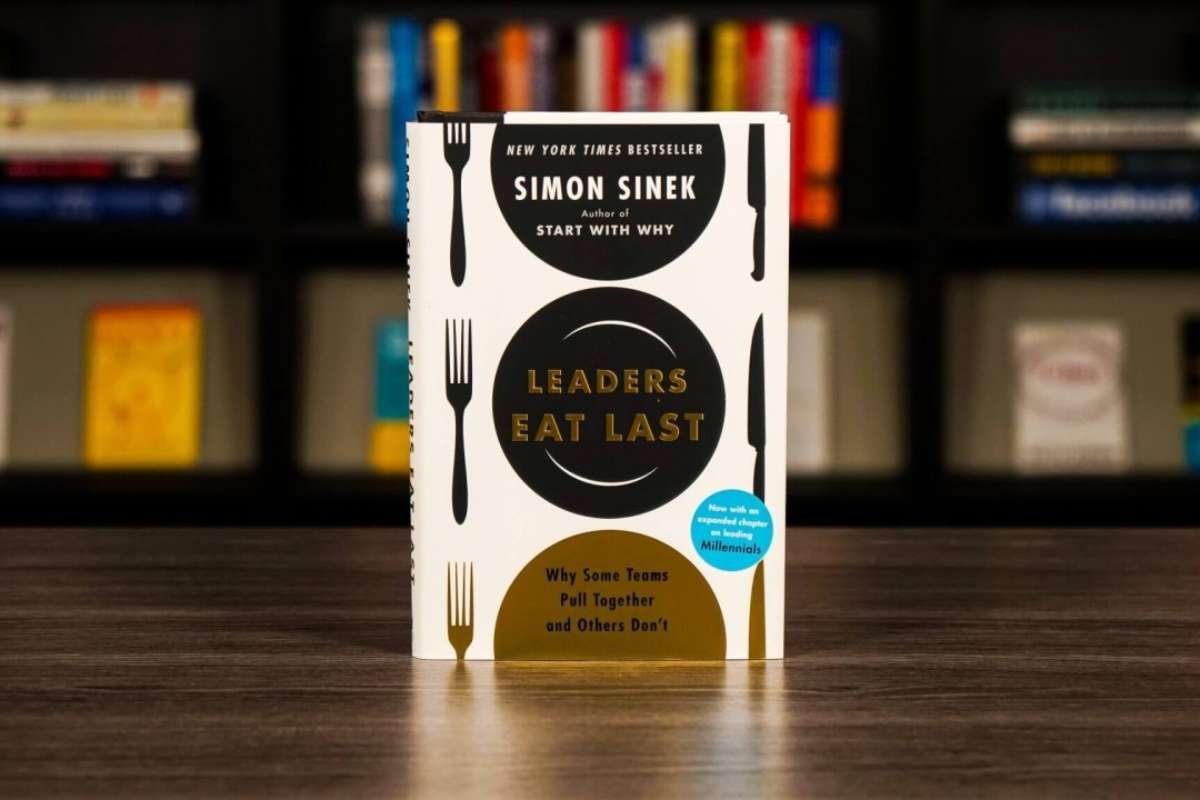
5. Leaders Eat Last by Simon Sinek
Best for: Organizational culture and employee trust
Simon Sinek’s Leaders Eat Last examines how leaders create environments where people feel trusted, supported, and motivated to work toward shared goals.
Business perspective:
Culture is often treated as a soft business issue, but it affects collaboration, communication, retention, and execution.
For companies implementing major technology or organizational changes, trust can become especially important.
McKinsey’s 2026 research emphasizes that leaders still need to provide direction, exercise judgment, build trust, and maintain accountability even as AI changes how work is performed.
Business takeaway: Technology can change workflows, but trust determines how effectively people adapt to those changes.
6. Thinking, Fast and Slow by Daniel Kahneman
Best for: Business decisions and risk management
Every business decision contains some degree of uncertainty.
Daniel Kahneman’s Thinking, Fast and Slow explores how people make decisions and how cognitive biases can influence judgment.
Business perspective:
Managers make hundreds of decisions involving hiring, pricing, investments, partnerships, forecasting, and resource allocation.
AI can provide recommendations faster, but managers still need to determine whether those recommendations are reasonable.
Business takeaway: Better decisions come from recognizing when intuition is useful and when deeper analysis is required.
7. The Innovator’s Dilemma by Clayton M. Christensen
Best for: Disruption and competitive survival
Why do successful companies sometimes struggle when new technologies emerge?
Christensen’s The Innovator’s Dilemma examines how established companies can become vulnerable to disruptive innovation precisely because they are focused on serving existing customers and protecting successful business models.
Business perspective:
The lesson is particularly important for companies facing AI-driven disruption.
A business should not only ask how technology can make its current model more efficient. It should also ask whether technology could change what customers expect altogether.
Business takeaway: Protecting the existing business should not prevent investment in the next business model.
8. Radical Candor by Kim Scott
Best for: Performance management and workplace communication
Managers often struggle between being too direct and avoiding difficult conversations altogether.
Kim Scott’s Radical Candor provides a framework based on caring personally while challenging directly.
Business perspective:
Poor communication can become a business cost. Unclear expectations can lead to repeated mistakes, weak accountability, delayed decisions, and underperformance.
LinkedIn’s 2026 research identifies team management, cross-functional collaboration, mentorship, and executive and stakeholder communication among important skills for today’s workforce.
Business takeaway: Clear feedback reduces the cost of unresolved performance problems.
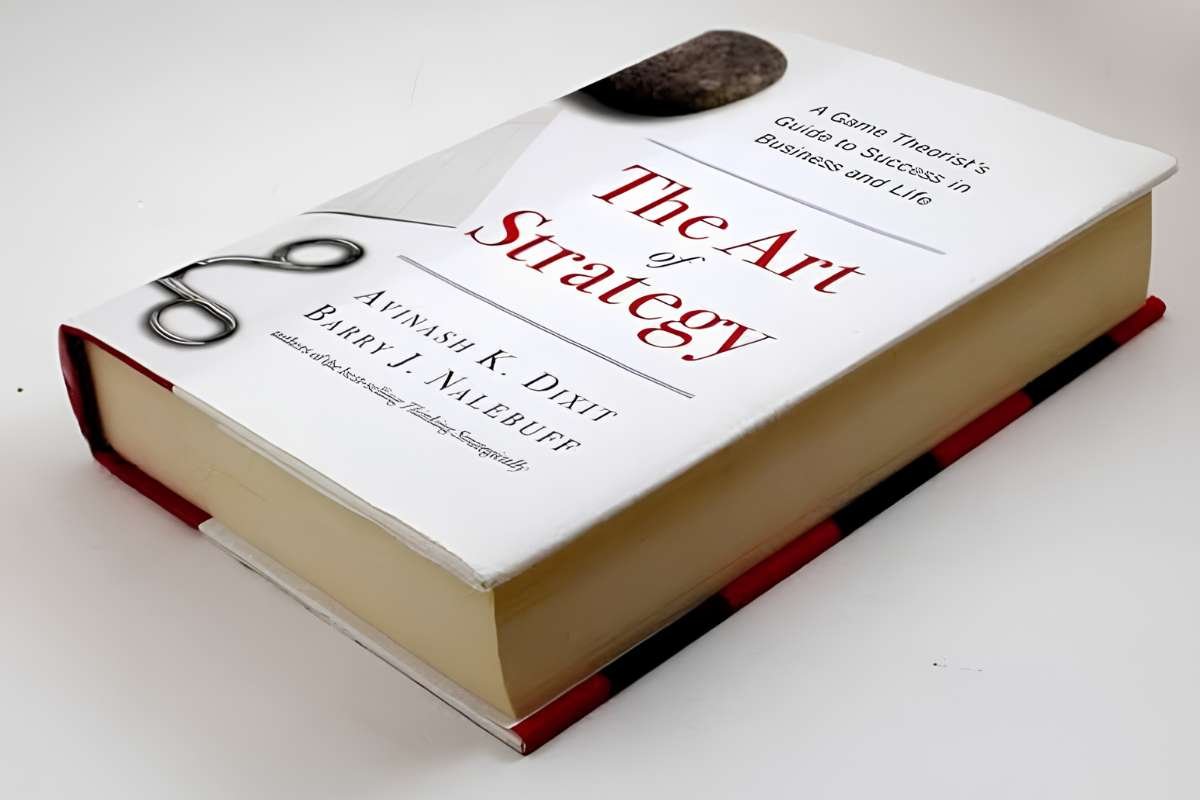
9. The Art of Strategy by Avinash K. Dixit and Barry J. Nalebuff
Best for: Competitive strategy and negotiation
Businesses rarely make decisions in isolation. Competitors react, customers change behavior, suppliers negotiate, and employees respond to incentives.
The Art of Strategy uses game theory to explain strategic decision-making.
Business perspective:
This makes the book particularly useful for leaders working on pricing, market entry, negotiations, partnerships, and competitive positioning.
Business takeaway: A strategy is incomplete until you consider how other stakeholders are likely to respond.
10. First, Break All the Rules by Marcus Buckingham and Curt Coffman
Best for: Talent management and employee performance
The book challenges conventional assumptions about managing employees and emphasizes understanding individual strengths.
Business perspective:
Businesses often try to standardize every aspect of employee management. But performance can improve when managers recognize differences in skills, motivations, and working styles.
As organizations increasingly prioritize skills over traditional career paths and job titles, this approach becomes particularly relevant. LinkedIn’s 2026 skills research highlights the growing importance of skills-based talent decisions.
Business takeaway: Put people where their strengths can create the greatest business value.
11. Leadership in War by Andrew Roberts
Best for: Crisis management and high-pressure decisions
Andrew Roberts examines historical military leaders and the decisions they made during periods of extreme uncertainty.
Business perspective:
Business leaders rarely operate under the same conditions as military commanders, but the decision-making challenges can be similar: incomplete information, competing priorities, limited resources, and significant consequences.
Business takeaway: Strong leadership means making informed decisions even when certainty is impossible.
12. Emotional Intelligence 2.0 by Travis Bradberry and Jean Greaves
Best for: Leadership effectiveness and workplace relationships
Emotional intelligence affects how leaders handle conflict, feedback, pressure, and relationships.
The book focuses on self-awareness, self-management, social awareness, and relationship management.
Business perspective:
A manager’s behavior influences team dynamics. A technically strong manager who cannot communicate effectively may still create significant organizational problems.
The WEF identifies empathy and active listening, leadership and social influence, and motivation and self-awareness among important workplace capabilities.
Business takeaway: Leadership effectiveness depends on how well you manage both yourself and your relationships.
13. Blue Ocean Strategy by W. Chan Kim and Renée Mauborgne
Best for: Business growth and competitive differentiation
Instead of competing within crowded markets, Blue Ocean Strategy encourages companies to rethink how they create customer value.
Business perspective:
This is useful for leaders asking:
- Can we create a new category?
- Can we serve an overlooked customer need?
- Can we eliminate unnecessary costs?
- Can we offer a different value proposition?
Business takeaway: Competitive advantage can come from changing the rules of competition rather than simply competing harder.
14. The Goal by Eliyahu M. Goldratt
Best for: Operations and process improvement
The Goal introduces the Theory of Constraints through a business story about improving manufacturing performance.
Its central lesson is simple: a system’s performance can be limited by a small number of constraints.
Business perspective:
The same principle applies to modern businesses.
A company might have excellent technology but slow approvals. It might have strong sales but weak fulfillment. It might automate customer service while leaving a major bottleneck in product development.
Business takeaway: Find the constraint before spending money on improvements elsewhere.
15. Dare to Lead by Brené Brown
Best for: Organizational change and courageous leadership
Brené Brown focuses on courage, vulnerability, trust, and accountability.
Business perspective:
Business transformation requires leaders to communicate difficult information, acknowledge uncertainty, address mistakes, and hold people accountable.
That becomes especially important during restructurings, technology adoption, mergers, and major strategic shifts.
Business takeaway: Leaders cannot build accountability while avoiding difficult conversations
16. High Output Management by Andrew S. Grove
Best for: Management systems, productivity, and operational scale
Former Intel CEO Andrew Grove’s High Output Management treats management as a system designed to increase organizational output.
One of the book’s central ideas is that a manager’s output is not simply what they personally accomplish. It is also the output produced by the teams and systems they influence.
Business perspective:
This is one of the most practical management books for leaders responsible for scaling teams.
A manager who personally completes 10 tasks may create less value than one who helps 10 employees become significantly more effective.
Business takeaway: Measure management by the performance you enable, not just the tasks you personally complete.
17. Good Strategy/Bad Strategy by Richard Rumelt
Best for: Corporate strategy and competitive positioning
Many companies confuse strategy with ambitious goals.
Richard Rumelt argues that a useful strategy should identify the critical challenge, establish a guiding approach, and coordinate actions around it.
Business perspective:
Statements such as “become the market leader” or “increase innovation” are goals, not complete strategies.
A strong business strategy explains what problem the company is solving and how it will respond.
Business takeaway: Strategy begins by identifying the real obstacle, not by creating an impressive-sounding ambition.
18. Measure What Matters by John Doerr
Best for: Goals, accountability, and performance measurement
John Doerr’s Measure What Matters popularized the use of Objectives and Key Results (OKRs) through examples from companies including Google.
Business perspective:
Companies can have talented employees and ambitious strategies but still struggle because employees are not aligned around measurable outcomes.
OKRs can help connect company priorities with team-level execution.
Business takeaway: What gets measured should connect directly to what the business is trying to accomplish.
19. The Hard Thing About Hard Things by Ben Horowitz
Best for: Entrepreneurship and difficult leadership decisions
Ben Horowitz focuses on the challenges that leaders face when there is no easy management formula.
The book covers hiring, firing, managing executives, handling crises, building companies, and making difficult decisions.
Business perspective:
This is especially relevant for founders, CEOs, and senior managers because business leadership is not always about applying a clean framework. Sometimes the leader has to choose between several imperfect options.
Business takeaway: Effective management requires the ability to make difficult decisions when every option has a downside.
20. The Five Dysfunctions of a Team by Patrick Lencioni
Best for: Team performance and organizational alignment
Patrick Lencioni presents five common dysfunctions that can weaken teams: absence of trust, fear of conflict, lack of commitment, avoidance of accountability, and inattention to results.
Business perspective:
Team dysfunction can become an operational problem.
When people do not trust each other, avoid difficult discussions, or fail to hold one another accountable, decisions slow down and execution suffers.
Business takeaway: Fix team dynamics before expecting a team to consistently deliver better results.
Management books for different business problems
There is no single best management book for every business challenge. The right choice depends on what the organization needs to improve.
| Business challenge | Best management books | Business outcome |
|---|---|---|
| Improve manager productivity | The 7 Habits, High Output Management | Better use of time and resources |
| Improve organizational performance | Good to Great, Measure What Matters | Stronger execution |
| Develop corporate strategy | Good Strategy/Bad Strategy, The Art of Strategy | Better strategic decisions |
| Drive innovation | The Lean Startup, The Innovator’s Dilemma | Faster experimentation and adaptation |
| Increase employee motivation | Drive, First, Break All the Rules | Stronger employee performance |
| Build trust | Leaders Eat Last, Dare to Lead | Stronger organizational culture |
| Improve decision-making | Thinking, Fast and Slow, Leadership in War | Better judgment under uncertainty |
| Improve feedback | Radical Candor | Clearer performance conversations |
| Develop leaders | Emotional Intelligence 2.0, High Output Management | More effective managers |
| Improve operations | The Goal, High Output Management | Greater operational efficiency |
| Create competitive advantage | Blue Ocean Strategy, The Innovator’s Dilemma | Stronger market positioning |
| Manage difficult periods | The Hard Thing About Hard Things, Leadership in War | Better crisis leadership |
| Improve team performance | The Five Dysfunctions of a Team, Leaders Eat Last | Better collaboration |
| Manage organizational change | Dare to Lead, The Innovator’s Dilemma | Better adaptation |
| Align teams with strategy | Measure What Matters, Good Strategy/Bad Strategy | Stronger strategic execution |
What these management books teach about running a business
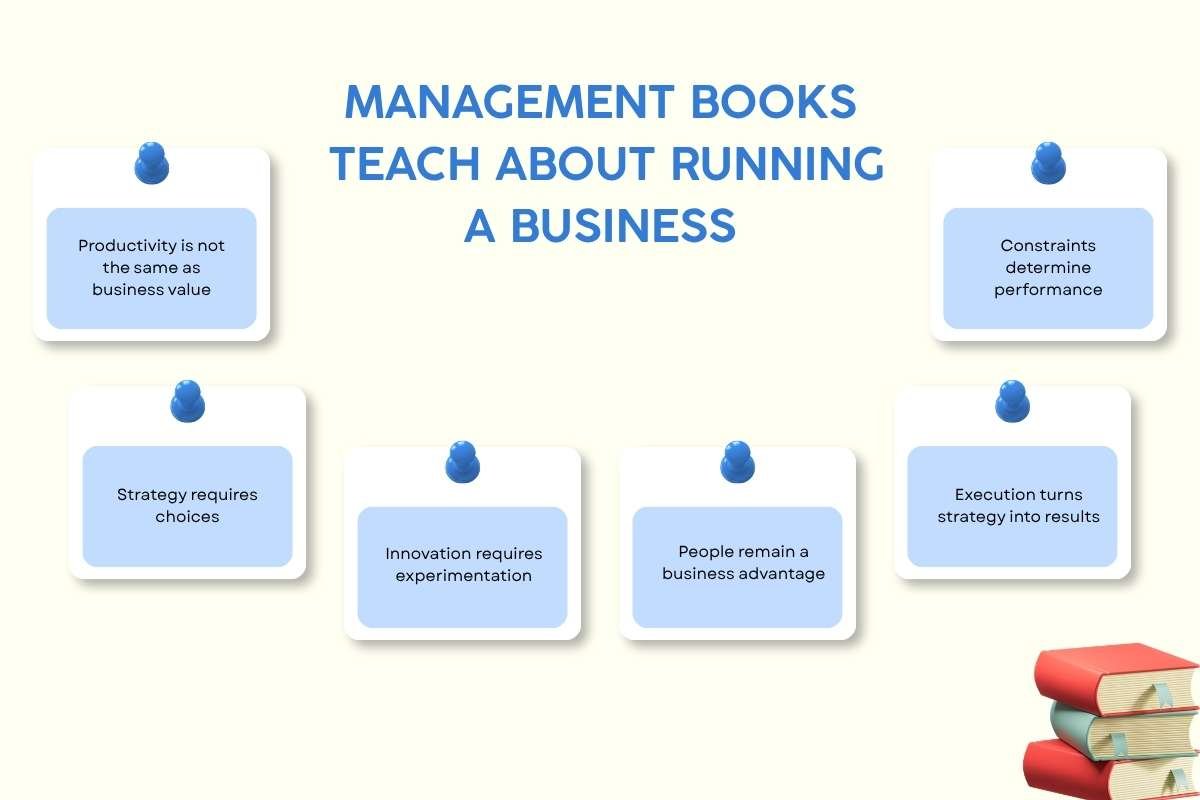
Although these management books approach leadership from different perspectives, several common business principles emerge.
1. Productivity is not the same as business value
AI can make individual employees faster without automatically improving revenue, margins, or customer outcomes.
The lesson from both current business research and books such as High Output Management and Good to Great is that leaders need to connect individual productivity with organizational performance.
Business question: Are we becoming faster, or are we actually becoming better?
2. Strategy requires choices
Good Strategy/Bad Strategy, Blue Ocean Strategy, and The Art of Strategy all point toward a similar principle: businesses cannot pursue every opportunity.
Leaders need to decide where the company will compete, how it will create value, and which opportunities it will deliberately ignore.
Business question: What are we choosing not to do?
3. Innovation requires experimentation
The Lean Startup and The Innovator’s Dilemma show why businesses need mechanisms for testing new ideas.
This is particularly important as AI changes products, services, and business models.
Business question: What assumption should we test before making a larger investment?
4. People remain a business advantage
Automation does not eliminate the importance of leadership.
Managers still need to motivate people, resolve conflicts, communicate expectations, build trust, and make difficult decisions.
McKinsey’s 2026 research similarly emphasizes that leaders must continue providing judgment, accountability, direction, and trust as organizations redesign work around AI.
Business question: Are our people systems helping employees perform at their best?
5. Execution turns strategy into results
A strategy only matters when employees can execute it.
Measure What Matters, High Output Management, and Good to Great all provide different ways of thinking about the connection between goals, teams, processes, and results.
Business question: Can our employees clearly connect their work to the company’s priorities?
6. Constraints determine performance
The Goal provides one of the clearest operational lessons in the list: improving every process does not matter if one major constraint continues to limit the entire system.
Business question: What single bottleneck is currently limiting growth?
How to choose the right management book for your business
With so many management books available, business leaders should choose based on the problem they need to solve rather than popularity alone.
- If your problem is strategy: Start with Good Strategy/Bad Strategy or The Art of Strategy.
- If your company needs innovation: Start with The Lean Startup or The Innovator’s Dilemma.
- If employee performance is the challenge: Consider Drive, First, Break All the Rules, or High Output Management.
- If teams are struggling: Read Radical Candor, Leaders Eat Last, or The Five Dysfunctions of a Team.
- If operations are inefficient: Start with The Goal or High Output Management.
- If decision-making is the problem: Choose Thinking, Fast and Slow or Leadership in War.
- If the company is going through major change: Consider Dare to Lead, The Hard Thing About Hard Things, or The Innovator’s Dilemma.
The most effective approach is to select one book, identify one business problem, apply one framework, and measure the result.
Conclusion
The best management books turn business challenges into practical frameworks for better decisions, stronger teams, and better performance.
These 20 titles cover strategy, innovation, operations, leadership, productivity, and growth, all of which matter as businesses adapt to AI and changing markets.
Instead of asking, “What is the best management book?”, ask:
“What business problem do we need to solve next?”
Choose the book that addresses that challenge, apply its ideas, and measure the results.
The right management books do not replace experience. They sharpen it.
FAQs
1. What are the best management books for business leaders?
Top choices include Good Strategy/Bad Strategy, Good to Great, High Output Management, The Art of Strategy, and Thinking, Fast and Slow. They cover strategy, execution, decision-making, and operations.
2. Which management book is best for new managers?
High Output Management, Radical Candor, and The 7 Habits of Highly Effective People are strong choices for new managers building leadership, communication, and productivity skills.
3. Which management books are best for CEOs?
CEOs can benefit from Good Strategy/Bad Strategy, The Hard Thing About Hard Things, The Innovator’s Dilemma, and High Output Management for strategy, growth, disruption, and execution.
4. How can management books improve business performance?
Management books provide practical frameworks for better decisions, stronger teams, innovation, productivity, and operational efficiency.
5. How many management books should a business leader read?
There is no fixed number. Start with one book that addresses a current business challenge, apply its ideas, and measure the results.