Why is Change Management Consulting so important in 2026? As organizations grapple with adopting AI, digital transformation, mergers, and changes to the workforce, success depends on people embracing change, not just deploying technology. In this guide, you’ll learn what Change Management Consulting is, why it’s important, the top benefits, real-world examples, typical services offered, and proven strategies that help organizations reduce resistance, accelerate adoption, and achieve lasting transformation results.
More business transformations fail because of people than technology. As organizations adopt AI, automate workflows, restructure teams, and navigate economic uncertainty, managing change has become a strategic priority. That’s why Change Management Consulting is quickly moving from a support function to a business imperative. It helps leaders align stakeholders, reduce resistance, and accelerate adoption. Resilient transformations deliver measurable business value. What it is and why it matters, benefits, examples, services, and strategies.
Table of Contents
What is change management consulting?
Change management consulting is the practice of helping organizations make changes to achieve desired results by assisting businesses in planning, implementing, and tracking changes to minimize disruption and maximize benefits. It’s really about getting people to adopt new processes, technologies, and behaviours so that transformations deliver genuine value.
The difference between project management and change management. Project management is about what to deliver, when, and within parameters, i.e., scope, tasks, and deliverables. Change management is the people side, how to manage the change, who will be affected, and how to enable that behavior change.
The importance of employee adoption for success: Transformations don’t work if people won’t change the way they operate. And the ultimate predictor of whether investments in technology and processes actually generate benefits is employee adoption.
The three pillars of successful change management
Competitors rarely explain this clearly:
| Pillar | Role |
| People | Ensures adoption, addresses resistance, builds capability |
| Processes | Sets the framework, defines new workflows and standards |
| Technology | Provides the tools and systems enabling the change |
All three need to be in alignment. Technology provides tools, processes create structure, but people drive adoption. Even the best technology and processes fail without strong Change Management Consulting.
Why change management consulting matters more in 2026?

Modern business faces unprecedented change: AI implementation, workforce reskilling, hybrid workplaces, mergers and acquisitions, cloud migration, and digital transformation. These shifts are not just technical. People are the critical success factor. Without addressing the human side, even the most advanced technology fails to deliver value.
The cost of poor change management
Neglecting the people side of change carries real costs:
| Issue | Impact |
| Delayed adoption | Missed milestones and prolonged timelines |
| Budget overruns | Extra spending on rework and redesign |
| Employee turnover | Loss of talent and increased recruitment costs |
| Productivity loss | Sustained declines in efficiency and work quality |
| Failed initiatives | Up to 70% of change programs miss their goals. |
Research shows projects with excellent Change Management Consulting are 6–7× more likely to achieve success. In 2026, with AI and hybrid work reshaping business, the cost of getting people wrong is too high to ignore.
Key benefits of change management consulting:
Effective Change Management Consulting delivers measurable advantages by focusing on the people side of transformation.
Primary benefits:
- Faster employee adoption – Employees embrace new processes quickly through targeted preparation and support
- Reduced resistance – Early stakeholder engagement addresses concerns before they become blockers
- Better communication – Clear, consistent messaging keeps everyone aligned throughout the journey
- Higher productivity – Teams maintain performance during transitions with proper training and support
- Lower implementation risk – Early risk identification prevents costly delays and disruptions
- Stronger leadership alignment – Executives and managers coordinate to drive consistent change
Short-term vs Long-term benefits
Short-term: Smoother transitions with less disruption to daily operations, and faster training outcomes as employees reach competency quickly.
Long-term: Organizations develop agility to adapt to future changes rapidly, and build a continuous improvement culture where change becomes embedded in how the company operates. This creates a lasting competitive advantage beyond any single initiative.
Change management consulting examples:
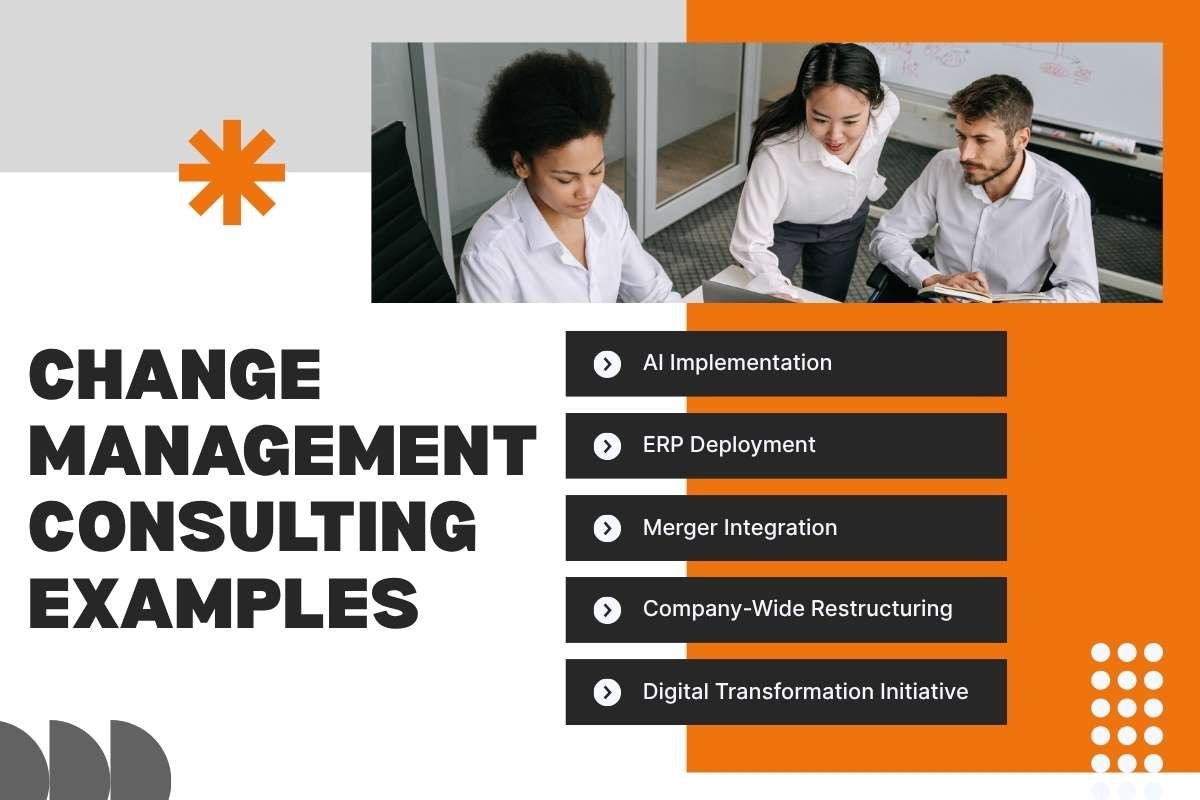
Example 1: AI implementation
Challenge: Employees resist AI tools due to fear of job displacement and uncertainty about new workflows.
Consultant actions: Conducted change impact assessment, defined AI scope, engaged leadership champions, and delivered targeted training on AI skills.
Business outcome: Enhanced reliability, efficiency, and sustainable AI adoption delivering real ROI.
Example 2: ERP deployment
Challenge: ERP project stalled due to poor employee adoption and a lack of focus on the people side.
Consultant actions: Built an OCM plan aligned to the project timeline, trained business users, and managed hypercare post-go-live.
Business outcome: Restarted stalled project successfully with a $100M medical equipment manufacturer, achieving full adoption.
Example 3: Merger integration
Challenge: Complex post-merger integration needed cost transparency and synergy baseline across two companies.
Consultant actions: Structured program management, created a data broker role, established leadership cascades, and defined a new operating model.
Business outcome: Merger completed on time and on budget with lasting operational results.
Example 4: Company-wide restructuring
Challenge: A 650-person department returning to the office after four years of remote work work with team redundancy issues.
Consultant actions: Two-phase approach: gradual reintegration first, then skills audit, team effectiveness review, and strategic reassignment.
Business outcome: High-performing team rebuilt with the right people in the right roles, driving business success.
Example 5: Digital transformation initiative
Challenge: Outdated processes caused declining productivity and employee resistance to new technology.
Consultant actions: Developed a clear change plan, delivered complete training programs, and implemented regular communication channels.
Business outcome: Productivity increased 23%, improved morale, smoother transition with minimal disruption.
Common change management consulting services:
Change readiness assessments, stakeholder analysis, communication planning, training programs, leadership coaching, organizational design, and adoption measurement are core services. Consultants assess readiness, develop strategies, design communication plans, train, and measure results.
What happens during a typical consulting engagement?
Phase 1: Assessment – Consultants conduct discussions, interviews, and data analysis to understand client needs, challenges, and opportunities. SWOT analysis identifies strengths and areas requiring improvement.
Phase 2: Strategy – Clear objectives are set, and strategic planning creates a detailed roadmap with actions, timelines, and resources. Risk assessments anticipate roadblocks and develop contingency plans.
Phase 3: Implementation – The plan executes as consultants work side-by-side with client teams to implement changes, streamline processes, and optimize workflows. Continuous monitoring ensures progress and adjustments as needed.
Phase 4: Reinforcement – Outcomes are measured against objectives to evaluate success. Knowledge transfer ensures client teams maintain and build upon improvements sustainably. Performance tracking and continuous refinement help organizations stay agile.
This structured approach ensures Change Management Consulting delivers lasting transformation results.
Best change management consulting strategies:

Strategy 1: Build executive sponsorship – Leaders must personally champion change and model new behaviors to drive accountability.
Strategy 2: Communicate early and often – Transparent, consistent messaging keeps stakeholders informed and reduces uncertainty throughout the journey.
Strategy 3: Identify change champions – Influential employees at all levels act as advocates who encourage peers and provide feedback.
Strategy 4: Use data-driven adoption metrics – Track usage, engagement, and performance to measure real adoption versus assumed progress.
Strategy 5: Prioritize employee training – Invest in role-based learning so people feel confident and capable with new tools and processes.
Strategy 6: Address resistance proactively – Listen to concerns early and adjust plans rather than pushing forward despite pushback.
Strategy 7: Reinforce change continuously – Celebrate wins, recognize adoption, and embed new behaviors through ongoing support.
Why traditional change models need updating for AI-driven organizations
Traditional paradigms assume linear, predictable change, with well-scoped end-states, and human-driven timelines. The change AI brings is dynamic, ongoing, and often unpredictable. Things change post-deployment of systems, changes that creators cannot entirely predict.
By 2026, change management will shift from “managing” change to sensing and responding in real time, using predictive analytics to anticipate engagement and detect signals of resistance early. This is a call for AI governance, adaptive playbooks, and continuous alignment across systems, people, and processes, not one-off rollout plans.
Conclusion:
Business transformations only work when people change, not just when technology is put in. Change Management Consulting has shifted from a support function to a strategic imperative, enabling leaders to align stakeholders, mitigate resistance, and accelerate adoption for AI implementations, mergers, and digital transformations. From readiness assessments to reinforcement strategies, it ensures faster adoption, lower risk, and enduring organizational agility. Don’t let the human side of change be your weak link in transformation.
Ready to change with confidence? Contact a Change Management Consulting expert today to assess your readiness and build a tailored adoption strategy.
FAQ:
1. What do change management consultants do?
Change management consultants guide organizations through major business transitions, such as mergers, new software rollouts, or restructuring.
2. How much does a change management consultant cost?
Change management consulting typically costs between $150 and $450+ per hour for independent experts, or anywhere from $10,000 to $1.5 million+ for large-scale, enterprise-wide project scopes.
3. Is CMC certification worth it?
Whether the CMC (Certified Management Consultant) is worth it depends entirely on which of the two primary certifications you are referring to: Management Consulting or Critical Care Nursing.
4. What are the 5 C’s of change management?
The 5 C’s of change management are Clarity, Communication, Culture, Capability, and Commitment.
5. Is change management high-paying?
Yes, change management is a highly lucrative career path. In the United States, professionals typically earn a median salary between $116,000 and $160,000 per year, with senior directors and high-end specialists frequently exceeding $200,000 annually.