
Time and attendance management keeps employee hours, attendance, and payroll on track. It is about much more than clocking in and out. This guide explains how time and attendance management helps businesses stay organized, reduce payroll errors, and meet compliance requirements. You’ll learn how systems, policies, and automation work together, what features really matter, and the common mistakes that can hold even the best attendance process back.
Picture this. One employee starts work from home, another arrives at the office, and a third works a night shift. Keeping track of everyone’s hours is not as simple as it used to be. Time and Attendance Management helps businesses stay organized as teams become more flexible and labor rules continue to change.
It is no longer just about recording clock-ins and clock-outs. In this guide, you’ll learn how modern attendance systems work, why clear policies matter, and how automation helps businesses save time while improving accuracy and compliance.
What is time and attendance management?
It is the process of recording employee work hours, attendance, breaks, overtime, and leave to ensure accurate payroll, labor law compliance, and workforce planning.
Tracking time simply means recording when employees start, stop, and finish work. Managing attendance goes a step further. It also covers approved leave, break times, overtime, shift schedules, and company attendance rules. Together, these help businesses keep daily operations running smoothly.
Whether you have five employees or five hundred, keeping accurate records matters. It helps reduce payroll mistakes, supports labor law compliance, and gives managers a clear view of who is available to work. Employees also benefit because their hours, leave, and overtime are recorded fairly. A good system builds trust, saves time, and makes it easier for businesses to plan ahead as they grow.
Why businesses can no longer rely on manual tracking

Many businesses still use paper timesheets or spreadsheets because they seem simple. But as teams grow, these methods become harder to manage. Small mistakes can turn into bigger problems that affect payroll, scheduling, and daily operations.
| Challenge | Business Impact |
|---|---|
| Buddy punching | Employees clock in for others, leading to false work hours. |
| Payroll mistakes | Incorrect records can result in overpayments or underpayments. |
| Time theft | Untracked breaks and inaccurate hours increase labor costs. |
| Human errors | Manual entries are easier to forget or enter incorrectly. |
| Hybrid teams | Tracking office and remote employees becomes more difficult. |
| Poor reporting | Managers have limited insight into attendance trends. |
| Lost productivity | HR spends more time fixing records instead of supporting employees. |
According to the U.S. Bureau of Labor Statistics’ American Time Use Survey (2025), 35% of employed people did some or all of their work from home on the days they worked. As businesses hire more employees across different locations and shifts, these losses can grow quickly. That is why many organizations now invest in Time and Attendance Management to improve accuracy and reduce costly errors.
Time and attendance management: systems, policies, and automation
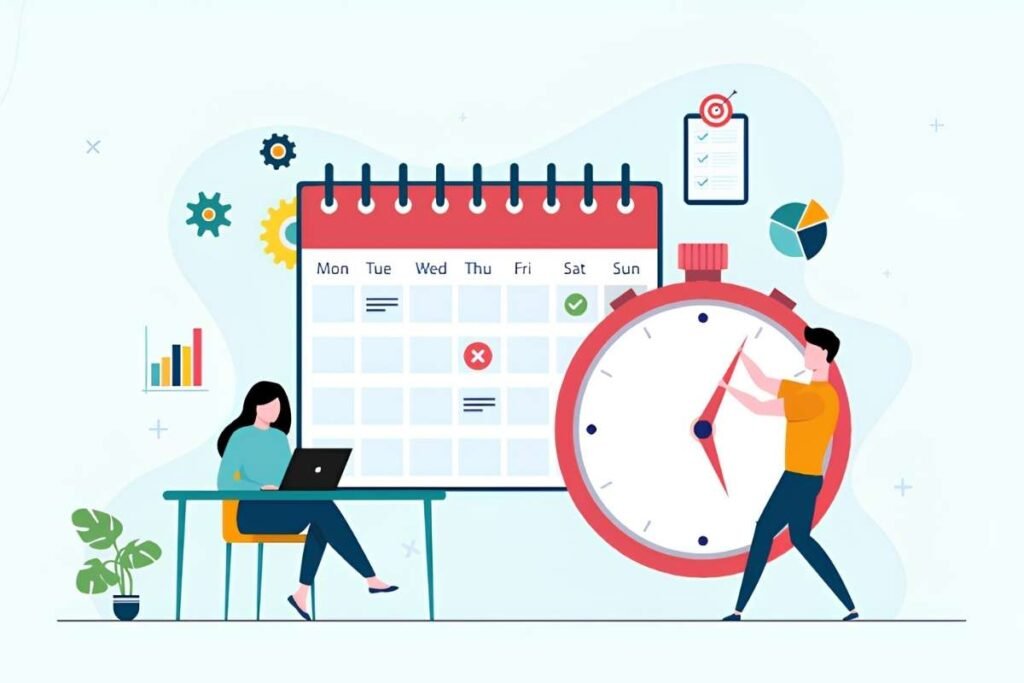
Many businesses think installing attendance software will solve every problem. In reality, accurate attendance tracking depends on three connected parts working together: systems, policies, and automation. If one is weak, the whole process suffers.
1. Systems collect accurate attendance data
Systems are the tools employees use every day. These may include biometric scanners, mobile apps, web portals, GPS tracking, and cloud platforms. They record work hours across offices, job sites, and remote locations. The right system gives managers a clear and reliable record without relying on paper timesheets or manual entries.
2. Policies set clear expectations
Technology cannot replace workplace rules. Every business needs clear policies for work hours, break times, overtime approvals, remote work, and leave requests. This is where Time and Attendance Management becomes more than a tracking tool. Good policies help everyone understand what is expected and make attendance decisions fair and consistent.
3. Automation keeps everything moving
Once systems and policies are in place, automation ties them together. It can send clock-in reminders, build shift schedules, flag overtime, approve leave requests, sync payroll, and generate compliance reports. This reduces manual work and helps managers respond faster.
Companies buy new software but keep outdated attendance policies. Some skip employee training and expect the technology to fix every issue on its own. That rarely works. The best results come when systems, policies, and automation support each other as one complete process.
Features to look for before choosing a solution
Choosing the right Time and Attendance Management solution is not about finding the one with the most features. Instead, focus on tools that solve real workplace problems and make daily tasks easier for both employees and managers.
| Feature | Why It Matters? |
|---|---|
| Mobile clock-in | Supports remote and field employees. |
| Biometric verification | Reduces buddy punching and false clock-ins. |
| GPS location | Confirms employees are at the correct job site. |
| Shift scheduling | Helps prevent staffing gaps and scheduling conflicts. |
| Payroll integration | Cuts down manual data entry and payroll errors. |
| Leave management | Makes leave requests and approvals easier to handle. |
| Real-time dashboards | Gives managers a live view of attendance and staffing. |
| Compliance reports | Keeps records ready for audits and labor requirements. |
As work becomes more flexible, managers need reliable attendance data to understand staffing needs and support employees effectively. According to Gallup’s State of the Global Workplace 2025, employee engagement is closely linked with higher productivity and stronger business performance. Accurate attendance records give managers better visibility into workforce patterns and help them make more informed scheduling decisions.
Before making a final choice, think about your team’s needs today and how they may change as the business grows. A solution that is easy to use and can grow with your business will deliver better long-term value.
Common mistakes that reduce the value of attendance systems
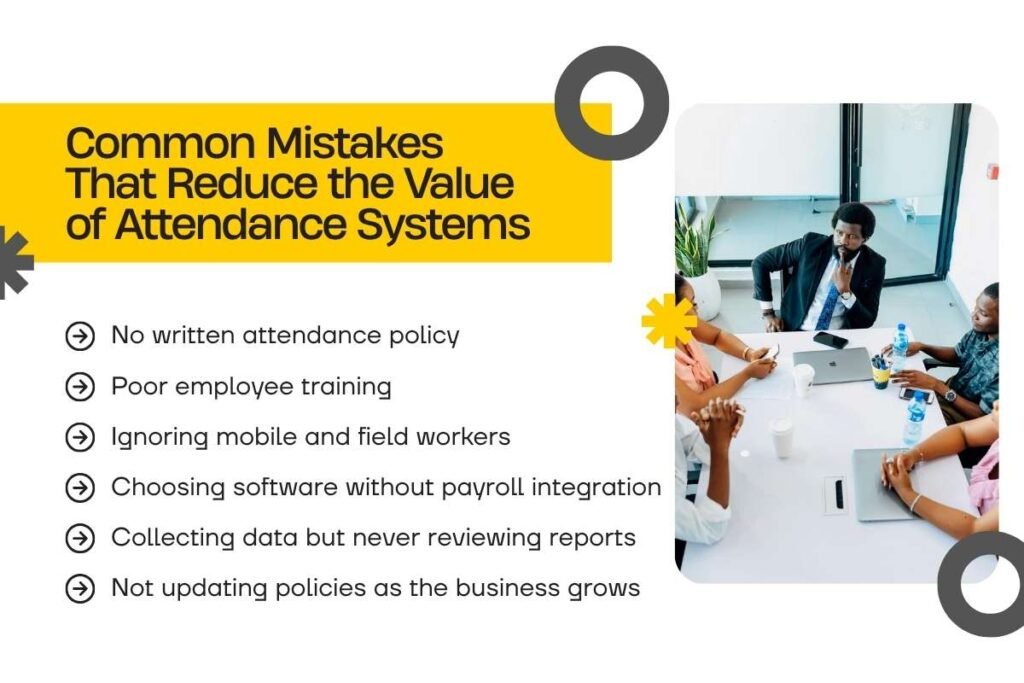
Even the best attendance software can fall short if it is not used the right way. Many businesses make simple mistakes that reduce their value over time.
- No written attendance policy: Employees need clear rules for work hours, breaks, overtime, and leave. Without them, confusion and inconsistent records become common.
- Poor employee training: A new system only works when everyone knows how to use it correctly. Short training sessions can prevent many avoidable mistakes.
- Ignoring mobile and field workers: If remote employees cannot clock in easily, attendance records become incomplete and less reliable.
- Choosing software without payroll integration: Manual data transfers take more time and increase the risk of payroll errors.
- Collecting data but never reviewing reports: Attendance reports can reveal trends like repeated lateness, overtime spikes, or staffing gaps, but only if managers review them regularly.
- Not updating policies as the business grows: New locations, larger teams, and flexible work schedules often require attendance rules to be updated.
According to the World Economic Forum’s Future of Jobs Report 2025, 60% of employers expect broader digital access to transform their business by 2030. As workplaces become more connected, businesses need attendance processes that can support office, remote, and field employees consistently. Businesses that regularly review and improve their Time and Attendance Management process are better prepared to support a growing workforce while maintaining accuracy and compliance.
Conclusion
Managing attendance today is about much more than recording when employees clock in and out. A reliable process combines the right systems, clear workplace policies, and smart automation to keep everything running smoothly. When these three work together, Time and Attendance Management helps reduce payroll errors, support labor law compliance, save time, and create a better experience for both employees and managers.
Before investing in new software, take a close look at your current process. Are your attendance policies clear? Does your system meet the needs of office, remote, and field employees? Are you using the data to improve scheduling and workforce planning? Fixing these gaps first will help you get far more value from any attendance solution you choose.
Frequently asked questions
1. What is the difference between time tracking and attendance management?
Time tracking records work hours. Attendance management also covers breaks, leave, overtime, schedules, and attendance policies.
2. Which industries benefit the most from attendance management systems?
Healthcare, manufacturing, retail, construction, hospitality, logistics, and professional services benefit from accurate attendance tracking.
3. How do biometric attendance systems improve accuracy?
They verify employee identity using fingerprints or facial recognition, reducing buddy punching and inaccurate clock-ins.
4. Can small businesses use cloud-based attendance software?
Yes. Cloud-based solutions are affordable, easy to set up, and can grow as the business expands.
5. How does attendance management help with labor law compliance?
It maintains accurate work hours, overtime, and leave records, making compliance and audits much easier