Strategic management is the process of setting clear goals, using resources wisely, adapting to market changes, and turning plans into action.
Strong strategic management companies use different approaches to stay competitive. Some focus on technology and innovation, while others prioritize efficiency, customer experience, expansion, or quick adaptation.
These companies offer practical examples of how good strategy connects business goals with people, technology, investment, and customer needs. The 10 companies below are selected based on their well-documented strategies and recent business actions, not as a financial ranking.
10 Strong Strategic Management Companies Showing How Strategy Works in 2026
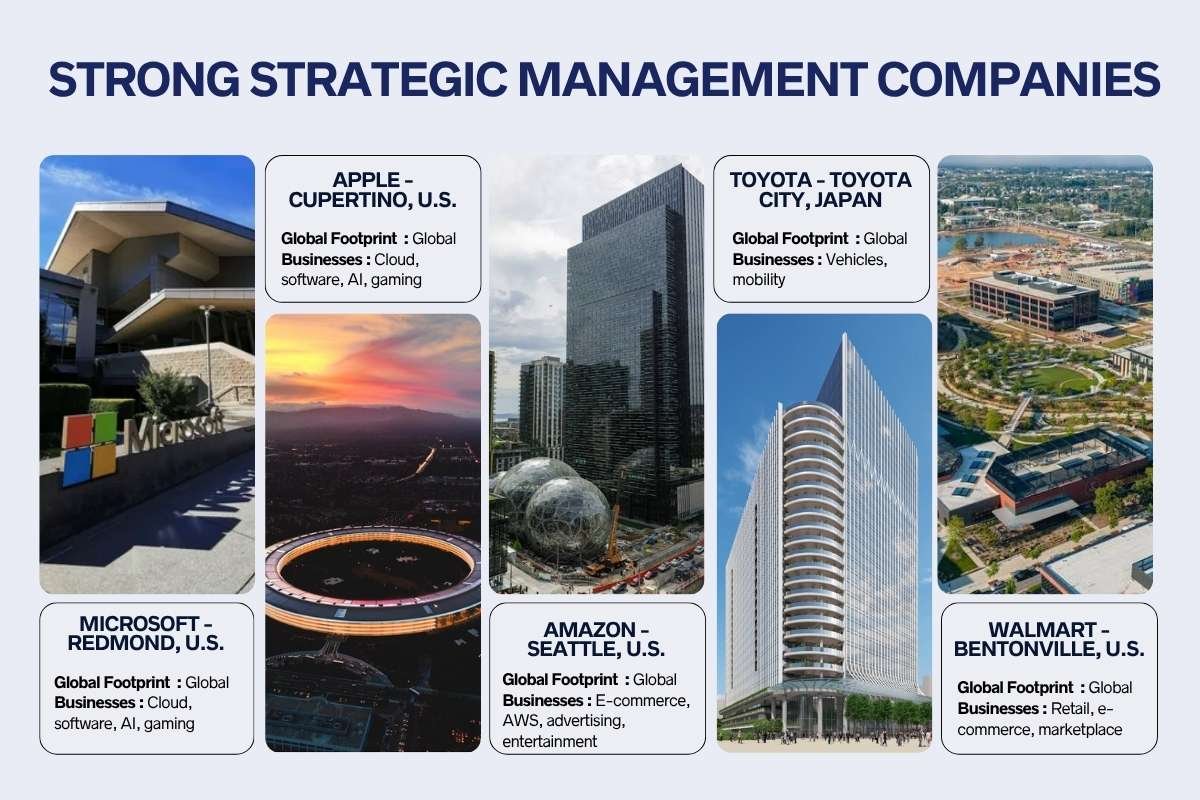
| Company & Headquarters | Global Footprint | Core Services / Businesses | Key Differentiator |
| Microsoft – Redmond, U.S. | Global | Cloud, software, AI, gaming | Combines AI, cloud, and software |
| Apple – Cupertino, U.S. | Global | iPhone, Mac, iPad, services | Strong product and service ecosystem |
| Amazon – Seattle, U.S. | Global | E-commerce, AWS, advertising, entertainment | Customer-focused innovation and diversification |
| Toyota – Toyota City, Japan | Global | Vehicles, mobility | Uses multiple technology paths for future mobility |
| Walmart – Bentonville, U.S. | Global | Retail, e-commerce, marketplace | Connects stores, online shopping, and technology |
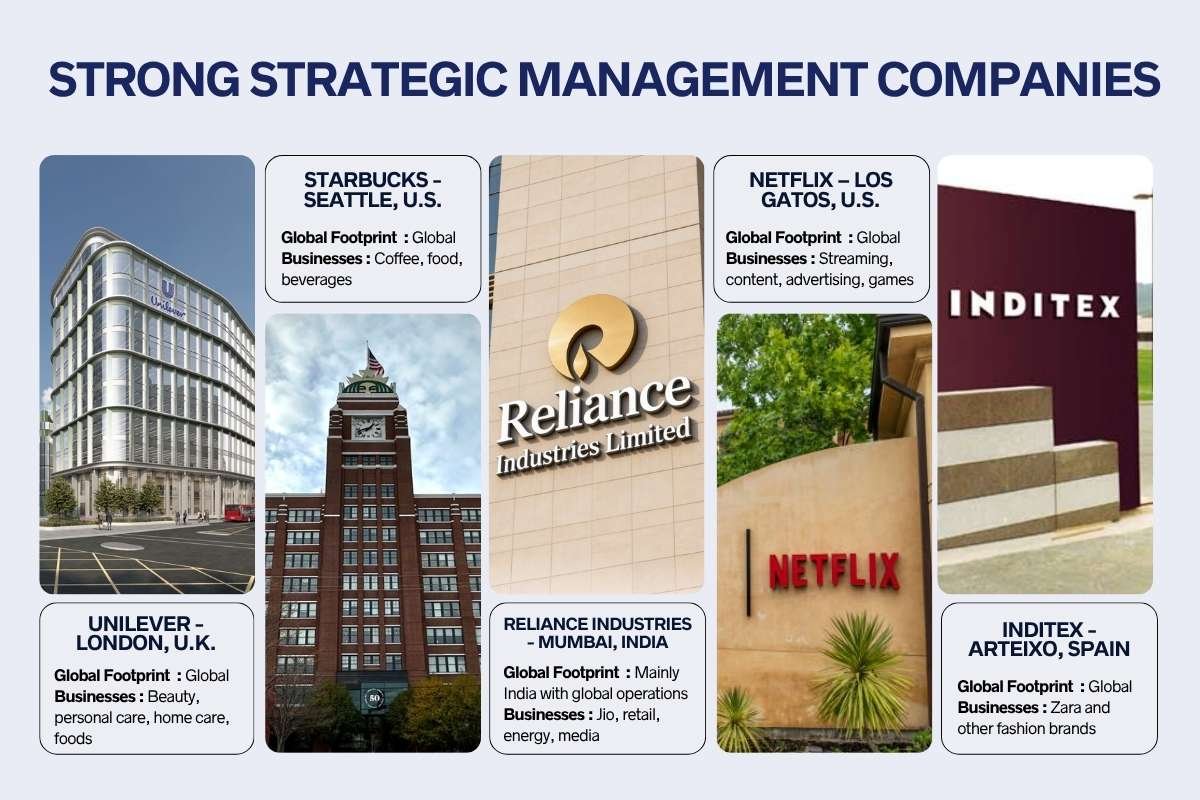
| Unilever – London, U.K. | Global | Beauty, personal care, home care, foods | Focuses on strong brands and key markets |
| Starbucks – Seattle, U.S. | Global | Coffee, food, beverages | Customer experience-led turnaround strategy |
| Reliance Industries – Mumbai, India | Mainly India with global operations | Jio, retail, energy, media | Builds connected digital and consumer businesses |
| Netflix – Los Gatos, U.S. | Global | Streaming, content, advertising, games | Combines global reach with local content |
| Inditex – Arteixo, Spain | Global | Zara and other fashion brands | Uses customer demand and agile operations to respond quickly |
1. Microsoft: Turning AI Into a Business Strategy
Microsoft provides one of the clearest examples of how a mature technology company can reposition itself around a major market shift.
Its strategy is no longer centered only on traditional software. Microsoft has connected cloud computing, enterprise software, developer tools, and AI through its broader ecosystem.
The company reported that customers were moving from AI experimentation toward real-world deployment during FY2026. Microsoft described this shift as the rise of “Frontier Firms,” where AI becomes part of core business operations rather than a standalone experiment.
Strategy lesson: A strong strategy does not simply follow a trend. It connects the trend to existing strengths.
2. Apple: Building Strength Through an Integrated Ecosystem
Apple demonstrates the value of long-term differentiation.
Apple combines hardware, software, and services instead of competing on a single product alone. This creates an ecosystem that encourages customers to remain within its product family.
In January 2026, Apple reported quarterly revenue of $143.8 billion, up 16% year over year. It also reported more than 2.5 billion active devices in its installed base, while Services revenue reached an all-time high.
This is a useful example of strategic management because Apple’s advantage comes from several connected decisions: product design, ecosystem integration, customer loyalty, and services expansion.
Strategy lesson: Competitive advantage becomes stronger when different parts of the business reinforce one another.
3. Amazon: Letting Customer Needs Drive Expansion
Amazon has built its strategy around customer needs while expanding into multiple businesses.
Its approach extends beyond e-commerce into AWS, advertising, entertainment, and other services. Amazon continues to emphasize customer obsession, experimentation, and long-term thinking as core elements of its operating model.
A strong example is Amazon’s advertising business. The company has continued developing advertising products while keeping relevance and customer experience at the center of the offering. It has also expanded AI-based advertising capabilities to improve targeting and campaign performance.
Strategy lesson: Diversification works better when new businesses build on existing capabilities instead of appearing disconnected from the core business.
4. Toyota: Preparing for Multiple Possible Futures
Toyota offers an important example of strategic flexibility.
Rather than betting its entire future on one vehicle technology, Toyota follows a multi-pathway approach that includes battery electric vehicles, hybrids, plug-in hybrids, hydrogen, and other powertrain options.
Toyota’s 2025 Integrated Report says the strategy is designed to provide mobility options that reflect different energy situations and customer needs while supporting its long-term carbon-neutrality goals.
This approach shows why strategic planning should account for uncertainty.
Strategy lesson: When the future is unclear, maintaining several viable paths can reduce strategic risk.
5. Walmart: Connecting Stores, E-Commerce and Technology
Walmart has responded to changes in shopping behavior by investing in an omnichannel business model.
Its 2026 Annual Report identifies e-commerce, technology, AI, supply-chain automation, advertising, acquisitions, new stores, and store improvements as important parts of its strategy. The company is focused on creating a connected shopping ecosystem across physical and digital channels.
The strategic strength here is not simply having physical stores and an online marketplace. It is connecting those assets so customers can move between channels more easily.
Walmart therefore demonstrates how strong strategic management companies can use existing assets while adapting to changing customer behavior.
Strategy lesson: Existing assets can become strategic advantages when businesses connect them with new technology.
6. Unilever: Simplifying the Portfolio to Sharpen Focus
Unilever provides a strong example of portfolio-level strategic management.
In 2025, Unilever completed the demerger of its Ice Cream business, allowing the company to create a more focused portfolio. It also concentrated on Power Brands, which accounted for 78% of turnover in 2025. Underlying sales growth reached 3.5%, while gross margin increased to 46.9%.
The company is also investing in digital commerce, premium offerings, AI-enabled capabilities, and its key growth markets, including the U.S. and India.
Strategy lesson: Sometimes strong strategic management means deciding what not to pursue.
7. Starbucks: Using Strategy to Rebuild the Core Business
Starbucks shows that strategic management is also about correcting course.
Its “Back to Starbucks” strategy focuses on coffee quality, customer experience, partner support, and the role of the coffeehouse as a place for connection. The company has backed this strategy with staffing investments, store improvements, and operational changes.
The strategy is now producing measurable results. In Q3 FY2026, global comparable-store sales increased 7.9%, while North America comparable-store sales increased 8.1%. Starbucks also reported its fourth consecutive quarter of global comparable-store sales growth.
Strategy lesson: A turnaround becomes credible when strategic priorities are supported by operational changes and measurable results.
8. Reliance Industries: Building Connected Consumer Ecosystems
Reliance Industries is a major Indian example of ecosystem-based strategic management.
The company has developed connected businesses across telecommunications, retail, digital commerce, media and consumer services.
Its 2025-26 Annual Report says Reliance Retail opened 1,564 stores during the year, reaching 20,160 stores, while its registered customer base increased to 387 million. JioMart also continued expanding hyperlocal fulfillment capabilities.
The strategy combines physical distribution, digital platforms, customer data, connectivity, and consumer services.
Reliance demonstrates how strong strategic management companies can build an ecosystem where different business units support and strengthen one another.
Strategy lesson: An ecosystem can create strategic strength when different businesses increase the value of one another.
9. Netflix: Combining Global Scale With Local Content
Netflix has transformed from a streaming platform into a broader entertainment business.
Its strategy combines original and licensed content, local-language productions, live programming, advertising, and games. Netflix says it now produces or co-produces content in more than 50 countries and languages, using a “local for local” approach to connect with audiences.
The company is also expanding advertising as another revenue stream. As of 2026, Netflix offers advertising-supported plans in 15 markets and has announced additional markets for 2027.
Strategy lesson: Global expansion is more effective when companies adapt their offerings to local customer preferences.
10. Inditex: Making Customer Feedback Part of the Strategy
Inditex, the parent company of Zara and other fashion brands, demonstrates the value of operational agility.
Its business model uses customer preferences to shape product priorities while integrating physical stores and online platforms.
In 2025, Inditex generated €39.9 billion in revenue, up 3.2% year over year, while net profit increased 6% to €6.2 billion. The company also invested in stores, e-commerce platforms, and technology designed to improve the customer experience.
Its strategy is particularly relevant to fast-changing industries because it connects customer demand, product decisions, technology, and distribution.
Strategy lesson: Strategy becomes stronger when businesses can turn customer feedback into faster operational decisions.
What Do These Companies Have in Common?
These companies operate in different industries, but they follow similar strategic management practices. They set clear goals, use their strengths, adapt to change, and measure results. This also helps explain strategic management vs. strategic planning.
Set clear priorities: Microsoft focuses on AI and cloud, Starbucks on customer experience, and Unilever on a focused portfolio.
Turn strategy into action: They align people, technology, investment, and operations with their goals.
Build on existing strengths: Amazon uses its technology and customer base across retail, cloud, and advertising, while Reliance connects telecom, retail, and digital services.
Adapt to change: Toyota is preparing for different energy options, while Netflix is expanding into advertising and games.
Measure results: They track revenue, customers, margins, sales, and other key performance indicators to see whether their strategies are working.
Strong strategic management is therefore not just about choosing a direction. It also requires execution, measurement, and continuous improvement, while avoiding strategic management mistakes that can weaken business performance.
Conclusion
Strong strategic management companies show that strategic management is an ongoing process, not just a business plan. Companies such as Microsoft, Apple, Amazon, Toyota, Walmart, Starbucks, and others succeed by setting clear goals, using their strengths, and adapting to market changes.
There is no single strategy that works for every business. The right approach depends on the industry, customers, resources, and long-term goals.
The key is simple: make clear decisions, execute them well, measure results, and adapt when needed. These are also important strategic management lessons from top CEOs (Cover Support).
FAQs
1. What are strong strategic management companies?
Companies that align long-term goals, resources, execution, and performance, such as Microsoft, Apple, Amazon, Toyota, and Walmart.
2. Which company has the best strategic management?
There is no single best company; Microsoft, Apple, Amazon, Toyota, and Starbucks each demonstrate different strategic strengths.
3. Why is Microsoft strong in strategic management?
Microsoft combines AI, cloud computing, and enterprise software to turn emerging technology into practical business growth.
4. What can businesses learn from Toyota?
Toyota shows how businesses can manage uncertainty by using multiple technology and mobility strategies.
5. How does Starbucks demonstrate strategic management?
Starbucks’ “Back to Starbucks” strategy focuses on improving customer experience, coffee quality, stores, and operational performance.
6. What is the key lesson from these companies?
Strong strategy means setting clear priorities, executing them effectively, measuring results, and adapting to market changes.