
What would you do if you had to make an important business decision without having all the answers?
That is the question at the heart of the Harvard Business School case method.
Instead of only learning business theories, students study real management situations and take the role of the decision-maker. They review the facts, identify the problem, compare options, and decide what they would do.
Harvard Business School says its MBA students read about 500 cases during the two-year MBA program. A typical case presents a real organization, a business problem, and a decision that needs to be made.
The goal is simple: learn how to think and decide like a business leader.
How does the Harvard Business School case method work?
The central idea is simple: learn business by making business decisions.
The Harvard Business School case method usually follows four connected steps:
- Read and analyze the situation.
- Discuss the problem with a small group.
- Debate the decision in class.
- Reflect on what the discussion changed or revealed.
HBS describes its cases as real management problems presented with the information and constraints available when the original decision had to be made. Students do not receive the final answer before making their own recommendation.
In simple terms: Read → Analyze → Discuss → Decide → Reflect
This type of practical learning can also support Business education for entrepreneurs, who often need to make decisions with limited information.
Why does the HBS case method focus on real problems?
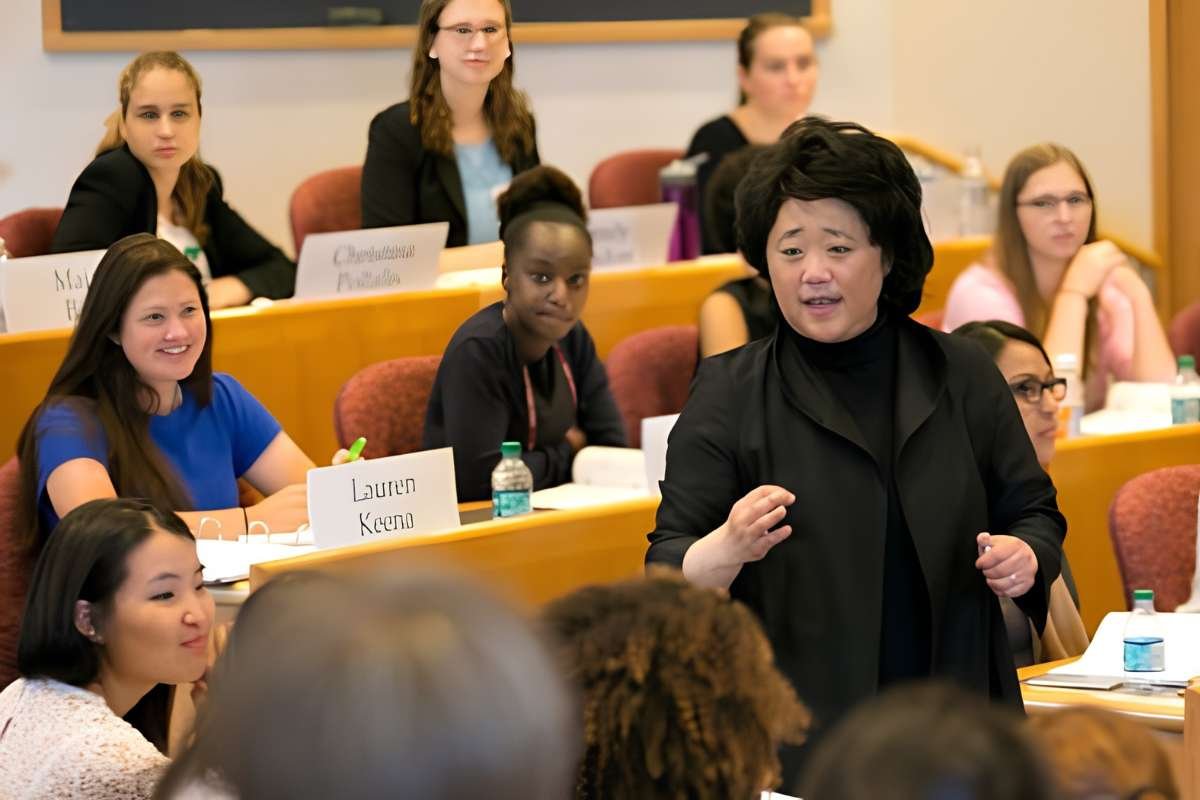
Business decisions rarely come with perfect information.
Managers may have incomplete data, limited time, competing priorities, and several possible solutions. The HBS case method tries to recreate this situation.
HBS describes its cases as firsthand accounts of real management problems. Students take the role of the manager and recommend an action without knowing the outcome.
This teaches an important business skill:
You do not always need a perfect answer. You need a well-reasoned decision.
For example, a company may be losing customers. The possible solutions could include lowering prices, improving the product, changing marketing, or entering a new market.
The case method asks students to decide:
- What is the real problem?
- What evidence supports the problem?
- What options are available?
- What are the risks?
- Which option should the company choose?
This makes business theory easier to apply in real situations and shows why a strong Business education curriculum should include practical decision-making.
How HBS’s teaching approach shapes business education
Real companies turn business theory into practical lessons
The history of the case method itself shows the connection between education and business. The first standalone HBS case, General Shoe Company, was published in 1921. It focused on a workplace problem involving employees leaving their shifts early and asked students to examine the situation and recommend possible action.
In 1922, HBS faculty formally named the teaching approach the “case system.” That same year, General Electric supported case research at the school.
This early connection between companies and classrooms helped establish a model that HBS still uses today.
It also highlights the difference between classroom learning and practical experience, which is useful when considering Business education vs work experience.
General Electric shows how cases explain strategy
General Electric has been the subject of several HBS cases.
One HBS case, General Electric: Consumer Electronics Group, examines GE’s takeover of RCA and the integration of their consumer electronics businesses. It covers competition, manufacturing, distribution, technology, and the strategic benefits of operating across different markets.
Instead of simply reading a definition of business strategy, students can examine how strategic choices affect a real organization.
That makes the lesson more practical.
Southwest Airlines shows the value of data
The case approach is also moving beyond traditional written cases.
In a 2023 HBS live case exercise, more than 1,000 MBA students studied Southwest Airlines using public financial and strategic information. Students researched company data, identified key issues, and discussed their findings.
This approach adds another important skill:
Using real data to support a business decision.
It connects case learning with research, financial analysis, and evidence-based thinking.
What skills does the HBS case method build?
The case method is not only about learning company stories.
It helps students practice skills they can use in different industries.
- Critical thinking: Students must decide which facts matter and which do not.
- Decision-making: They must choose an action even when information is incomplete.
- Communication: Students need to explain their recommendations clearly.
- Listening: They must understand why other people may reach a different conclusion.
- Leadership: Students practice defending an idea while remaining open to better arguments.
- Problem-solving: Cases require students to break large problems into smaller questions.
HBS says the method develops communication, listening, analysis, and leadership skills and prepares students for time-sensitive decisions made with limited information.
These skills also help explain the Business education ROI, especially when education can be applied directly to workplace decisions.
Why different opinions make the method stronger

Imagine 50 people looking at the same business problem.
One person may focus on customers.
Another may focus on costs.
Someone else may focus on employees.
Another may focus on long-term growth.
The case method brings these perspectives together.
HBS describes its classroom as a shared learning process in which students and faculty learn from one another. Students have a responsibility not only to learn but also to contribute to the learning of others.
This is important because business leadership is rarely about finding a solution alone.
It is about hearing different views, testing your assumptions, and choosing the strongest path forward.
Is the case method still relevant in modern business?
Yes.
The business environment has changed dramatically since the first HBS case in 1921. Companies now deal with AI, digital platforms, global competition, cybersecurity, changing customer expectations, and fast-moving markets.
But one thing has not changed: Leaders still have to make decisions with incomplete information.
HBS continues to update its teaching approach. Its current MBA academic experience combines case-based learning with field-based learning and global experiences.
HBS also uses newer formats, including multimedia and live cases, to make business learning more practical and connected to current information.
So, the case method is not simply an old classroom tradition. It continues to evolve with business education. This is also relevant when comparing Business Schools in US, as different schools use different combinations of case-based, experiential, and classroom learning.
How can you use the case method outside HBS?
You do not need to study at Harvard to use the basic idea.
Try this simple five-step approach:
- Pick a real business problem.
For example, a company is losing customers. - Collect reliable facts.
Use company reports, official data, customer research, and trusted industry sources. - Create possible solutions.
List two or three realistic options. - Choose one.
Explain why it is better than the alternatives. - Challenge your decision.
Ask what could make your recommendation fail.
This process can help students, entrepreneurs, managers, and professionals improve their decision-making skills.
It also creates a natural bridge between business theory and real-world action.
The key lesson from the Harvard Business School case method

The biggest lesson is not memorizing 500 business cases.
It is learning how to think when the answer is not obvious.
A good case does not simply ask, “What happened?”
It asks: “What would you do?”
That small change creates a very different learning experience.
Students must analyze evidence, listen to other perspectives, make a decision, and accept that their first answer may not be the best one.
That is why the Harvard Business School case method remains an important part of business education.
Conclusion
The Harvard Business School case method turns business education into an active decision-making exercise.
Students study real business problems, work with incomplete information, discuss different viewpoints, and make decisions they can defend.
Its history began with the General Shoe Company case in 1921, while today’s HBS approach includes traditional cases, live cases, field learning, and newer multimedia formats.
The core idea, however, remains simple: Business leaders learn not only by knowing the answer, but by learning how to make a good decision when there is no obvious answer.
FAQs
1. What is the Harvard Business School case method?
The Harvard Business School case method is a teaching approach where students analyze real business problems, make decisions, and discuss their recommendations with classmates and faculty.
2. How many cases do HBS MBA students read?
HBS says MBA students read about 500 cases during the two-year program.
3. What skills does the HBS case method develop?
It develops analysis, decision-making, communication, listening, leadership, and problem-solving skills.
4. When did the HBS case method begin?
The first standalone HBS case, The General Shoe Company, was published in 1921. HBS faculty formally named the approach the “case system” in 1922.
5. Are HBS cases based on real businesses?
Yes. HBS cases are based on real management situations and place students in the position of decision-makers.
6. Why is the case method useful for business students?
It gives students practice making decisions with incomplete information, defending their ideas, listening to other perspectives, and applying business concepts to practical problems.