
Why does Amazon keep entering industries that seem far removed from its original online bookstore business?
The answer is not simply aggressive expansion. Amazon has built a strategic management system that connects customer needs, long-term investments, technology, operational execution, and continuous experimentation.
From an online bookstore, Amazon’s strategic management approach expanded into e-commerce, cloud computing, advertising, entertainment, healthcare, devices, logistics, and artificial intelligence. In 2025, Amazon generated $716.9 billion in net sales, up 12% from 2024. AWS alone generated $128.7 billion, with sales growing 20% year over year.
This growth illustrates an important strategic management principle: a successful strategy is not a document that stays unchanged. It is a system for deciding where to compete, how to create value, where to invest, and when to change direction.
For a broader understanding of how businesses create long-term direction, see Enterprise Wired’s guide to business strategy planning.
What is Amazon’s Strategic Management Approach and Why Does It Work?
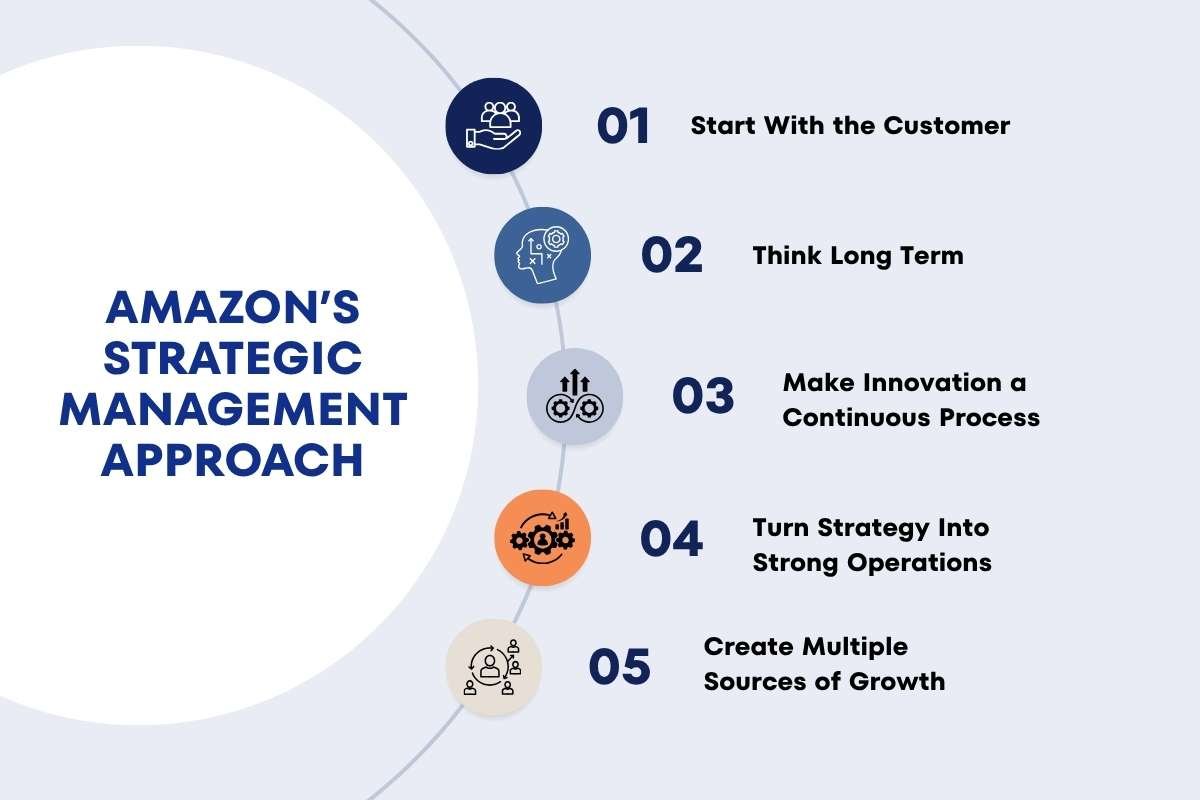
Amazon’s strategic management approach focuses on customers, long-term growth, innovation, efficient operations, and continuous improvement. Instead of copying competitors, Amazon studies customer needs, tests new ideas, invests in technology, and adapts its strategy as markets change.
Amazon’s Leadership Principles highlight four key ideas: customer obsession, invention, operational excellence, and long-term thinking.
1. Start With the Customer
Amazon follows a “work backward” approach. Teams first identify a customer problem and then build a solution around it.
For example, Amazon’s AI shopping assistant Rufus helps customers compare products, answer questions, and make buying decisions. Amazon also uses AI-generated review summaries and shopping guides to make product research easier.
Why it works: Starting with customer needs helps Amazon create products and services that solve real problems.
Walmart uses a similar customer-first strategy by focusing on value, convenience, assortment, and digital shopping.
2. Think Long Term
Amazon often invests in businesses and technologies that may take years to deliver their full value.
AWS is a strong example. Amazon originally built cloud infrastructure to support its own operations. It later turned that capability into AWS, a major global cloud business.
This shows an important strategy lesson: a solution created for an internal problem can become a valuable business opportunity.
3. Make Innovation a Continuous Process
Amazon treats innovation as an ongoing part of its strategy. Its Leadership Principles include “Invent and Simplify,” “Think Big,” and “Bias for Action.”
This mindset has helped Amazon expand from online books into areas such as:
- Prime
- AWS
- Kindle
- Alexa
- Prime Video
- Advertising
- AI-powered shopping
- Custom AI chips
Amazon’s shareholder communications also emphasize questioning existing processes and looking for better ways to serve customers.
The key idea: Amazon does not innovate simply to use new technology. It uses innovation to solve customer problems and create new business opportunities.
Different strategic management models can help organizations evaluate opportunities, innovation, and competitive positioning.
4. Turn Strategy Into Strong Operations
A good strategy needs strong execution. Amazon supports its customer promise through its fulfillment centers, logistics network, automation, inventory systems, and delivery operations.
For example, Amazon has redesigned parts of its fulfillment network to place inventory closer to customers and speed up deliveries.
The basic strategy is simple:
Better operations → faster service → better customer experience → stronger customer loyalty.
This shows why strategic management vs strategic planning need to work together.
5. Create Multiple Sources of Growth
Amazon has grown beyond its online store. Its businesses now include AWS, advertising, Prime, third-party sellers, entertainment, devices, healthcare, and logistics.
In 2025, Amazon reported $716.9 billion in net sales, while AWS generated $128.7 billion in sales.
However, Amazon does not simply enter every available market. It looks for opportunities where its existing technology, customer base, logistics, infrastructure, or other capabilities can create additional value.
Its acquisition of One Medical is one example. Amazon saw an opportunity to combine One Medical’s patient-focused healthcare model with Amazon’s technology and customer experience capabilities.
In simple terms, Amazon’s strategic management approach works because it connects customer needs with innovation, long-term investment, strong execution, and continuous adaptation.
How Amazon Builds and Continuously Adapts Its Strategy?

A strategy becomes powerful when an organization can change without losing its core direction.
Amazon’s approach can be understood as a continuous cycle:
Customer insight → Strategic decision → Experimentation → Investment → Execution → Measurement → Learning → Adaptation
This follows the broader strategic management process, where businesses move from analysis and strategy formulation to implementation, evaluation, and adaptation.
1. Amazon Uses Customer Signals to Identify Opportunities
Amazon looks at customer reviews, buying behavior, searches, feedback, and delivery expectations to identify problems.
It then asks: Can technology, a better process, or a new service solve this problem?
This approach now includes AI. In 2026, Amazon reported strong growth in AWS and said its AI business had crossed a $25 billion annual revenue run rate. It also reported a more than 40% increase in same-day and overnight deliveries during the first half of 2026 compared with the previous year.
These results show how Amazon changes its investments as customer needs and technology evolve.
2. It Separates Reversible and Difficult Decisions
Amazon uses a simple idea for decision-making: some decisions can be changed, while others cannot.
Reversible decisions can be tested quickly. More difficult or costly decisions receive deeper analysis before action.
This helps Amazon avoid spending too much time on low-risk decisions while giving important investments the attention they need. It creates a balance between speed, flexibility, and careful judgment.
3. It Treats Technology as a Strategic Capability
Technology is more than a support tool for Amazon. It is part of how the company creates and delivers value.
AWS, AI, automation, recommendation systems, robotics, advertising technology, and smart fulfillment systems all support Amazon’s business model.
AWS is a strong example. Amazon originally developed cloud infrastructure to support its own technology needs and later turned that capability into a global cloud business.
The key lesson is simple: technology creates strategic value when it helps a company serve customers better, lower costs, create new products, or build capabilities competitors find difficult to copy.
Microsoft follows a similar approach by continuing to invest heavily in cloud and AI infrastructure as these technologies reshape its business.
4. Amazon Measures Outcomes and Adjusts Investments
Amazon does not rely on assumptions alone. It tracks sales, profits, customer experience, operational performance, and business growth to evaluate its decisions.
For example, AWS sales grew 20% in 2025, reaching $128.7 billion, while AWS operating income reached $45.6 billion. Amazon has also continued making major investments in AI and infrastructure.
This shows how Amazon balances growth with financial discipline.
Businesses can apply the same approach by setting clear KPIs, reviewing results regularly, and moving resources toward strategies that deliver stronger results.
Strategic control and evaluation involves monitoring performance and adjusting strategy when results or conditions change.
5. Amazon Changes the Method Without Abandoning the Core
One of the most important features of Amazon’s strategy is the difference between principles and tactics.
The principles remain relatively stable:
- Put customers first
- Think long term
- Keep innovating
- Simplify processes
- Improve operations
- Take calculated risks
- Learn from results
Its business has moved from books to e-commerce, cloud computing, streaming, advertising, and AI. The method changes, but the strategic direction remains customer-focused and innovation-driven.
In short, Amazon’s strategic management approach is built around continuous learning. The company keeps its core principles steady but changes its investments, technology, and execution as customers and markets change.
Where Amazon strategic management case studies can be examined alongside other companies that have adapted their strategies over time.
Conclusion
Amazon’s success comes from a strategy that stays focused but adapts to change. Amazon’s strategic management approach centers on customer needs, long-term growth, innovation, efficient operations, and smart investment.
Amazon applies these principles across e-commerce, AWS, advertising, healthcare, entertainment, logistics, and AI. This shows that strategic management is an ongoing process, not a one-time plan.
The key lesson for other businesses is simple: understand customers, test new ideas, measure results, invest for the future, and adapt when the market changes.
FAQs
1. What is Amazon’s strategic management approach?
It focuses on customer needs, long-term growth, innovation, operational efficiency, and continuous adaptation.
2. What are the main elements of Amazon’s strategy?
Customer obsession, innovation, long-term thinking, technology, operational excellence, calculated risks, and continuous learning.
3. How does Amazon maintain its competitive advantage?
Amazon combines technology, logistics, cloud services, data, scale, and continuous innovation to deliver strong customer value.
4. How does Amazon adapt its strategy to market changes?
It studies customer needs, tests new ideas, measures results, and shifts investments toward promising opportunities.
5. Is Amazon’s strategy only focused on e-commerce?
No. Amazon also operates in AWS, advertising, entertainment, healthcare, logistics, devices, and AI.
6. What can other businesses learn from Amazon’s strategy?
Businesses can focus on customers, test ideas, measure results, invest for the long term, and adapt quickly to market changes.