“On Amazon, visibility isn’t luck—it’s engineered.”
With more than 300 million active users and millions of sellers competing daily, Amazon has evolved into one of the most competitive digital marketplaces in the world. Today, simply listing a product is no longer enough. Brands need a structured and evolving Amazon Marketing Strategy to stand out, convert effectively, and scale sustainably.
In 2026, success on Amazon is driven by a combination of search optimization, high-quality content, strategic advertising, and continuous performance tracking. The brands that win are not necessarily those with the best products but those with the most effective systems.
This guide breaks down a modern marketing strategy step by step, helping you move from basic visibility to predictable revenue growth.
What Is an Amazon Marketing Strategy?
At its core, an Amazon Marketing Strategy is a structured, data-driven approach to increasing product visibility, conversions, and long-term brand growth on Amazon.
But in 2026, it’s no longer just about ranking higher in search results; it’s about owning the entire customer journey within the Amazon ecosystem.
From the moment a shopper types a keyword to the second they click “Buy Now,” every touchpoint, search rankings, product images, reviews, ads, pricing, and even external traffic plays a role in influencing the final decision.
Why It Matters More Than Ever?
- 70%+ of Amazon shoppers never click past the first page
- Products with optimized listings and ads see 2–3x higher conversion rates.
- Amazon’s ad business alone generates $40B+ annually, highlighting the growing importance of paid visibility.
This means brands that rely only on organic rankings or basic listings are leaving massive revenue on the table.
What Makes a Strong Amazon Marketing Strategy?
A high-performing strategy isn’t built on a single tactic; it’s a combination of interconnected elements:
| Discoverability | Amazon SEO & keyword optimization |
| Conversion | High-quality listings, A+ Content, reviews |
| Visibility Boost | Sponsored ads and promotions |
| Retention & Loyalty | Offers, repeat purchase strategies |
| Scalability | Data tracking and performance optimization |
Think of it as a flywheel: better visibility drives more clicks, which leads to more sales, which improves rankings, creating a compounding growth effect.
Core Pillars of an Amazon Marketing Strategy
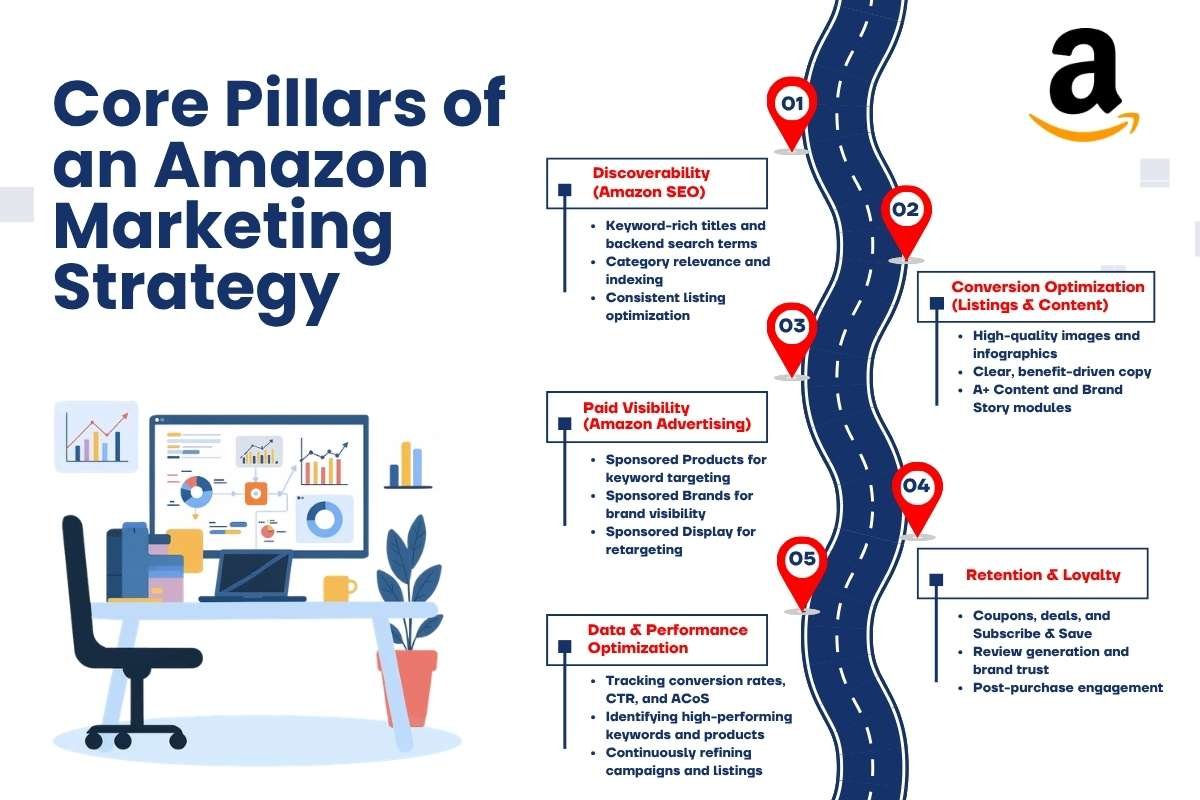
If Amazon is a high-performance marketplace, then your strategy is only as strong as the pillars holding it up. The most successful brands on Amazon don’t rely on a single tactic;c they build a multi-layered system in which each element reinforces the others.
In fact, brands that integrate multiple levers, SEO, ads, and content often see 30–50% higher overall sales growth compared to those using a single-channel approach.
The 5 Core Pillars You Need to Win
1. Discoverability (Amazon SEO)
Before anything else, your product needs to be found. With millions of competing listings, ranking for the right keywords is critical. Without strong SEO, even the best products remain invisible.
- Keyword-rich titles and backend search terms
- Category relevance and indexing
- Consistent listing optimization
2. Conversion Optimization (Listings & Content)
Getting clicks is only half the battle; conversion is where revenue is made. Data shows that optimized listings can improve conversion rates by up to 25–35%.
- High-quality images and infographics
- Clear, benefit-driven copy
- A+ Content and Brand Story modules
3. Paid Visibility (Amazon Advertising)
Organic reach alone is no longer enough in a competitive Amazon Marketing Strategy. Amazon ads have become essential for gaining traction, especially for new products entering crowded categories. With Amazon’s ad revenue surpassing $40 billion annually, it’s clear that paid strategies are no longer optional; they are a core growth driver within any effective marketing strategy.
- Sponsored Products for keyword targeting
- Sponsored Brands for brand visibility
- Sponsored Display for retargeting
4. Retention & Loyalty
Winning a customer once is expensive; keeping them is where profitability lies.
- Coupons, deals, and Subscribe & Save
- Review generation and brand trust
- Post-purchase engagement
5. Data & Performance Optimization
Every click, impression, and conversion on Amazon generates valuable data. The difference between average and high-growth brands is how they use it.
- Tracking conversion rates, CTR, and ACoS
- Identifying high-performing keywords and products
- Continuously refining campaigns and listings
Amazon SEO and Listing Optimization
If your product isn’t showing up, it isn’t selling. On Amazon, visibility is controlled by a powerful search algorithm (commonly referred to as A9/A10), and it prioritizes one thing above all: relevance + performance.
In simple terms, Amazon ranks products that are most likely to convert, not just those that match a keyword.
Why Amazon SEO Is Non-Negotiable?
- Over 70% of purchases happen on page one.
- Listings optimized for keywords and conversion see 2x–3x higher sales velocity.
- Higher conversion rates directly improve organic rankings over time.
This means SEO isn’t just about traffic, it’s about sustained growth.
The 4 Key Elements of Amazon SEO
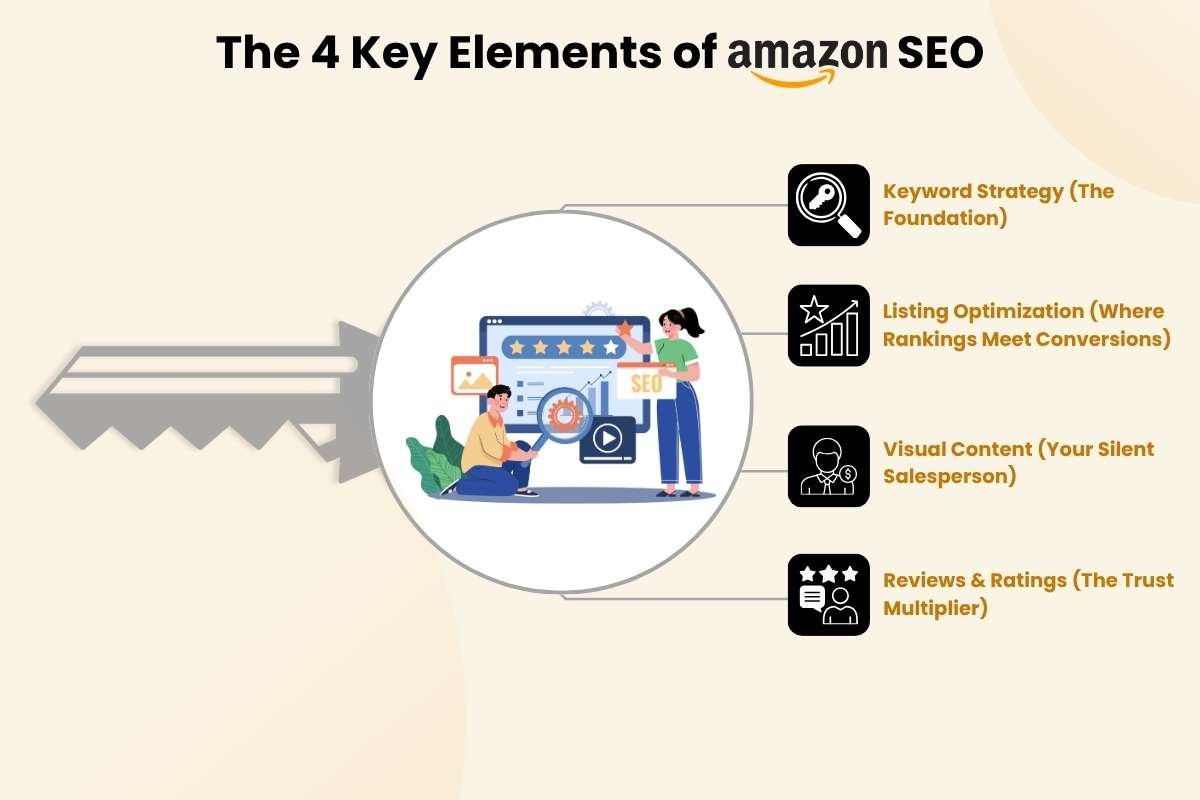
1. Keyword Strategy (The Foundation)
| What It Focuses On | Identifying high-intent search terms |
| Key Impact on Performance | Improves visibility & organic rankings |
| Optimization Tip | Target a mix of high-volume + long-tail keywords |
2. Listing Optimization (Where Rankings Meet Conversions)
| What It Focuses On | Title, bullet points, and description |
| Key Impact on Performance | Boosts CTR and conversion rate (CVR) |
| Optimization Tip | Write benefit-driven, keyword-rich copy |
3. Visual Content (Your Silent Salesperson)
| What It Focuses On | Images, infographics, lifestyle visuals |
| Key Impact on Performance | Increases conversions by 20–30% |
| Optimization Tip | Use high-quality images that tell a story |
4. Reviews & Ratings (The Trust Multiplier)
| What It Focuses On | Customer feedback and social proof |
| Key Impact on Performance | Builds trust and improves rankings |
| Optimization Tip | Aim for 4.2★+ and consistent review flow |
The Real Ranking Formula: Amazon SEO isn’t just about keywords; it’s about performance signals:
Keyword Relevance + CTR + Conversion Rate + Sales Velocity = Higher Rankings
Why This Matters More Than Ever?
In crowded categories, customers don’t just compare products; they compare brands.
| Without strong content: | Your product looks genericTrust dropsConversion rates suffer |
| With A+ Content and Stores: | You control the narrativeYou highlight differentiation clearlyYou reduce hesitation and returns |
Key Elements of High-Converting Content

| 1. Visual Storytelling | Use lifestyle images to show real-world usageHighlight key USPs through infographicsKeep branding consistent across all assets |
| 2. Comparison Modules | Help customers choose between your own productsReduce confusion and decision fatigueIncrease basket size through upselling |
| 3. Clear Value Communication | Focus on benefits, not just features.Address common objections proactively.Reinforce quality, durability, and trust signals. |
The Hidden Advantage: Better Ad Performance
Here’s what many brands overlook: strong content doesn’t just improve conversions, it also:
- Improves ad efficiency (lower ACoS)
- Increases time spent on the page
- Boosts overall sales velocity
This creates a compounding effect across your entire marketing strategy.
Amazon Advertising Strategy
If SEO helps you get discovered, advertising is what helps you scale aggressively within a strong Amazon Marketing Strategy. In today’s competitive ecosystem, relying on organic traffic alone is no longer sustainable, especially when paid visibility often decides who wins the “Buy Box attention. In fact, Amazon’s advertising business has grown into a $40B+ revenue engine, proving that paid discovery is now central to marketplace success and a critical pillar of any high-performing marketing strategy.
Why Amazon Ads Are a Game-Changer:
- Sponsored listings appear in top search positions instantly
- Ads can increase product visibility by 3x–5x during launch phases
- Well-optimized campaigns can reduce ACoS by 20–30% over time
Core Types of Amazon Ads
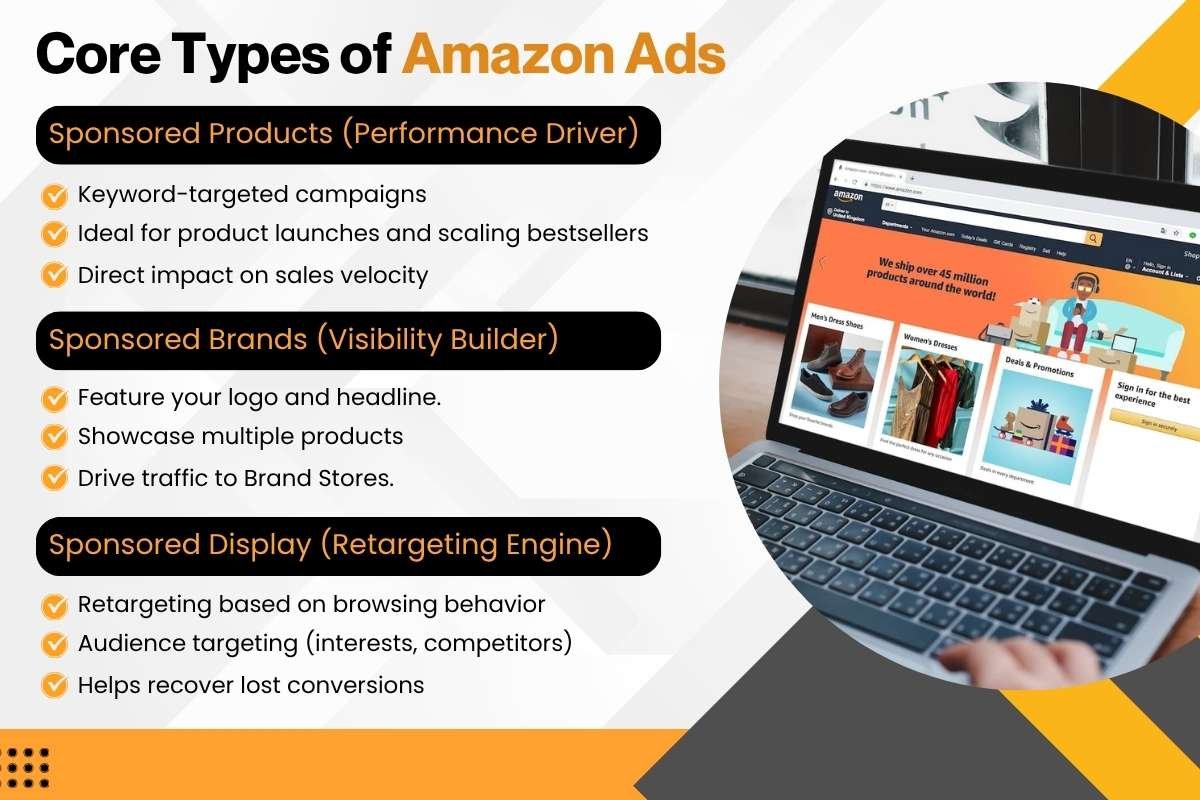
1. Sponsored Products (Performance Driver)
These are the most widely used ad types, appearing directly in search results and product pages.
- Keyword-targeted campaigns
- Ideal for product launches and scaling bestsellers
- Direct impact on sales velocity
Most sellers allocate 60–70% of their Amazon ad budget here.
2. Sponsored Brands (Visibility Builder)
These ads help you promote your entire brand, not just one product.
- Feature your logo and headline.
- Showcase multiple products
- Drive traffic to Brand Stores.
Perfect for increasing brand recognition and cross-selling.
3. Sponsored Display (Retargeting Engine)
These ads follow customers even after they leave your listing.
- Retargeting based on browsing behavior
- Audience targeting (interests, competitors)
- Helps recover lost conversions
Retargeted users are up to 70% more likely to convert than cold traffic.
Promotions and Loyalty-Driven Offers
Once your ads are driving traffic, the next challenge is simple: turn clicks into conversions and one-time buyers into repeat customers within a well-optimized Amazon Marketing Strategy. In a marketplace where acquisition costs keep rising, retention becomes the real profit lever. Studies show that increasing customer retention by just 5% can boost profits by 25–95%, making it a powerful growth driver in e-commerce ecosystems like Amazon and an essential component of any sustainable marketing strategy.
Why Promotions Still Matter in 2026?
Promotions are not just discount tools; they are conversion accelerators and ranking signals.
- Discounted products often see 20–40% higher conversion rates
- Lightning Deals and Coupons increase short-term sales velocity
- Higher sales velocity improves organic ranking stability
Key Types of Amazon Promotions
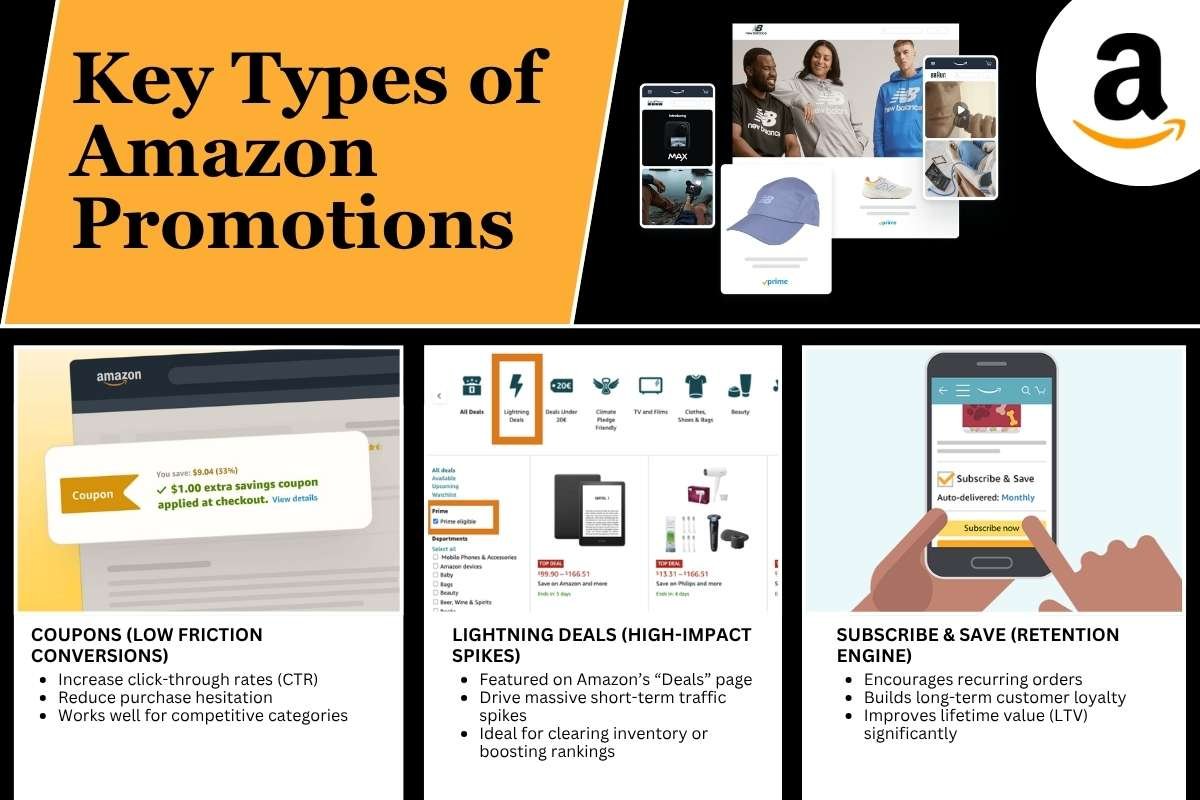
1. Coupons (Low Friction Conversions)
Coupons add a visible discount badge on listings, making them highly effective.
- Increase click-through rates (CTR)
- Reduce purchase hesitation
- Works well for competitive categories
Listings with coupons often see a 5–15% lift in conversions.
2. Lightning Deals (High-Impact Spikes)
These are time-bound offers that create urgency.
- Featured on Amazon’s “Deals” page
- Drive massive short-term traffic spikes
- Ideal for clearing inventory or boosting rankings
Best used strategically, not continuously.
3. Subscribe & Save (Retention Engine)
This model is built for repeat purchases and predictable revenue.
- Encourages recurring orders
- Builds long-term customer loyalty
- Improves lifetime value (LTV) significantly
Subscription-based buyers can be 2–3x more valuable over time.
External Traffic Strategy
Up until now, we’ve focused on optimizing within Amazon, but the next level of growth in an effective Amazon Marketing Strategy comes from bringing customers in from outside the platform.
Why? Because relying only on Amazon search traffic limits your scale. In contrast, brands that drive external traffic often see 15–30% higher total sales velocity, especially during launches and peak campaigns.
Why External Traffic Matters?
Amazon’s algorithm rewards one thing above all: sales performance. When traffic comes from outside sources and converts well, it signals strong demand, which can:
- Improve organic keyword rankings
- Boost product visibility faster
- Reduce long-term advertising dependency
Key External Traffic Channels
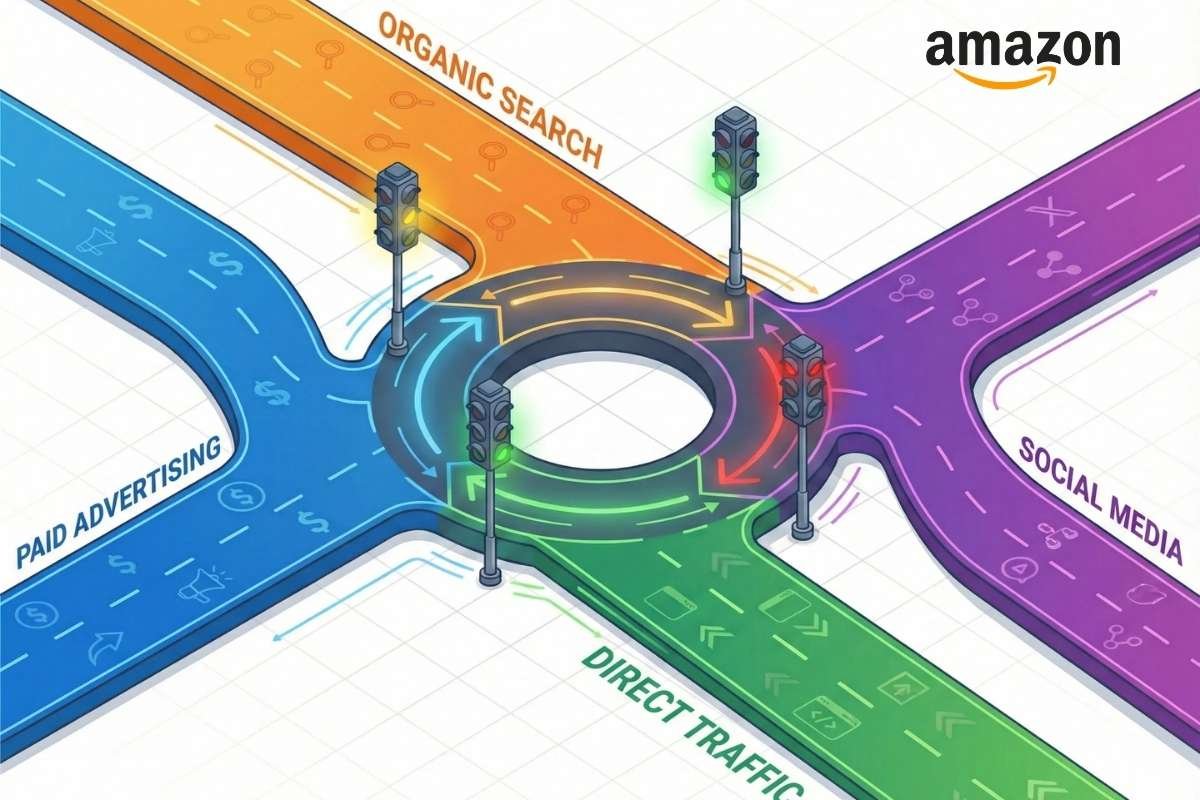
1. Social Media Marketing
Platforms like Instagram, YouTube, and TikTok are powerful discovery engines.
- Influencer collaborations
- Product demos and reviews
- Short-form video content
Influencer-driven traffic can generate 2–5x higher engagement rates than traditional ads.
2. Google Ads & Search Traffic
Capturing intent outside Amazon is a major growth lever.
- Keyword-targeted Google Search Ads
- Product comparison landing pages
- Retargeting campaigns
This brings high-intent buyers directly into your Amazon listings.
3. Email Marketing & CRM Lists
Owned audiences are the most reliable traffic source.
- Product launch emails
- Discount announcements
- Repeat purchase reminders
Email-driven traffic typically converts at 2–3x higher rates than cold traffic.
Channel Mix and Omnichannel Thinking
At this stage, you’re no longer just selling on Amazon; you’re building a multi-channel growth system where every platform plays a specific role in driving awareness, traffic, and conversions within a mature Amazon Marketing Strategy.
The reality of 2026 is simple: customers don’t shop in one place anymore. They discover on social media, compare on Google, and finally purchase on Amazon. Brands that align with this behavior see 20–40% higher overall conversion efficiency compared to single-channel sellers.
What Is Omnichannel Thinking?
Omnichannel marketing is the strategy of connecting all customer touchpoints into one unified experience. Instead of treating channels separately, you design them to work together:
- Social media builds awareness
- Google captures intent
- External content educates
- Amazon closes the sale
The goal is consistency, not fragmentation.
Why Channel Mix Matters?
| Brands that rely only on Amazon face three major limitations: | High dependency on paid adsLimited brand recallVulnerability to algorithm changes |
| In contrast, omnichannel brands benefit from: | Stronger customer trustLower acquisition costs over timeHigher repeat purchase rates |
Studies in e-commerce ecosystems show omnichannel customers spend 30–50% more per purchase cycle than single-channel buyers.
Building the Right Channel Mix:

1. Awareness Channels (Top Funnel)
- Instagram, TikTok, YouTube
- Influencer collaborations
- Short-form product storytelling
Goal: Make customers aware that your product exists.
2. Consideration Channels (Middle Funnel)
- Google Search Ads
- Blogs and comparison content
- Reviews and affiliate sites
Goal: Help customers evaluate and trust your product.
3. Conversion Channel (Bottom Funnel)
- Amazon listings
- Sponsored ads inside Amazon
- Brand Store and A+ Content
Goal: Convert high-intent traffic into sales.
Why Integration Drives Better Results?
When channels operate in isolation, performance is limited. But when they are connected within a cohesive Amazon Marketing Strategy, every interaction reinforces the next.
For example, external content increases branded searches on Amazon. Higher branded searches improve organic rankings. Better rankings reduce ad dependency. And improved ad efficiency increases profitability.
This creates a compounding loop where growth becomes progressively easier over time.
Brands that implement this kind of integration often see significantly higher customer lifetime value, sometimes increasing overall revenue per customer by 25–60%, simply because trust and familiarity are built before the final click.
How to Measure Success?
Once your channel ecosystem is in place, the next question becomes critical: Is your Amazon strategy actually working or just looking good on paper?
On Amazon, guesswork doesn’t scale; data does. Every click, impression, and purchase leaves a signal, and the brands that grow fastest are the ones that know exactly how to interpret those signals.
In fact, Amazon’s internal marketplace behavior shows a clear pattern within an effective Amazon Marketing Strategy: listings that consistently improve their core performance metrics see 2x–4x faster ranking growth compared to stagnant listings.
1. Why Measurement Is a Growth Lever (Not Reporting)?
Most sellers treat analytics as reporting. High-performing brands treat it as decision-making fuel.
Because on Amazon, even small improvements compound quickly. A slight increase in click-through rate or conversion rate can dramatically change visibility, which then feeds back into more traffic and sales.
This is why measurement isn’t the final step; it’s part of the growth loop itself.
2. The Metrics That Actually Matter
Instead of tracking everything, successful brands focus on a small set of high-impact indicators.
The first is Click-Through Rate (CTR), which shows how attractive your listing is in search results within an optimized Amazon Marketing Strategy. If CTR is low, it usually signals weak images, poor pricing perception, or unconvincing titles.
Next is Conversion Rate (CVR), which reveals how effectively your listing turns visitors into buyers. Even a 1–2% improvement here can significantly increase revenue without additional traffic.
Then comes Advertising Cost of Sales (ACoS), which measures ad efficiency. A declining ACoS over time usually indicates that your campaigns are becoming more optimized and your organic ranking is strengthening.
Finally, Organic Ranking Position is the outcome metric. It reflects how well all your efforts, SEO, ads, content, and reviews, are working together.
3. The Feedback Loop That Drives Growth
What makes Amazon unique is how tightly these metrics are connected within a well-executed Amazon Marketing Strategy. Better CTR brings more traffic. Better CVR improves sales velocity. Higher sales velocity improves rankings. Better rankings reduce dependency on ads. And lower ad dependency improves profitability.
This creates a self-reinforcing loop where performance improves naturally over time if the right metrics are being optimized consistently.
4. Moving from Data to Decisions
The biggest mistake brands make is collecting data without acting on it. High-growth sellers don’t just track metrics; they constantly refine based on them.
If CTR drops, they test new images or titles. If conversion weakens, they improve product content or pricing strategy. If ACoS rises, they refine targeting and keyword structure.
On Amazon, agility matters more than perfection.
Data and Momentum-Based Strategy
Once you understand how to measure performance, the next step is learning how to use that data to build momentum within a strong Amazon Marketing Strategy. On Amazon, growth is rarely linear; it’s cumulative. The brands that scale fastest are not just optimized—they are momentum-driven systems.
In simple terms, momentum on Amazon is created when performance signals continuously reinforce each other better sales lead to better rankings, which lead to more visibility, which leads to even more sales.
1. What “Momentum” Really Means on Amazon
Momentum is the point where your product stops depending heavily on ads and starts gaining organic pull on its own.
At this stage, even small improvements in performance can trigger disproportionately large growth because the algorithm begins to trust your product as a consistent converter.
Data from marketplace behavior patterns shows that listings with sustained sales velocity improvements can experience 2x–3x faster organic ranking acceleration compared to unstable listings.
2. The Momentum Loop Explained
Momentum is built through a continuous feedback cycle. When your listing receives traffic, whether from ads, external sources, or search, it generates engagement signals like clicks and conversions. These signals tell Amazon that your product is relevant and valuable.
As a result, your ranking improves within a well-executed Amazon Marketing Strategy. Improved ranking brings more organic impressions. More impressions lead to more sales. And those sales further reinforce your position. This is the core reason why early traction is so important: Amazon rewards consistency, not spikes alone.
3. Using Data to Build Sustainable Growth
Data becomes powerful when it is used to guide direction, not just evaluate outcomes.
For example, if a product shows strong click-through rates but weak conversions, the issue is not visibility, but persuasion. That signals a need to improve listing content, images, or pricing perception.
On the other hand, if conversions are strong but traffic is low, the opportunity lies in scaling SEO or increasing ad exposure.
Similarly, if both CTR and CVR are strong, the focus shifts to scaling budgets and expanding keyword reach.
In each case, data doesn’t just describe performance, it tells you exactly where to act next.
4. Turning Short-Term Wins into Long-Term Growth
Many sellers on Amazon focus on short bursts of performance, launch spikes, discount campaigns, or seasonal pushes. But sustainable success comes from converting those spikes into stable growth patterns.
That means reinvesting early sales velocity into better rankings as part of a refined Amazon Marketing Strategy, then using those rankings to reduce ad dependency over time. It also means continuously refining keywords, creatives, and pricing based on live performance data rather than static assumptions.
Brands that master this transition often see lower acquisition costs over time and significantly higher organic contribution to total sales.
Advanced Tactics for 2026
Once your brand has stable traction on Amazon, growth stops being about fixing fundamentals and starts becoming about engineering a competitive advantage.
At this stage, the difference between average and top-performing brands is not effort; it’s precision in execution. In fact, mature Amazon sellers often generate 40–70% of revenue from advanced scaling systems rather than basic listing optimization.
Advanced Growth Tactics Overview
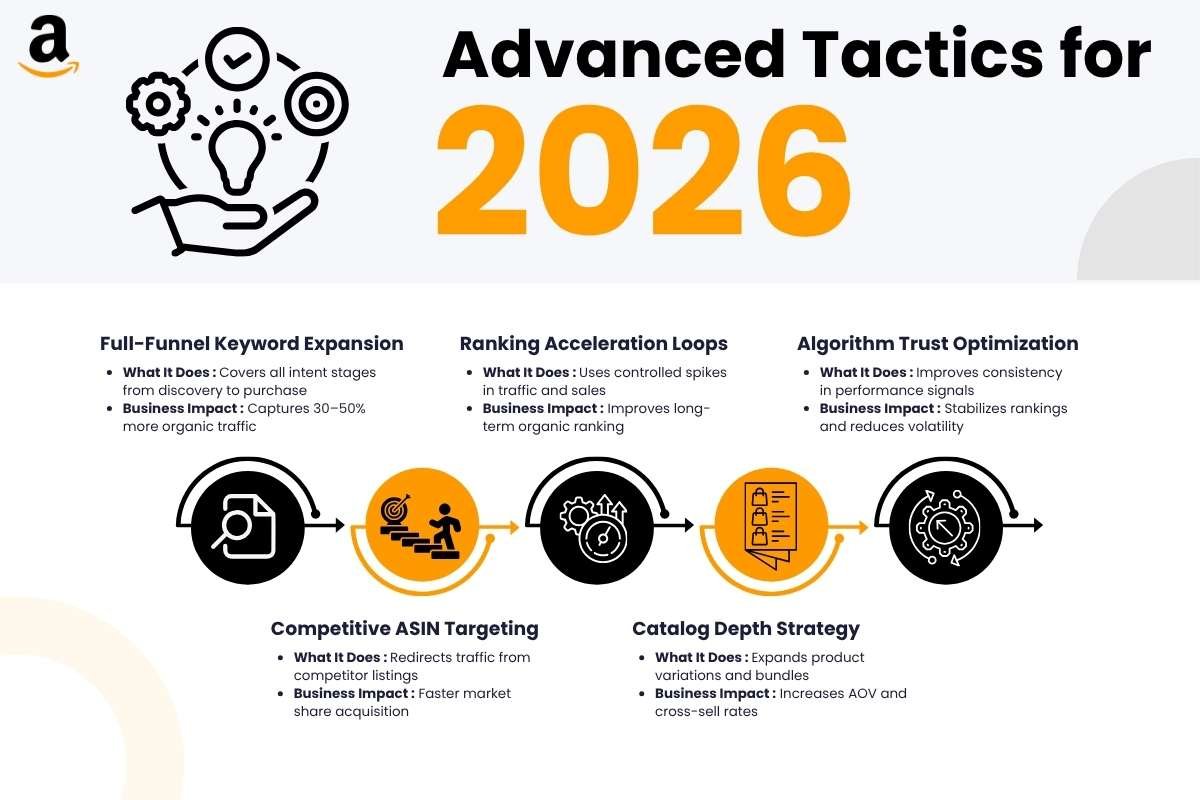
Here’s a simplified breakdown of the most impactful advanced strategies used by high-growth Amazon brands:
| Advanced Tactic | What It Does | Business Impact |
| Full-Funnel Keyword Expansion | Covers all intent stages from discovery to purchase | Captures 30–50% more organic traffic |
| Competitive ASIN Targeting | Redirects traffic from competitor listings | Faster market share acquisition |
| Ranking Acceleration Loops | Uses controlled spikes in traffic and sales | Improves long-term organic ranking |
| Catalog Depth Strategy | Expands product variations and bundles | Increases AOV and cross-sell rates |
| Algorithm Trust Optimization | Improves consistency in performance signals | Stabilizes rankings and reduces volatility |
1. Full-Funnel Keyword Expansion
Instead of focusing only on high-volume search terms, advanced approaches within an effective Amazon Marketing Strategy build coverage across the entire buyer journey, starting from awareness-based queries to highly specific purchase intent searches.
This ensures your product appears not just when customers are ready to buy, but also when they are still exploring solutions.
2. Competitive ASIN Targeting
One of the most powerful growth levers is directly targeting competitor traffic. Rather than waiting for customers to find you, you strategically position your product in front of shoppers already viewing similar listings.
This approach is especially effective in saturated categories where differentiation is subtle but conversion intent is high.
3. Ranking Acceleration Loops
Instead of relying on slow organic buildup, advanced sellers using a strategic Amazon Marketing Strategy intentionally create controlled spikes in demand through a combination of ads, promotions, and external traffic.
When executed correctly, these spikes improve sales velocity, which strengthens ranking signals and triggers longer-term organic visibility improvements.
4. Catalog Depth Strategy
Top brands rarely rely on a single product. Instead, they build structured catalogs that cover multiple price points, use cases, and customer segments.
This not only increases average order value but also strengthens brand authority within the category.
5. Algorithm Trust Optimization
At the highest level, success on Amazon depends on trust signals within a robust Amazon Marketing Strategy. The algorithm consistently rewards brands that demonstrate stable performance over time.
This includes consistent conversion rates, strong review profiles, low return rates, and reliable fulfillment performance.
Once this trust is established, ranking becomes significantly more stable even in highly competitive environments.
Mistakes to Avoid
Even with a strong strategy in place, many brands fail to scale on Amazon because of a few repeated, avoidable mistakes. And the impact is bigger than most realize; poor execution doesn’t just slow growth, it can completely block visibility and profitability.
In fact, a large share of underperforming listings don’t fail because of bad products, but because of misaligned strategy, weak optimization, or inconsistent execution.
1. Treating Amazon Like a “Set and Forget” Platform
One of the most common mistakes in any Amazon Marketing Strategy is assuming that once a listing is live, the job is done. In reality, Amazon is a constantly shifting ecosystem. Keywords change, competitors adjust pricing, and customer behavior evolves. Listings that are not regularly optimized start losing visibility over time, even if they were performing well initially. On Amazon, stagnation almost always leads to decline.
2. Over-Reliance on Ads Without Fixing the Listing
Many sellers try to “buy their way out” of poor performance using ads. While advertising is powerful, it cannot compensate for a weak product page. If CTR or conversion rate is low, increasing ad spend only amplifies inefficiency. This leads to rising ACoS and declining profitability instead of growth. Ads can scale success, but they cannot fix broken fundamentals.
3. Ignoring Conversion Rate Optimization
Traffic is often treated as the main KPI, but conversion is what actually drives revenue within a high-performing Amazon Marketing Strategy. Poor images, unclear messaging, or a lack of trust signals can drastically reduce conversion rates even if visibility is strong. Small improvements in conversion efficiency can significantly outperform large traffic increases.
Simple 90-Day Amazon Marketing Plan
At this point, we’ve covered the full spectrum of growth from SEO and ads to omnichannel execution and advanced scaling on Amazon. But strategy only matters when it turns into execution.
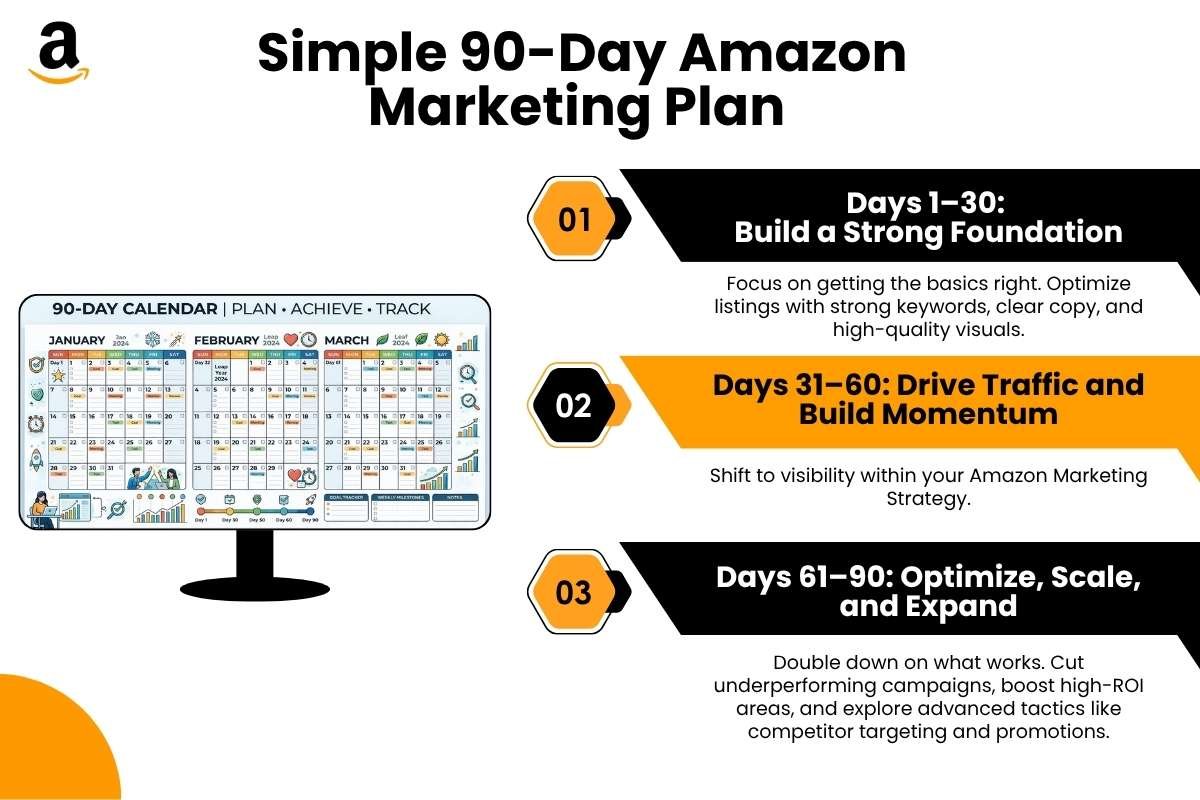
So here’s a simplified, action-driven 90-day roadmap that brings everything together into a structured growth system.
1. Days 1–30: Build a Strong Foundation
Focus on getting the basics right. Optimize listings with strong keywords, clear copy, and high-quality visuals. Set up your Brand Store, A+ Content, and initial ads to gather data. The goal is clarity and a solid base, not scale.
2. Days 31–60: Drive Traffic and Build Momentum
Shift to visibility within your Amazon Marketing Strategy. Scale ads, refine targeting, and start driving external traffic. Track key metrics like CTR, conversion rate, and ACoS to build consistent sales velocity.
3. Days 61–90: Optimize, Scale, and Expand
Double down on what works. Cut underperforming campaigns, boost high-ROI areas, and explore advanced tactics like competitor targeting and promotions. This is where rankings improve, ad efficiency rises, and growth becomes more organic.
This is how brands transition from early-stage sellers to sustainable, scalable Amazon businesses.
Conclusion:
A successful Amazon Marketing Strategy in 2026 is not about isolated tactics; it’s about building a connected system where SEO, ads, content, and data work together.
When executed correctly, this system creates predictable and compounding growth. Instead of relying on short-term wins, brands can build long-term dominance within their categories.
Ultimately, Amazon rewards consistency, performance, and strategic execution. The brands that understand this and act on it are the ones that scale.
FAQs
1. What is an Amazon marketing strategy?
An Amazon marketing strategy on Amazon is a structured plan to improve product visibility, conversions, and sales using SEO, ads, content, promotions, and external traffic.
2. How can I use Amazon SEO in my strategy?
Amazon SEO helps you rank higher in search results by optimizing keywords, titles, bullet points, and backend terms so your products match customer search intent.
3. What are the main Amazon ad types?
The main ad types, Sponsored Products, Sponsored Brands, and Sponsored Display, each play a distinct role within an effective Amazon Marketing Strategy, designed for visibility, brand building, and retargeting.
4. How important are reviews and content?
Very important, reviews build trust, while strong content (like A+ Content and images) improves conversions and directly impacts rankings.
5. Can I use external traffic with Amazon?
Yes, external traffic from social media, Google, and influencers can boost sales velocity and improve organic rankings on Amazon.
6. How do I know if my Amazon marketing strategy is working?
Track key metrics like CTR, conversion rate, ACoS, and organic rankings. Improving trends across these indicators show your strategy is performing well.