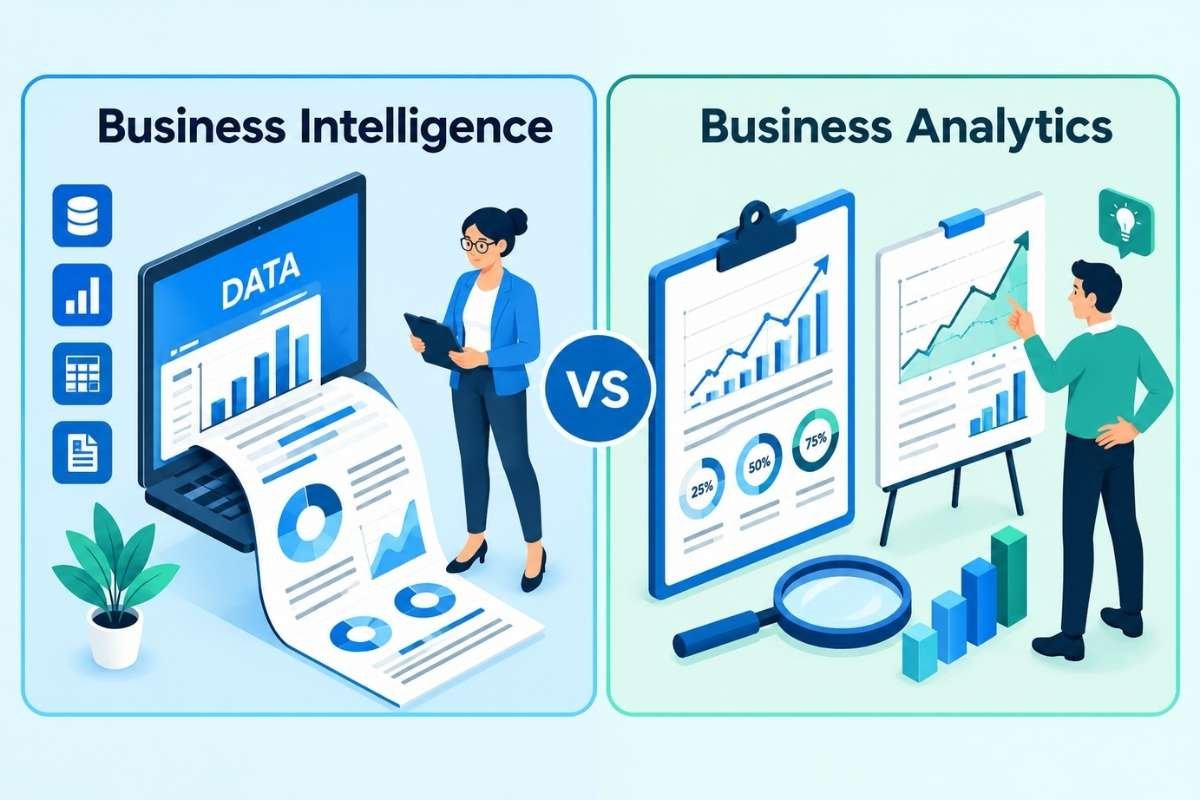
Business intelligence (BI) tracks past and current business performance through reports and dashboards, while business analytics (BA) uses statistical analysis and predictive models to explain trends and forecast outcomes.
BI helps businesses understand what happened, whereas BA helps explain why it happened and what might happen next. Both support data-driven decision-making, but they serve different purposes.
What is the difference between business intelligence and business analytics?
Business intelligence and business analytics turn business data into useful insights, but they approach decision-making differently.
Business intelligence (BI) involves collecting, organizing, analyzing, and presenting business data through reports, dashboards, and performance metrics. It helps teams understand what happened in the past and what is happening now.
Business analytics (BA) uses statistical analysis, data mining, forecasting, and predictive modeling to investigate business problems, identify patterns, and estimate future outcomes. Depending on the method, it can also help recommend actions.
In simple terms, BI helps businesses monitor performance, while BA helps them investigate causes and evaluate future possibilities.
How do business intelligence and business analytics differ in tools, methods, and outcomes?
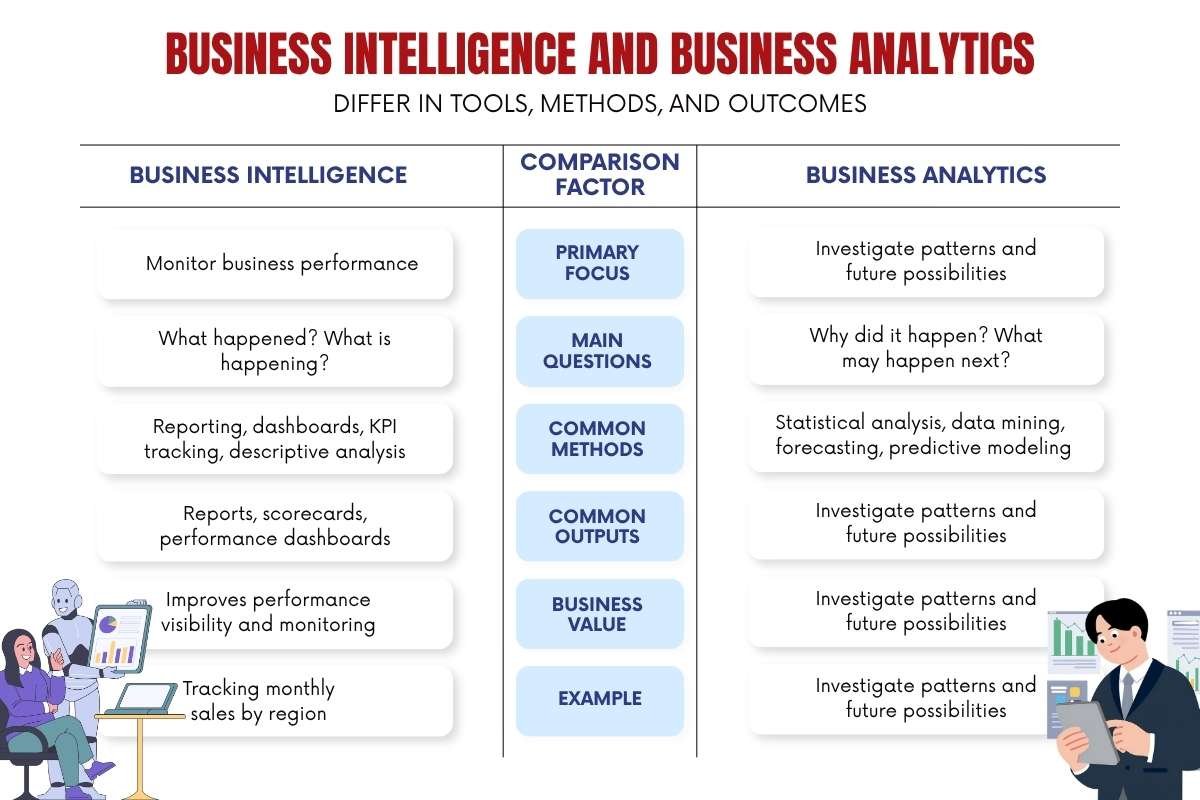
The main differences appear in their objectives, analytical methods, outputs, and business applications.
| Comparison factor | Business Intelligence | Business Analytics |
|---|---|---|
| Primary focus | Monitor business performance | Investigate patterns and future possibilities |
| Main questions | What happened? What is happening? | Why did it happen? What may happen next? |
| Common methods | Reporting, dashboards, KPI tracking, descriptive analysis | Statistical analysis, data mining, forecasting, predictive modeling |
| Common outputs | Reports, scorecards, performance dashboards | Forecasts, predictive models, scenario analysis |
| Business value | Improves performance visibility and monitoring | Supports deeper analysis and forward-looking decisions |
| Example | Tracking monthly sales by region | Forecasting sales for the next quarter |
➔ Business intelligence tools:
BI tools help companies combine data from different sources and present it in an accessible format. Common options include:
- Microsoft Power BI: Connects, visualizes, and shares business data through reports and dashboards.
- Tableau: Supports interactive visualizations and business performance analysis.
- SAP Analytics Cloud: Supports business reporting, analytics, and planning.
➔ Business analytics methods and tools:
Business analytics can use the same platforms as BI, along with specialized analytical methods and programming tools.
- Statistical analysis: Identifies relationships, variations, and patterns in data.
- Predictive modeling: Estimates future outcomes using historical data.
- Forecasting: Projects sales, demand, revenue, or other business measures.
- Python and R: Support statistical computing, data analysis, and predictive modeling.
The distinction is not always about which software a company uses. Many modern platforms support both reporting and advanced analytics. The main difference lies in the business question, analytical method, and expected outcome.
When should a business use business intelligence or business analytics?
The choice between business intelligence and business analytics depends on the problem a company wants to solve. BI is useful for regular performance monitoring, while BA is valuable when a business needs to investigate causes, forecast results, or evaluate possible decisions.
Businesses can use BI when they need to:
- Track revenue, profit margins, and sales performance.
- Monitor marketing campaign results and customer activity.
- Compare performance across departments or locations.
- Identify operational issues through dashboards and reports.
Businesses can use BA when they need to:
- Forecast future sales and customer demand.
- Identify factors contributing to customer churn.
- Estimate how price changes may affect revenue.
- Evaluate different business strategies using data.
Example: An e-commerce company notices that its monthly sales have declined. Its BI dashboard highlights the decline and identifies the affected product categories. Business analytics can then investigate possible causes, such as changing prices, seasonal demand, or reduced customer engagement.
The company can use these findings to test different strategies and make more informed decisions. BI provides visibility into the problem, while BA helps investigate it and assess potential solutions.
Real-world example of business intelligence vs business analytics
Example: Gini & Jony (Indian clothing retailer) – (BI Case Study)
Gini & Jony used a business intelligence solution from BIRetail to track stock and identify fast-selling clothing styles. Its stock reports helped the team identify fast-moving items within three weeks and plan to sell the remaining stock over the next four weeks.
Business Intelligence (BI): The company used stock reports to identify which clothing styles sold quickly.
Business Analytics (BA): The company could analyze sales trends to estimate future demand and plan stock levels. This is an illustrative application, not a separately reported result from the case study.
Can business intelligence and business analytics work together to improve business decisions?

Yes. Business intelligence and business analytics can work together to help companies move from understanding performance to evaluating future actions.
BI organizes business information and presents it through reports, dashboards, and key performance indicators (KPIs). BA builds on that information by examining patterns, testing assumptions, and estimating possible outcomes.
A company can combine both approaches through the following process:
1. Collect business data: Gather information from sales, marketing, finance, customers, and operations.
2. Monitor performance: Use BI dashboards to track KPIs and identify unusual changes.
3. Investigate patterns: Apply business analytics to examine the possible reasons behind those changes.
4. Evaluate future outcomes: Use forecasting or scenario analysis to assess potential business decisions.
5. Measure results: Monitor the impact of the chosen action through BI reports and refine the strategy as needed.
For example, a subscription business may use BI to monitor customer cancellations. BA can analyze customer behavior to identify factors associated with cancellations and estimate which customer groups may be at greater risk. The business can then test retention strategies and monitor their results.
This combined approach helps decision-makers connect historical performance, current conditions, and future planning.
Conclusion
Business intelligence vs business analytics is not simply a choice between two competing approaches. BI helps companies monitor performance and understand business data, while BA supports deeper investigation, forecasting, and the evaluation of possible decisions.
Businesses that need regular reports and performance tracking can start with Business Intelligence. Those that need to investigate complex problems or predict future outcomes can apply business analytics. Combining both can help organizations make informed decisions, improve operations, and align business strategies with measurable goals.
FAQs
1. What is the main difference between business intelligence and business analytics?
BI tracks business performance, while BA studies trends and predicts future results.
2. Is business analytics a part of business intelligence?
It depends on the framework. Both use data to support business decisions.
3. Which is better, BI or BA?
BI is best for tracking performance, while BA helps predict outcomes. The choice depends on business needs.
4. What tools are used for BI and BA?
BI tools include Power BI and Tableau. BA also uses Python, R, and statistical methods.
5. Can small businesses use BI and BA?
Yes. They can track sales, forecast demand, and understand customer behavior.