Businesses rarely fail because they have no goals. More often, they struggle because their goals are not translated into consistent action.
This is where the difference between strategic management vs strategic planning becomes important.
Strategic planning focuses on setting a long-term direction. It helps an organization decide what it wants to achieve, where it should compete, and which priorities deserve resources. Strategic management goes further. It connects those plans with execution, performance monitoring, decision-making, and adjustments when business conditions change.
Think of it this way: strategic planning creates the roadmap; strategic management ensures the organization follows, evaluates, and updates it.
The two concepts are closely connected, but they are not interchangeable. Understanding the difference can help business leaders allocate resources more effectively, respond to market changes, and keep employees aligned with organizational goals.
What is strategic management vs strategic planning, and why does the difference matter?

The simplest way to understand strategic management vs strategic planning is to look at their purpose.
Strategic planning is the structured process of defining an organization’s long-term objectives and deciding how it intends to achieve them.
Strategic management is the broader, ongoing process of analyzing the business environment, developing strategy, implementing it, evaluating results, and adapting when necessary. For a deeper understanding, see our Strategic Management guide.
OpenStax describes strategic management as a set of activities managers use to position a firm for successful competition. It also notes that managers often work on analysis, execution, and future strategy simultaneously rather than following a rigid sequence.
Strategic planning, meanwhile, creates the longer-term framework. Strategic plans typically define an organization’s vision, strategic objectives, and broad approaches for achieving those objectives.
Strategic planning: deciding where to go
A strategic plan generally answers questions such as:
- What do we want to achieve?
- Where do we want the organization to be in three, five, or more years?
- Which markets or customers should we prioritize?
- What capabilities do we need?
- What resources will support our priorities?
- How will we measure success?
For example, a retailer may decide that expanding its digital business, improving supply-chain efficiency, and strengthening customer loyalty are major priorities for the next few years.
That decision became part of its strategic plan.
Strategic management: making the strategy work
Strategic management takes those priorities into the real business environment. It involves the Strategic Management Process, which covers how organizations move from analysis and strategy formulation to implementation and evaluation.:
- Analyzing internal strengths and weaknesses.
- Monitoring competitors, customers, technology, and market conditions.
- Selecting and refining strategies.
- Allocating resources.
- Implementing strategic initiatives.
- Measuring performance.
- Correcting problems.
- Adapting strategy when circumstances change.
This makes strategic management a continuous cycle rather than a document produced once a year.
| Real-World Example: Microsoft Microsoft demonstrates the link between planning and management through its AI strategy. Its 2025 Annual Report highlights long-term investment in AI while continuing to execute and scale existing businesses. This shows how strategic planning sets direction, while strategic management turns that direction into ongoing investments, products, and measurable results. |
Strategic planning sets the direction. Strategic management keeps it moving.
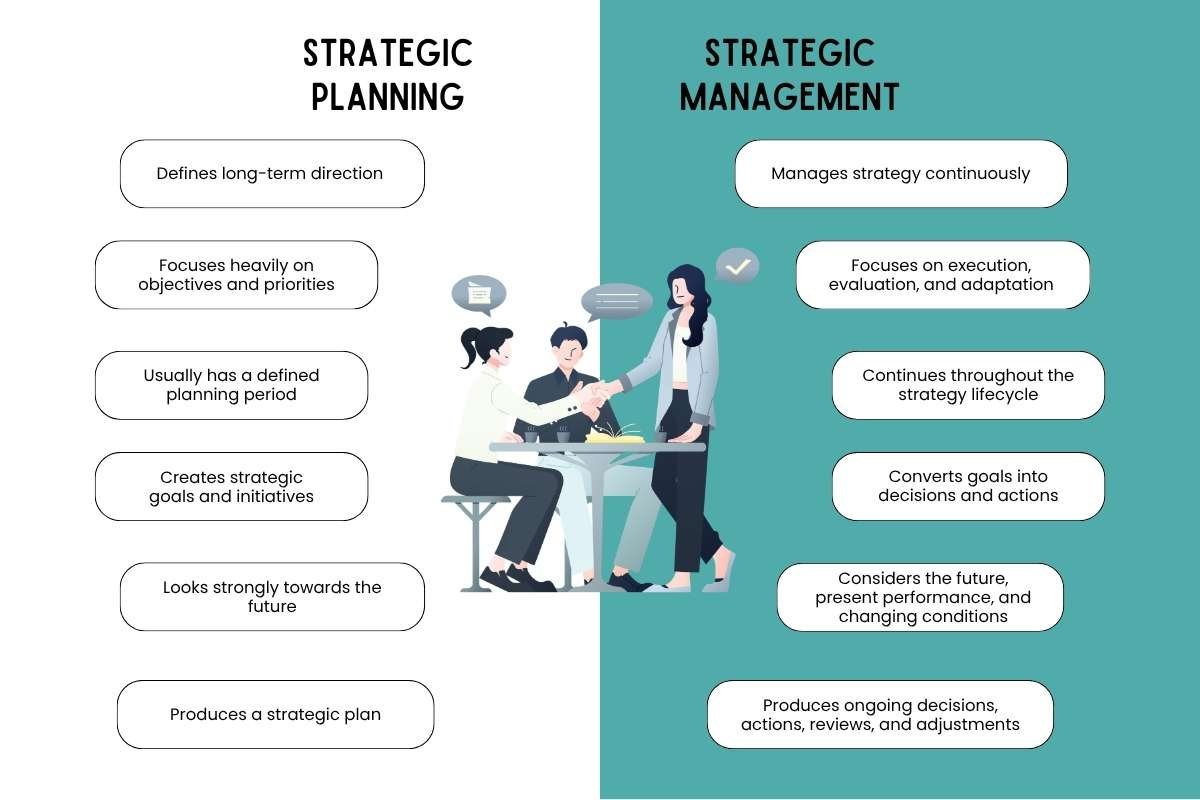
The biggest mistake businesses make is treating strategic management vs strategic planning as the same activity.
They are better understood as two connected parts of the strategy cycle.
| Strategic Planning | Strategic Management |
| Defines long-term direction | Manages strategy continuously |
| Focuses heavily on objectives and priorities | Focuses on execution, evaluation, and adaptation |
| Usually has a defined planning period | Continues throughout the strategy lifecycle |
| Creates strategic goals and initiatives | Converts goals into decisions and actions |
| Looks strongly towards the future | Considers the future, present performance, and changing conditions |
| Produces a strategic plan | Produces ongoing decisions, actions, reviews, and adjustments |
1. Planning answers “Where are we going?”
Strategic planning establishes the destination.
A company may decide to:
- Enter a new market
- Launch a new product category
- Improve customer retention
- Build digital capabilities
- Reduce operating costs
- Strengthen sustainability
- Expand internationally
The plan provides priorities and a framework for action.
2. Management answers “How are we performing?”
Once implementation begins, leadership needs evidence.
Are sales moving toward the target?
Are customers responding positively?
Are investments producing expected returns?
Are competitors changing their approach?
Are employees equipped to execute the strategy?
Strategic management keeps asking these questions.
3. Management also answers “What needs to change?”
Markets do not remain static.
A five-year plan created today may encounter new regulations, technologies, competitors, customer preferences, economic conditions, or supply-chain challenges.
Strategic management provides the flexibility to respond when markets, technology, competitors, or customer expectations change. Avoiding common Strategic Management Mistakes can help organizations execute strategy more effectively.
This is why an effective strategy is not simply plan → execute → forget.
It is closer to: Analyze → Plan → Implement → Measure → Learn → Adapt → Repeat
This continuous cycle is consistent with the strategic-management process described by OpenStax, which emphasizes that organizations often analyze, formulate, and execute strategy at the same time.
The real difference becomes clear when you look at starbucks
Starbucks offers a strong recent example of how planning and management can operate together.
The company introduced its “Back to Starbucks” strategy to refocus on coffee, craft, the coffeehouse experience, customer service, and partner experience. Starbucks said it began putting this strategy into action during fiscal 2025.
The plan established a direction.
But Starbucks did not stop with the strategy statement.
The company reported operational changes including menu simplification, marketing changes, improvements to the in-store experience, staffing initiatives, and a four-minute café wait-time goal.
| Expert Perspective Starbucks CEO Brian Niccol said the company was “testing and learning at speed” to identify the right investments. This shows that strategic management goes beyond making a plan. It requires testing actions, reviewing results, and adjusting the strategy when needed. |
By January 2026, Starbucks was reporting progress on its transformation plan while introducing further coffeehouse innovations and a redesigned loyalty program.
This is a practical example of strategic management vs strategic planning:
- Planning: Define the desired transformation.
- Management: Implement initiatives, monitor results, make investments, and continue adjusting the approach.
The company therefore demonstrates why a strategic plan should not be treated as the final product. It should become an input into continuous management.
How strategic management and strategic planning work together
The two approaches work best as a connected system.
Step 1: Understand the current situation
Leaders assess the organization, customers, competitors, market trends, resources, risks, and opportunities.
Step 2: Set strategic priorities
The organization determines what matters most and establishes measurable long-term objectives.
This is the heart of strategic planning.
Step 3: Choose strategic actions
Leaders decide how resources, people, technology, partnerships, and investments will support those priorities.
Step 4: Implement the strategy
Departments translate strategic priorities into initiatives, budgets, projects, and operational activities.
This is where strategic management becomes highly visible.
Step 5: Measure performance
Leadership tracks financial and non-financial indicators.
Examples include revenue growth, market share, customer retention, productivity, employee metrics, operational efficiency, and progress toward strategic goals.
Step 6: Adapt
If the market changes or an initiative underperforms, management reassesses the strategy.
This final step feeds new information back into planning.
That is why the relationship can be represented as:
Strategic Planning → Strategic Execution → Performance Review → Strategic Management → Updated Planning
PepsiCo shows why strategy must evolve with the business

PepsiCo provides another useful example.
Its pep+ (PepsiCo Positive) strategy connects sustainability and business transformation with long-term growth and resilience. PepsiCo describes pep+ as a business strategy focused on strengthening resilience, responding to changing consumer preferences, and creating long-term value.
Importantly, PepsiCo has not treated its long-term goals as permanently fixed.
In 2025, the company refined several pep+ goals based on progress, business growth, external realities, and lessons learned.
By 2026, PepsiCo continued reporting progress and adapting its approach toward longer-term objectives. Its latest reporting emphasizes that strategy and decision-making are informed by ongoing performance data.
This is exactly where strategic management adds value.
A strategic plan gives PepsiCo long-term priorities. Strategic management provides the feedback loop that helps the company determine whether those priorities, investments, and actions remain appropriate.
Which one should a business focus on?
The answer is both. Strategic planning gives a business clear long-term direction, while strategic management turns that direction into action and keeps it on track.
Planning without management can remain only a document. Management without planning can become reactive and lack a clear goal.
For small businesses, the process can stay simple:
- Set a clear long-term goal.
- Choose 3-5 key priorities.
- Set measurable objectives.
- Assign resources and responsibilities.
- Track key performance indicators (KPIs).
- Review progress regularly.
- Adjust the strategy when needed.
Larger organizations may use a more detailed approach involving corporate strategy, business-unit plans, budgets, risk management, performance reviews, and regular strategy updates.
In simple terms: Strategic planning sets the direction, while strategic management keeps the business moving toward it.
Conclusion
The difference between strategic management vs strategic planning is simple: strategic planning sets the direction, while strategic management turns that direction into action and adapts it over time.
Planning helps a business set goals and priorities. Strategic Management helps execute those goals, measure results, and respond to market changes.
Examples from Microsoft, Starbucks, and PepsiCo show that successful businesses need both clear direction and continuous action.
In the end, a strategy should not remain a document. It should guide decisions, improve performance, and evolve as the business changes.
FAQs
1. What is the difference between strategic management and strategic planning?
Strategic planning sets long-term goals and direction. Strategic management turns those plans into action, measures results, and adapts the strategy when needed.
2. Is strategic management the same as strategic planning?
No. Strategic planning focuses on setting goals and priorities, while strategic management covers planning, implementation, performance evaluation, and continuous improvement.
3. Which comes first: strategic planning or strategic management?
Strategic planning is an important part of strategic management. However, strategic management is an ongoing process that includes planning, execution, evaluation, and adaptation.
4. Why is strategic planning important?
Strategic planning gives a business clear goals and priorities. It also helps leaders allocate resources and keep teams focused on long-term objectives.
5. Why is strategic management important?
Strategic management helps businesses turn plans into measurable results. It also helps them respond to market changes and improve their strategy over time.