Turning a business strategy into real results requires more than setting goals. Teams need a clear way to prioritize objectives, assign responsibilities, measure progress, and make timely decisions.
This is where Strategic management tools help. They provide practical frameworks, software, and templates for planning, executing, and tracking business strategy.
For example, SWOT can assess the business position, OKRs can turn priorities into measurable goals, and KPI dashboards can track whether key initiatives are delivering results. The right tools depend on the company’s goals, size, industry, and resources.
Why do strategic management tools matter for business growth?
Strategic tools are simple frameworks, methods, and software that help businesses turn plans into clear actions and measurable results. They help leaders decide what matters most, assign responsibility, track progress, and make better strategic decisions.
In simple terms, these tools help answer five important questions:
- Where are we today?
- Where do we want to go?
- What should we focus on first?
- Who will handle each priority?
- Are we getting the expected results?
Different tools solve different problems. SWOT analysis helps a company understand its strengths, weaknesses, opportunities, and threats, making it a useful part of the wider strategic planning process.
The biggest benefit comes from using these tools together. A company can use SWOT to identify its priorities, OKRs to set measurable targets, and a KPI dashboard to check whether those targets are being achieved.
| Real-World Example: Google Uses OKRs to Set Clear Goals Google is one of the most widely cited examples of OKR use. John Doerr introduced OKRs to Google’s founders in 1999, when Google had about 40 employees. The framework helped the company connect ambitious objectives with measurable results. For example, an objective might be “Improve customer experience.” Key results could include reducing response time by 20% or increasing customer satisfaction to 90%. |
This shows how an idea that sounds broad can become a goal that teams can actually measure.
Which strategic management tools actually turn plans into results?
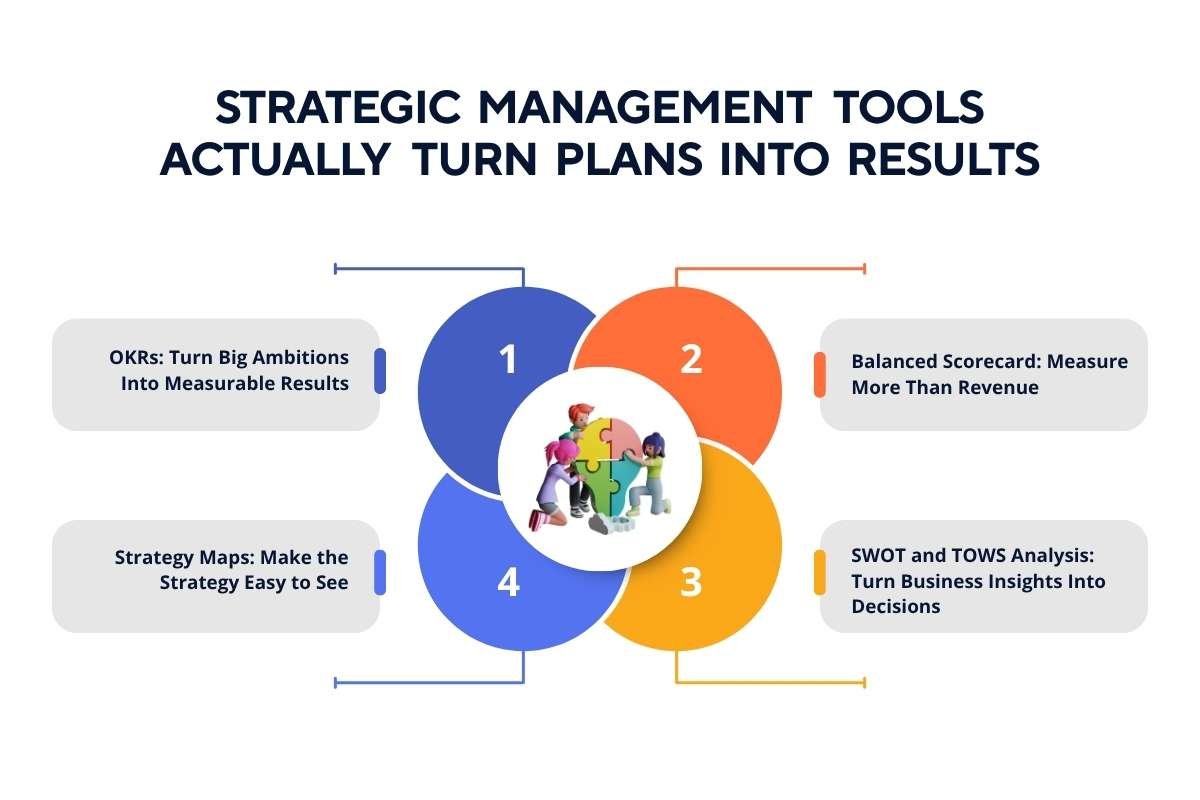
There is no single best tool for every organization. The following frameworks cover different parts of the strategic management process.
1. OKRs: Turn big ambitions into measurable results
Objectives and Key Results (OKRs) connect broad business goals with specific, measurable outcomes.
An objective describes what the organization wants to accomplish. Key results define how progress will be measured.
Example:
- Objective: Improve customer retention.
- Key Result 1: Increase annual retention from 82% to 90%.
- Key Result 2: Reduce customer response time by 25%.
- Key Result 3: Increase customer satisfaction score to 90%.
John Doerr, who introduced OKRs to Google, explains the basic idea clearly: “The objective is what we’re trying to achieve. The key result is how we’re going to get it done.”
OKRs are particularly useful when an organization needs stronger alignment between leadership priorities and team-level execution.
Microsoft’s documentation also distinguishes objectives from measurable key results and initiatives that support them.
Best for: Goal alignment, quarterly planning, measurable outcomes, and cross-functional execution.
2. Balanced scorecard: Measure more than revenue
A Balanced Scorecard prevents organizations from judging strategy only through financial results.
The traditional model looks at four perspectives:
- Financial: Are we creating economic value?
- Customer: How do customers view our performance?
- Internal processes: Which processes must improve?
- Learning and growth: What capabilities and skills support future performance?
This approach helps connect operational improvements with longer-term business outcomes. Strategy software can also use these four perspectives to cascade objectives across departments.
Best for: Enterprise performance management, KPI tracking, strategic alignment, and organizations with multiple departments.
3. SWOT and TOWS Analysis: Turn business insights into decisions
SWOT analysis examines:
- Strengths
- Weaknesses
- Opportunities
- Threats
SWOT is useful for understanding the current strategic position. But the analysis becomes more actionable when teams use a TOWS matrix to match internal and external factors.
For example:
- Strength + Opportunity: Use strong brand recognition to enter a growing market.
- Weakness + Opportunity: Improve digital capabilities before expanding.
- Strength + Threat: Use operational efficiency to defend against new competitors.
- Weakness + Threat: Reduce dependence on a vulnerable supplier.
Best for: Market assessment, strategic planning, competitive analysis, and decision-making.
4. Strategy maps: Make the strategy easy to see
A strategy map provides a visual representation of how strategic objectives connect.
For example:
| Employee capability → Better processes → Higher customer satisfaction → Stronger financial performance |
This helps employees understand why their work matters beyond their individual tasks.
Strategy maps are commonly used with Balanced Scorecards to show relationships between objectives and performance measures.
Best for: Communicating strategy, aligning departments, explaining cause-and-effect relationships, and executive reviews.
Which strategy execution software can make execution easier?

Frameworks establish the structure, but software can make execution easier when plans become complex.
1. Cascade
Cascade Strategy Platform brings strategic plans, objectives, initiatives, KPIs, dashboards, and relationships into one platform. Its strategy execution approach covers planning, execution, measurement, and reporting.
Cascade is useful for organizations that need centralized visibility across multiple strategic plans and teams.
2. WorkBoard
WorkBoard focuses on enterprise strategy execution and OKRs. Its current platform connects strategy, outcomes, investments, OKRs, initiatives, portfolios, projects, and people.
It can be particularly relevant for large organizations managing complex goal-setting and execution processes.
3. Spider Impact
Spider Impact supports Balanced Scorecards, KPIs, dashboards, reports, and performance management. Its customer stories include organizations such as the University of Sharjah, Grenada Co-operative Bank, and Abdul Latif Jameel.
Grenada Co-operative Bank, for example, previously managed its Balanced Scorecard with Excel and moved to Spider Impact to improve collaboration, data integrity, and cloud-based access.
4. Asana, Monday.com, and Jira
General work-management platforms can also support strategy execution when teams connect projects and tasks to strategic goals.
Asana, for example, documents how Xero uses the platform to connect OKRs with project execution and cross-functional accountability.
These tools are generally more focused on work and project management than specialized strategy platforms, so the right choice depends on how much strategic planning, KPI management, and executive reporting the organization requires.
Which strategic management templates make execution simpler?
Software is not mandatory. Smaller businesses can start with simple spreadsheets or documents.
1. One-page strategic plan
A one-page strategic plan summarizes the essentials:
- Vision
- Mission
- Core values
- Strategic priorities
- Major objectives
- Key measures
- Important initiatives
It gives employees a quick reference without forcing them to read a lengthy strategy document.
2. KPI Dashboard Tracker
A KPI tracker records important measures weekly or monthly.
A basic tracker can include:
| KPI | Target | Current Result | Owner | Status | Review Date |
| Revenue growth | 15% | 12% | Sales Head | At risk | Monthly |
| Customer retention | 90% | 87% | Customer Success | Watch | Monthly |
| Delivery time | 48 hrs. | 44 hrs. | Operation | On track | Weekly |
The purpose is not to collect every available metric. It is to monitor the measures that actually indicate strategic progress.
3. Initiative Action Plan
An initiative action plan converts objectives into accountable work.
Include:
- Strategic objective
- Initiative
- Project owner
- Supporting team
- Start date
- Due date
- Required resources
- Expected result
- KPI
- Current status
This structure helps close the gap between “we should do this” and “someone is responsible for doing this.”
How to choose the right strategic management tools
The best Strategic management tools are the ones that solve a specific business need. Using more tools does not automatically improve strategy.
- Unclear goals: Use OKRs to set clear, measurable priorities.
- Weak performance tracking: Use a Balanced Scorecard and KPI dashboard.
- Need to assess market position: Use SWOT and TOWS analysis.
- Goals feel disconnected: Use a Strategy Map to show how objectives relate.
- Complex plans across teams: Consider strategy execution software such as Cascade, WorkBoard, or Spider Impact.
- Small business needs: Start with a one-page strategy plan and simple KPI tracker.
The key is to keep the process focused. Choose the tools that match your goals, resources, and execution needs, then connect them with your broader strategic management framework and review progress regularly.
What mistakes can make strategic management tools fail?

Even effective Strategic management tools can fail when used incorrectly.
Watch for these common mistakes:
- Tracking too many KPIs: Focus only on metrics linked to strategic goals.
- Treating strategy as a yearly task: Review progress regularly and adjust when business conditions change.
- Measuring activity instead of results: Focus on business outcomes, not just completed tasks.
- Setting too many priorities: Keep strategic goals focused and manageable.
- Leaving ownership unclear: Assign a responsible person to every major goal or initiative.
A simple, focused approach makes strategy easier to execute, measure, and improve.
Conclusion
Strategic management tools help businesses bridge the gap between planning and execution. OKRs turn priorities into measurable outcomes, Balanced Scorecards provide a broader performance view, SWOT and TOWS support strategic decisions, and Strategy Maps make relationships between goals easier to understand.
Software such as Cascade, WorkBoard, Spider Impact, and work-management platforms can add visibility and accountability when execution becomes complex.
The best approach is not to adopt every available framework. Choose tools that match your organization’s goals, resources, management style, and execution challenges. When strategy management, ownership, KPIs, initiatives, and regular reviews work together, strategic planning becomes a practical management process rather than a document that sits unused.
FAQs
1. What are Strategic management tools?
Strategic management tools are frameworks, software, and templates that help businesses set goals, execute plans, measure results, and improve strategy.
2. What are the most common Strategic management tools?
Common tools include OKRs, Balanced Scorecards, SWOT, TOWS, Strategy Maps, KPI dashboards, and strategy execution software.
3. Which Strategic management tool is best for setting goals?
OKRs are effective for turning business priorities into clear, measurable objectives and key results that teams can track.
4. What software is used for strategy execution?
Popular options include Cascade, WorkBoard, and Spider Impact, while Asana, Monday.com, and Jira can connect daily work with strategic goals.