Learning how to secure accounting data is essential for protecting sensitive financial information from cyber threats, fraud, and data breaches. This guide explains practical security measures such as encryption, multi-factor authentication (MFA), role-based access, secure backups, and SOC 2 compliance, while also showing how cloud accounting software, ERP security, and accounting cybersecurity best practices help businesses keep financial data safe in 2026.
Financial data is one of the most valuable assets a business owns. It contains payroll records, invoices, tax documents, banking details, customer payment information, and financial reports that guide important business decisions. If this data is stolen, altered, or lost, the consequences can include financial losses, legal penalties, operational disruption, and damage to customer trust.
As cyber threats continue to evolve, businesses of every size face increasing pressure to strengthen their security practices. According to IBM’s Cost of a Data Breach Report, financial information remains one of the most targeted types of business data because it offers direct monetary value to attackers.
This is why understanding how to secure accounting data has become essential rather than optional. Whether your company uses cloud accounting software, an ERP platform, or a hybrid financial system, protecting accounting data should be a core part of your cybersecurity strategy.
This guide explains the most effective methods to secure accounting data, including encryption protocols, SOC 2 security practices, and practical measures businesses can implement to reduce risk.
Why how to secure accounting data matters more than ever for businesses in 2026
Accounting data security is the process of protecting financial information from unauthorized access, cyberattacks, data loss, and manipulation. Understanding how to secure accounting data helps businesses protect bank details, payroll, tax records, invoices, and financial statements through encryption, access controls, employee awareness, and security compliance.
In 2026, with cloud accounting, AI-powered finance tools, and remote work becoming the norm, securing accounting data is more important than ever. A single cyberattack or compromised account can lead to financial loss, compliance issues, and reputational damage. That’s why businesses should follow trusted security practices like the CIA Triad to keep financial data confidential, accurate, and always available.
| Security Principle | Why It Matters |
| Confidentiality | Ensures that only authorized users can access sensitive financial information. |
| Integrity | Protects accounting records from unauthorized changes, errors, or fraud. |
| Availability | Keeps financial systems and data accessible whenever authorized users need them. |
Following these principles helps businesses protect accounting data, maintain compliance, and ensure business continuity.
Today, securing financial data is a business necessity. Strong security measures reduce fraud and cyber risks, protect customer trust, support compliance, and keep financial operations running smoothly. For businesses adopting modern financial systems, cloud accounting software also improves security, accessibility, and business continuity.
5 biggest threats that put your accounting data at risk
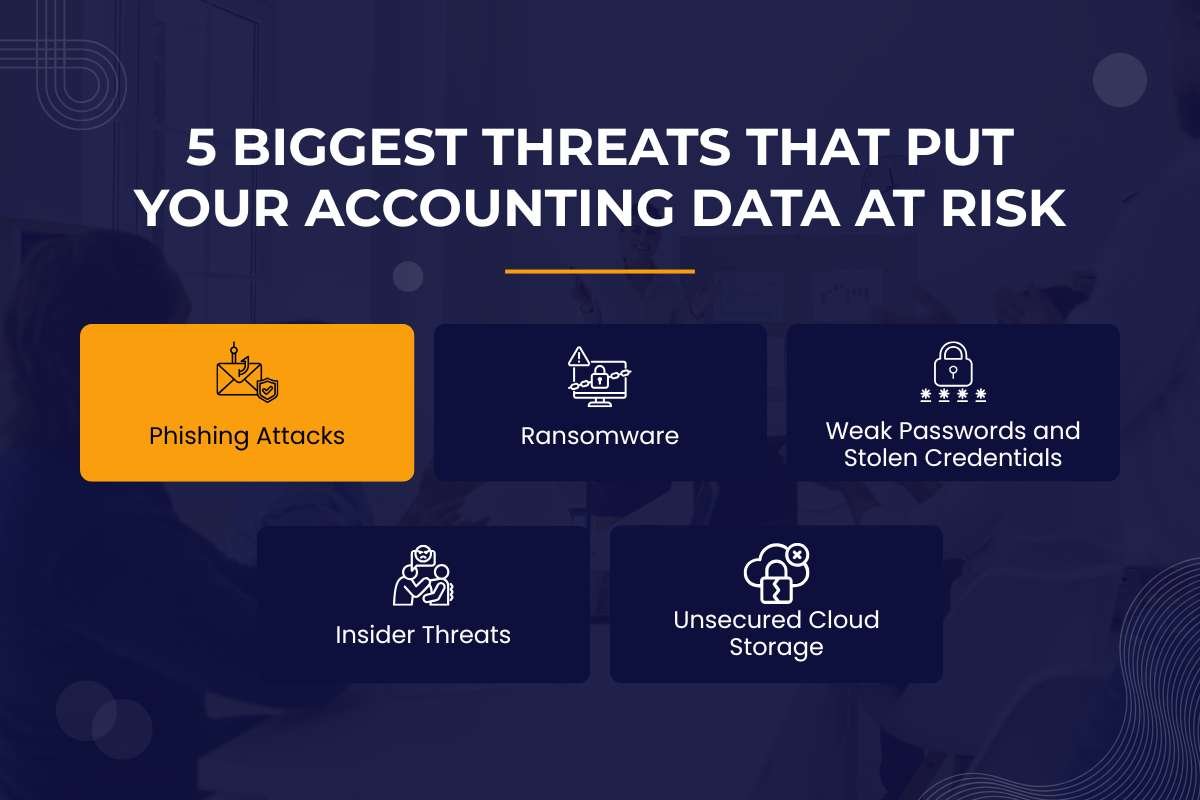
Accounting data is a common target for cybercriminals because it contains sensitive financial and customer information. Understanding the most common threats helps businesses strengthen their security before an attack occurs.
- Phishing Attacks: Fraudulent emails trick employees into sharing login credentials or approving fake payments. Employee awareness and email verification are the best defenses.
- Ransomware: Ransomware locks accounting files and demands payment to restore access. Regular encrypted backups help businesses recover quickly.
- Weak Passwords and Stolen Credentials: Weak or reused passwords make it easier for attackers to access accounting systems. Strong passwords and multi-factor authentication (MFA) greatly reduce this risk.
- Insider Threats: Employees or contractors with unnecessary access can accidentally or intentionally expose financial data. Role-based access controls help prevent this.
- Unsecured Cloud Storage: Poorly configured cloud storage can leave financial records exposed. Using SOC 2-compliant providers and regularly reviewing security settings helps keep accounting data safe.
How encryption protects your financial data from modern cyberattacks
Encryption protects sensitive accounting data by converting it into unreadable code that only authorized users can access. To strengthen how to secure accounting data, businesses should encrypt financial information both at rest (stored data) and in transit (data shared between devices, users, or cloud platforms). This helps prevent unauthorized access even if data is intercepted.
The two most important types of encryption include:
| Encryption Type | Purpose |
| Data at Rest Encryption | Protects stored financial records, databases, backups, and cloud storage. |
| Data in Transit Encryption | Secures information while it moves between devices, accounting software, cloud platforms, and banking systems. |
Today, most trusted accounting software providers rely on advanced security protocols such as AES-256 encryption for stored data and Transport Layer Security (TLS) for data transmitted over the internet. These technologies help ensure that sensitive financial information remains protected from interception and unauthorized access.
Encryption is especially important for businesses that:
- Store financial records in the cloud.
- Support remote or hybrid work environments.
- Exchange financial data with clients or vendors online.
- Process digital payments and banking transactions.
When combined with strong authentication and access controls, encryption significantly reduces the likelihood of financial data exposure, even if a device is lost or a network is compromised.
Why SOC 2 compliance is essential for how to secure accounting data
As businesses increasingly rely on cloud accounting software and ERP platforms, understanding how to secure accounting data requires more than strong passwords and antivirus software. One of the most recognized security frameworks for cloud-based service providers is SOC 2 (System and Organization Controls 2).
Developed by the American Institute of Certified Public Accountants (AICPA), SOC 2 helps organizations demonstrate that they follow strict security and privacy practices when handling customer data. While SOC 2 certification is typically obtained by software providers, businesses should also understand its principles when selecting accounting or financial management solutions.
If your accounting software is SOC 2 compliant, it generally means the provider has implemented controls to protect customer information against unauthorized access, security threats, and operational risks.
The five SOC 2 trust service criteria
SOC 2 is built around five key principles that help organizations maintain secure and reliable systems.
| Trust Service Criteria | Why It Matters for Accounting Data |
| Security | Protects accounting systems from unauthorized access and cyberattacks. |
| Availability | Ensures financial systems remain operational with minimal downtime. |
| Processing Integrity | Confirms financial transactions are processed accurately and completely. |
| Confidentiality | Safeguards sensitive payroll, tax, banking, and financial records. |
| Privacy | Protects personal information collected during financial operations. |
When evaluating accounting software, looking for SOC 2 compliance provides additional confidence that the provider follows industry-recognized security practices.
If you’re evaluating cloud-based finance platforms, read cloud accounting software to understand the security features modern solutions provide.
5 proven ways to secure accounting data and prevent costly breaches
Protecting accounting data requires a combination of technology, employee awareness, and regular security checks. These best practices help reduce the risk of data breaches and financial fraud.
- Enable Multi-Factor Authentication (MFA): Use MFA to add an extra layer of security beyond passwords. It helps protect accounting software, ERP systems, payroll platforms, banking portals, and cloud storage from unauthorized access.
- Limit Access with Role-Based Permissions: Give employees access only to the financial data they need for their jobs. Regularly review user permissions and remove access for inactive or former employees.
- Keep Software Updated: Update accounting software, ERP systems, operating systems, and security tools regularly to fix vulnerabilities and protect against emerging cyber threats.
- Back Up Financial Data Regularly: Schedule automatic, encrypted backups and test them regularly. Following the 3-2-1 backup rule helps ensure quick recovery from ransomware attacks or accidental data loss.
- Monitor Financial Systems Continuously: Track login attempts, unusual transactions, and changes to financial records using audit logs and security monitoring tools to detect threats early.
Businesses comparing security capabilities across financial systems should understand ERP vs Accounting Software to know how enterprise platforms provide advanced security controls.
Case study: Microsoft’s Zero Trust security
Microsoft protects its financial and business data using a Zero Trust security model that combines multi-factor authentication (MFA), encryption, role-based access, and continuous monitoring. This approach helps prevent unauthorized access while supporting secure remote collaboration.
Key Takeaway: To improve how to secure accounting data, businesses should use layered security measures such as encryption, MFA, role-based access, and SOC 2-compliant cloud platforms.
Expert insight
“Cybersecurity is a business issue, not just a technology issue. It requires the right combination of people, processes, and technology.” – Kevin Mitnick, Former Hacker & Cybersecurity Consultant
Even the strongest encryption cannot stop security incidents caused by phishing, weak passwords, or excessive user permissions.
Businesses that combine secure technology with clear security policies, regular employee training, continuous monitoring, and access controls are better prepared to protect sensitive accounting information and reduce cyber risks.
Conclusion
Securing financial data is essential for every business in today’s digital world. Understanding how to secure accounting data involves using layered security measures such as encryption, multi-factor authentication, role-based access, secure backups, and continuous monitoring.
Choosing SOC 2-compliant accounting software and regularly reviewing security practices helps protect sensitive financial information, maintain compliance, and build long-term trust. Strong accounting technology and data security are an ongoing investment that supports business growth and resilience.
Frequently asked questions (FAQs)
1. What is the best way to secure accounting data?
Use encryption, multi-factor authentication (MFA), role-based access, regular backups, and SOC 2-compliant accounting software.
2. Why is encryption important for accounting data?
Encryption protects financial data by making it unreadable to unauthorized users, even if it is intercepted.
3. What is SOC 2, and why does it matter?
SOC 2 is a security standard that ensures cloud service providers protect customer data through strong security controls.
4. How often should accounting data be backed up?
Back up accounting data daily and test backups regularly to ensure quick recovery during data loss or cyberattacks
5. Can small businesses secure accounting data on a budget?
Yes. Using MFA, strong passwords, software updates, encrypted storage, and employee training provides effective protection at a low cost.