Want to get your head around Revenue Acceleration and why it matters in 2026? This guide teaches businesses how to accelerate revenue growth by focusing on increasing conversion rates, sales velocity, retention, and team alignment, instead of just generating more leads. Learn the four pillars of Revenue Acceleration, uncover hidden growth bottlenecks, measure the right metrics, and put into practice proven strategies to build a more efficient, predictable, and sustainable revenue engine.
Revenue Acceleration has become one of the hottest growth strategies in 2026. Companies can’t just generate more leads to grow revenue anymore. Businesses face pressure to generate revenue faster and more efficiently. Along with rising acquisition costs, longer buying cycles, and more competition. This process connects marketing, sales, and customer success into a single growth system. Rather than treating them as separate functions, to deliver better conversion, shorter sales cycles, improved retention, and predictable growth.
Today, companies are seeking a sustainable competitive advantage. But they must understand how revenue acceleration works.
Table of Contents
What is revenue acceleration?
Revenue Acceleration is the strategic process of expediting how quickly a company generates revenue by aligning marketing, sales, and customer success teams around shared goals and data.
Growth vs. Acceleration
| Aspect | Growth | Acceleration |
| Focus | Increasing the total revenue amount | Increasing the rate of revenue change |
| Metric | Revenue % increase over time | Speed/velocity of revenue generation |
| Timeframe | Long-term trajectory | Short-to-medium term speed improvement |
Acceleration is the rate of change of growth, like velocity vs. speed in physics.
Revenue acceleration vs. RevOps
- 1. RevOps (Revenue Operations): Builds the operational foundation, aligning teams, removing bottlenecks, and optimizing touchpoints for sustainable speed.
- 2. Revenue Acceleration: Takes fast, impactful action, shortening deal cycles and converting prospects faster using tactics and tools.
Revenue acceleration vs. Demand generation
- 1. Demand Generation: Creates awareness and interest where none existed (ads, webinars, content).
- 2. Revenue Acceleration: Shortens time from awareness to decision, turning awareness into action by removing friction.
Why speed & Efficiency matter?
Acceleration focuses on speed and efficiency because it optimizes the revenue formula:
Revenue = Pipeline × Conversion × Velocity × Retention
It improves one or more variables: more pipeline, higher conversion rates, faster deal velocity, or better retention.
Why revenue acceleration matters more than ever in 2026?

Volume-based growth is crashing. In 2026, the old playbook of spending more on leads to get more revenue is breaking. This speeding up revenue through efficiency, not just volume, is now the only sustainable path.
Why the old model is failing:
| Challenge | Reality in 2026 |
| Rising CAC | B2B acquisition costs surged 60% in 5 years, averaging $536 (SaaS: $702) |
| Longer Buying Journeys | Buying committees are larger, journeys are non-linear, and ad costs rose 15% year-over-year. |
| AI-Driven Competition | AI sales tools boost productivity 30–40% and shorten cycles by 25%, and adopters win faster. |
| Budget Pressure | Companies must shrink spend while hitting targets; volume requires unsustainable marketing spend. |
| Retention Priority | Acquiring new customers is costly; keeping existing ones drives predictable revenue. |
Efficiency is the new growth model.
Growth through volume fails because paying for low-quality leads diminishes profits and forces high discounts to close deals. Revenue Acceleration flips this by optimizing the revenue formula: improving pipeline quality, conversion rates, deal velocity, and retention instead of just buying more leads.
Organizations centralizing RevOps and using AI-powered revenue tech are more likely to exceed goals and retain performers. In 2026, speed matters. But only if it’s efficient speed. It creates a predictable revenue engine while delivering better buyer experiences.
The 4 pillars of revenue acceleration:
Revenue Acceleration is the process of aligning sales, marketing, and customer success to grow revenue rapidly. It relies on four interconnected pillars, and a weakness in any one slows the entire system.
Pillar 1: Revenue visibility
Unified data, forecasting, and real-time insights ensure every team sees the same customer journey from a “Single Source of Truth”. Without this, Marketing and Sales leak revenue by operating on different data.
Pillar 2: Revenue velocity
Faster movement through funnel stages and reduced sales friction shorten the sales cycle. Bottlenecks (like slow legal reviews or poor lead handoffs) create friction that kills speed.
Pillar 3: Customer expansion
Upselling, cross-selling, and retention drive expansion revenue, the “turbo” of acceleration. It’s 5–25× more expensive to acquire new customers than to keep existing ones, so weak retention cripples sustainable growth.
Pillar 4: Revenue intelligence
AI, predictive analytics, and buyer signals enable smarter decisions and faster responses to buyer needs. Without this, teams miss critical signals and waste time on low-value prospects.
Why one weak pillar slows everything?
These pillars form a revenue engine, not a checklist. If Visibility is broken, you can’t measure Velocity. If Velocity is slow, Expansion opportunities are missed. If Intelligence is weak, you chase the wrong deals. The system compounds: a bottleneck in any pillar reduces the entire pipeline’s speed and efficiency.
It requires all four pillars working together to remove friction and maximize every customer interaction.
Revenue bottlenecks that quietly slow growth:
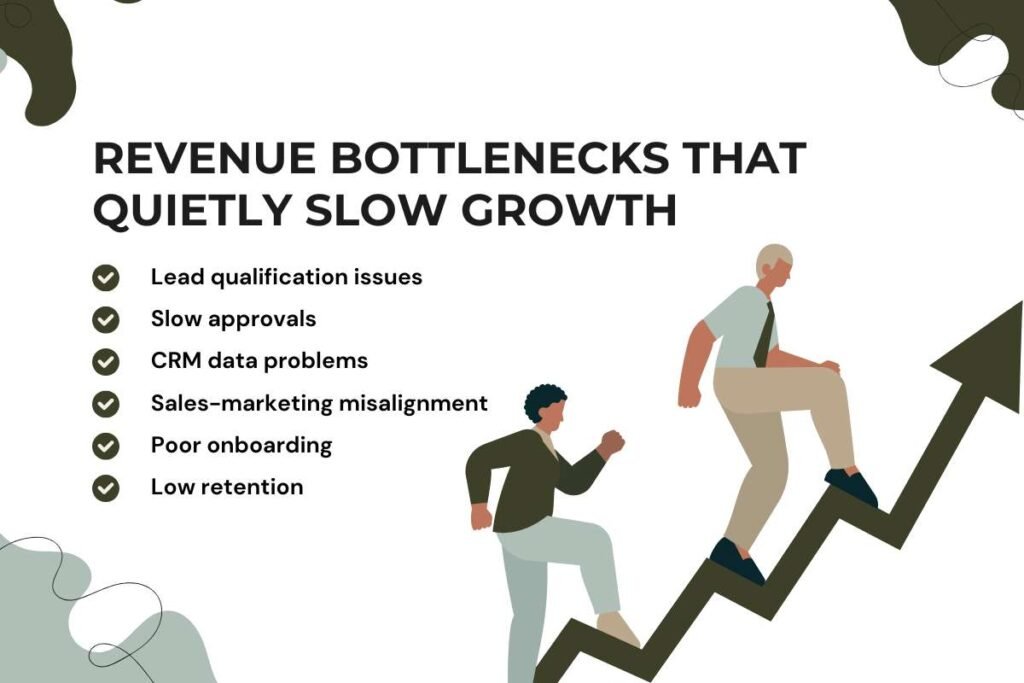
Revenue bottlenecks are structural traffic jams that slow everything in your growth engine. They exist even when activity is high. Common ones include:
- Lead qualification issues: Poor vetting wastes sales time on bad deals
- Slow approvals: Legal, procurement, or pricing delays stall closing
- CRM data problems: Inaccurate or incomplete data breaks forecasting
- Sales-marketing misalignment: Marketing focuses on volume; sales struggles to convert
- Poor onboarding: Slow customer activation kills early retention
- Low retention: Churn eats revenue faster than you can replace it
Warning signs your revenue engine is slowing
Spot these early before they become critical:
| Warning Sign | What It Means |
| Longer sales cycles | Deal velocity dropping—friction is building. |
| Declining win rates | Your engine needs a systems upgrade, not a tune-up. |
| Growing pipeline but flat revenue | “The Deal Mirage”, same deals recycled, motion without momentum |
| Increasing customer churn | You’re spending more to acquire than customers are worth (high CAC, low LTV) |
Diagnostic framework: fix it now
Use this 5-step process to diagnose and fix bottlenecks immediately:
- Baseline the revenue funnel (90–180 days): Track stage conversion, time-in-stage, and drop-off reasons
- Segment by ICP and source: Identify which customer segments are healthy vs. unhealthy
- Locate the first meaningful drop: Find the earliest stage where conversion declines or velocity spikes
- Map leakage to root causes: Is it targeting, offers, handoffs, enablement, or data trust?
- Install governance cadence: Weekly reviews to prioritize improvements and track adoption.
Revenue Acceleration requires fixing bottlenecks systematically, not hiring more reps or spending more on ads.
Proven revenue acceleration strategies:

Revenue Acceleration is the coordinated effort to shorten the path from prospect to revenue by aligning marketing, sales, and customer success. Here are six proven strategies with the highest-impact vs. the lowest-effort recommendations:
6 Strategies
Strategy 1: Prioritize high-intent buyers
Focus on Account-Based Marketing (ABM) and refine lead scoring to target high-value accounts.
Strategy 2: Reduce sales cycle friction
Map the customer journey, identify bottlenecks, and automate follow-ups using CRM tools.
Strategy 3: Improve handoffs between teams
Establish unified revenue targets, shared KPIs (lead quality, conversion, retention), and communication routines.
Strategy 4: Use AI for prioritization
Leverage AI-driven analytics to monitor performance, forecast revenue, and identify growth opportunities.
Strategy 5: Focus on retention before acquisition
Double down on customer success, satisfaction, and loyalty. Retention is 5–25× cheaper than acquisition.
Strategy 6: Create a revenue feedback loop
Run experiments, gather customer feedback regularly, and adapt quickly based on results.
Highest-impact vs. Lowest-effort (Quick wins)
| Quick Win (High Impact, Low Effort) | Why It Works |
| Simplify the internal approval process. | Removes bottlenecks that stall deals |
| Improve the sales script for conversion. | Small tweak that boosts win rates |
| Fix recurring operational bottleneck. | Eliminates friction in the funnel |
| Automate small reporting tasks | Saves time, improves visibility |
These quick wins deliver the best return for minimal effort. Prioritize them first in your backlog.
Conclusion:
Revenue Acceleration is not just a buzzword. It is the new growth model for 2026. Efficiency trumps volume in a world of higher costs, longer cycles, and AI-driven competition. Aligning marketing, sales, and customer success around the four pillars: Visibility, Velocity, Expansion, and Intelligence. It creates a predictable revenue engine that removes friction and maximizes every customer interaction. First, find the bottlenecks, then grab quick wins like simplifying approvals or enhancing sales scripts. Speed is important, but it’s only effective speed that creates sustainable growth.
Conduct a revenue funnel audit this week and identify your first bottleneck to solve.
FAQ:
1. What does it mean to accelerate revenue?
To accelerate revenue, businesses have to personalize customer engagement, automate workflows, and foster continuous collaboration between departments through data sharing and common goal setting.
2. What is the 3 3 3 rule in sales?
The 3-3-3 rule in sales is a framework used to optimize cold outreach, follow-ups, and messaging.
3. What is the revenue acceleration model?
This is a high-speed feedback loop that gathers data, informs success, and provides feedback.
4. Is a 10% increase in revenue good?
Yes, a 10% increase in revenue is generally considered good, as it typically outpaces average economic and inflation growth. However, whether it translates to business success depends heavily on specific metrics and industry context.
5. What is the #1 rule of sales?
The Number #1 rule in sales – keep your prospect entertained during the sales process.