Machine learning for business is reshaping how companies operate by enabling automation, predictive analytics, and data-driven decision-making. It helps organizations improve efficiency, reduce operational costs, and deliver personalized customer experiences. From fraud detection and demand forecasting to marketing optimization and supply chain management, machine learning is being widely adopted across industries. As businesses become more data-centric, it is emerging as a key driver of innovation, competitiveness, and long-term growth.
Businesses today generate more data than ever before, but the real advantage lies in how intelligently they use it. That is why machine learning for business is rapidly becoming a game-changer across industries.
According to industry reports, the global AI market is projected to exceed $1 trillion in the coming years as companies invest heavily in automation, predictive analytics, and personalized customer experiences. Businesses using machine learning are already improving efficiency, reducing costs, and making faster, data-driven decisions.
From Amazon recommending products instantly to Netflix predicting viewer preferences, machine learning is powering smarter business operations worldwide. Companies are using it to detect fraud, forecast demand, optimize supply chains, and improve customer engagement.
As competition becomes increasingly data-driven, machine learning for business is no longer optional, it is becoming essential for growth, innovation, and long-term success.
What is machine learning for business?
Machine learning is a branch of artificial intelligence that enables systems to learn from data, identify patterns, and make decisions without constant human programming. In business, it helps companies analyze massive volumes of data faster and more accurately than traditional systems.
The adoption is growing rapidly. According to Gartner, global AI spending is projected to surpass $2.59 trillion in 2026 as businesses invest heavily in automation, predictive analytics, and AI-driven operations.
Today, machine learning for business is powering some of the world’s largest companies. Amazon uses machine learning to recommend products based on customer behavior, while Netflix analyzes viewing patterns to personalize content recommendations. Banks use it to detect fraud in seconds, retailers forecast demand using predictive analytics, and manufacturers rely on it for predictive maintenance to reduce downtime.
Businesses mainly use machine learning in three ways:
| Supervised Learning | Predicts outcomes using historical data, such as sales forecasting and fraud detection. |
| Unsupervised Learning | Finds hidden patterns in data for customer segmentation and trend analysis. |
| Reinforcement Learning | Continuously improves decisions through trial and error, often used in automation and dynamic pricing. |
As businesses become increasingly data-driven, machine learning is shifting from a competitive advantage to a core business necessity.
Why machine learning matters for modern businesses?

Businesses today are under constant pressure to make faster decisions, reduce costs, and deliver personalized customer experiences at scale. Machine learning is helping companies achieve all three by turning real-time data into actionable insights.
According to a report by McKinsey & Company, organizations using AI and machine learning across business functions are reporting major productivity gains, improved forecasting accuracy, and lower operational costs.
Source: https://www.mckinsey.com/capabilities/quantumblack/our-insights/the-state-of-ai
Here are some of the biggest reasons why machine learning for business is becoming essential:
1. Smarter decision-making
Machine learning analyzes massive datasets within seconds, helping businesses make faster and more accurate decisions.
Examples:
- Banks detect fraudulent transactions in real time
- Retailers forecast customer demand more accurately
- Logistics companies optimize delivery routes using predictive analytics
2. Personalized customer experiences
Businesses use machine learning to understand customer behavior and deliver highly personalized experiences.
Examples:
- Netflix recommends shows based on viewing history
- Spotify creates personalized playlists
- eCommerce brands suggest products based on browsing patterns
3. Increased automation and efficiency
Machine learning automates repetitive tasks, reducing manual effort and improving operational speed.
Businesses use it for:
- AI chatbots and virtual assistants
- Automated email marketing
- Invoice processing
- Supply chain optimization
4. Cost reduction
AI-driven systems help companies minimize errors, reduce downtime, and optimize resource usage.
For example:
- Manufacturers use predictive maintenance to prevent equipment failures
- Businesses automate customer support to reduce operational expenses
- Retailers optimize inventory management to avoid overstocking
5. Competitive advantage
Companies using machine learning can respond faster to market trends, customer demands, and business risks.
According to industry studies, businesses investing in AI and machine learning are gaining advantages in:
- Customer retention
- Operational efficiency
- Revenue growth
- Data-driven innovation
As industries become increasingly digital, machine learning for business is no longer just a technology trend it is becoming a core strategy for long-term growth and competitiveness.
Real-world applications of machine learning in business
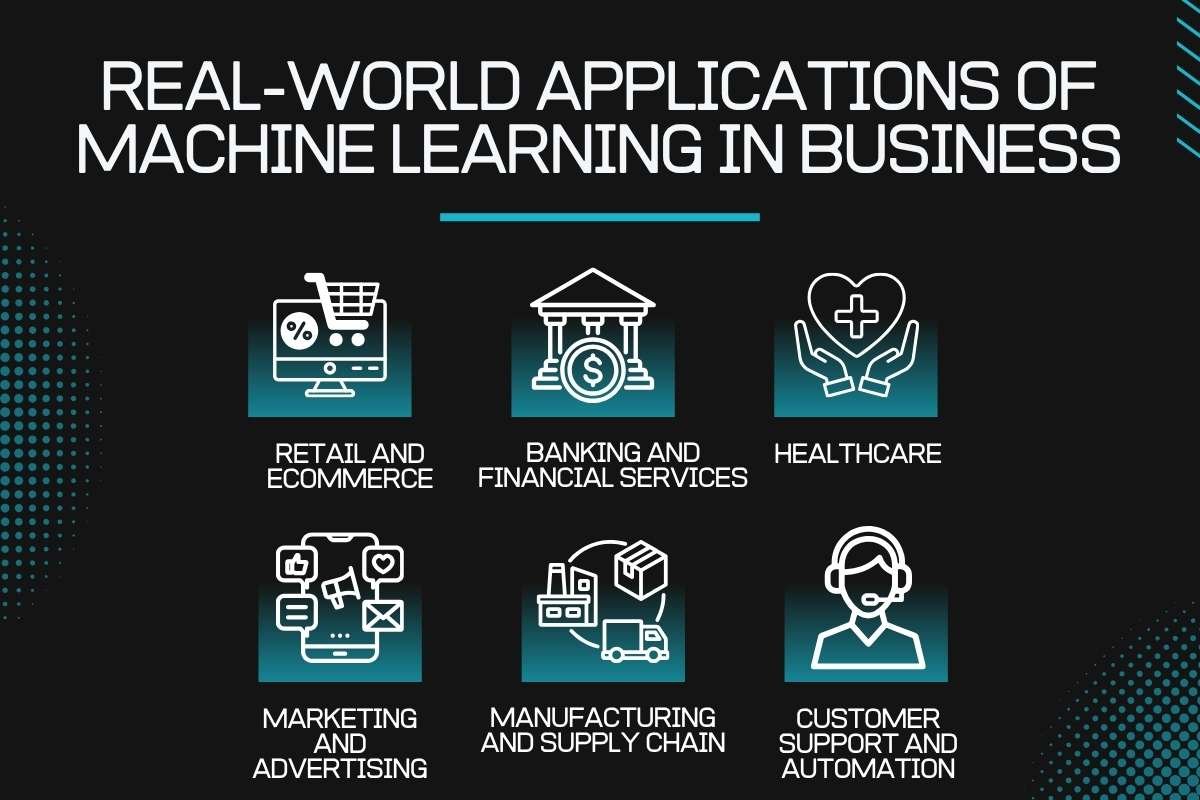
Machine learning is rapidly becoming a core business technology across industries. According to recent industry estimates, nearly 88% of organizations now use AI and machine learning in at least one business function, while global AI spending is expected to reach nearly $2.6 trillion in 2026.
From retail and finance to healthcare and manufacturing, businesses are using machine learning to improve efficiency, reduce costs, and deliver more personalized customer experiences.
1. Retail and ecommerce
Retailers use machine learning to analyze customer behavior, forecast demand, and personalize shopping experiences.
Key applications include:
- Product recommendation engines
- Dynamic pricing
- Inventory forecasting
For example, Amazon uses machine learning algorithms to recommend products based on browsing and purchase history, helping drive customer engagement and sales. Industry reports show that nearly 90% of retailers are already testing or using AI technologies in some capacity.
2. Banking and financial services
Financial institutions use machine learning to improve security, automate risk analysis, and detect fraud in real time.
Common use cases:
- Fraud detection
- Credit scoring
- Algorithmic trading
Machine learning models can identify suspicious transaction patterns within seconds, helping banks reduce financial fraud and improve compliance processes.
3. Healthcare
Healthcare organizations use machine learning to improve diagnostics, patient care, and operational efficiency.
Applications include:
- Disease prediction
- Medical image analysis
- Personalized treatment recommendations
AI-driven healthcare technologies are also becoming one of the fastest-growing segments in the global AI market, with strong projected growth over the next decade.
4. Marketing and advertising
Marketing has become increasingly data-driven with machine learning.
Businesses use it for:
- Customer segmentation
- Predictive analytics
- Personalized advertisements
Platforms like Google and Meta use machine learning algorithms to analyze user behavior and deliver highly targeted ads. Similarly, Netflix and Spotify rely heavily on recommendation systems to improve user engagement and retention.
5. Manufacturing and supply chain
Manufacturers use machine learning to optimize operations and reduce downtime.
Key benefits include:
- Predictive maintenance
- Supply chain forecasting
- Quality inspection automation
Predictive maintenance systems help companies identify equipment failures before they happen, reducing maintenance costs and operational disruptions.
6. Customer support and automation
Businesses are increasingly automating customer service using AI-powered chatbots and virtual assistants.
Machine learning helps with:
- 24/7 customer support
- Faster query resolution
- Automated responses
According to industry studies, businesses focusing on targeted AI implementation are already seeing measurable returns, with some organizations generating nearly $3 for every $1 invested in AI initiatives. As industries become increasingly data-driven, machine learning for business is evolving from a competitive advantage into a business necessity.
How businesses can successfully implement machine learning?
While machine learning offers massive growth potential, implementation success depends on strategy, data quality, and long-term scalability. Many businesses invest in AI tools, but only companies with clear objectives and structured execution achieve measurable results.
According to McKinsey & Company, organizations that strategically integrate AI into core business operations are significantly more likely to see revenue growth and operational efficiency gains. At the same time, studies show that poor data quality costs businesses millions of dollars annually, making data management one of the most critical factors in AI success.
Here are the key steps businesses should follow for successful machine learning implementation:
1. Define clear business goals
Businesses should first identify the exact problems machine learning can solve instead of adopting AI simply because it is trending.
| Why it matters | Aligns AI with business needs |
| Business Impact | Higher ROI and faster adoption |
Common business goals include:
- Reducing operational costs
- Improving customer experience
- Detecting fraud faster
Companies with focused AI strategies often achieve faster adoption and measurable returns.
2. Collect and organize high-quality data
Machine learning systems are only as effective as the data they receive. Inaccurate, outdated, or incomplete data can reduce prediction accuracy and create unreliable outcomes.
| Why it matters | Improves prediction accuracy |
| Business Impact | Better decision-making |
Businesses should focus on:
- Clean and structured datasets
- Real-time data collection
- Data security and compliance
Industry experts frequently describe data as the “new oil” powering AI-driven businesses.
3. Start with small pilot projects
Many successful companies begin with small AI pilot programs before scaling machine learning across departments.
| Why it matters | Reduces implementation risks |
| Business Impact | Easier scalability |
Popular pilot projects include:
- AI chatbots
- Recommendation engines
- Predictive sales forecasting
This approach helps businesses test performance, measure ROI, and minimize implementation risks.
4. Invest in the right tools and talent
Machine learning implementation requires both advanced technology and skilled professionals.
| Why it matters | Ensures proper AI deployment |
| Business Impact | Stronger innovation |
Businesses commonly invest in:
- Cloud-based AI platforms
- Data scientists and ML engineers
- Automation tools
According to industry reports, demand for AI and machine learning specialists has grown rapidly as businesses accelerate digital transformation initiatives.
5. Continuously monitor and improve AI models
Machine learning models require continuous updates to maintain accuracy and efficiency.
| Why it matters | Prevents outdated predictions |
| Business Impact | Long-term performance |
Businesses should regularly:
- Monitor prediction accuracy
- Remove biased data
- Update algorithms
Without regular optimization, AI systems can become outdated and less reliable over time.
6. Prioritize ethical and responsible AI
As AI adoption grows, businesses are facing increasing pressure to ensure transparency, fairness, and data privacy.
| Why it matters | Builds customer trust |
| Business Impact | Reduces compliance risks |
Key considerations include:
- Ethical AI governance
- Customer data protection
- Regulatory compliance
Companies that prioritize responsible AI implementation are more likely to build long-term customer trust and reduce reputational risks.
As competition becomes increasingly data-driven, businesses that implement machine learning strategically are gaining advantages in automation, operational efficiency, customer engagement, and innovation.
Challenges of using machine learning for business

Despite its growing adoption, implementing machine learning is not without challenges. While businesses are investing billions into AI-driven technologies, many organizations still struggle with data quality, infrastructure limitations, talent shortages, and ethical concerns.
According to industry studies, one of the biggest barriers to AI success is poor data management. Even advanced machine learning systems can produce inaccurate results if they are trained on incomplete, biased, or low-quality data.
1. Poor data quality
Machine learning models depend heavily on accurate and structured data. If businesses use outdated, incomplete, or inconsistent datasets, prediction accuracy can decline significantly.
Common data-related issues include:
- Duplicate records
- Missing information
- Unstructured datasets
Poor-quality data can lead to flawed business decisions and reduced AI performance.
2. High implementation costs
Building machine learning systems often requires major investments in:
- Cloud infrastructure
- AI software platforms
- Data storage systems
For small and medium-sized businesses, these costs can become a major barrier to adoption.
3. Shortage of skilled AI professionals
The demand for AI talent continues to grow globally, but many businesses struggle to hire experienced:
- Data scientists
- Machine learning engineers
- AI specialists
This talent gap can slow implementation and increase project costs.
4. Data privacy and security risks
As machine learning systems process massive volumes of customer and business data, privacy concerns are becoming increasingly important.
Businesses must ensure:
- Secure data storage
- Compliance with privacy regulations
- Protection against cyber threats
Failure to protect sensitive data can lead to financial penalties and reputational damage.
5. Bias in machine learning models
Machine learning systems can sometimes produce biased outcomes if they are trained on biased datasets.
This can impact areas such as:
- Hiring decisions
- Loan approvals
- Customer targeting
Businesses must regularly monitor AI systems to ensure fairness and accuracy.
6. Integration with legacy systems
Many organizations still rely on outdated software and infrastructure that may not easily support AI technologies.
Common integration challenges include:
- Compatibility issues
- Slow system performance
- Complex data migration
This often delays AI implementation across large enterprises.
7. Continuous monitoring and maintenance
Machine learning models are not “set-and-forget” systems. They require ongoing updates to maintain performance and adapt to changing business environments.
Businesses must continuously:
- Retrain models
- Monitor prediction accuracy
- Update datasets
Without regular maintenance, AI systems can become less effective over time.
Despite these challenges, businesses that overcome implementation barriers are gaining significant advantages in efficiency, automation, customer experience, and long-term innovation.
Future of machine learning for business

Machine learning is rapidly becoming one of the most important technologies shaping the future of business. As companies generate larger volumes of data every day, businesses are increasingly using AI-driven systems to automate operations, improve customer experiences, and make faster decisions.
According to industry reports, global AI spending is expected to cross $2.59 trillion by 2026 as organizations continue investing in automation, predictive analytics, and intelligent business solutions. From startups to global enterprises, businesses are now treating machine learning as a long-term growth strategy rather than just a technology trend.
Here are the five biggest trends shaping the future of machine learning for business:
1. Hyper-personalized customer experiences
Businesses are using machine learning to understand customer behavior in real time and deliver highly personalized experiences.
Examples include:
- Product recommendations on Amazon
- Personalized playlists on Spotify
- Content suggestions on Netflix
Studies show that personalized experiences can significantly improve customer engagement and retention rates.
2. Faster business automation
Machine learning is expected to automate more business operations in the coming years, helping companies reduce manual work and improve efficiency.
Businesses are automating:
- Customer support
- Inventory management
- Fraud detection
This allows employees to focus more on strategic and creative tasks instead of repetitive processes.
3. Rise of generative AI
Generative AI tools are transforming how businesses create content, analyze data, and interact with customers.
Companies are increasingly using AI for:
- Content generation
- Business reporting
- AI chatbots
This trend is expected to accelerate as businesses integrate AI into daily operations.
4. Smarter predictive analytics
Machine learning is helping businesses predict customer behavior, market trends, and operational risks more accurately.
Industries using predictive analytics include: Retail, Finance, Healthcare, Manufacturing, Logistics
Businesses that use predictive insights can often make faster and more informed decisions than competitors.
5. Ethical and responsible AI
As AI adoption grows, businesses are facing increasing pressure to use machine learning responsibly.
Companies are now focusing on:
- Data privacy
- AI transparency
- Bias reduction
Businesses that prioritize responsible AI practices are more likely to build long-term customer trust and brand credibility.
As industries become increasingly data-driven, machine learning for business is expected to become a core part of modern business strategy, innovation, and competitive growth.
Conclusion:
Machine learning is rapidly transforming how businesses operate, helping companies automate processes, improve customer experiences, reduce costs, and make faster data-driven decisions. From predictive analytics and fraud detection to personalized recommendations, businesses across industries are already using AI to gain a competitive edge.
As global AI adoption continues to grow, machine learning for business is becoming more than just a technology trend, it is now a key driver of innovation, efficiency, and long-term growth. Companies that invest in intelligent, ethical, and data-driven AI strategies today are likely to lead the future business landscape.
FAQs
-
What is machine learning for business?
It is the use of AI systems that analyze business data, identify patterns, and make predictions to improve decisions, efficiency, and customer experience.
-
How is machine learning used in businesses?
It is used for recommendations, fraud detection, customer support automation, predictive analytics, marketing, and demand forecasting.
-
Which industries use machine learning the most?
Retail, banking, healthcare, manufacturing, logistics, and digital media industries rely heavily on machine learning.
-
What are the main challenges of machine learning in business?
Key challenges include poor data quality, high costs, talent shortage, privacy risks, and system integration issues.
-
What is the future of machine learning for business?
It will focus on smarter automation, predictive insights, hyper-personalization, generative AI, and ethical AI adoption.