
Business Growth Consulting helps companies improve profitability, scale operations, and adapt to changing market conditions through data-driven strategies and expert guidance. From startups to large enterprises, businesses use growth consulting to strengthen customer retention, optimize efficiency, identify expansion opportunities, and build sustainable long-term success in an increasingly competitive business landscape.
Why do some businesses scale rapidly while others struggle to survive despite having great products or services? The answer often lies in strategy. Nearly 20% of small businesses fail within their first year, and almost 50% shut down within five years, showing that growth today requires far more than just strong sales. In an increasingly competitive and fast-changing market, businesses need the right direction, efficient operations, and smart decision-making to grow sustainably.
This is where Business Growth Consulting has become a powerful advantage for modern companies. From startups to established enterprises, businesses are leveraging growth consultants to identify new opportunities, improve profitability, streamline operations, and build scalable strategies. With the global consulting industry valued at over $300 billion, the demand for expert-led business transformation is rising rapidly. By combining data, market insights, and strategic execution, business growth consulting helps companies reduce costly mistakes and accelerate long-term growth.
What is business growth consulting?
Business Growth Consulting is a strategic service that helps companies improve performance, increase revenue, and scale sustainably. Unlike traditional consulting, which often focuses on solving a single business problem, growth consulting takes a broader approach by identifying opportunities across operations, marketing, sales, finance, and customer experience to drive long-term business expansion.
A business growth consultant works closely with organizations to analyze current challenges, market trends, customer behavior, and growth potential. Based on these insights, they create customized strategies that help businesses improve efficiency, strengthen their market position, and achieve measurable results. Whether it is helping a startup scale faster, improving customer retention for an established brand, or guiding a company through digital transformation, growth consultants focus on building strategies that support sustainable success.
As industries become more competitive and consumer expectations continue to evolve, businesses are increasingly relying on data-driven consulting to stay ahead. This is one of the key reasons why Business Growth Consulting has become an essential investment for companies looking to grow smarter, adapt faster, and remain competitive in a rapidly changing business environment.
Why is business growth consulting important?

In today’s fast-changing business landscape, sustainable growth requires far more than just increasing sales. Rising competition, changing customer expectations, and rapid digital transformation have made it difficult for businesses to scale efficiently. Research shows that companies with a well-defined growth strategy are more likely to outperform competitors in profitability and long-term stability. This is why Business Growth Consulting has become essential for modern businesses.
Many organizations struggle with stagnant revenue, operational inefficiencies, poor customer retention, and unclear expansion strategies. Business growth consultants help identify these challenges and create data-driven solutions that improve performance and scalability. By bringing industry expertise and an outside perspective, consultants help businesses uncover opportunities they often overlook internally.
Some of the key reasons why Business Growth Consulting is important include:
Improving revenue growth through strategic planning
- Identifying new market and expansion opportunities
- Enhancing operational efficiency and productivity
- Strengthening customer acquisition and retention strategies
- Reducing costly business mistakes and risks
- Supporting digital transformation and innovation
As industries continue to evolve, businesses that fail to innovate and scale strategically risk falling behind. Business growth consulting helps companies stay competitive by combining market insights, performance analysis, and practical execution strategies that support long-term success.
Key benefits of business growth consulting
One of the biggest advantages of Business Growth Consulting is that it helps companies move from reactive decision-making to strategic growth planning. Instead of relying on trial and error, businesses gain access to expert insights, proven frameworks, and data-driven strategies that improve overall performance and long-term scalability.
As markets become more competitive, companies that invest in strategic consulting often gain a stronger advantage in areas such as revenue growth, operational efficiency, and customer retention. Growth consultants not only identify problems but also create actionable solutions tailored to a company’s goals, industry, and market conditions.
Some of the major benefits of Business Growth Consulting include:
- Accelerated revenue growth through targeted business strategies
- Better operational efficiency by identifying process gaps and inefficiencies
- Improved customer acquisition and retention strategies
- Stronger brand positioning in competitive markets
- Smarter decision-making backed by market research and business analytics
- Increased scalability through structured growth planning
- Enhanced adaptability to market trends and industry changes
- Reduced financial and operational risks through expert guidance
Another major benefit is the ability to save time and resources. Many businesses spend years experimenting with strategies that may not deliver results. Growth consultants help companies focus on what works by using industry expertise, performance analysis, and proven growth models. This allows businesses to scale faster, improve profitability, and build a more sustainable foundation for long-term success.
Core business growth consulting services
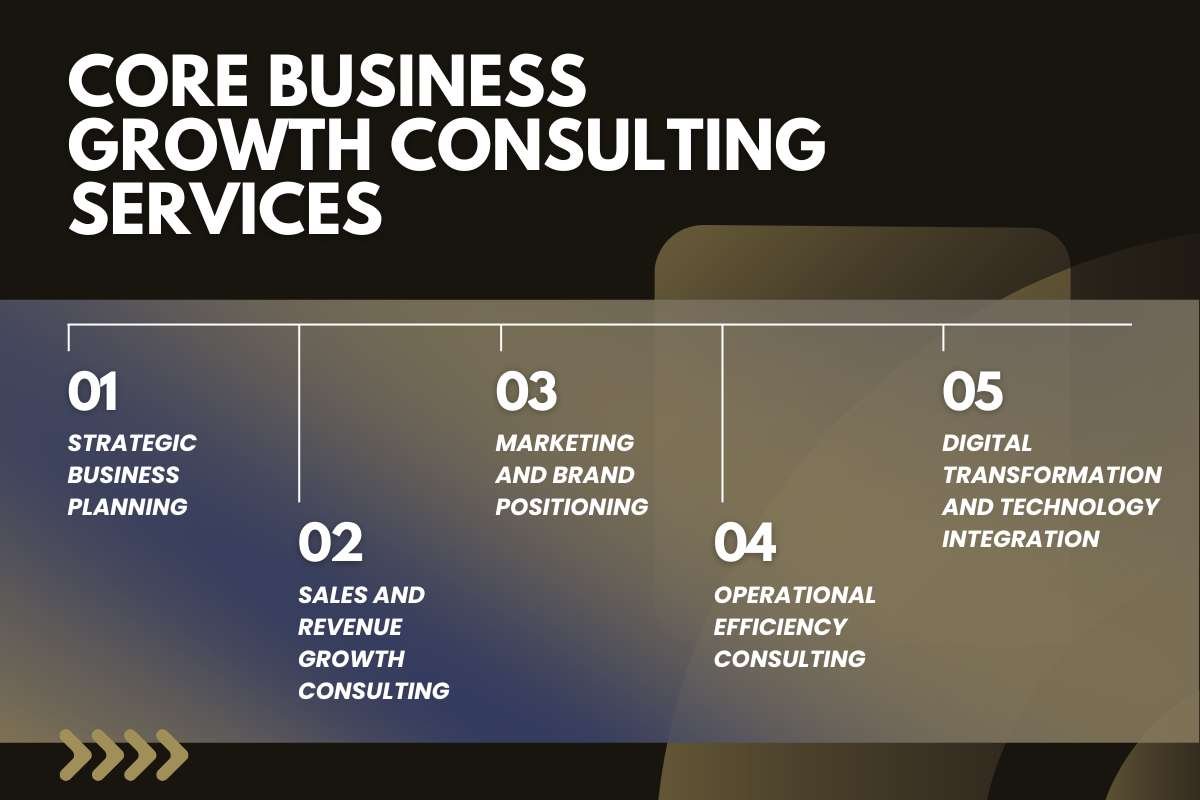
Business Growth Consulting covers a wide range of services designed to help companies improve performance, increase profitability, and scale sustainably. Since every business faces different challenges, growth consultants create customized strategies based on industry trends, business goals, customer behavior, and operational needs.
From improving sales performance to optimizing internal processes, these services focus on building a strong foundation for long-term growth rather than short-term gains.
1. Strategic business planning
A clear strategy is essential for sustainable growth. Consultants help businesses define long-term goals, identify growth opportunities, analyze competitors, and create actionable roadmaps that align with market demands and business objectives.
2. Sales and revenue growth consulting
Many businesses struggle with inconsistent revenue and declining conversions. Growth consultants analyze sales processes, customer journeys, and pricing strategies to improve lead generation, conversion rates, and overall profitability.
3. Marketing and brand positioning
Strong branding and effective marketing are critical for business expansion. Consultants help businesses improve market positioning, strengthen brand identity, optimize digital marketing strategies, and target the right customer segments more effectively.
4. Operational efficiency consulting
Operational inefficiencies can slow growth and increase costs. Business growth consultants identify workflow gaps, improve resource allocation, streamline processes, and help organizations increase productivity without compromising quality.
5. Digital transformation and technology integration
As businesses become more technology-driven, digital transformation has become a major growth factor. Consultants help companies adopt automation, AI tools, data analytics, and digital systems that improve efficiency, customer experience, and scalability.
By combining strategy, operations, marketing, and financial planning, Business Growth Consulting helps organizations build a scalable growth model that supports long-term business success.
Best business growth consulting strategies
Successful business growth is rarely accidental. Companies that scale consistently often follow structured, data-driven strategies that help them adapt to market changes, improve customer relationships, and increase operational efficiency. This is where Business Growth Consulting plays a critical role by helping organizations implement strategies that deliver measurable and sustainable results.
While every business has different goals and challenges, some growth strategies have proven highly effective across industries.
1. Market expansion strategies
One of the most common growth approaches is expanding into new markets. This may include targeting new customer segments, entering different geographic regions, or launching products for a wider audience. Growth consultants conduct market research and competitive analysis to identify expansion opportunities with the highest growth potential.
2. Customer retention and loyalty strategies
Acquiring new customers is important, but retaining existing customers is often more profitable. Studies show that increasing customer retention can significantly improve profitability. Consultants help businesses strengthen customer experience, improve engagement, and build loyalty programs that increase long-term customer value.
3. Data-driven decision-making
Modern businesses generate massive amounts of data, but many fail to use it effectively. Growth consultants use business analytics, customer insights, and performance metrics to help organizations make smarter and faster decisions backed by real data rather than assumptions.
4. Process automation and operational optimization
Inefficient processes can slow down growth and increase operational costs. Consultants help businesses adopt automation tools, optimize workflows, and improve resource management to increase productivity and scalability.
5. Strategic partnerships and collaborations
Collaborations can accelerate business growth by expanding reach, improving credibility, and creating new revenue opportunities. Growth consultants help businesses identify strategic partnerships that align with their long-term goals.
By implementing the right combination of these strategies, businesses can strengthen their competitive position, improve profitability, and achieve sustainable long-term growth in an increasingly dynamic market.
What are the 4 business growth strategies?
Businesses looking to scale successfully often rely on proven growth models that help them expand revenue, increase market share, and strengthen long-term sustainability. Among the most widely used frameworks are the four core business growth strategies that organizations across industries use to accelerate expansion while managing risk effectively.
These strategies help businesses identify the best path for growth based on their products, customers, and target markets.
1. Market penetration
Market penetration focuses on increasing sales of existing products or services within the current market. Businesses achieve this through stronger marketing campaigns, competitive pricing, improved customer retention, and higher brand visibility. Since it targets existing customers and markets, it is often considered one of the lowest-risk growth strategies.
2. Market development
This strategy involves entering new markets with existing products or services. Businesses may target different geographic regions, customer segments, or industries to expand their reach. Growth consultants help companies evaluate market demand, competition, and scalability before expansion.
3. Product development
Product development focuses on introducing new products or improving existing offerings to meet changing customer needs. Businesses that continuously innovate are more likely to maintain a competitive advantage and improve customer loyalty in evolving markets.
4. Diversification
Diversification is considered one of the highest-risk but potentially highest-reward growth strategies. It involves entering entirely new markets with new products or services. Many companies use diversification to reduce dependency on a single revenue stream and create long-term business stability.
These four strategies provide businesses with a structured framework for sustainable expansion. Business growth consultants help organizations choose the right strategy based on market conditions, operational capabilities, and long-term business objectives.
What are the 7 stages of business growth?
Every business goes through different stages of growth, and each stage comes with its own challenges, opportunities, and strategic priorities. Understanding these stages helps businesses make smarter decisions and prepare for long-term scalability. This is one of the key areas where Business Growth Consulting becomes valuable, as consultants help organizations navigate each phase more effectively.
- Idea and Development Stage: This is the earliest stage where a business idea is developed and tested. Companies focus on market research, product validation, and building a business model that solves a real customer problem.
- Startup Stage: At this stage, businesses officially launch their products or services and begin acquiring customers. The primary focus is on building brand awareness, generating revenue, and establishing a market presence.
- Survival Stage: Many businesses struggle during this phase because of cash flow issues, rising competition, and operational challenges. Companies must focus on improving efficiency, customer retention, and financial stability to survive.
- Growth Stage: Once a business gains stability, the focus shifts toward scaling operations, increasing revenue, and expanding customer reach. Businesses often invest in hiring, technology, and marketing during this phase.
- Expansion Stage: In this stage, businesses explore new markets, diversify products or services, and strengthen operational capabilities. Strategic planning becomes critical to manage rapid expansion effectively.
- Maturity Stage: At maturity, businesses achieve stable revenue and a strong market position. The challenge here is maintaining innovation, improving efficiency, and staying competitive in evolving markets.
- Renewal or Exit Stage: Businesses eventually reach a stage where they either reinvent themselves through innovation and transformation or prepare for acquisition, merger, or exit strategies. Companies that fail to adapt during this stage often face decline.
Each growth stage requires different strategies, leadership decisions, and operational priorities. Business growth consultants help organizations identify where they stand and implement the right strategies to move successfully into the next phase of growth.
Real-world business growth consulting examples

The impact of Business Growth Consulting can be seen across industries, from startups and retail brands to manufacturing companies and SaaS businesses. As competition increases and markets evolve faster, companies are relying more on data-driven consulting to improve scalability, profitability, and operational efficiency. In fact, the global consulting industry is now valued at more than $380 billion and is projected to grow significantly in the coming years, reflecting the rising demand for strategic business transformation.
1. Startup scaling through digital strategy
Many startups struggle to survive beyond their early growth phase. Research shows that nearly 45% of businesses fail within their first five years, often due to poor planning, cash flow issues, and lack of market adaptability. Growth consultants help startups overcome these challenges by improving customer acquisition, refining business models, and implementing scalable growth strategies. Businesses with structured planning and data-driven decision-making are significantly more likely to achieve long-term sustainability.
2. Retail businesses improving customer retention
Retail companies increasingly use business growth consulting to improve customer retention and profitability. Studies consistently show that retaining existing customers is more cost-effective than acquiring new ones. Consultants analyze customer behavior, purchasing trends, and sales data to create loyalty programs, optimize pricing strategies, and improve customer experience, leading to stronger long-term revenue growth.
3. Manufacturing companies optimizing operations
Manufacturing businesses often face operational inefficiencies, rising production costs, and supply chain challenges. Growth consultants help companies streamline workflows, improve inventory management, and adopt automation technologies that increase productivity while reducing operational costs. Businesses that improve operational efficiency are often better positioned to scale sustainably in competitive industries.
4. SaaS companies expanding into new markets
SaaS and technology companies frequently rely on growth consulting to support rapid expansion. Consultants help these businesses improve subscription models, strengthen customer onboarding, optimize pricing strategies, and identify high-growth markets. AI-driven consulting has also become a major trend, with many consulting firms now using automation and advanced analytics to deliver faster and more measurable business outcomes.
The value of consulting is increasingly backed by measurable business impact. Research highlighted by the Financial Times found that companies using consulting services experienced a 3.6% increase in labor productivity over five years, demonstrating how strategic consulting can contribute to long-term business performance.
Many global consulting firms have built their reputation around helping organizations achieve large-scale business transformation, including:
- McKinsey & Company
- Boston Consulting Group
- Deloitte
These examples show how Business Growth Consulting helps organizations adapt to changing markets, reduce costly mistakes, and build scalable strategies that support sustainable long-term growth.
How much should I pay for a business consultant?
The cost of hiring a Business Growth Consultant can vary significantly depending on factors such as experience, industry expertise, project scope, and business size. While some consultants charge hourly rates, others work on project-based pricing or long-term retainer models.
On average, small business consultants may charge anywhere between $50 to $300 per hour, while highly experienced strategy or growth consultants can charge $75 to $500 per hour or more. Large consulting firms often price projects in the thousands or even millions of dollars depending on complexity and business scale.
Several factors influence consulting fees, including:
- Industry specialization and expertise
- Business size and growth stage
- Scope and duration of the project
- Complexity of business challenges
- Consultant reputation and track record
- Geographic location and market demand
Common Business Consulting Pricing Models
- Hourly Pricing: This is one of the most common pricing models for short-term consulting projects or advisory sessions. Businesses typically pay based on the consultant’s time and expertise.
- Project-Based Pricing: For specific goals such as market expansion, operational optimization, or digital transformation, consultants may charge a fixed project fee based on deliverables and expected outcomes.
- Monthly Retainer Model: Many businesses prefer long-term consulting support through monthly retainers. This model provides ongoing strategic guidance, performance tracking, and operational support.
- Performance-Based Pricing: In some cases, consultants charge based on measurable business results such as revenue growth, lead generation, or operational improvements. This model is more common in sales and growth-focused consulting.
While consulting costs may seem high initially, businesses often view them as strategic investments rather than expenses. A skilled growth consultant can help companies improve profitability, reduce inefficiencies, and avoid costly mistakes, ultimately delivering a strong return on investment over time.
What is the minimum salary of a consultant?
The salary of a business consultant can vary widely based on experience, specialization, industry, and geographic location. Entry-level consultants typically earn lower salaries while experienced consultants working in high-demand sectors such as strategy, AI, finance, or digital transformation can earn significantly more.
On average, the minimum salary of a consultant in many entry-level roles ranges between $50,000 and $70,000 per year globally. In countries like India, fresh consultants may start with annual salaries ranging from ₹4 lakh to ₹8 lakh depending on the company, skill set, and industry exposure. Graduates entering top consulting firms often receive higher compensation packages along with bonuses and performance incentives.
Several factors influence a consultant’s salary, including:
- Educational background and certifications
- Industry specialization and technical expertise
- Years of business or consulting experience
- Company size and consulting firm reputation
- Geographic location and market demand
- Communication, leadership, and analytical skills
Consultants with expertise in business growth, AI implementation, financial strategy, and digital transformation are currently among the highest in demand. As businesses continue investing in operational efficiency and scalable growth strategies, consulting remains one of the most lucrative and fast-growing professional career paths globally.
What is the highest-paid type of consultant?
The consulting industry includes a wide range of specializations, but some consulting fields consistently offer significantly higher salaries because of their impact on business performance, profitability, and digital transformation. As industries become more technology-driven and competitive, consultants with specialized expertise are commanding premium compensation globally.
1. Strategy consultants
Strategy consultants are among the highest-paid professionals in the consulting industry. They help businesses solve complex challenges related to market expansion, profitability, mergers, and long-term growth planning. Top global firms such as McKinsey, BCG, and Bain are known for offering highly competitive compensation packages to strategy consultants.
2. AI and digital transformation consultants
With businesses rapidly adopting artificial intelligence, automation, and digital technologies, AI consultants have become one of the most in-demand consulting professionals. These consultants help organizations improve efficiency, automate operations, and implement data-driven business models.
3. Financial consultants
Financial consultants advise businesses on investment planning, risk management, profitability improvement, and financial restructuring. Companies often rely on financial consultants during expansion, acquisitions, or economic uncertainty, making this one of the highest-paying consulting specializations.
4. Healthcare consultants
Healthcare consultants work with hospitals, pharmaceutical companies, and healthcare organizations to improve operational efficiency, regulatory compliance, and patient experience. The growing healthcare industry has increased demand for specialized consulting expertise worldwide.
5. IT and cybersecurity consultants
As cyber threats continue to rise, businesses are heavily investing in cybersecurity and IT infrastructure. Consultants in cloud computing, cybersecurity, and enterprise technology transformation are among the highest-paid experts in the consulting sector.
Several factors contribute to higher consultant salaries, including specialized expertise, business impact, global demand, and the ability to solve high-value business problems. Consultants who combine industry knowledge with data-driven decision-making and digital skills often achieve the highest earning potential in the modern consulting landscape.
Do business consultants make a lot of money?

Business consulting is widely considered one of the most lucrative professional career paths, especially for consultants with strong industry expertise and proven business results. As companies continue investing in growth, digital transformation, and operational efficiency, the demand for skilled consultants has increased significantly across industries.
Experienced business consultants can earn substantial incomes through consulting fees, retainers, performance-based projects, and long-term corporate partnerships. According to industry estimates, senior consultants at top global firms can earn six-figure salaries, while independent consultants often scale their income based on niche expertise and client portfolio.
Several factors influence how much a business consultant can earn:
- Industry specialization and demand
- Years of consulting and business experience
- Reputation and track record of results
- Client size and project complexity
- Geographic market and consulting niche
- Ability to generate measurable business growth
Consultants specializing in strategy, AI, digital transformation, finance, and business growth often command some of the highest fees because businesses directly associate their work with revenue generation and long-term profitability.
Another major advantage of consulting is scalability. Unlike traditional jobs with fixed salaries, consultants can increase earnings by working with multiple clients, building consulting agencies, offering online advisory services, or developing specialized business solutions. Many successful consultants also generate income through workshops, courses, public speaking, and corporate training programs.
However, high earnings in consulting usually come with strong competition, continuous learning, and the ability to consistently deliver measurable results. Businesses are willing to pay premium fees to consultants who can solve critical problems, improve efficiency, and accelerate growth in a rapidly evolving market.
Conclusion:
In today’s competitive market, sustainable growth requires more than just increasing sales. Businesses need the right strategy, operational efficiency, and adaptability to scale successfully. This is where Business Growth Consulting plays a critical role by helping companies improve profitability, identify growth opportunities, and build scalable business models.
From startups to large enterprises, organizations are increasingly relying on growth consultants to make smarter decisions, reduce risks, and stay competitive in a rapidly evolving market. As technology and customer expectations continue to change, businesses that focus on strategic growth and innovation are more likely to achieve long-term success.
1. What is Business Growth Consulting?
It is a consulting service that helps businesses improve revenue, scalability, and long-term growth strategies.
2. Why do businesses hire growth consultants?
Businesses hire growth consultants to improve efficiency, identify opportunities, and increase profitability.
3. How much do business consultants charge?
Consulting fees vary based on experience, industry, and project scope.
4. Can startups benefit from business growth consulting?
Yes, startups use growth consulting to scale faster, improve operations, and attract customers.
5. Which industries use business growth consulting?
Industries like technology, retail, healthcare, finance, and manufacturing commonly use growth consulting.