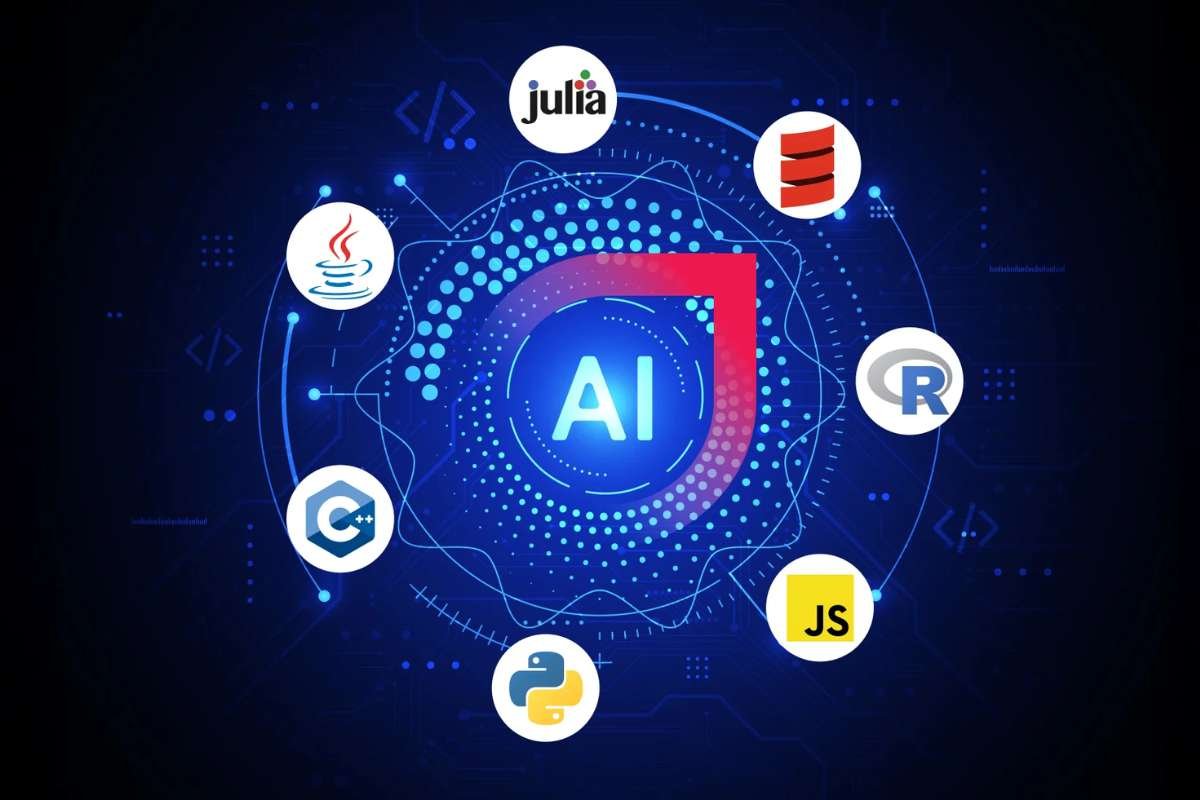
Artificial intelligence is growing fast, and choosing the right programming language can make AI development easier and more effective. This guide compares the 12 best Programming Languages for AI in 2026, including their strengths, use cases, and key benefits. Whether you’re a beginner or an experienced developer, you’ll learn which language best fits your AI projects.
Artificial intelligence is changing how businesses work, create products, and solve problems. From chatbots and virtual assistants to medical tools and self-driving cars, AI is now part of everyday life. As it grows, choosing the right programming languages for AI has become more important than ever.
Not every language is built for the same task. Some are great for training machine learning models, while others work better for fast applications, large datasets, or AI running on mobile devices. Understanding the strengths of different Programming Languages can help you choose the best one for your next project.
Here are the 12 best programming languages for AI and where each one shines.
1. Python
Python continues to lead the list of Programming Languages for AI because it is easy to learn, flexible, and backed by one of the largest developer communities in the world. Most modern AI frameworks are built around Python, making it one of the most apt choices for beginners as well as professionals.
Popular AI libraries include:
- TensorFlow
- PyTorch
- Scikit-learn
- Keras
- Hugging Face Transformers
- JAX
What is Python used for in AI?
Python is widely used to build machine learning models, large language models (LLMs), chatbots, recommendation systems, computer vision tools, speech recognition software, and AI agents. It is also the leading language for generative AI development.
2. C++
C++ ranks high because of its speed and performance. While Python is often used to develop AI models, C++ is commonly used behind the scenes to make those models run faster. Many AI frameworks include C++ components to improve performance.
What is C++ used for in AI?
C++ is used in robotics, autonomous vehicles, computer vision, game AI, edge AI, and real-time decision-making systems. It is ideal when speed and low memory usage are critical.
3. Java
Java remains one of the most trusted Programming Languages for AI in large organizations. Its stability, security, and scalability make it a strong choice for enterprise AI applications.
Java also supports popular machine learning libraries such as DeepLearning4J and Weka.
What is Java used for in AI?
Java is used to build AI-powered business software, fraud detection systems, customer service platforms, recommendation engines, and cybersecurity solutions.
4. JavaScript
JavaScript has become more relevant in AI over the past few years. With frameworks like TensorFlow.js, developers can train and run machine learning models directly inside a web browser without relying on a server.
What is JavaScript used for in AI?
JavaScript is used for AI-powered websites, browser-based machine learning, smart chatbots, image recognition, voice assistants, and real-time data visualization.
5. Julia
Julia continues to gain popularity because it combines simple syntax with excellent speed. It is designed for scientific computing and can handle large datasets and complex mathematical operations with ease.
As more researchers work with larger AI models, Programming Languages for AI, like Julia, are becoming more valuable for high-performance computing.
What is Julia used for in AI?
Julia is used for machine learning research, scientific computing, mathematical modeling, optimization, and deep learning projects that require fast numerical calculations.
6. Rust

Rust is one of the fastest-growing programming languages in modern software development. Its focus on memory safety and high performance makes it attractive for AI infrastructure and production systems.
Many companies like Cloudflare and OpenAI are now using Rust to build secure AI services and improve the performance of AI applications.
What is Rust used for in AI?
Rust is used for AI infrastructure, inference engines, edge AI, robotics, and cloud-based AI services where reliability and performance matter.
According to the Stack Overflow Developer Survey 2025, Rust continues to rank among the most admired programming languages, reflecting its growing adoption in high-performance software development, including AI infrastructure.
7. R
R remains one of the most useful Programming Languages for AI when a project depends on statistics, data analysis, and visualization. Although Python is more common for production AI systems, R is still widely used by researchers, universities, healthcare organizations, and financial analysts.
Popular AI and machine learning packages include:
- caret
- randomForest
- xgboost
- tidyverse
What is R used for in AI?
R is mainly used for predictive analytics, statistical modeling, data mining, machine learning research, and creating detailed data visualizations.
8. Go (Golang)
Go has become a popular choice for building cloud-based AI services because it is simple, fast, and supports concurrency. While it is not used to train most AI models, it is excellent for deploying and managing AI applications at scale.
What is Go used for in AI?
Go is used for AI APIs, backend services, cloud platforms, microservices, and distributed AI systems that need high performance and reliability.
9. Scala
Scala combines object-oriented and functional programming, making it a strong choice for big data and AI projects. It works closely with Apache Spark, which many organizations use to process massive datasets.
Many organizations choose Scala for AI projects that involve large-scale data processing.
What is Scala used for in AI?
Scala is used for big data analytics, machine learning pipelines, recommendation systems, and enterprise AI applications that process large datasets.
According to the Stanford AI Index Report 2026, enterprise investment in AI continues to grow as organizations expand the use of AI across business operations, increasing demand for scalable data and machine learning platforms.
10. Swift
Swift is Apple’s programming language for iOS, macOS, watchOS, and visionOS. Thanks to Apple’s Core ML framework, developers can build AI features that run directly on Apple devices without sending data to the cloud.
What is Swift used for in AI?
Swift is used for voice assistants, image recognition, text prediction, language translation, and other AI-powered features in Apple applications.
11. Lisp
Lisp has played an important role in artificial intelligence since the early days of AI research. Although it is no longer widely used in commercial software, it remains valuable for symbolic AI and academic research.
What is Lisp used for in AI?
Lisp is used for symbolic reasoning, expert systems, knowledge representation, and AI research that involves complex logical relationships.
12. Prolog
Prolog is different from most programming languages because it is based on logic rather than step-by-step instructions. It remains useful for solving rule-based problems where reasoning is more important than speed.
What is Prolog used for in AI?
Prolog is used for expert systems, knowledge-based applications, natural language processing, automated reasoning, and intelligent decision-making systems.
Conclusion
Choosing the right Programming Languages for AI depends on what you want to build. Python remains the industry leader because of its simple syntax, rich ecosystem, and unmatched library support. At the same time, languages like C++, Java, JavaScript, Julia, Rust, Go, R, Scala, Swift, Lisp, and Prolog all offer unique strengths for different AI applications.
No single language is perfect for every AI project. The best choice depends on your goals, the AI tools you plan to use, and the performance your application requires.
The TIOBE Programming Community Index (2026) continues to rank Python as the world’s most popular programming language, reflecting its widespread use across AI, machine learning, automation, and data science.
FAQs
1. Will AI replace coding jobs?
AI is changing how software is built, but it is not replacing programmers. Instead, AI helps developers write code faster, test applications, and find bugs. Human developers are still needed to design systems, solve complex problems, and maintain AI applications.
2. How do you choose the right programming language for AI?
Choosing the right programming language for AI depends on your project goals. Consider these factors before making a decision:
Type of AI project
1. Performance requirements
2. Available AI libraries
3. Community support
4. Ease of learning
5. Scalability
6. Deployment platform
Python is often the best starting point, while languages like C++, Rust, and Go are better for performance-focused applications.
3. Which coding language is best for AI?
Python remains the best overall choice because it offers the largest collection of AI frameworks, simple syntax, and strong community support. However, other Programming Languages for AI, like C++, Java, Julia, Rust, and JavaScript, are better suited for certain tasks.
4. Which programming language is best for generative AI?
Python is the leading language for generative AI because frameworks such as PyTorch, TensorFlow, Hugging Face Transformers, LangChain, and JAX are primarily built for Python. Most large language models (LLMs) are also developed and deployed using Python-based tools.