A fitness tracker once answered one simple question: How many steps did you take today? In 2026, Active Tracker Watches can monitor workouts, heart rate, sleep, recovery, location, and daily movement, with newer models using AI for more personalized insights.
Counterpoint Research reports that edge-AI-capable smartwatches made up 25% of global smartwatch shipments in Q1 2026, up 70% year over year. IDC also recorded 145.7 million wearable shipments during the quarter, showing continued demand for smarter health and fitness tracking.
The question now is not which tracker has the most features, but which device offers the right data, useful insights, privacy, and battery life for your lifestyle.
What are active tracker watches?
Active tracker watches are wearable devices that monitor physical activity, fitness, and selected health and wellness metrics.
Depending on the device, sensors can include:
- Accelerometers for movement
- Gyroscopes for motion and orientation
- Optical sensors for heart rate
- GPS for outdoor positioning
- Temperature sensors
- Altimeters or barometers
- Blood oxygen sensors
- Electrical sensors for certain heart-related measurements
Basic fitness bands may focus on steps, calories, heart rate, sleep, and workouts. More advanced watches can add GPS, training-load measurements, recovery scores, safety features, advanced sleep analysis, and broader smartwatch capabilities.
One important distinction remains: wearable health data is not automatically medical data. Many consumer devices explicitly state that their wellness measurements are not intended to diagnose or treat medical conditions. Xiaomi, for example, makes this qualification for its Smart Band 10, while Fitbit similarly limits several measurements to wellness purposes.
That distinction should shape how consumers interpret tracker results and how businesses use wearable data.
How fitness tracker technology has evolved
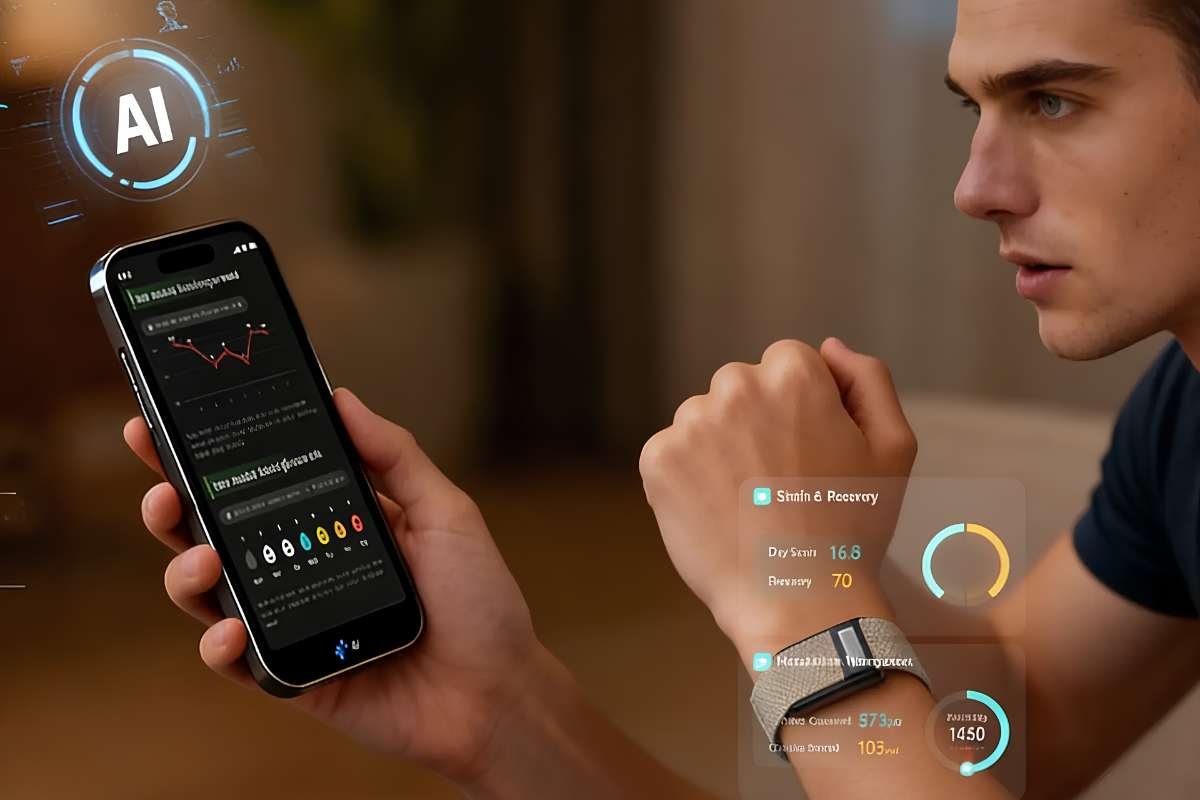
The evolution of fitness trackers can be understood in four stages.
1. Step counting
Early trackers primarily measured movement and converted it into steps, distance, and estimated calories.
The main goal was behavioral: encourage users to move more.
2. Continuous sensing
Optical heart-rate sensors, GPS, sleep tracking, and additional sensors expanded what wearables could measure.
Instead of checking activity once a day, users could begin seeing patterns across workouts, sleep, and daily routines.
3. Health and recovery insights
The next shift was from isolated measurements to combined insights.
A device can now use heart rate, sleep, activity, and other signals to provide information about recovery, training readiness, stress, or overall trends.
That is more useful than simply telling someone that their heart rate was 72 beats per minute at a particular moment.
4. AI-assisted interpretation
In 2026, the next stage is increasingly about interpretation at the device level.
Counterpoint reports that edge AI in smartwatches is being used for health monitoring, safety alerts, and personalized recommendations. It also expects edge-AI penetration in smartwatches to approach 32% during 2026.
The significance is not that every tracker suddenly needs AI.
The real development is that wearables are becoming better at turning large volumes of sensor data into information that users can act on.
Counterpoint projects that edge-AI-enabled wearables could account for nearly 75% of the cumulative $1 trillion wearable revenue opportunity between 2026 and 2032.
For buyers, this means evaluating what the software does with the data, not just how many sensors are inside the device.
2026 wearable market: What’s changing and why it matters
The wearable market is becoming more fragmented rather than simply growing in one direction.
| Market indicator | 2026 figure/outlook |
|---|---|
| Global wearable shipments, Q1 2026 | 145.7 million |
| Q1 2026 year-over-year growth | 4.3% |
| Full-year smartwatch shipments | 159.7 million |
| 2026 smartwatch outlook | -2.8% YoY |
| 2026 wristband shipments | 40.2 million |
| Wristband outlook | -6.8% YoY |
| 2026 smart ring shipments | 4.9 million |
| Smart ring outlook | +12.8% YoY |
| 2026 smart glasses shipments | 13.6 million |
| Smart glasses outlook | +41.4% YoY |
IDC expects total wearable-device shipments to grow at a 2.6% CAGR from 2026 through 2030, reaching approximately 693.2 million units by 2030.
The takeaway is important: the wearable opportunity is expanding, but traditional fitness bands are not necessarily where all the growth is happening.
Smartwatches are moving toward premium health and AI capabilities, while rings, smart glasses, and other form factors are creating new ways to collect and use personal data. IDC’s 2026 outlook also identifies smart glasses and smart rings among the fastest-growing categories.
8 features that matter when choosing active tracker watches in 2026
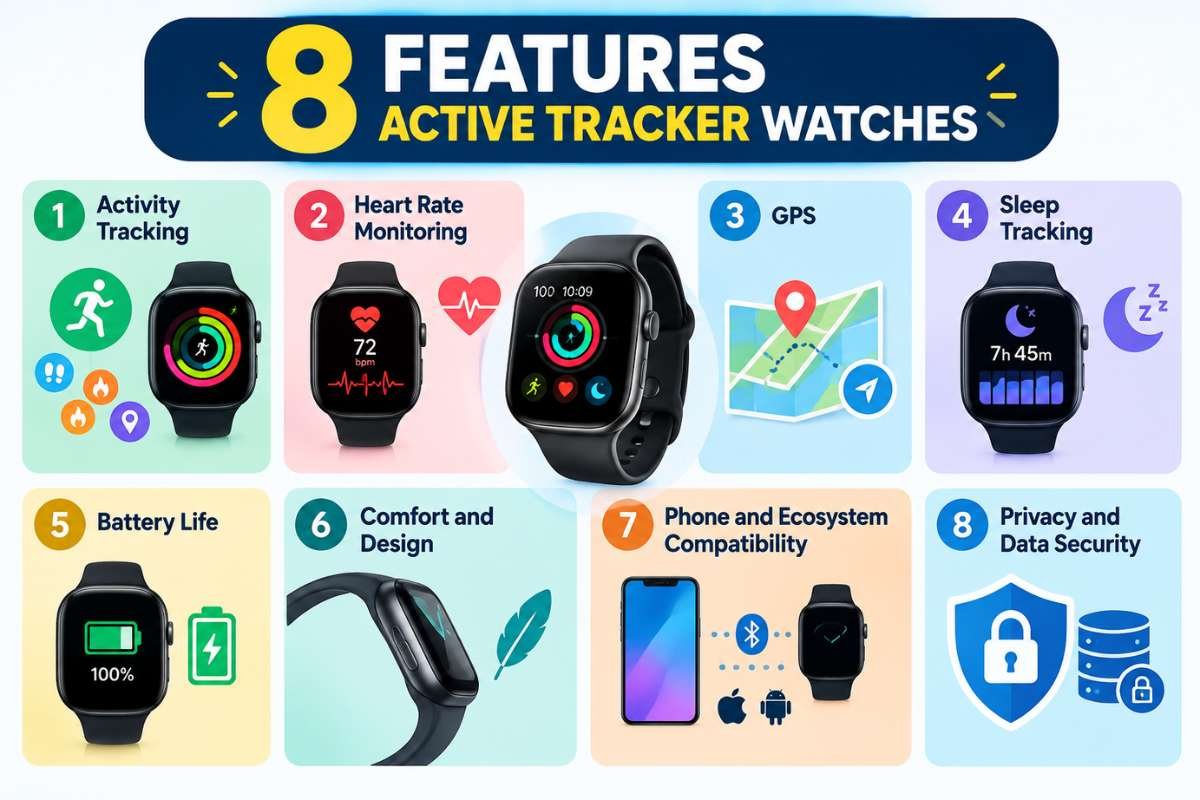
1. Activity tracking
Activity tracking remains the foundation.
Look for reliable measurements of:
- Steps
- Distance
- Active minutes
- Workout duration
- Calories
- Exercise type
Do not assume that a higher calorie number means greater accuracy. Energy expenditure is difficult for consumer wearables to estimate precisely, so calorie figures are better used for trends than as exact measurements.
For someone whose main goal is increasing daily movement, a lightweight fitness band may be sufficient. An endurance athlete, on the other hand, may need much more detailed training data.
2. Heart rate monitoring
Heart-rate monitoring is useful for understanding workout intensity and long-term trends.
Depending on the model, you may get:
- Resting heart rate
- Continuous heart rate
- Heart-rate zones
- High/low heart-rate alerts
- Heart-rate variability
- Irregular-rhythm notifications
The important consideration is not simply whether a device has heart-rate monitoring, but how consistently and accurately it performs during the activities you care about.
3. GPS
GPS matters most for runners, cyclists, hikers, and outdoor athletes.
Built-in GPS lets a watch record routes without depending entirely on a smartphone. Connected GPS can be sufficient for casual outdoor activity.
If you regularly train outdoors, compare GPS accuracy, battery consumption, route functionality, and whether the watch can maintain tracking during longer sessions.
4. Sleep tracking
Sleep tracking has become one of the most common wellness features.
Depending on the device, you may receive:
- Sleep duration
- Sleep stages
- Sleep consistency
- Overnight heart rate
- Sleep score
- Breathing-related measurements
- Recovery information
The useful question is not “Does this watch measure sleep?”
Almost every major wearable now does.
Instead ask: Does the device make the information understandable and useful over time?
5. Battery life
Battery life can determine whether a tracker becomes part of your routine or ends up in a drawer.
Long battery life is particularly valuable if you want continuous sleep and recovery tracking.
For example, Fitbit rates Charge 6 for up to seven days, although features such as its always-on display and SpO2 tracking can increase charging frequency.
Xiaomi rates the Smart Band 10 for up to 21 days in typical use, falling to nine days with its always-on display enabled.
Apple’s Watch SE 3, by comparison, provides up to 18 hours of normal use, reflecting the different priorities of a full smartwatch.
6. Comfort and design
A wearable only produces useful long-term data if you actually wear it.
Consider:
- Weight
- Strap material
- Display size
- Water resistance
- Sleep comfort
- Charging method
- Replacement straps
A smaller tracker may be preferable for overnight use, while a larger smartwatch may offer a better experience during workouts and everyday tasks.
7. Phone and ecosystem compatibility
Compatibility can affect everything from notifications to health-data syncing.
Check:
- Android/iOS compatibility
- Companion app requirements
- Smartphone features
- Third-party app support
- Data export options
- Compatibility with existing fitness platforms
A technically impressive watch is a poor purchase if it does not work properly with your phone.
8. Privacy and data security
Wearables can collect information about activity, sleep, heart rate, location, and behavioral patterns.
That makes privacy a buying consideration rather than an afterthought.
Before purchasing, check:
- What information is collected
- Where it is stored
- Whether it is encrypted
- Which third parties can access it
- Whether data can be exported
- Whether an account is mandatory
- How account and data deletion works
The more health information a platform collects, the more important these questions become.
Best active tracker watches to consider in 2026
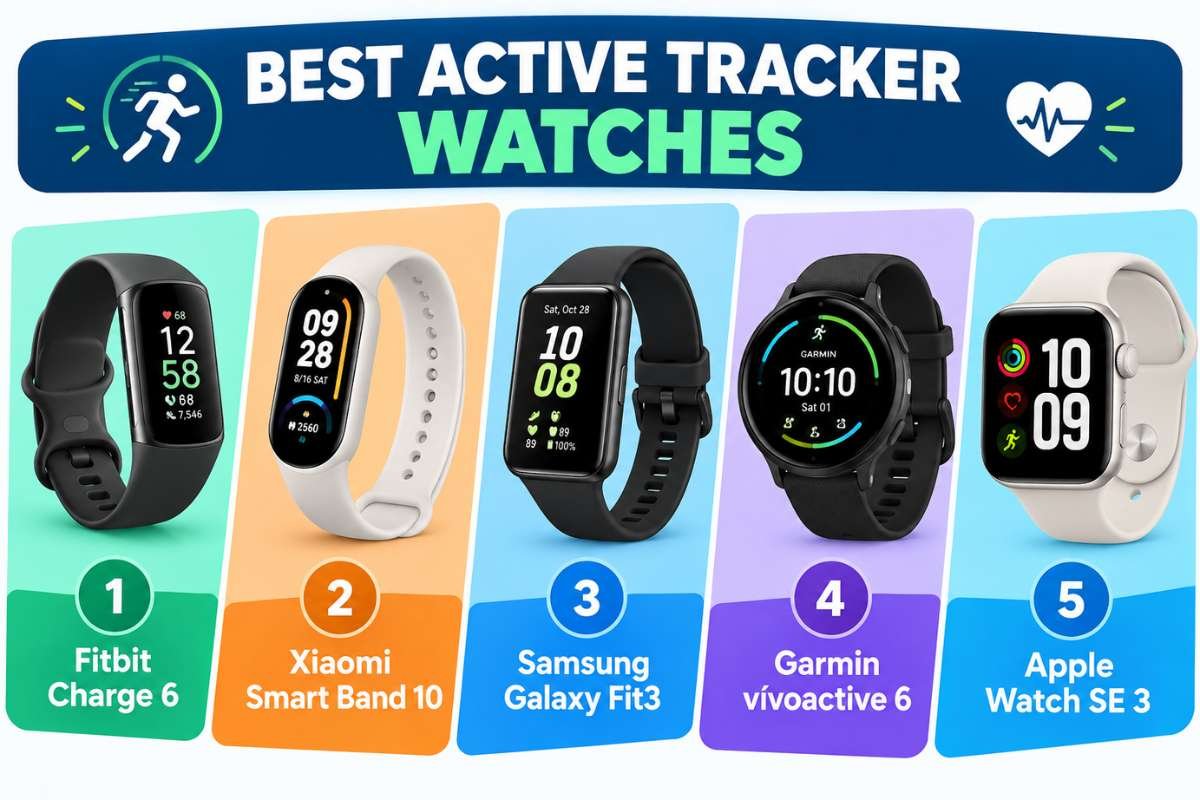
Rather than naming one universal winner, it is more useful to match products to different needs.
1. Fitbit Charge 6: Best for balanced fitness tracking
Fitbit Charge 6 is a dedicated tracker for users who want health and fitness features without moving fully into smartwatch territory.
It includes built-in GPS, an optical heart-rate sensor, SpO2-related sensing, NFC, and up to seven days of battery life under specified conditions. It is compatible with iOS 16.4 or later and Android 11 or later.
- Best for: Everyday fitness, activity, and wellness tracking.
- Watch out for: Some advanced software features and ecosystem services may depend on Google’s Fitbit platform and subscription structure.
2. Xiaomi Smart Band 10: Best for budget-oriented fitness tracking
The Xiaomi Smart Band 10 provides a broad set of features in a compact band.
It supports 150+ sports modes, heart rate, blood oxygen, sleep, and stress monitoring, and Xiaomi rates it for up to 21 days of typical use.
- Best for: Buyers who prioritize battery life, activity tracking, and affordability.
- Watch out for: Its capabilities are closer to a fitness band than a full smartwatch, and Xiaomi states that its health features are not designed for medical purposes.
3. Samsung Galaxy Fit3: Best for a simple Samsung ecosystem
Galaxy Fit3 supports more than 100 exercises and focuses on activity, sleep, and everyday wellness tracking.
Its battery is rated for up to 13 days under specified conditions.
- Best for: Users looking for a simple fitness band within a compatible Samsung/Android setup.
- Watch out for: Availability varies by market, so buyers should check current local availability rather than assuming the product is widely sold.
4. Garmin vívoactive 6: Best for training-focused users
The Garmin vívoactive 6 sits closer to the smartwatch side of the category.
It combines sports features with health and recovery tools such as Body Battery and Sleep Coach. Garmin rates it for up to 11 days of battery life in smartwatch mode.
- Best for: Runners, active users, and people who want deeper training insights.
- Watch out for: It costs more than a basic fitness band and may offer more functionality than casual users need.
5. Apple Watch SE 3: Best for iPhone users
Apple Watch SE 3 is a smartwatch rather than a traditional tracker, but it is an important option for iPhone users who want fitness tracking alongside broader smartwatch functionality.
Apple lists sleep score, heart-rate tracking, GPS, workout tracking, Fall Detection, Crash Detection, water resistance, and up to 18 hours of normal battery life. Apple’s India store lists the SE 3 from ₹29,900.
- Best for: iPhone users who want fitness, health, safety, and smartwatch features in one device.
- Watch out for: Its shorter battery life and higher cost compared with basic fitness bands.
Pay once or keep paying? The model matters
The purchase price does not tell the full cost of a wearable.
| Model | Upfront cost | Recurring cost | Typical value proposition |
|---|---|---|---|
| Basic fitness band | Low | Usually none | Activity and basic wellness |
| Advanced fitness tracker | Medium | May be optional | Deeper health and fitness insights |
| Sports smartwatch | Medium-high | Usually optional | Training and performance |
| Premium smartwatch | High | Apps/services may add costs | Health + connectivity |
| Subscription-led wearable | Medium/high | Regular subscription | Advanced analytics/coaching |
| Enterprise wearable program | Variable | Platform/service fees | Wellness, safety, training, analytics |
The business model matters because some wearable companies make the device the entry point and monetize software, coaching, analytics, or premium insights afterward.
For consumers, compare the estimated cost over two or three years.
For businesses, calculate:
Hardware + software + subscriptions + implementation + support + replacement + security = total cost of ownership.
That can change which option looks cheapest.
Active tracker watches vs. smartwatches
The two categories overlap, but they still serve different purposes.
Choose a fitness tracker if you mainly want activity, sleep, heart-rate, and workout data.
Choose a smartwatch if you also want calls, apps, navigation, payments, richer notifications, safety features, and deeper smartphone integration.
| Feature | Fitness Tracker/Band | Smartwatch |
|---|---|---|
| Step tracking | Strong | Strong |
| Heart-rate monitoring | Usually | Usually |
| Sleep tracking | Usually | Usually |
| GPS | Model-dependent | Common |
| Battery life | Usually longer | Usually shorter |
| Apps | Limited | Extensive |
| Calls/messages | Limited | Often supported |
| Health features | Varies | Usually broader |
| Price | Generally lower | Generally higher |
| Best for | Fitness and wellness | Fitness + everyday connectivity |
The business opportunity behind active tracker watches
The commercial opportunity extends well beyond selling watches.
Wearable companies can build revenue through:
- Hardware
- Premium subscriptions
- Digital coaching
- Corporate wellness platforms
- Healthcare partnerships
- Insurance programs
- Fitness memberships
- Research platforms
- Enterprise analytics
- APIs and health-data integrations
The larger opportunity is moving from selling sensors to selling outcomes.
A device that simply reports steps has limited differentiation.
A platform that helps a user understand training load, sleep patterns, recovery, or behavior over time can create greater ongoing value.
Counterpoint estimates that the overall wearables market represents a cumulative $1 trillion revenue opportunity between 2025 and 2032, with edge AI expected to capture a substantial share of that opportunity.
Enterprise use cases for wearable technology
Businesses are also finding applications for wearable technology beyond employee step challenges.
- Employee Wellness: Organizations can run voluntary programs focused on physical activity, healthy routines, or general wellness. The emphasis should remain on participation rather than surveillance.
- Workplace Safety: Wearables can support worker tracking, training, environmental monitoring, and safety applications, particularly in industrial environments. The GAO identifies worker monitoring, training, tracking, and physically assistive technologies among workplace wearable applications.
- Training and Performance: Sports organizations, fitness businesses, and physically demanding workplaces can use wearable data to support training and performance programs.
- Remote Health Programs: Wearable data can contribute to remote monitoring and digital-health programs. However, businesses need to distinguish wellness products from regulated medical devices and establish appropriate clinical and privacy safeguards.
- Research: With appropriate consent and governance, aggregated wearable data can support research into activity, sleep, behavior, and health patterns.
What businesses should look for
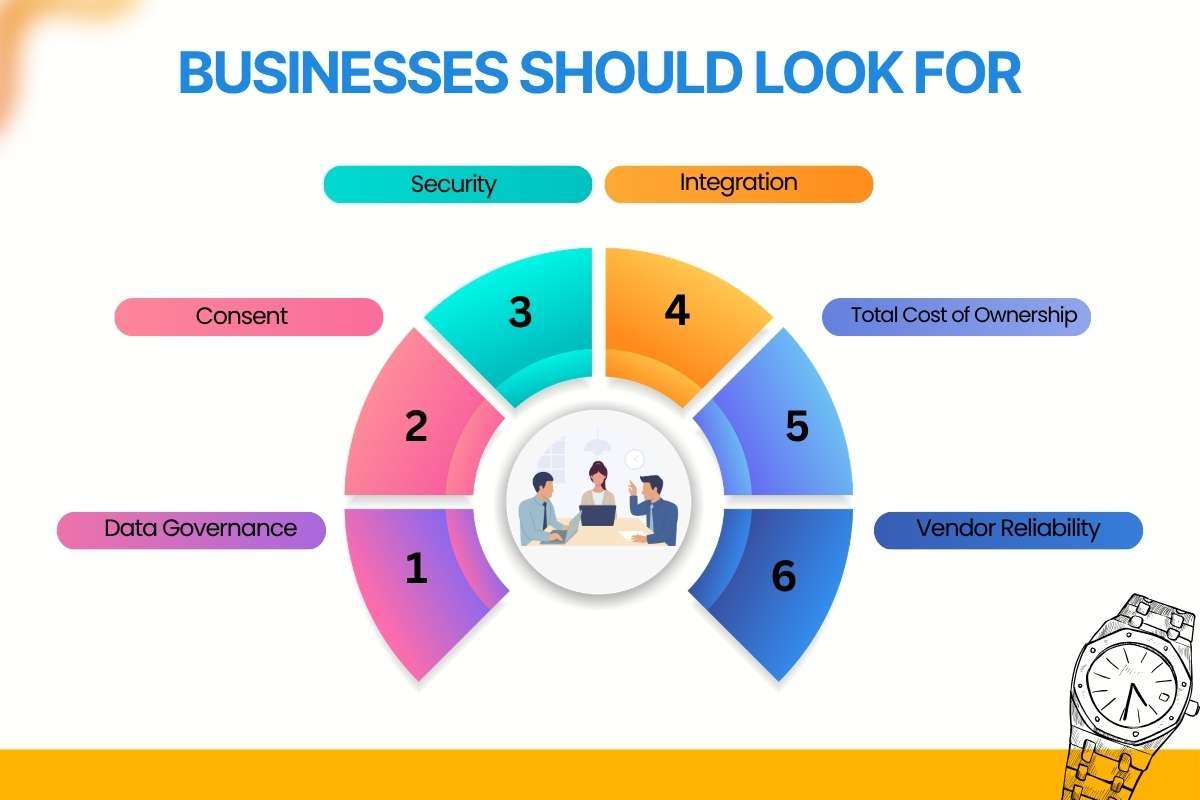
A business choosing wearables should evaluate the platform, not just the device.
1. Data governance
Define:
- What data is collected
- Why it is collected
- Who can access it
- How long it is retained
- When it is deleted
2. Consent
Employee participation should be transparent and voluntary where appropriate.
Employees should know whether their individual information can be viewed by managers or whether only aggregated results will be reported.
3. Security
Evaluate:
- Encryption
- Authentication
- Access controls
- API security
- Cloud security
- Device management
- Vendor incident response
A wearable ecosystem has multiple potential attack points: the device, smartphone, application, cloud platform, integrations, and administrative systems.
4. Integration
The platform should integrate with the organization’s existing wellness, HR, analytics, safety, or healthcare systems where appropriate.
5. Total cost of ownership
Do not evaluate only the device purchase price.
Include licenses, implementation, training, support, replacement units, data storage, security, and employee onboarding.
6. Vendor reliability
Evaluate the vendor’s:
- Security record
- Update policy
- Support model
- Financial stability
- Product roadmap
- Data portability
- Exit process
A wearable program can become difficult to manage if the vendor stops supporting its hardware or changes its subscription model.
Privacy and data security considerations
Wearable data can be highly personal because it is generated continuously.
A privacy-conscious approach starts with data minimization: collect only what is necessary for the stated purpose.
Consumers should:
- Review permissions
- Use strong account authentication
- Keep apps updated
- Understand third-party integrations
- Disable unnecessary sharing
- Review account deletion options
Businesses should go further.
They should separate individual health information from management reporting wherever possible, restrict access, establish retention limits, and use aggregated or anonymized information when individual-level data is not necessary.
This matters particularly as AI moves more processing onto the wearable.
Counterpoint notes that edge AI can allow certain health and safety processing to happen locally rather than relying entirely on cloud services, potentially improving response time and privacy. But on-device AI does not eliminate privacy risks. Data can still leave the device through connected apps, cloud services, integrations, or backups.
How to choose the right active tracker watch
Start with the activity you actually perform.
- For walking: Prioritize steps, heart rate, comfort, sleep tracking, and battery life.
- For running: Look for GPS, heart-rate zones, pace, training metrics, and recovery information.
- For cycling: Prioritize GPS, battery life, route tracking, and compatibility with relevant accessories.
- For strength training: Look for workout tracking, heart rate, recovery insights, and a comfortable fit.
- For general wellness: Focus on activity, sleep, heart-rate trends, stress, and ease of use.
- For smartwatch functionality: Choose a device with apps, notifications, payments, safety features, and strong smartphone integration.
- For enterprise use: Put security, consent, data governance, integration, vendor stability, and total cost of ownership ahead of flashy specifications.
5 mistakes that can make you regret your tracker
| Buying the device with the most features | More features can create more complexity without adding value. |
| Ignoring battery life | Frequent charging can interrupt the continuous data collection that makes wearables useful. |
| Treating every health metric as equally accurate | Different measurements have different levels of reliability. |
| Forgetting subscription costs | The cheapest device upfront may not be the cheapest over three years. |
| Ignoring privacy | Health, location, sleep, and behavioral data should be treated as sensitive information. |
| Buying outside your ecosystem | Check smartphone compatibility before purchasing. |
| Using consumer wellness data as a medical diagnosis | A wearable can highlight patterns, but that does not automatically make it a clinical diagnostic device. |
Conclusion
The best Active Tracker Watches in 2026 are not necessarily the most expensive or feature-packed. The right choice balances tracking accuracy, comfort, battery life, compatibility, cost, privacy, and software support.
For businesses, wearables also require clear goals, employee consent, strong data governance, cybersecurity, and realistic costs.
As wearables become smarter and more personalized, the most valuable device is not the one that collects the most data, but the one that turns the right data into useful insights and decisions.
FAQs
1. What are active tracker watches?
Active tracker watches are wearable devices that monitor activity and fitness metrics such as steps, distance, heart rate, workouts, sleep, and sometimes GPS, recovery, and other wellness measurements.
2. Are active tracker watches better than smartwatches?
Not necessarily. Fitness trackers are generally smaller and offer longer battery life, while smartwatches provide broader communication, app, safety, and connectivity features. The right choice depends on how you plan to use the device.
3. How much should I spend on an active tracker watch?
Start with your requirements rather than a fixed price. Basic users may only need an affordable fitness band, while runners, athletes, and smartwatch users may benefit from spending more. Remember to include subscription fees and replacement costs.
4. Are fitness tracker readings accurate?
Accuracy varies by device, metric, activity, and conditions. Heart-rate and movement measurements can be useful for tracking trends, but consumer wellness measurements should not automatically be treated as medical diagnoses.
5. Can businesses use active tracker watches?
Yes. Potential applications include voluntary employee wellness programs, workplace safety, training, remote health initiatives, and research. Businesses should establish clear consent, security, access, and data-retention policies before collecting employee wearable data.