Learn why businesses invest in B2B growth consulting to uncover hidden revenue bottlenecks and build scalable growth systems. This guide explains the common challenges slowing business growth, what growth consultants actually deliver beyond strategic advice, how to decide between consulting and internal hiring, and the signs that indicate your company may need expert guidance to achieve more predictable, sustainable revenue.
Growth is harder than ever in 2026, and more leads don’t mean more revenue. Stalled pipelines, declining conversion rates, inefficient spend and operational friction are hampering growth efforts across sales, marketing, and product teams in companies. That’s why B2B growth consulting has moved from a nice-to-have to a strategic investment. Specialist advisors diagnose growth bottlenecks, redesign go-to-market engines, and align people, data, and technology to unlock sustained revenue.
And you’ll learn how modern growth consulting can determine the real constraints, the high-impact levers to pull, and the practical steps to turn leads into predictable and scalable revenue.
Table of Contents
Why companies seek B2B growth consulting?
Companies are investing more than ever in B2B Growth Consulting, as marketing alone is becoming harder to win growth. Customer acquisition costs are increasing, making every lead more costly. Buying cycles are getting longer, slowing revenue. AI is transforming how buyers research and compare vendors. And leaders face relentless pressure to deliver more predictable growth with less waste.
This is why growth today requires more than campaigns. Marketing can generate attention, but it cannot fix broken handoffs, weak qualification, poor sales follow-up, or a mismatched offer. B2B growth consultants help companies connect strategy, sales, marketing, and operations so demand turns into revenue more reliably.
It is also becoming popular because AI is reshaping how teams work and how customers buy. Companies need clearer positioning, better data, and tighter execution to stay competitive as tools, channels, and buying behavior change faster than before.
In simple terms, businesses are not just trying to get more leads anymore. They are trying to build a growth system that is efficient, measurable, and resilient.
The growth problems most businesses fail to diagnose:
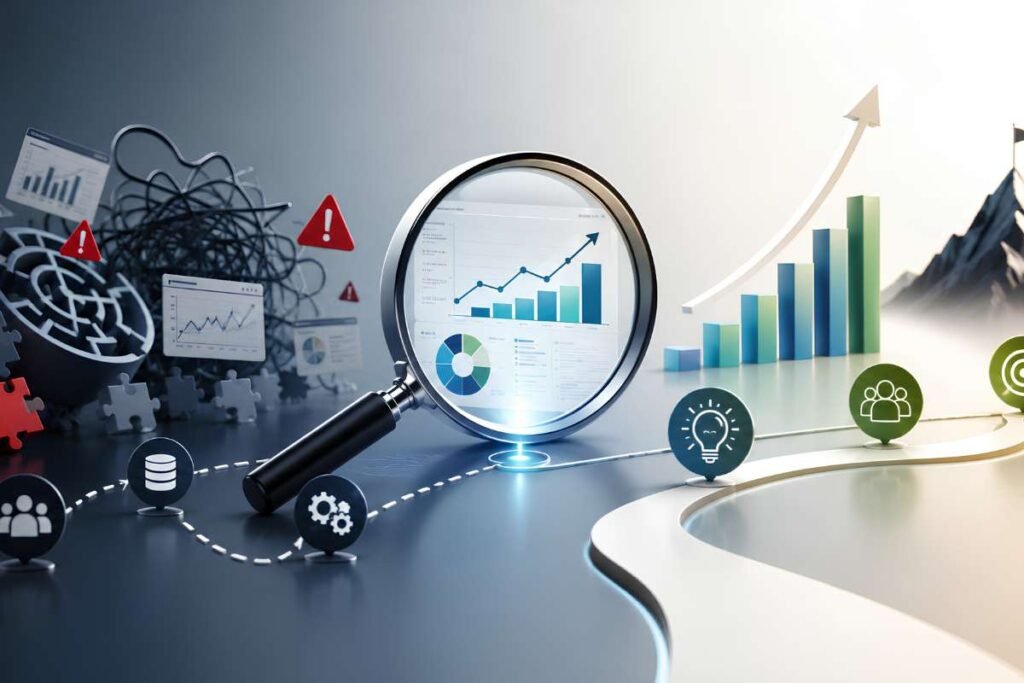
Many businesses think they have a lead problem when the real issue is a growth system problem. In practice, B2B growth consulting often starts by spotting symptoms like rising revenue with weak profitability, sales, and marketing working in separate lanes. And growth depends on just a few large accounts.
Another common warning sign is that customer acquisition costs keep climbing while pipeline velocity slows. That usually means more money is being spent to create less momentum. This is a clear sign that the go-to-market engine is getting less efficient.
You may also see the business becoming too dependent on a handful of big deals. That can look healthy on paper. But it creates risk because one delayed renewal, lost account, or stalled opportunity can hit the forecast hard.
The harder-to-spot problem is when marketing and sales do not share the same definitions, priorities, or follow-up process. When that happens, leads get created but not converted, and the pipeline slows even though activity looks busy.
These symptoms matter because they show growth is being held back by friction, not just demand. That is why B2B growth consultants are increasingly used to diagnose what is slowing revenue before companies spend more on the wrong fix.
What B2B growth consulting actually delivers beyond advice?

B2B Growth Consulting delivers more than advice by turning growth issues into concrete outputs you can act on. The value is not just in recommendations; it is in the assessments, plans, and operating changes that follow.
1. A Growth Opportunity Assessment usually produces a prioritized list of where growth is leaking or underused, often tied to revenue, margin, pricing, or channel performance. In practice, that means a ranked opportunity map, not a generic strategy memo.
2. A Revenue Funnel Analysis shows where prospects drop off across the buying journey. The tangible output is a funnel dashboard or leakage report that highlights conversion rates, bottlenecks, and the stages causing the biggest revenue loss.
3. Go-To-Market Optimization converts into clearer target segments, tighter positioning, channel choices, sales motions, and performance benchmarks. The output is usually a revised GTM model, updated priorities, and metrics that teams can track week to week.
4. A Customer Retention Strategy delivers actions to reduce churn and increase expansion revenue. That can include account segmentation, renewal plays, customer health indicators, and a retention plan with owners and timelines.
5. An Executive-Level Growth Roadmap is the most practical deliverable of all. It often includes a 90-day or multi-quarter roadmap, KPI targets, governance cadence, and named accountabilities so leadership can execute without ambiguity.
In short, the real output of B2B Growth Consulting is a set of decisions, tools, and execution plans that make growth measurable and repeatable.
B2B growth consulting vs hiring internal teams:
B2B growth consulting is best when you need strategic diagnosis, not just more activity. An agency is better for execution support, while a VP Growth makes sense when you want long-term internal leadership.
| Option | Best For | Cost | Speed |
| Consultant | Strategic diagnosis | Medium | Fast |
| Agency | Execution support | Medium-High | Medium |
| VP Growth | Long-term leadership | High | Slow |
The main difference is what you are buying. A consultant helps identify what is broken, what to prioritize, and what should change first. An agency usually runs campaigns and delivers output. A VP of growth owns the function and builds leadership capacity inside the business.
This matters because many companies do not need more tactics. They need clarity. If the funnel is leaking, the positioning is unclear, or teams are misaligned, B2B growth can uncover the real issue quickly.
Choose a consultant when you need a fast reset and sharper direction. Choose an agency when the strategy is already clear, and you need hands to execute. Choose a VP of growth when you are ready to invest in a durable internal growth leader.
When should a company consider B2B growth consulting?
A company should consider B2B growth consulting when growth starts to stall, and the numbers stop making sense. A quick checklist helps spot the pattern before it gets worse.
- Growth has stalled. Revenue is flat, slowing, or plateauing, even though the team is still busy.
- Revenue targets are missed. Forecasts keep slipping, and the gap between plan and actual keeps widening.
- Sales cycles are lengthening. Deals take more time to close, which usually signals friction in the buying process.
- Marketing ROI is unclear. Lead generation may be active, but it is hard to see which efforts are actually creating revenue.
- Expansion plans are failing. New markets, segments, or offers are not converting the way leadership expected.
These signs matter because they often point to a system problem, not just a sales or marketing problem. When growth is slowing across multiple areas at once. The business may need a closer look at strategy, funnel health, and execution.
If three or more apply, a growth assessment may be worthwhile.
Conclusion:
Just more activity doesn’t win growth in 2026. The winners are the companies that solve the real friction in their funnel, sharpen their strategy, and turn scattered efforts into a system that can scale.
That’s the essence of B2B growth consulting: not more noise, but better decisions and better execution. If your team is experiencing stalled pipelines, weak conversion, or inconsistent revenue, now is the time to dig deeper. The biggest upside and what’s holding you back can be seen in a focused growth assessment.
Want to see where your growth might be leaking? Look at your funnel, your handoffs, and your conversion points first.
FAQs:
1. What does a B2B consultant do?
B2B sales consulting involves sales experts helping businesses improve how they sell to other businesses. A B2B sales consultant helps companies optimize their sales strategies, processes, and team performance to drive revenue growth.
2. What is the 95 5 rule for B2B?
The B2B 95/5 rule states that at any given time, only about 5% of a company’s target market is actively looking to buy, while the remaining 95% are “out-market” and won’t need the product until the future.
3. What is B2B growth?
B2B growth refers to the strategies and processes a business uses to scale revenue, acquire new business clients, and retain existing ones.
4. Does B2B pay well?
Yes, B2B (Business-to-Business) pays very well, particularly in sales and marketing.
5. Is $100 an hour good for consulting?
Whether $100 an hour is a “good” rate for consulting depends heavily on your industry, experience, and the scope of work.