This article explains the difference in growth hacking vs growth marketing by showing how one focuses on rapid experimentation and quick user acquisition, while the other builds structured systems for long-term retention and revenue growth. It also goes into how each approach fits different business stages and why most companies combine both instead of choosing one.
You’ve probably heard both terms thrown around like they mean the same thing. Growth hacking, growth marketing, scale fast, drive traction. But when you actually sit down to build something, the difference in growth hacking vs growth marketing starts to matter more than you’d expect.
Think about it for a second. Are you chasing quick wins to spike user numbers, or are you building a system that keeps bringing people back long after the first click? That tension sits right at the heart of this conversation.
Growth hacking often leans into speed, experimentation, and unconventional tactics that deliver rapid bursts of results. Growth marketing, on the other hand, tends to play a longer game, focusing on consistency, brand trust, and sustainable customer relationships.
The tricky part is that most businesses don’t get to choose just one. They have to figure out how these two approaches interact. And that is exactly what we will cover in this article. So let us begin.
Growth hacking vs Growth marketing: key differences explained
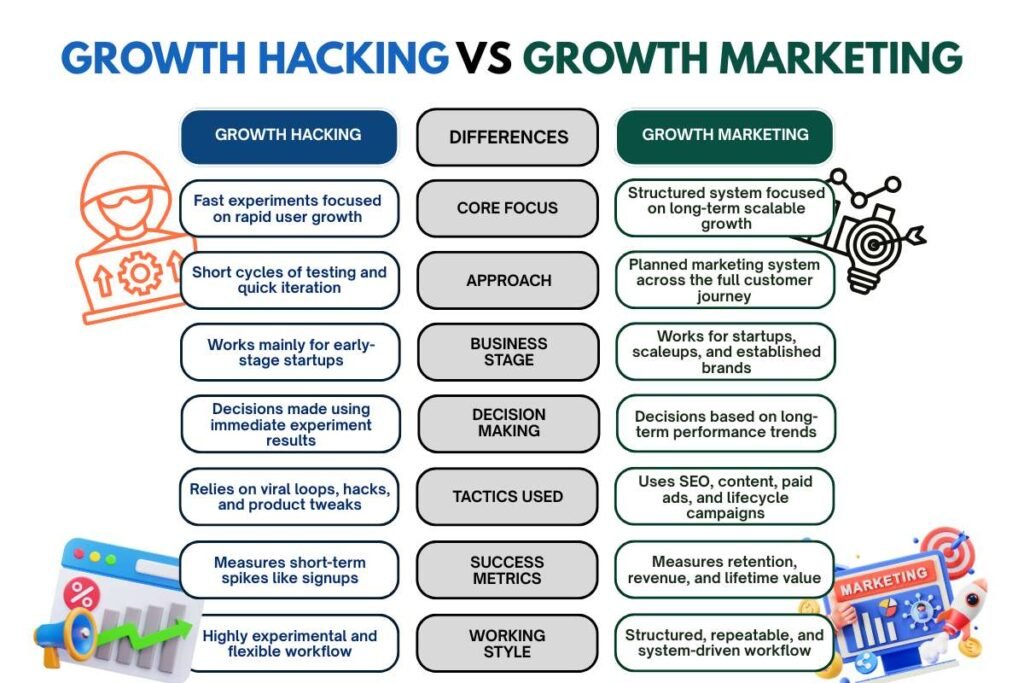
Growth hacking and growth marketing are often used in the same conversations, but they follow very different ideas in practice. Both aim to increase users and revenue, yet the way they approach growth changes the entire strategy behind them.
One relies on speed, testing, and quick wins, while the other builds structured systems designed for steady and long-term results. Understanding these differences helps make sense of when each approach works best.
| Growth Hacking | Differences | Growth Marketing |
| Fast experiments focused on rapid user growth | Core focus | Structured system focused on long-term scalable growth |
| Short cycles of testing and quick iteration | Approach | Planned marketing system across the full customer journey |
| Works mainly for early-stage startups | Business stage | Works for startups, scaleups, and established brands |
| Decisions made using immediate experiment results | Decision making | Decisions based on long-term performance trends |
| Relies on viral loops, hacks, and product tweaks | Tactics used | Uses SEO, content, paid ads, and lifecycle campaigns |
| Measures short-term spikes like signups | Success metrics | Measures retention, revenue, and lifetime value |
| Highly experimental and flexible workflow | Working style | Structured, repeatable, and system-driven workflow |
1. Core focus:
Growth hacking targets fast user growth. Teams chase quick wins that show immediate traction. They test ideas rapidly and scale what works without delay. The focus stays on speed and short-term impact. Growth marketing builds long-term systems for steady growth. It connects acquisition, activation, retention, and revenue into one flow. The aim stays on consistency and scale over time.
2. Approach:
Growth hacking runs on constant experiments. Teams try small ideas, measure results quickly, and shift direction fast. There is little waiting or long planning. Growth marketing follows a planned structure. It sets clear goals across channels before execution. Each campaign fits into a larger strategy that guides long-term performance.
3. Business stage:
Growth hacking fits early-stage startups. These companies often need users quickly to validate their product. They rely on fast tactics because resources are limited. Growth marketing fits companies with existing traction. It helps them expand in a stable way across new markets and audiences without losing consistency.
4. Decision making:
Growth hacking depends on immediate feedback. If an experiment shows results, teams scale it quickly. If it fails, they stop it without hesitation. Decisions move fast and adjust often. Growth marketing studies data over longer periods. It avoids reacting to short spikes and focuses on patterns that stay consistent over time.
5. Tactics:
Growth hacking often uses viral mechanics. These include referral loops, product triggers, and share-based incentives that push fast user spread. Growth marketing uses broader channels. It includes SEO, content, paid ads, email flows, and lifecycle campaigns that support every stage of the funnel.
6. Metrics:
Growth hacking tracks immediate results. Signups, downloads, and clicks matter most because they show fast impact. Growth marketing tracks deeper metrics. It focuses on retention, lifetime value, churn rate, and repeat engagement to measure real business health.
7. Working style:
Growth hacking works in fast-changing environments. Teams test often and adjust direction based on what performs. There is constant movement and iteration. Growth marketing builds structured systems. It relies on repeatable processes that keep performance stable even when campaigns change.
Growth hacking vs Growth marketing: which matters more?

There is no single winner between growth hacking and growth marketing. The better choice depends on the stage of the business and the goal behind growth. Both approaches solve different problems, so comparing them as direct substitutes does not give a complete picture. One focuses on speed, while the other focuses on stability.
Growth hacking works best when a product is new and still proving itself in the market. At this stage, the biggest challenge is getting attention quickly without large budgets or established channels. Growth hacking helps teams test ideas fast and find early signals of demand. It creates momentum in situations where waiting for long-term strategies would slow down progress. For startups that need validation, this approach often becomes the first step toward visibility.
However, that speed comes with limits. Growth hacking does not always build lasting systems. Many tactics lose impact once the initial excitement fades or once users become familiar with them. This is where growth marketing becomes more important. It focuses on building repeatable systems that continue to bring users in even after early traction has been achieved. Instead of depending on short bursts of success, it builds consistency across channels.
Growth marketing becomes more valuable when a company wants to scale beyond early growth. At that stage, businesses care less about quick spikes. It cares more about retention, customer lifetime value, and predictable revenue.
Growth marketing connects different parts of the user journey so that acquisition does not happen in isolation. It ensures that users who come in also stay, engage, and eventually convert into customers.
In simple terms, growth hacking helps you get started, while growth marketing helps you grow properly. One creates early momentum, and the other builds stability. Treating them as competing methods misses their real value, which lies in how well they can work together at different stages of growth.
Growth hacking and Growth marketing trends in 2026

The way companies approach growth in 2026 is becoming more connected and data-driven. Growth hacking is still widely used for early traction, especially in fast-moving startups, but it is no longer limited to random experiments. Teams now rely more on structured testing and better analytics to decide what to scale. At the same time, growth marketing continues to grow as the foundation for future strategy. There is a stronger focus on full-funnel performance and personalized user journeys.
Artificial intelligence has changed how both approaches operate. Marketing teams now use AI to speed up content creation, test variations, and improve campaign performance across channels. According to HubSpot, around 80% of marketers use AI for content creation, and 75% use it for media production. This shift has made experimentation faster for growth hacking. It has also improved efficiency in growth marketing systems.
The overall direction is clear. The gap between growth hacking and growth marketing is shrinking as both rely on automation, real-time data, and continuous optimization. Businesses are combining fast experimentation with structured systems instead of choosing one over the other. This blended approach helps companies grow quickly while still maintaining stability and getting predictable results.
Conclusion:
Growth rarely comes from a single approach. Some moments demand speed, quick testing, and sharp execution. Others require patience, structure, and a focus on building something that lasts beyond short-term spikes. The real challenge is knowing what kind of growth the situation calls for.
When growth hacking vs growth marketing is viewed together, it becomes less about choosing a side and more about understanding intent. One pushes momentum forward in bursts, while the other shapes how that momentum holds over time. The strongest outcomes usually come from recognizing when to experiment fast and when to build steady systems that keep working in the background.
People also ask
1. What is the main difference between growth hacking vs growth marketing?
Growth hacking focuses on rapid experimentation and quick results, while growth marketing emphasizes sustainable growth strategies.
2. Is growth hacking only useful for startups?
It is most common in startups, but larger companies also use it for testing new ideas or campaigns quickly.
3. Can growth marketing work without growth hacking?
Yes, but it may take longer to identify what strategies work best without fast experimentation.