Civic education plays a central role in helping individuals understand how society and governance function. This article explains its importance in building informed, responsible citizens while outlining key components such as critical thinking, civic participation, and ethical decision-making. It also explores the challenges that limit its effectiveness and how it can evolve to stay relevant.
You see it in small moments. A conversation about a policy that turns into confusion. A vote cast without full understanding. An opinion shaped more by noise than by facts. These are not rare situations. They happen every day, often without people realizing what is missing.
A society does not weaken all at once. It fades when people stop questioning, stop participating, or feel disconnected from how decisions are made. The gap is not always about access. It is often about understanding.
Civic education sits at the center of that gap. It builds the awareness, judgment, and confidence people need to take part in public life with clarity instead of guesswork.
In this article, we will understand why it matters, what it includes, the challenges it faces, and why it remains essential today. So let us start with the first question: why is it important?
What is the importance of civic education?
A strong democracy depends on people who understand their role in it. Educating people can help individuals see how their actions connect to society and governance. It builds awareness, shapes opinions, and prepares people to take part in public life with confidence and responsibility.
1. Foundations of democracy
Citizen Education is foundational to the principles of democracy. It equips individuals with an understanding of democratic values, rights, and responsibilities, fostering a sense of civic duty and active participation in the democratic process.
2. Informed decision-making
An informed citizenry is essential for the functioning of a democracy. Civic Education provides individuals with the tools to critically analyze information, evaluate sources, and make informed decisions, contributing to a well-informed and discerning public.
3. Civic engagement and participation
Citizen Education encourages active participation in civic and community life. It empowers individuals to engage in various forms of civic participation, including voting, community service, advocacy, and contributing to the betterment of society.
4. Social cohesion and inclusivity
By promoting an understanding of diverse perspectives and fostering a sense of social cohesion, Citizen Education contributes to building inclusive communities. It encourages respectful dialogue, tolerance, and cooperation among individuals with differing backgrounds and beliefs.
5. Responsible global citizenship
In an interconnected world, this type of education extends beyond national boundaries. It cultivates a sense of global citizenship, emphasizing the interconnectedness of global issues and the responsibility of individuals to contribute to positive change on a global scale.
What are the 8 key components of civic education?
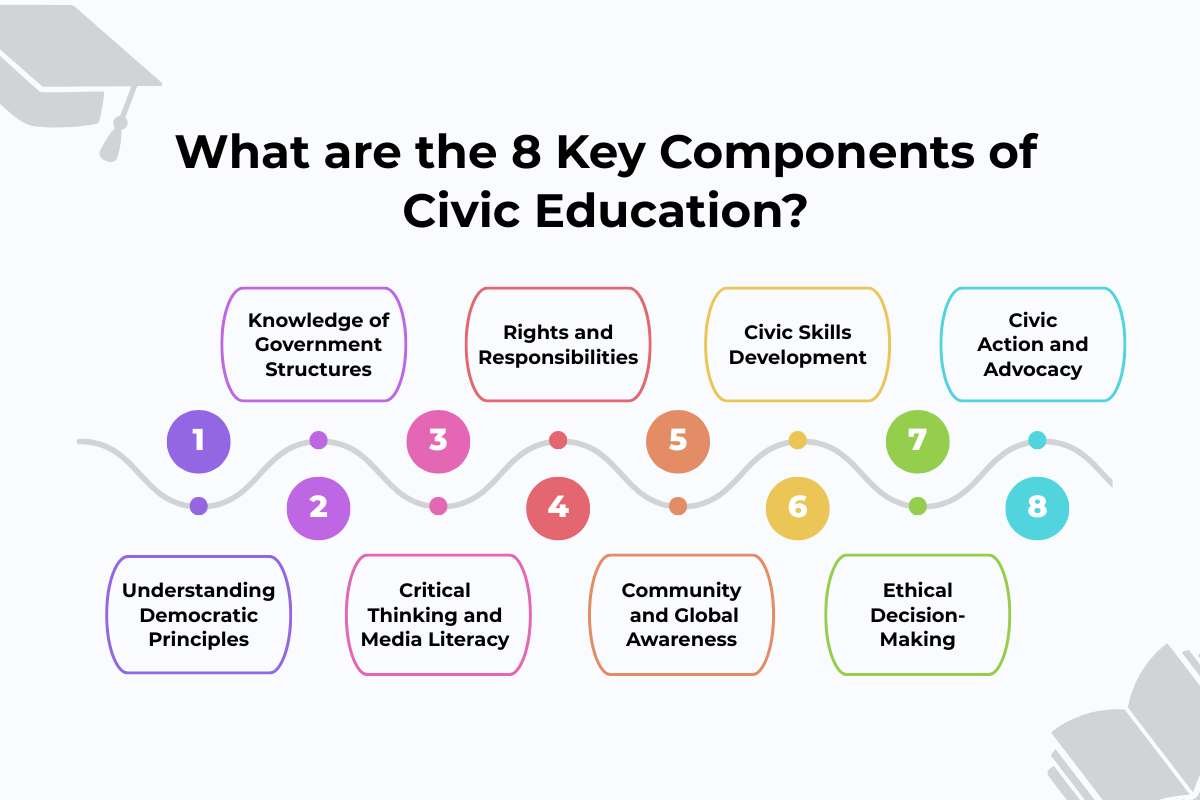
To create active and aware citizens, we must go beyond theory. There needs to be a clear structure that combines knowledge, skills, and values. These components work together to help individuals understand systems, think critically, and act with purpose in real situations.
1. Understanding democratic principles
Civic education begins with an exploration of democratic principles, including the rule of law, individual rights, equality, and the separation of powers. It provides a foundation for individuals to comprehend the structures and values underpinning democratic societies.
2. Knowledge of government structures
An essential component of Citizen Education involves imparting knowledge about government structures, both at the local and national levels. This includes an understanding of the legislative, executive, and judicial branches, as well as the roles of elected officials.
3. Critical thinking and media literacy
Citizen Education emphasizes critical thinking skills and media literacy. In civic education, individuals are taught to critically evaluate information, discern bias, and navigate the media landscape, enabling them to make well-informed decisions and participate in public discourse.
4. Rights and responsibilities
Individuals need to be aware of their rights and responsibilities as citizens. Citizen Education instills an understanding of the rights guaranteed by constitutions and legal frameworks, along with the responsibilities that come with being an active participant in society.
5. Community and global awareness
Citizen Education goes beyond the individual and fosters awareness of the community and global contexts. It encourages individuals to understand the challenges and opportunities facing their communities and the interconnectedness of global issues.
6. Civic skills development
Practical skills are integral to this education. This includes communication skills, conflict resolution, community organizing, and the ability to engage in civil discourse. These skills empower individuals to actively contribute to civic life.
7. Ethical decision-making
Citizen Education places a strong emphasis on ethical decision-making. Individuals are guided in understanding ethical considerations in civic life, including issues related to justice, equity, and the common good.
8. Civic action and advocacy
Empowering individuals to translate knowledge into action is a key goal of Citizen Education. It encourages civic action, community service, and advocacy, enabling individuals to be agents of positive change within their communities.
What are some challenges in civic education?
While civic education plays a vital role, it does not come without barriers. Many systems struggle to deliver it effectively due to gaps in access, resources, and changing social dynamics. These challenges affect how well individuals can learn and apply civic knowledge in everyday life.
1. Limited inclusion in curricula
It is not universally prioritized in educational curricula. Limited time and resources are allocated to this crucial subject, leading to variations in the depth and breadth of Citizen Education across educational institutions.
2. Digital information landscape
The digital age presents challenges in navigating the vast information landscape. Civic education must address the prevalence of misinformation and disinformation and the need for enhanced media literacy to equip individuals with the skills to discern reliable sources.
3. Cultural and political sensitivities
Citizen Education may encounter challenges related to cultural and political sensitivities. Balancing diverse perspectives and addressing controversial issues in a way that respects differing viewpoints is a delicate aspect of Citizen Education.
4. Teacher preparedness
Effective Citizen Education relies on well-prepared educators who can facilitate meaningful discussions and engage students in critical thinking. Ensuring teacher preparedness and ongoing professional development is essential for the success of Citizen Education programs.
5. Societal inequalities
Inequities within societies can impact access to quality Citizen Education. Ensuring that Citizen Education reaches all segments of society, including marginalized communities, is crucial for building inclusive and participatory democracies.
6. Lack of civic engagement opportunities
Citizen Education is most effective when complemented by opportunities for practical civic engagement. Limited opportunities for students and individuals to apply their knowledge in real-world contexts can hinder the development of active citizenship.
7. Political polarization
Political polarization within societies can present challenges for Citizen Education. Encouraging respectful dialogue and fostering a sense of shared responsibility becomes more challenging in environments characterized by deep political divisions.
8. Globalization and diverse perspectives
In an increasingly interconnected world, Citizen Education must consider diverse global perspectives. Addressing global issues and fostering an understanding of international relations contribute to the development of responsible global citizens.
Future considerations in citizen education
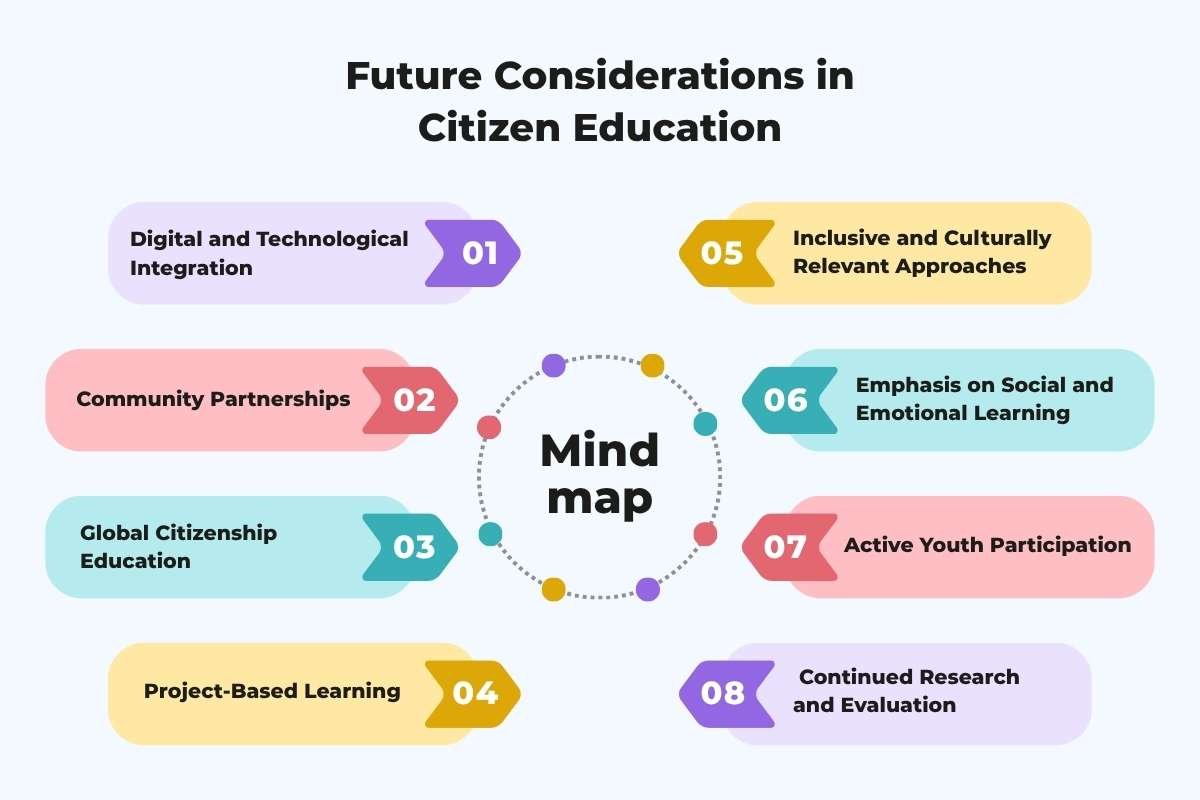
As society evolves, citizenship education must evolve with it. New technologies, global connections, and shifting social needs are changing how people learn and engage. Looking ahead, it is important to dive into ways to make civic education more practical, inclusive, and relevant for future generations.
1. Digital and technological integration
Embracing digital tools and technology can enhance Citizen Education. Integrating online platforms, interactive resources, and digital simulations can make Civic education more engaging and relevant to the tech-savvy generations.
2. Community partnerships
Collaboration with community organizations, local governments, and non-profits can strengthen Citizen Education. Community partnerships provide real-world connections, expose individuals to diverse experiences, and create opportunities for civic engagement.
3. Global citizenship education
Given the interconnected nature of global challenges, there is a growing need for a focus on global citizenship education. Citizen Education should incorporate a broader perspective, emphasizing the role individuals play in addressing global issues.
4. Project-based learning
Implementing project-based learning approaches can make Citizen Education more experiential. Encouraging students to undertake community projects, engage in service learning, and address real-world issues enhances the practical application of civic knowledge.
5. Inclusive and culturally relevant approaches
Civic education should be inclusive and culturally relevant, acknowledging diverse perspectives and histories. Incorporating local context and narratives ensures that Citizen Education resonates with the experiences of all individuals within a given society.
6. Emphasis on social and emotional learning
Integrating social and emotional learning (SEL) components into Citizen Education can enhance interpersonal skills, empathy, and resilience. SEL fosters the development of emotionally intelligent and socially aware citizens.
7. Active youth participation
Empowering youth to actively participate in civic life is crucial for the future of democracy. Citizen Education should include avenues for youth leadership, encouraging them to voice their opinions, advocate for change, and contribute to societal progress.
8. Continued research and evaluation
Ongoing research and evaluation are essential for refining Citizen Education approaches. Studying the impact of Citizen Education programs, identifying best practices, and adapting curricula based on empirical evidence contribute to continuous improvement.
Conclusion
A strong society does not run on systems alone. It runs on people who understand how those systems work and choose to take part in them. When that understanding is missing, participation drops and decisions become disconnected from the people they affect.
Over time, civic education helps close that gap. It builds awareness, encourages responsibility, and gives individuals the confidence to engage with purpose. That is what keeps public life active, informed, and moving in the right direction.
FAQs
1. What is civic education?
It is the process of teaching people about their rights, duties, and how government and public systems function.
2. Why is it important?
It helps people make informed decisions, participate in society, and understand how policies affect their lives.
3. Who benefits from civic education?
Everyone. Students, adults, and communities all benefit from better awareness and participation.
Links: https://enterprisewired.com/exploring-k-12-online-schools/