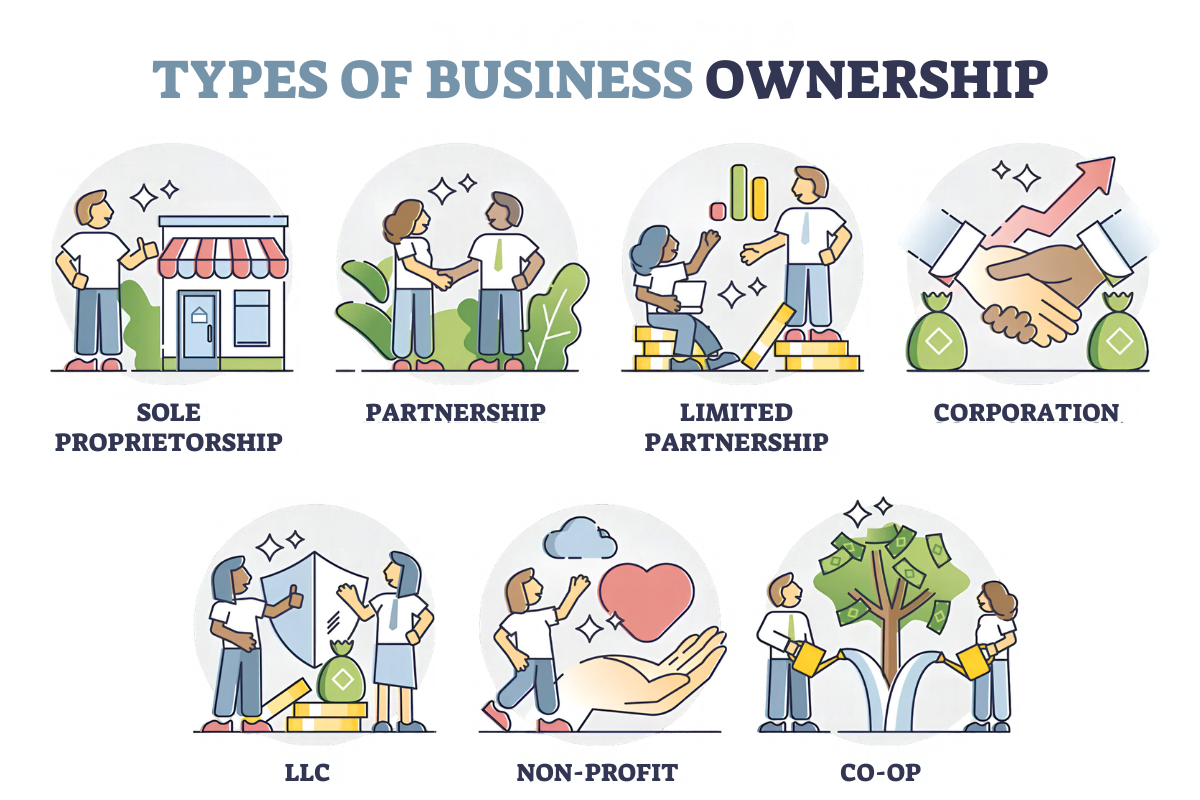
Over the past decade, I’ve consulted with dozens of growing companies and watched founders make the same pivotal mistake: treating their legal structure as an afterthought rather than a core strategic asset. When I launched my first venture years ago, I fell into the trap of operating as a sole proprietorship just to save on setup fees, only to realize later that my personal savings were dangerously exposed to commercial liabilities.
Selecting the right legal entity is one of the most foundational decisions an entrepreneur makes. According to the U.S. Small Business Administration (SBA), your choice governs your operational flexibility, tax liability, personal exposure, and ability to raise capital.
Below is my in-depth breakdown of the 8 primary types of business ownership, complete with clear descriptions, comparative advantages, and real-world trade-offs.
1. Sole proprietorship
A sole proprietorship is an unincorporated business owned and managed by a single individual. It is the default legal classification when a person launches a commercial activity without formally registering as another entity type.
- Taxation: Pass-through entity taxation; profits and losses are reported on Schedule C of the owner’s individual federal income tax return (IRS Sole Proprietorships Guide).
- Governance: Absolute management authority rests solely with the owner.
- Liability: Unlimited personal liability; no legal separation exists between personal assets and business obligations.
2. Partnership (general partnership & limited partnership)

A partnership involves two or more individuals or entities entering into a commercial agreement to share profits, operational responsibilities, and financial losses.
General Partnership (GP): In a General Partnership, all partners actively manage daily operations and share equal unlimited personal liability for debts and legal liabilities incurred by the entity or any co-partner.
Limited Partnership (LP): A Limited Partnership consists of at least one general partner with unlimited personal liability and operational oversight, alongside limited partners (silent investors) whose financial exposure is restricted strictly to their capital investment.
- Taxation: Pass-through taxation; partnership income flows to individual returns via Schedule K-1.
- Governance: Governed by an internal Partnership Agreement outlining profit allocation and operational authority.
- Liability: Unlimited for general partners; limited for limited partners.
3. Limited liability partnership (LLP)
A Limited Liability Partnership (LLP) is a specialized partnership structure designed predominantly for licensed professionals, such as attorneys, certified public accountants (CPAs), and architects.
Unlike general partnerships, an LLP grants every partner protection against legal claims, negligence, or malpractice liabilities caused by other partners in the firm.
- Taxation: Pass-through entity taxation.
- Governance: Partners manage daily operations jointly according to their formal LLP agreement.
- Liability: Liability is limited; personal assets remain shielded from professional negligence or debts committed by partners.
4. Limited liability company (LLC)
A Limited Liability Company (LLC) is a statutory hybrid structure combining the pass-through tax efficiency of a partnership with the limited personal liability protections of a formal corporation.
LLC owners are classified as “members,” and the entity can be organized as a Single-Member LLC or Multi-Member LLC.
- Taxation: Highly flexible pass-through taxation. By default, single-member LLCs are taxed as sole proprietorships, and multi-member LLCs as partnerships. However, an LLC can elect to be taxed as an S Corporation or C Corporation using IRS filings.
- Governance: Governed by an internal Operating Agreement; can be member-managed or manager-managed.
- Liability: Members are shielded from personal financial responsibility for company obligations, provided corporate formalities are maintained.
5. C corporation (C Corp)

A C Corporation is a distinct, independent legal entity owned by shareholders. It maintains perpetual existence separate from its owners, directors, and executives.
C Corporations are the gold standard for high-growth tech ventures, venture capital fundraising, and publicly traded companies due to their ability to issue multiple classes of stock (e.g., preferred stock).
- Taxation: Subject to corporate-level tax (21% federal rate) plus individual tax on dividends distributed to shareholders, a dynamic commonly known as double taxation.
- Governance: Structured governance consisting of Shareholders, a Board of Directors, and Corporate Officers.
- Liability: Strongest liability protection available; shareholders are not personally liable for corporate obligations.
6. S corporation (S Corp)
An S Corporation is a specialized tax election granted under Subchapter S of the Internal Revenue Code rather than a distinct legal entity type. An LLC or C Corporation files IRS Form 2553 to request S Corp tax status.
This election avoids corporate double taxation by passing income directly to shareholders while allowing active business owners to optimize payroll taxes through a combination of reasonable salary and shareholder distributions.
- Taxation: Pass-through tax status with federal corporate tax exemption.
- Governance: Requires formal corporate governance (directors, officers, annual shareholder meetings, and strict recordkeeping).
- Restrictions: Restricted to 100 shareholders (who must be U.S. citizens or permanent residents) and one class of stock.
7. Nonprofit corporation
A Nonprofit Corporation is organized specifically to fulfill charitable, educational, religious, or public benefit purposes rather than generate private profits for owners or shareholders.
To achieve federal tax exemption, the organization must apply for and receive tax-exempt status under Section 501(c)(3) of the Internal Revenue Code from the IRS.
- Taxation: Tax-exempt on earnings related to its exempt purpose; eligible to receive tax-deductible public donations and federal grants.
- Governance: Governed by a Board of Directors; retained profits must be reinvested into the organizational mission.
- Liability: Directors and officers are shielded from personal liability for organizational debts.
8. Cooperative (Co-op)

A Cooperative is a user-owned, user-controlled business entity organized to serve the economic needs of its member-owners, who actively use its services or products (e.g., agricultural cooperatives or retail utility co-ops).
Unlike traditional corporations where voting power scales with equity shares, cooperatives operate on a democratic principles framework where each member receives one vote regardless of equity holdings.
- Taxation: Profits are distributed back to members as tax-favored patronage dividends based on usage.
- Governance: Democratic governance structured around one member, one vote.
- Liability: Members enjoy limited personal liability equivalent to corporate shareholders.
Summary comparison of types of business ownership
| Structure Type | Personal Liability Shield | Federal Tax Treatment | Operational Flexibility | Capital Raising Ability |
|---|---|---|---|---|
| Sole Proprietorship | None (Unlimited) | Pass-Through (Schedule C) | Maximum / Unstructured | Low (Personal loans) |
| General Partnership | None (Unlimited / Joint) | Pass-Through (Form 1065) | High / Flexible | Moderate (Partner capital) |
| LLP | Limited (Shields partner claims) | Pass-Through | High / Professional rules | Moderate |
| LLC | Strong (Asset protection) | Flexible (Pass-Through / Elective) | High / Custom Operating Rules | High (Private equity) |
| C Corporation | Strongest | Corporate level + Dividend Tax | Structured / Formal | Unlimited (Stocks, VC, IPO) |
| S Corporation | Strong | Pass-Through (Form 1120-S) | Strict corporate rules | Restricted (100 owner max) |
| Nonprofit | Strong | Exempt (501(c)(3) Status) | Mission-focused / Formal | Grants and Donations |
| Cooperative | Limited | Patronage Dividend Distributions | Democratic (1 member, 1 vote) | Member Capital Shares |
How to choose the right structure for your business
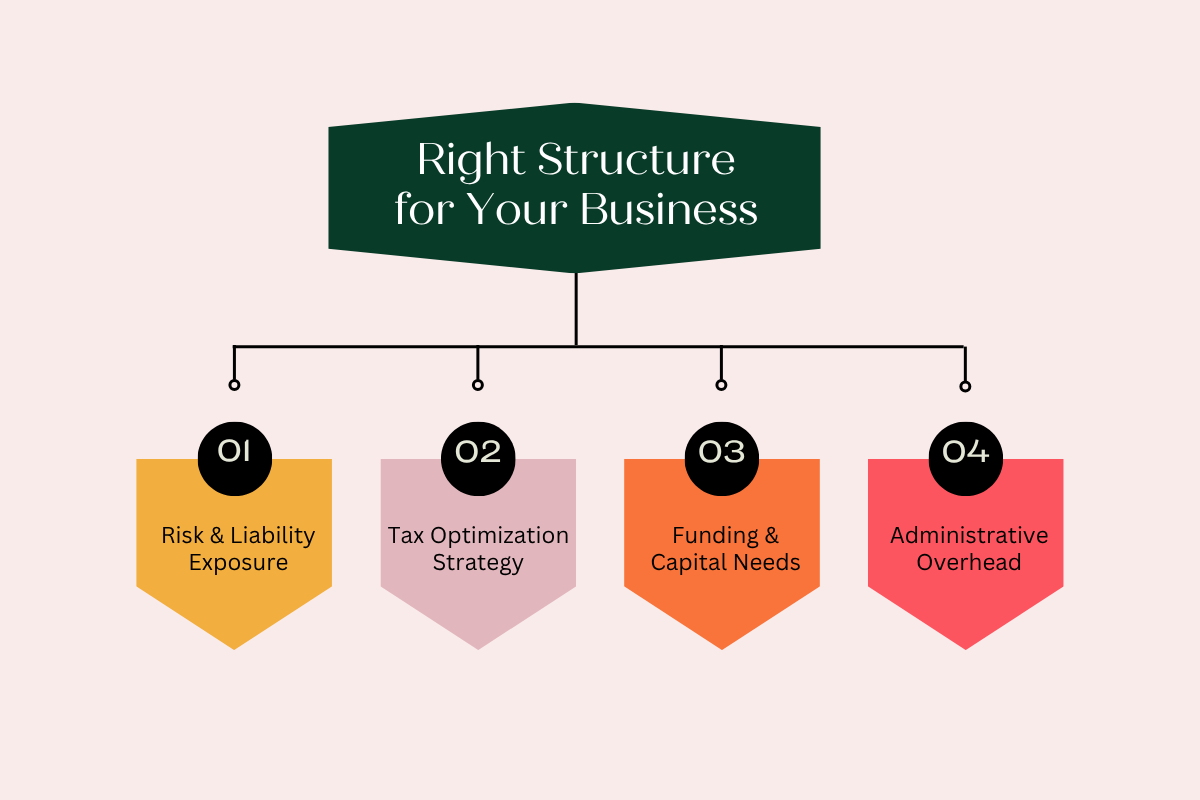
Selecting among the various types of business ownership requires balancing current risk against long-term operational vision. Evaluate these four core decision factors:
- Risk & Liability Exposure: High-risk industries with public foot traffic, physical inventory, or employee liabilities require the asset shielding of an LLC or C Corp over a sole proprietorship.
- Tax Optimization Strategy: Pass-through entities avoid double taxation, but high-earning businesses may lower self-employment taxes by electing S Corp status or reinvesting profits within a C Corp.
- Funding & Capital Needs: Institutional venture capital firms almost exclusively invest in Delaware C Corporations due to standardized equity structures.
- Administrative Overhead: Sole proprietorships carry virtually no maintenance requirements, whereas corporations demand annual meetings, board resolutions, and state filings.
Conclusion
Navigating the landscape of types of business ownership can feel overwhelming, but in my professional experience, taking the time to evaluate your long-term goals upfront saves immense legal and financial friction down the road.
Whether you are launching a lean freelance agency as a sole proprietor or scaling a high-growth startup destined for venture backing, your legal structure is the scaffolding of your enterprise. Always consult with a certified CPA or business attorney before finalizing your filing to ensure your personal assets are fully shielded, and your tax strategy is optimized.
FAQs on types of business ownership
1. What are the most common types of business ownership?
The sole proprietorship is the most common business ownership type in the United States due to its minimal setup costs and lack of formal registration requirements.
2. Can a single owner form a corporation?
Yes, a single founder can incorporate as a Single-Member C Corporation or single-shareholder S Corporation while holding all executive officer roles.
3. Which business ownership structure offers the best tax advantages?
The LLC offers the most tax flexibility because it allows owners to select pass-through taxation, S Corp status, or C Corp taxation based on income levels.
4. What is the primary difference between an S Corp and a C Corp?
C Corps pay tax at the corporate level and have no shareholder limits, whereas S Corps feature pass-through taxation but restrict ownership to 100 U.S. shareholders.
5. Do I need a lawyer to choose or set up my business entity?
While self-filing is common for simple single-member LLCs, consulting a business attorney or CPA is recommended when handling multiple founders, venture funding, or complex tax considerations.