
Workforce planning helps organizations align talent strategies with business goals by forecasting future headcount, skills, and workforce capacity. This guide explores the differences between strategic and operational workforce planning, outlines a four-stage planning framework, and shares best practices for building a resilient, future-ready workforce. Learn how proactive workforce planning can reduce talent gaps, improve agility, and support sustainable business growth in a rapidly changing world.
Business growth rarely slows because of a lack of opportunity; it slows because organisations don’t have the right people in place when it matters most. Whether it’s expanding into a new market, launching a product, or scaling operations, reacting to talent gaps at the last minute often leads to rushed hiring, rising costs, and overworked teams.
That’s why workforce planning is more important than ever. As IBM reports, the share of jobs requiring reskilling has increased from 6% to 35% in recent years, driven by AI and rapid technological change. Workforce planning helps organizations stay ahead by ensuring they have the right people, with the right skills, in the right roles, at the right time to achieve their business goals.
In this guide, you’ll learn how to forecast headcount, skills, and capacity, understand the workforce planning process, and discover practical strategies to build a workforce that’s ready for future growth.
Strategic vs. Operational workforce planning: understanding the two approaches
Effective workforce planning isn’t just about filling open positions; it’s about preparing for both today’s priorities and tomorrow’s opportunities. To do that, organizations typically plan across two time horizons: strategic workforce planning and operational workforce planning. While both aim to ensure the business has the right talent, they serve different purposes.
Strategic workforce planning (3–5 Years)
Strategic workforce planning focuses on the long term. It aligns future business goals with the talent, skills, and workforce capabilities needed to achieve them. Whether an organization is entering a new market, adopting AI-driven technologies, or expanding its product portfolio, strategic planning helps leaders anticipate workforce needs well before they become urgent.
For example, if a company plans to automate key business processes over the next three years, it may need to hire AI specialists, upskill existing employees, or redesign certain roles. Planning gives organizations time to build these capabilities instead of relying on last-minute recruitment.
Operational workforce planning (Up to 12 Months)
Operational workforce planning focuses on short-term execution. It ensures the business has enough people to meet current demand while maintaining productivity and controlling labor costs.
This includes activities such as:
- Managing seasonal hiring spikes
- Scheduling shifts and staffing levels
- Filling immediate vacancies
- Balancing workloads across teams
- Addressing short-term skill gaps
For instance, a retail business may increase staffing during the holiday season, while a manufacturing company may adjust workforce capacity to meet production targets.
Why organizations need both?
Strategic and operational workforce planning aren’t separate processes; they work best together. Strategic planning prepares the organization for future growth, while operational planning keeps day-to-day operations running smoothly. Businesses that combine both are better equipped to respond to market changes, close skill gaps proactively, and ensure talent supports long-term business objectives rather than becoming a constraint.
With these two planning horizons in place, the next step is understanding what organizations need to forecast, starting with headcount, skills, and capacity.
The core pillars of workforce planning: headcount, skills, and capacity

Once organizations understand when they’re planning for talent, the next question is what exactly should they forecast? Effective workforce planning rests on three core pillars: headcount, skills, and capacity. Together, they provide a complete picture of whether the workforce can support business goals.
1. Forecasting headcount: do you have enough people?
Headcount planning focuses on the number of employees needed to meet current and future demand. It goes beyond simply counting employees and takes into account factors such as:
- Employee turnover and attrition
- Retirements and succession needs
- Business expansion plans
For example, if a company expects a 20% increase in sales next year, it needs to determine whether its current workforce can support that growth or if additional hiring will be required.
2. Forecasting skills: do you have the right capabilities?
Having enough employees isn’t enough if they lack the skills the business needs. As industries evolve, so do workforce requirements. According to IBM, the share of jobs requiring reskilling has jumped from 6% to 35% in recent years, highlighting how quickly skill demands are changing.
Skills forecasting helps organizations answer critical questions:
- Which skills are becoming obsolete?
- What new capabilities will the business need?
- Which employees can be upskilled or reskilled?
By identifying these shifts early, organizations can invest in training and talent development instead of scrambling to hire scarce skills later.
3. Forecasting capacity: can your workforce handle the work?
Capacity planning measures whether teams have the time and resources to deliver the expected workload. Even if an organization has the right headcount and skills, employees can still become overwhelmed if work isn’t distributed effectively.
Capacity planning helps businesses:
- Monitor workloads and productivity
- Optimize staffing and scheduling
- Prevent employee burnout
A team operating at full capacity for an extended period often faces declining productivity, higher turnover, and increased hiring costs. Understanding workforce capacity allows leaders to make proactive decisions before these issues affect performance.
Why do these three pillars matter?
Headcount tells you how many people you need. Skills reveal what capabilities they must have. Capacity shows whether they can realistically deliver the work.
When organizations forecast all three together, workforce planning shifts from a hiring exercise to a strategic business tool that ensures the right talent is available, prepared, and positioned to support future growth.
The next step is turning these insights into action through a structured workforce planning process. That’s where the four-stage workforce planning framework comes in.
The modern 4-stage workforce planning framework
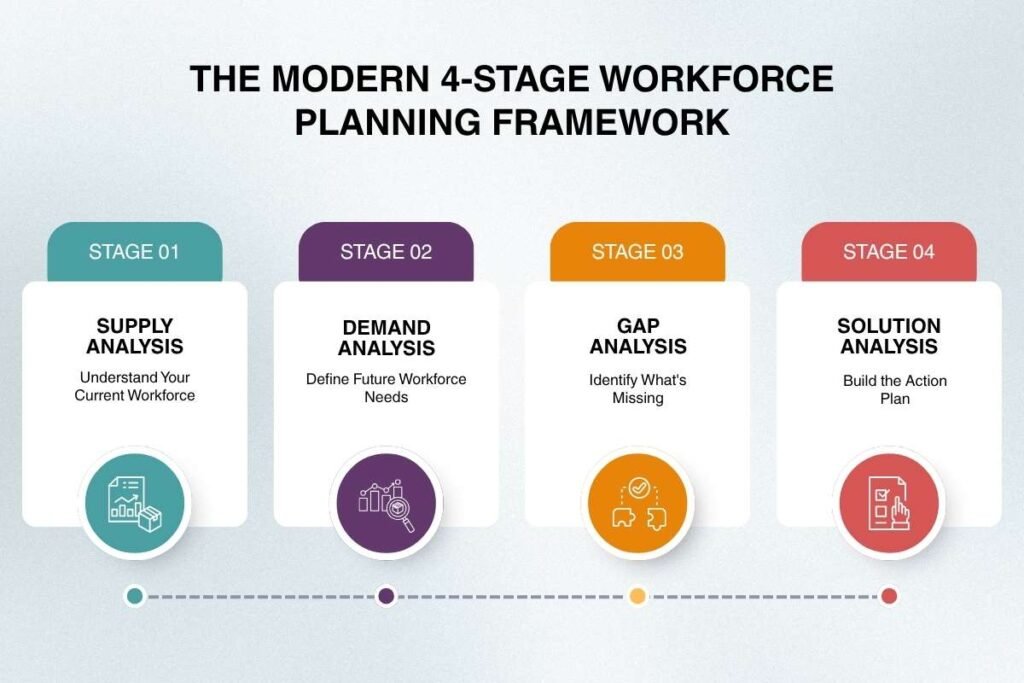
Knowing how many people you need, the skills they require, and the capacity of your teams is only half the equation. The real value of workforce planning comes from turning those insights into action. That’s where a structured framework helps.
Most organizations follow a four-stage approach:
Supply Analysis → Demand Analysis → Gap Analysis → Solution Analysis.
Stage 1: Supply analysis – understand your current workforce
| Key Question | What talent do we have today? |
| Activities | Audit workforce, map skills, analyze attrition and demographics |
| Typical Outputs | Current headcount, skills inventory, succession risks |
The first step is taking stock of the talent you already have.
This involves answering questions such as:
- How many employees do we currently have?
- What skills and certifications do they possess?
- Which roles are hardest to fill?
A thorough workforce audit gives organizations a clear picture of their strengths and vulnerabilities. Without understanding the current state of the workforce, it’s impossible to plan effectively for the future.
Stage 2: Demand analysis – define future workforce needs
| Key Question | What talent will we need in the future? |
| Activities | Align workforce needs with business goals, growth plans, and technology changes |
| Typical Outputs | Future headcount and skill requirements |
Next, organizations need to determine what their workforce should look like in the future.
This analysis is closely tied to business strategy. If the company plans to increase revenue, expand into new markets, launch new products, or adopt new technologies, it will likely require different skills and additional talent.
Key questions include:
- What roles will be critical in the next one to three years?
- What new skills will the business need?
- How much workforce growth will plans require?
The goal is to ensure workforce planning supports business objectives instead of reacting to them.
Stage 3: Gap analysis – identify what’s missing
| Key Question | Where are the shortages or surpluses? |
| Activities | Compare current capabilities with future needs |
| Typical Outputs | Talent gaps, skill shortages, excess capacity |
Gap analysis compares your current workforce against future requirements.
This stage helps organizations identify:
- Talent shortages
- Emerging skill gaps
- Roles at risk of becoming redundant
For example, a company investing heavily in automation may discover it has enough employees overall but lacks workers with data analytics or AI-related skills.
This is often the most revealing stage because it highlights the exact areas where action is needed.
Stage 4: Solution analysis – build the action plan
| Key Question | How do we close the gaps? |
| Activities | Develop hiring, reskilling, and outsourcing strategies |
| Typical Outputs | Action plan based on Build, Buy, or Borrow decisions |
Once gaps are identified, organizations can develop strategies to close them.
Most workforce plans rely on three approaches:
- Build: Upskill or reskill existing employees.
- Buy: Recruit external talent with the required expertise.
- Borrow: Use contractors, consultants, or outsourcing partners to address immediate needs.
The right solution often involves a combination of all three. For example, a company may hire a few specialists externally while simultaneously training existing employees to build long-term capabilities.
The framework at a glance
Supply Analysis → Demand Analysis → Gap Analysis → Solution Analysis
This simple but powerful process helps organizations move from guesswork to informed decision-making. Instead of reacting to talent shortages after they arise, leaders can anticipate workforce needs and build a plan to meet them.
Of course, even the best framework is only effective when applied thoughtfully. The next step is understanding the best practices that separate successful workforce planning from a one-time forecasting exercise.
Strategic best practices for effective workforce planning

A workforce plan is only as good as the decisions that come from it. While the four-stage framework provides structure, successful organizations go a step further by focusing on a few practices that make workforce planning more agile, accurate, and business-driven.
1. Focus on the roles that matter most
Not every role has the same impact on business performance. Trying to map every position in detail can quickly become overwhelming and add unnecessary complexity.
Instead, apply the Pareto Principle: focus on the critical 20% of roles that drive the majority of business outcomes. These could include leadership positions, highly specialized technical roles, or customer-facing teams that directly influence revenue and growth.
Prioritizing critical roles helps organizations allocate resources where they matter most and address talent risks before they become business risks.
2. Plan for multiple futures
Business conditions rarely unfold exactly as expected. Markets shift, customer demand changes, and new technologies can reshape workforce needs almost overnight.
That’s why workforce planning should include multiple scenarios, such as:
- A high-growth scenario that requires rapid hiring
- A slow-growth scenario that prioritizes efficiency
- A disruption scenario driven by economic changes or emerging technologies
Scenario planning allows organizations to adapt quickly instead of rebuilding their workforce strategy from scratch whenever conditions change.
3. Use data, not assumptions
The days of relying solely on intuition to make workforce decisions are over. Modern workforce planning is increasingly powered by data and predictive analytics.
Organizations are using workforce data to:
- Identify employees at risk of leaving
- Predict future skill shortages
- Monitor workforce capacity and productivity
Data-driven planning enables leaders to make more informed decisions, reduce uncertainty, and respond proactively to talent challenges.
4. Make workforce planning an ongoing process
One of the biggest mistakes organizations make is treating workforce planning as an annual exercise. In reality, workforce needs evolve continuously.
Business priorities change. New technologies emerge. Employee expectations shift.
The most successful organizations review and update their workforce plans regularly, ensuring that talent strategies remain aligned with business goals throughout the year.
The business ROI of workforce planning
Workforce planning requires time, data, and cross-functional collaboration, so it’s fair to ask: Is it worth the investment? For most organizations, the answer is a clear yes. When done effectively, workforce planning delivers measurable benefits that go far beyond hiring.
1. Lower costs and better resource allocation
Reactive hiring is expensive. Last-minute recruitment often leads to higher hiring costs, increased overtime, and productivity losses from understaffed teams.
By anticipating talent needs in advance, organizations can:
- Reduce emergency hiring expenses
- Avoid unnecessary overtime costs
- Allocate talent more efficiently
In short, workforce planning helps businesses put the right resources in the right place before problems become costly.
2. Stronger employee retention
Employees are more likely to stay when they can see a future within the organization. Workforce planning helps companies identify skill gaps, create development opportunities, and build clear career pathways.
This benefits both employees and employers. Teams gain access to reskilling and internal mobility opportunities, while organizations retain valuable institutional knowledge and reduce turnover-related costs.
3. Greater organizational resilience
Economic uncertainty, technological disruption, and changing customer demands have made adaptability a business necessity.
Organizations with strong workforce planning capabilities are better prepared to:
- Respond to market changes
- Address emerging skill needs
- Scale teams up or down when required
Rather than constantly playing catch-up, these businesses can adjust their workforce strategies with confidence and maintain momentum during periods of change.
A competitive advantage, not just an HR exercise

At its core, workforce planning is about readiness. It ensures that when opportunities arise, or challenges emerge, the organization has the people, skills, and capacity to respond effectively.
The companies that consistently outperform their peers aren’t necessarily the ones with the largest workforces. They’re the ones that plan ahead, invest in the right capabilities, and treat talent as a strategic asset.
Ultimately, workforce planning isn’t just about filling jobs. It’s about building a workforce that can support growth, adapt to change, and drive long-term business success.
Conclusion:
The workforce challenges organizations face today skill shortages, rapid technological change, and shifting business priorities can’t be solved with last-minute hiring. They require a more deliberate approach to planning talent for the future.
That’s what workforce planning is all about. By forecasting headcount, skills, and capacity, organizations can move from reacting to talent gaps to preparing for them. The result is a workforce that’s better aligned with business goals, more resilient to change, and ready to support long-term growth.
Most importantly, workforce planning isn’t a one-time HR project or an annual exercise. It’s an ongoing business discipline that helps leaders make smarter decisions about hiring, reskilling, and workforce investments.
The sooner organizations start planning for the workforce they need tomorrow, the better prepared they’ll be to seize new opportunities and navigate uncertainty with confidence.
Frequently asked questions (FAQs)
1. What is workforce planning?
Workforce planning is the process of ensuring an organization has the right people, skills, and resources to meet current and future business goals.
2. Why is workforce planning important?
It helps businesses avoid talent shortages, reduce hiring costs, improve retention, and prepare for change.
3. What are the main elements of workforce planning?
The three key elements are headcount, skills, and capacity.
4. What are the four stages of workforce planning?
The process includes Supply Analysis, Demand Analysis, Gap Analysis, and Solution Analysis.
5. How often should workforce planning be reviewed?
Workforce plans should be reviewed regularly, at least annually, and more frequently in fast-changing industries.