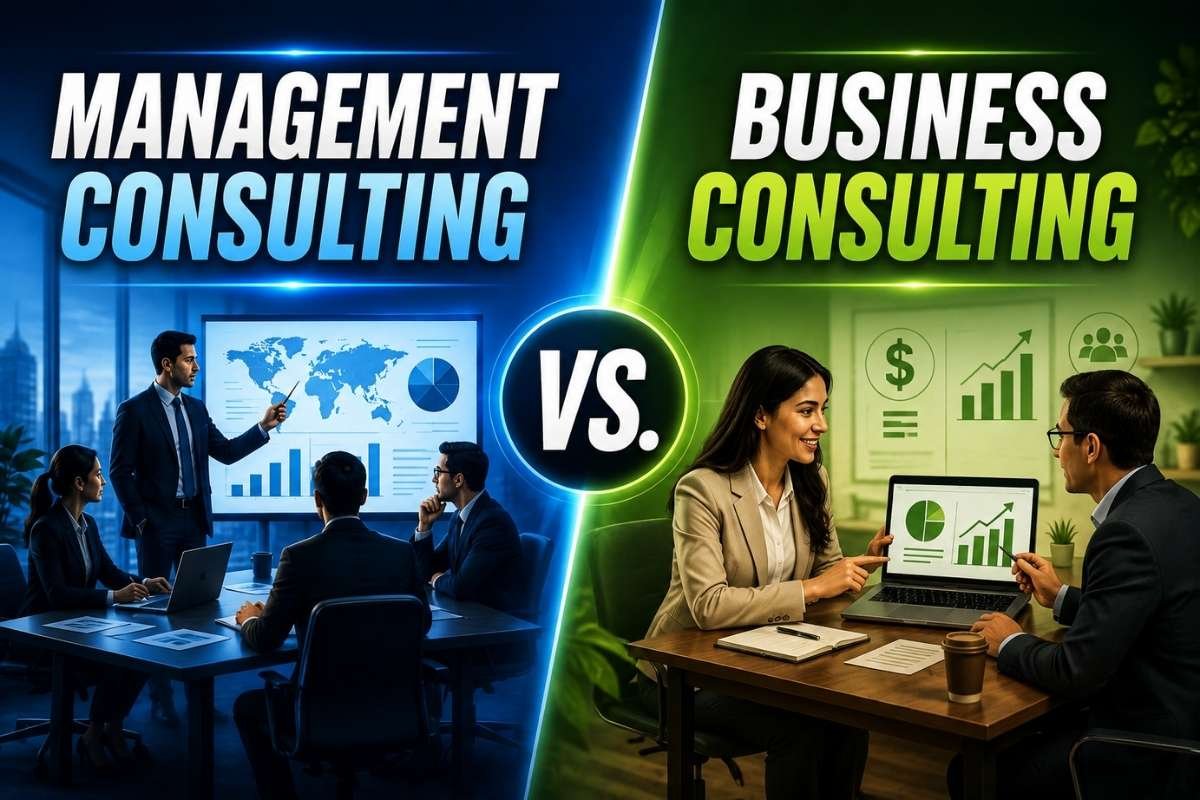
This blog provides a clear and detailed comparison between Management Consulting vs. Business Consulting, two closely related yet distinct areas within the consulting industry. It explains how management consulting focuses on high-level strategy, long-term planning, and organizational transformation, while business consulting is centered on improving day-to-day operations, efficiency, and functional performance. The guide also explores key consulting firms, essential frameworks, career progression paths, and future industry trends, helping readers understand where each type of consulting fits in the business ecosystem and which path may align better with their goals.
The consulting industry is now worth over $300 billion globally, driven by rising demand for faster growth, cost efficiency, and digital transformation. From global corporations to growing startups, companies increasingly rely on consultants to solve complex business problems and improve performance.
But this has also created a common confusion: Management Consulting vs. Business Consulting.
Both aim to improve business outcomes, but they work at different levels. Management consulting focuses on high-level strategy and organizational transformation, while business consulting is more focused on operations, processes, and functional improvements.
This difference is important not just for companies choosing the right expertise, but also for professionals planning a career in consulting. Firms like McKinsey, BCG, Bain, Deloitte, PwC, and Accenture all operate in this space, but with different roles and focus areas.
In this blog on Management Consulting vs. Business Consulting, we’ll break down the key differences between the two, explore major consulting firms like the Big 4 and Big 5, understand core concepts like the McKinsey 3 Rule, and look at how consulting careers actually progress.
What is consulting?
Consulting is the practice of helping businesses solve problems and improve performance using outside expertise. Instead of relying only on internal teams, companies bring in consultants to get an objective view, structured analysis, and practical solutions.
At its core, consulting is about answering three simple questions:
- What is going wrong?
- Why is it happening?
- How can it be fixed?
Businesses hire consultants for different reasons; some need help increasing profits, others want to reduce costs, improve efficiency, or make better strategic decisions. In many cases, consultants are also brought in during major changes like expansion, restructuring, or digital transformation.
What makes consulting valuable is its problem-solving approach backed by data, industry experience, and proven frameworks. Consultants don’t just give advice; they analyze situations, identify gaps, and recommend actionable steps that can be implemented across teams and departments.
Because of this, consulting has become a key support system for organizations of all sizes, from startups refining their operations to global companies redesigning their long-term strategy.
What is business consulting?
Business consulting focuses on improving a company’s day-to-day operations and functional performance. It helps organizations fix inefficiencies, reduce costs, and improve productivity across areas like operations, marketing, HR, and finance.
In simple terms, it is about helping businesses run better and more efficiently.
This type of consulting is widely used by startups and mid-sized companies, where even small improvements can have a direct impact on profitability. Research across consulting engagements shows companies can achieve 10–30% efficiency gains through process and operational improvements.
Business consultants typically work on:
- Process and operations optimization
- Cost reduction strategies
- Marketing and sales improvement
Engagements are usually short to mid-term with clear, measurable outcomes like faster processes, lower costs, or improved output.
Unlike strategy-focused consulting, business consulting is more execution-driven and focuses on fixing immediate business challenges.
What is management consulting?
Management consulting focuses on helping organizations solve high-level strategic and organizational problems. Instead of improving individual functions, it looks at the business as a whole and guides top leadership on long-term direction and transformation.
In simple terms, management consultants help companies decide what to do and how to compete better in the future.
They are typically engaged by large corporations, often at the CEO or board level, for decisions involving growth strategy, restructuring, market expansion, or performance turnaround.
Common areas of work include:
- Corporate strategy and long-term planning
- Organizational restructuring
- Business transformation and change management
According to industry benchmarks, management consulting projects are often high-value, long-term engagements, with global firms like McKinsey, BCG, and Bain handling multi-million-dollar strategy assignments for Fortune 500 companies.
Unlike business consulting, which focuses on execution and operations, management consulting is more decision-focused and future-oriented, shaping the overall direction of the organization.
Management consulting vs business consulting: key differences
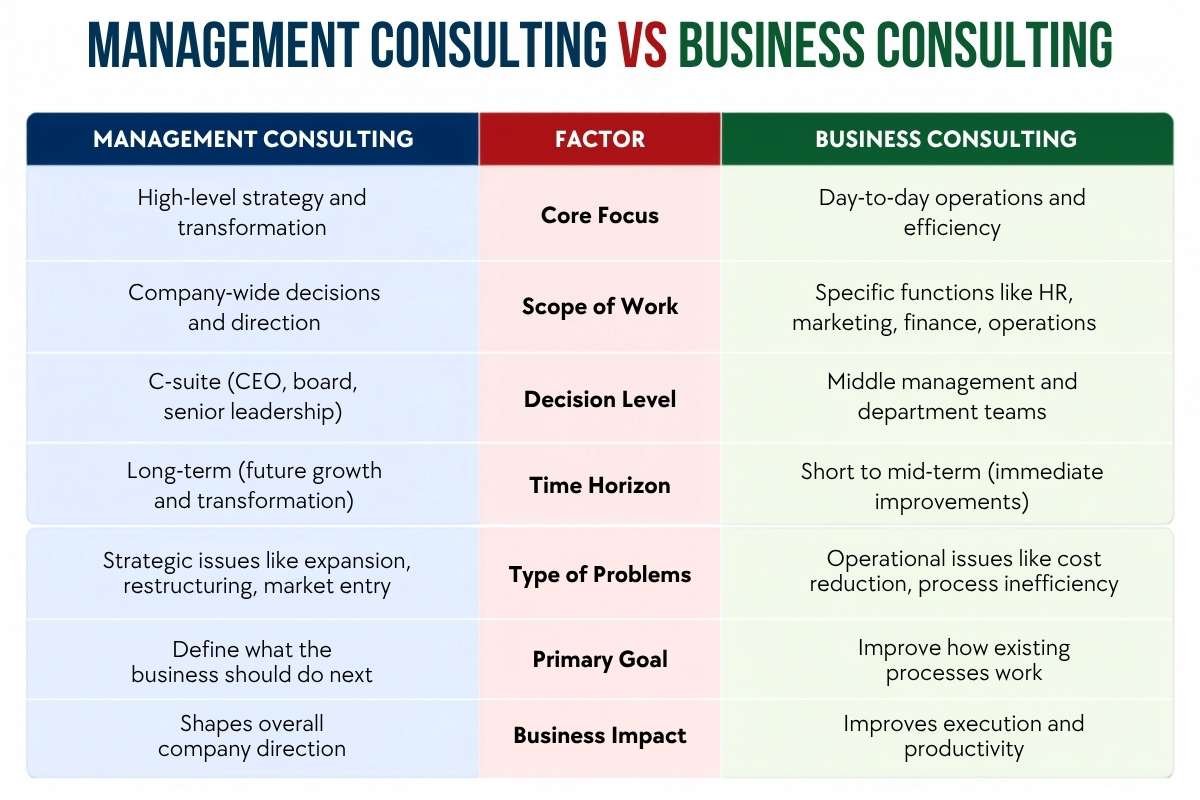
Although both aim to improve business performance, they operate at different levels: strategy vs execution.
| Management Consulting | Factor | Business Consulting |
| High-level strategy and transformation | Core Focus | Day-to-day operations and efficiency |
| Company-wide decisions and direction | Scope of Work | Specific functions like HR, marketing, finance, operations |
| C-suite (CEO, board, senior leadership) | Decision Level | Middle management and department teams |
| Long-term (future growth and transformation) | Time Horizon | Short to mid-term (immediate improvements) |
| Strategic issues like expansion, restructuring, market entry | Type of Problems | Operational issues like cost reduction, process inefficiency |
| Define what the business should do next | Primary Goal | Improve how existing processes work |
| Shapes overall company direction | Business Impact | Improves execution and productivity |
Management consulting defines the direction of the business, while business consulting ensures the business runs efficiently on the ground.
Big 4 in consulting & management consulting firms
The consulting industry is dominated by a few major players, often grouped based on their scale, services, and influence.
Who are the big 4 in consulting?
The Big 4 consulting firms originally grew from accounting and audit services but now operate large consulting divisions across industries:
- Deloitte
- PwC (PricewaterhouseCoopers)
- EY (Ernst & Young)
- KPMG
These firms primarily focus on audit, tax, advisory, and business consulting services, making them the largest diversified professional services networks in the world.
Who are the big 4 management consultants?
In pure strategy and high-level management consulting, the most recognized firms are:
- McKinsey & Company
- Boston Consulting Group (BCG)
- Bain & Company
- Deloitte (Strategy & Operations consulting arm)
These firms focus heavily on corporate strategy, transformation, and executive decision-making support for large global organizations.
Who are the big 5 management consultants?
When one more major player is added due to its global scale and digital consulting strength, the list expands to:
- McKinsey & Company
- BCG
- Bain & Company
- Deloitte
- Accenture
Accenture is often included because of its strong presence in technology-driven transformation, digital consulting, and large-scale implementation projects.
Why McKinsey is not part of the big 4
McKinsey is not included in the Big 4 because:
- The Big 4 originated as accounting and audit firms
- McKinsey is a pure-play strategy consulting firm
- It does not have audit or tax roots like Deloitte, PwC, EY, or KPMG
- Its focus is strictly on high-level strategy and management advisory
Key Consulting Concepts and Frameworks
Consulting isn’t just about giving advice; it is built on structured thinking models and repeatable frameworks that help break down complex business problems into clear, actionable parts. A few of these concepts are widely used across top consulting firms.
What is the McKinsey 3 rule?
The McKinsey 3 Rule is a prioritization principle used to simplify complex business problems. It suggests that in most situations, around three key drivers typically explain the majority of the outcome.
Instead of spreading effort across dozens of issues, consultants focus on the top 3 factors that actually move the business needle.
In practice, this approach is used to:
- Break large problems into manageable parts
- Identify the highest-impact drivers quickly
- Avoid analysis paralysis in fast-moving business situations
This thinking style is heavily used in real consulting projects and case interviews because it forces clarity and speed in decision-making. In fact, consulting firms consistently prioritize 80/20-style problem-solving, where a small number of variables drive most of the results.
What are the 4 types of business management?
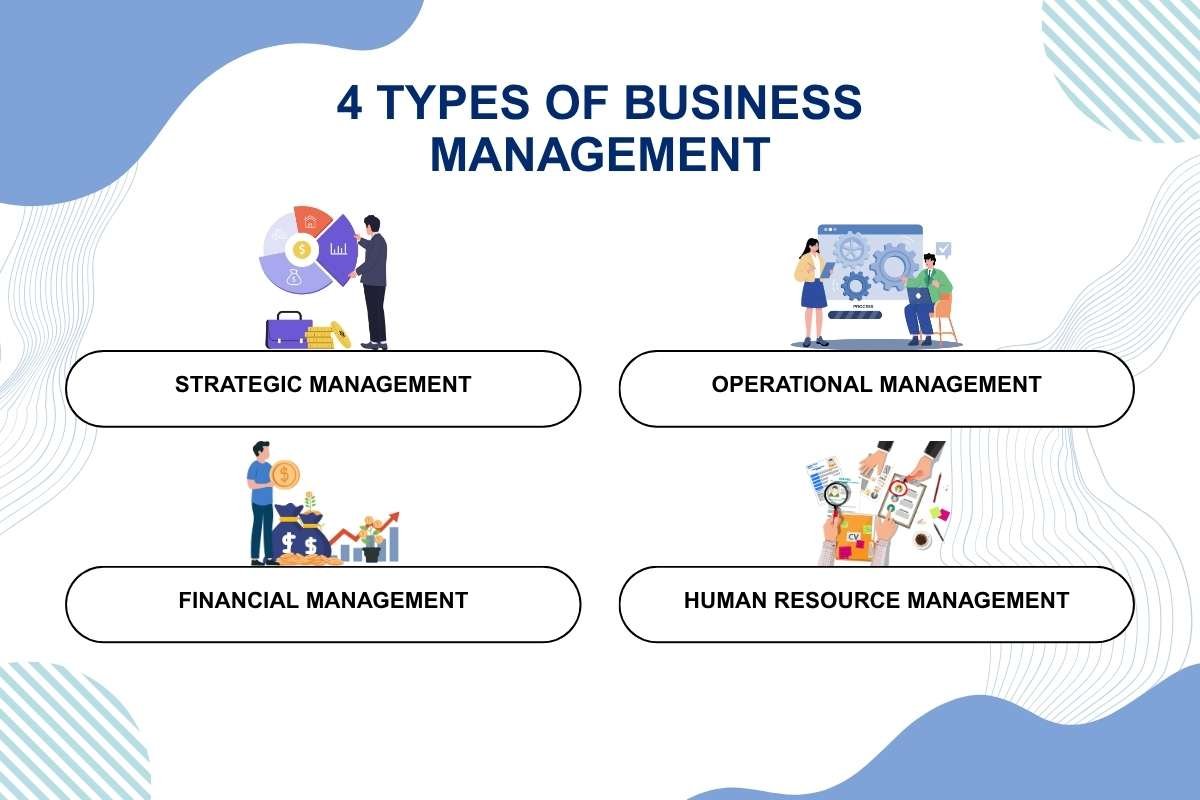
Business management is generally divided into four core pillars that together define how an organization runs and grows:
| Strategic Management | Focuses on long-term direction, competitive positioning, and growth planning. This is where companies decide where to play and how to win. |
| Operational Management | Deals with daily execution, workflow efficiency, and process optimization. This area often directly impacts productivity and cost efficiency. |
| Financial Management | Covers budgeting, capital allocation, profitability tracking, and cost control. Strong financial management is linked to higher business stability and growth potential. |
| Human Resource Management | Focuses on workforce planning, talent acquisition, performance management, and organizational culture. |
In real consulting engagements, these four areas are often interconnected. For example, improving operational efficiency can directly reduce costs, while better HR planning can improve overall productivity.
Business consultants typically specialize in one or more of these pillars, depending on the client’s industry challenges and growth stage.
Hierarchy of consultants (career progression)
Consulting has one of the most structured career ladders in the corporate world. Most top firms follow a clear progression path where responsibilities, client exposure, and decision-making power increase at every level.
The typical hierarchy looks like this:
| Analyst / Associate Consultant | Entry-level role focused on research, data analysis, and supporting project teams. Most work revolves around building slides, gathering insights, and running basic analysis. |
| Consultant | Takes ownership of specific workstreams, interacts with clients, and contributes to problem-solving and recommendations. |
| Senior Consultant | Manages multiple workstreams, leads junior team members, and plays a stronger role in shaping project outcomes. |
| Engagement Manager / Project Leader | Responsible for end-to-end project delivery, client communication, and overall team performance. |
| Partner / Principal | Highest level, focused on bringing in clients, setting strategy for engagements, and maintaining long-term client relationships. |
As professionals move up this ladder, the nature of work shifts significantly from data-heavy execution at junior levels to strategic decision-making and client leadership at senior levels.
In top consulting firms like McKinsey, BCG, and Bain, this progression is highly competitive, with only a small percentage of consultants reaching partner-level roles. This structured hierarchy is one of the reasons consulting is considered both demanding and highly rewarding as a career path.
Can a management consultant become a CEO?
Yes, many management consultants eventually move into CEO and senior executive roles, and this is one of the most well-known career transitions in the business world.
Management consulting builds skills that are directly relevant to leadership positions, such as:
- Strategic decision-making
- Problem structuring and fast analysis
- Exposure to multiple industries and business models
Because consultants often work on company-wide transformation and high-stakes decisions, they develop a strong understanding of how businesses operate end-to-end.
This is why consulting is often seen as a fast-track pipeline to leadership roles, especially in large corporations. In fact, a significant number of Fortune 500 CEOs have prior consulting experience, particularly from firms like McKinsey, BCG, and Bain.
However, the transition is not automatic. Moving from consulting to a CEO role typically requires:
- Deep industry expertise over time
- Strong operational leadership experience
- Ability to manage large teams and execution at scale
In short, management consulting provides the strategic foundation, but leadership experience and execution capability ultimately determine whether someone can become a CEO.
Skills required in business vs management consulting

While both consulting paths rely on strong analytical thinking, the skills needed in each role differ based on the type of problems being solved.
1. Skills required in business consulting
Business consulting is more execution and operations-focused, so the skillset is grounded in practical business improvement:
- Process and operational understanding to identify inefficiencies
- Functional expertise in areas like marketing, finance, HR, or supply chain
- Problem-solving ability to fix short-term business challenges
These skills help consultants deliver measurable improvements such as cost reduction, faster workflows, and better departmental performance.
2. Skills required in management consulting
Management consulting demands a more strategic and high-level skill set:
- Strategic thinking to define long-term business direction
- Structured problem-solving to break complex issues into clear parts
- Data-driven decision-making for large-scale business impact
This role requires the ability to step back and look at the business as a whole, rather than focusing on individual functions.
When should a business hire each type of consultant?
Choosing between a business consultant and a management consultant depends on the nature of the problem a company is trying to solve. The key difference lies in whether the issue is operational or strategic.
1. When to hire a business consultant
A business consultant is the right choice when the focus is on improving how the business runs on a day-to-day basis. These situations are usually internal, process-driven, and measurable in the short term.
Companies typically hire business consultants when they need to:
- Fix inefficiencies in operations or workflows
- Reduce costs and improve margins
- Improve performance in specific departments like sales, HR, or finance
For example, if a company is spending too much on operations or facing delays in delivery cycles, a business consultant helps identify bottlenecks and streamline execution.
2. When to hire a management consultant
A management consultant is brought in when the problem is larger, more complex, and tied to the overall direction of the company. These engagements are usually linked to leadership decisions and long-term transformation.
Companies typically hire management consultants for:
- Corporate strategy and growth planning
- Market expansion or entry into new regions
- Organizational restructuring or transformation
For example, if a company is struggling with declining market share or planning a major expansion, management consultants help leadership decide the best strategic path forward.
Future of the consulting industry

The consulting industry is evolving quickly as businesses face faster disruption, digital adoption, and increasing global competition. Traditional boundaries between business consulting and management consulting are also becoming less rigid.
One of the biggest shifts is the rise of digital and technology-driven consulting. Firms like Accenture and Deloitte are increasingly focused on helping companies with cloud adoption, automation, data analytics, and AI-led transformation. Today, a large portion of consulting revenue is tied to digital and technology projects rather than pure advisory work.
Another major trend is the growing use of data and AI in decision-making. Instead of relying only on experience and frameworks, consultants now use advanced analytics to support recommendations, improve forecasting accuracy, and measure business impact more precisely.
At the same time, the line between management consulting and business consulting is blurring. Many firms now offer hybrid consulting models, combining strategy, operations, and technology implementation under one umbrella.
Key trends shaping the future include:
- Increased demand for AI and automation consulting
- Strong growth in digital transformation projects
- Integration of strategy and execution in consulting services
Overall, the consulting industry is moving toward a more data-driven, technology-enabled, and execution-focused model, where consultants are expected to not only advise but also help implement solutions.
Conclusion:
Management Consulting vs. Business Consulting highlights two complementary approaches to improving organizational performance. Management consulting focuses on long-term strategy and high-level business decisions, while business consulting focuses on improving daily operations and efficiency. Both play a vital role in driving business performance from different angles.
In practice, companies often use both Management Consulting vs. Business Consulting services to balance strategy with execution. As the industry evolves with digital transformation and AI, the distinction is becoming less rigid, making integrated consulting approaches more important than ever.
FAQs
1. What is the main difference between management consulting and business consulting?
Management consulting focuses on strategy and long-term business decisions, while business consulting focuses on improving operations, efficiency, and day-to-day processes.
2. Which is more strategic: management consulting or business consulting?
Management consulting is more strategic as it deals with company-wide direction, growth planning, and organizational transformation.
3. Who hires management consultants?
Large corporations, CEOs, and boards typically hire management consultants for high-level decisions like expansion, restructuring, or market entry.
4. When should a company hire a business consultant?
A business consultant is best suited for solving operational issues such as reducing costs, improving workflows, or optimizing specific departments.
5. Can a consultant work in both management and business consulting?
Yes, many consulting firms offer hybrid roles where professionals work across strategy, operations, and implementation depending on project needs.