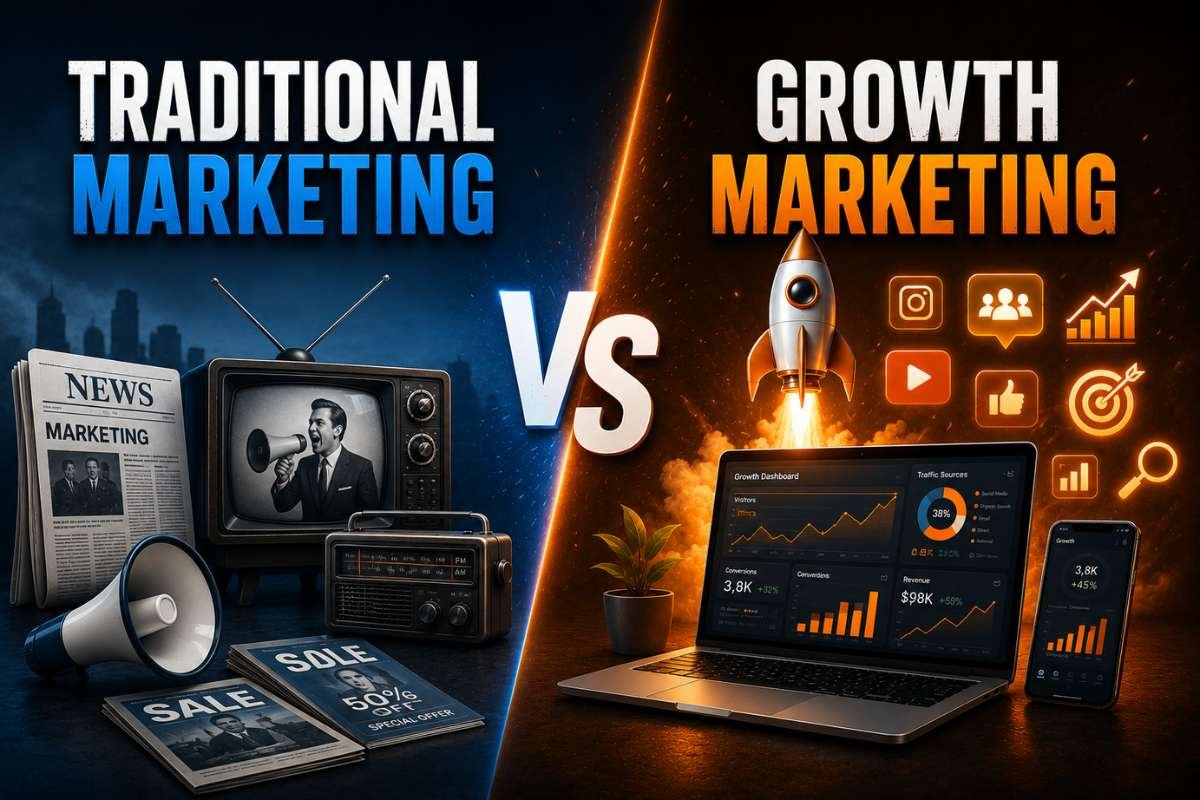
Understand traditional marketing vs growth marketing before investing in your marketing budget or choosing channels for your business. This guide explains the key differences between traditional and growth marketing, why businesses are shifting toward data-driven strategies, and which approach suits different business models. It also explores how combining both methods can improve brand awareness, customer acquisition, retention, and long-term business growth.
A good marketing strategy is not just about advertising. It can affect customer acquisition, brand awareness, and long-term business growth. Traditional Marketing vs Growth Marketing Understanding helps businesses to not waste their money on channels that don’t align with their goals. Traditional marketing is about awareness and credibility building. And growth marketing is about continuous experimentation, measurable performance, and optimisation of the customer lifecycle.
Rather than asking which strategy is better overall, the more helpful question is which one is best for your business today. In this guide, we will compare the two approaches. And explain when each is best suited, and show how many successful organisations are combining them for greater success.
Table of Contents
Traditional marketing vs Growth marketing at a glance:
Traditional Marketing vs Growth Marketing is mainly about focus and feedback. Traditional marketing aims to build broad awareness with planned campaigns. Growth marketing uses data and experimentation to improve acquisition, retention, and revenue across the full funnel. In simple terms, one is campaign-led and brand-led. The other is test-led and performance-led.
Quick comparison
| Aspect | Traditional Marketing | Growth Marketing |
| Definition | Offline or broad-reach marketing through channels like print, TV, radio, direct mail, and billboards | A dynamic, scalable approach that supports long-term growth across the whole funnel |
| Primary objective | Build brand awareness and reach a wide audience. | Drive measurable growth through experimentation, optimisation, and customer lifetime value offers. |
| How it works | Uses fixed campaigns and planned messaging | Uses testing, data, and continuous iteration. |
| Success measure | Reach, impressions, and brand recall | Conversions, retention, and sustainable revenue growth offers. |
Definitions
Traditional marketing refers to established marketing methods that happen offline or through mass media, such as print, broadcast, direct mail, phone, and outdoor ads. Its purpose is usually to create visibility and recognition for a brand.
Growth marketing is a data-driven strategy that goes beyond initial promotion and focuses on helping a business grow through the full customer journey. It emphasises experimentation, customer loyalty, and continuous improvement.
Primary objective
Traditional marketing primarily seeks awareness and reach, especially at the top of the funnel. Growth marketing primarily seeks measurable business outcomes such as acquisition, retention, and long-term revenue growth.
Why this matters today
This comparison matters because customer journeys are now fragmented across channels, and businesses need both brand building and measurable performance. Many teams still use traditional tactics for trust and visibility, but growth marketing helps them adapt faster with data and optimisation.
What makes traditional marketing different from growth marketing?
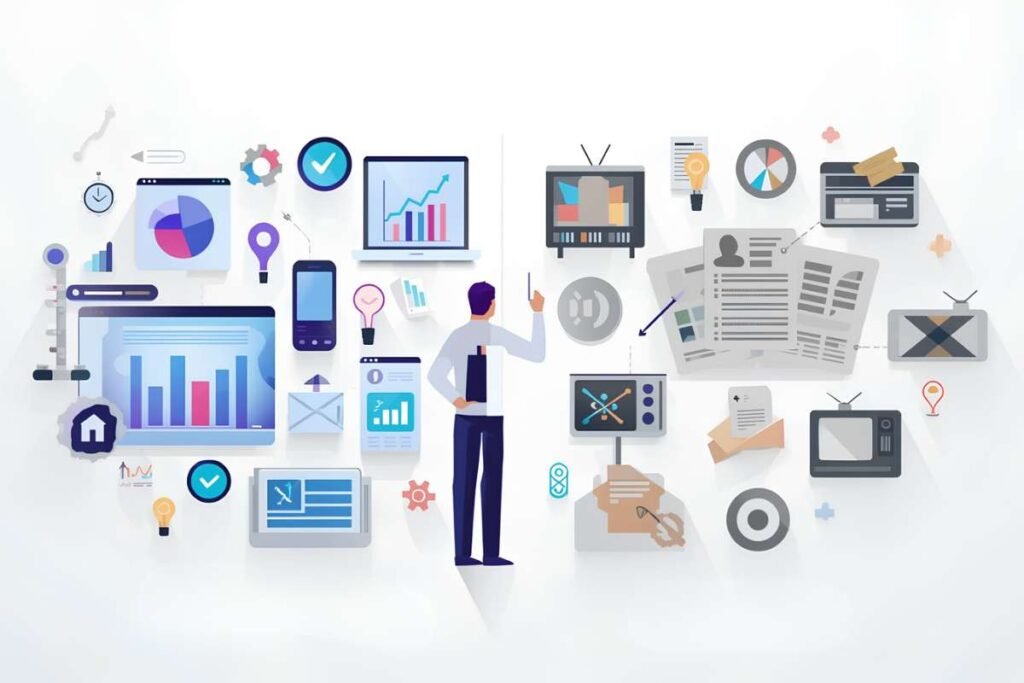
Traditional Marketing vs Growth Marketing comes down to mindset: traditional marketing is usually campaign-led, brand-led, and built around broad awareness. While growth marketing is customer-led, data-led, and built around continuous improvement across the full journey. Traditional marketing asks, “How do we reach more people?” Growth marketing asks, “How do we keep learning and growing with each customer?”
1. Philosophy
Traditional marketing is centred on planning, messaging, and brand presence. Growth marketing is centred on experimentation, learning, and scaling what works. That makes the first approach more fixed and the second more adaptive.
2. Customer journey
Traditional marketing often focuses on the early part of the journey: awareness and consideration. Growth marketing follows the customer beyond the first conversion and looks at activation, retention, repeat use, and loyalty. In practice, that means growth marketing sees the customer relationship as ongoing, not one-time.
3. Funnel vs lifecycle
Traditional marketing usually thinks in funnels: attract, convert, and move on. Growth marketing thinks in lifecycle terms, where the goal is to improve every stage after acquisition, too. This is why growth teams care about long-term value, not only top-of-funnel volume.
4. Campaigns vs experimentation
Traditional marketing relies on planned campaigns with set messages and timelines. Growth marketing uses testing, measurement, and iteration to refine the offer, channel mix, and experience. The difference is not just tactics. It is how decisions are made.
5. Brand vs growth
Traditional marketing is strongest at brand building and broad visibility. Growth marketing is strongest at measurable outcomes such as conversions, retention, and customer lifetime value. Both can build a business, but they optimise for different results.
Why are businesses shifting towards growth marketing?
More businesses are moving toward growth marketing. Because it fits a market where customer acquisition is more expensive, attention is fragmented, and results need to be proved fast. Instead of relying mainly on one-time campaigns, growth marketing uses data, AI, and ongoing testing to improve both acquisition and retention.
Why is the shift happening?
Rising customer acquisition costs are pushing teams to do more with less. When paid reach gets more expensive, businesses need better targeting, stronger conversion rates, and more efficient retention to protect margins.
AI-powered marketing is another big driver. AI now helps marketers personalise messages, automate repetitive work, and optimise campaigns faster than manual methods. That makes growth marketing more practical because teams can test and adjust at speed.
Privacy-first advertising is also changing the game. As tracking becomes more limited, marketers have less room to depend on old targeting habits and more reason to build first-party data, improve customer experience, and measure outcomes more carefully. Growth marketing fits that shift because it relies less on broad assumptions and more on direct signals from customer behaviour.
Why does it work better now?
Growth marketing is built on data-driven decision-making. This helps teams spend budgets more intelligently and spot what actually moves conversion or retention. It also depends on continuous experimentation, so businesses can keep learning instead of waiting for the next big campaign cycle.
The retention side matters too. Keeping an existing customer is often more efficient than constantly finding a new one. So businesses are paying more attention to lifecycle value, repeat purchase, and loyalty economics. That is a major reason growth marketing feels more relevant in 2026.
Which strategy works best for your business?

Traditional marketing vs growth marketing works best when matched to the business model, stage, and sales cycle. In most cases, traditional marketing is better for broad awareness. While growth marketing is better when you need measurable, iterative improvement in leads, conversions, retention, or revenue.
Best fit by scenario
- Startup: Growth marketing. Startups usually need fast testing, clear signals, and efficient spending to find what works.
- Small business: Mixed approach. Use traditional marketing for local trust and visibility, plus growth marketing for tracking what brings customers back.
- Ecommerce: Growth marketing. Ecommerce benefits from testing offers, landing pages, retargeting, and retention loops.
- SaaS: Growth marketing. SaaS depends on acquisition, activation, usage, and renewals, so lifecycle thinking matters more than one-off campaigns.
- Local business: Traditional marketing plus light growth tactics. Local reach, referrals, and community visibility matter, but simple tracking and optimisation can improve results.
- Enterprise: Hybrid. Enterprises often need brand-level reach and long-term market presence, but also data-driven optimisation across teams and channels.
- B2B: Growth marketing. Longer sales cycles reward education, nurturing, and measurable pipeline improvement.
- Healthcare: Mixed approach. Trust and credibility are essential, so traditional marketing can support reputation, while growth marketing helps measure patient acquisition and engagement.
- Manufacturing: Traditional marketing with selective growth use. Brand credibility, trade visibility, and account-based outreach often matter most, but growth tactics can improve lead quality.
Simple decision framework
Choose traditional marketing if your main goal is reach, trust, or brand awareness. Choose growth marketing if your main goal is measurable acquisition, conversion, retention, or revenue improvement. If your business needs both visibility and performance, start with traditional for trust, then layer growth to optimise results.
For readers comparing traditional marketing vs growth marketing, the best strategy is usually not either/or. It is matching the method to the business stage and goal.
Can traditional and growth marketing work together?
Yes, the two can work very well together. In fact, many strong brands use traditional marketing vs growth marketing as a sequence: traditional builds awareness, and growth turns that attention into measurable action.
A simple hybrid flow looks like this:
Traditional
↓
Brand awareness
↓
Growth campaigns
↓
Email nurturing
↓
Retention
↓
Referral
Traditional marketing builds reach, trust, and familiarity at the top of the journey, while growth marketing uses testing and tracking to improve conversions and customer value over time. Together, they work well because customers often learn a brand in one place and convert later in another, so awareness alone is not enough. The strongest brands use traditional marketing to tell the story and growth marketing to measure what actually drives results, creating a wider stage plus a feedback loop that supports better acquisition, retention, and referrals.
Conclusion:
The real win in the debate around traditional marketing vs growth marketing is not choosing one forever, but choosing the right mix for your goals. Traditional marketing builds trust and reach. Growth marketing turns attention into measurable results through testing and optimisation. The best strategies do both: one builds awareness, the other builds performance. If you want to get more customers and grow better in the long run, start by aligning your marketing strategy to your business stage, and optimize as you go along.
FAQs:
1. What is the difference between growth marketing and traditional marketing?
Growth marketing is an adaptive, data-centric approach that identifies effective growth strategies through rapid experimentation. It differs from traditional marketing by focusing on the entire customer journey, leveraging real-time analytics, and employing a flexible, iterative process.
2. What is an example of growth marketing?
Growth marketing is a data-driven approach that focuses on the entire customer lifecycle: acquisition, engagement, retention, and referral.
3. Which pays more, HR or marketing?
Marketing generally pays more than Human Resources (HR), especially at mid-to-senior levels, as it is classified as a revenue-generating department.
4. What are the 7Ps of traditional marketing?
But while you may be familiar with the ‘4P Marketing Mix’, the ‘7Ps of Marketing’ is an expansion of that and includes Product, Price, Promotion, Place, People, Process, and Physical Evidence.
5. Which type of marketing is best?
There is no single “best” marketing strategy; it depends entirely on your business model, target audience, and budget. However, digital marketing typically yields the highest return on investment (ROI).